

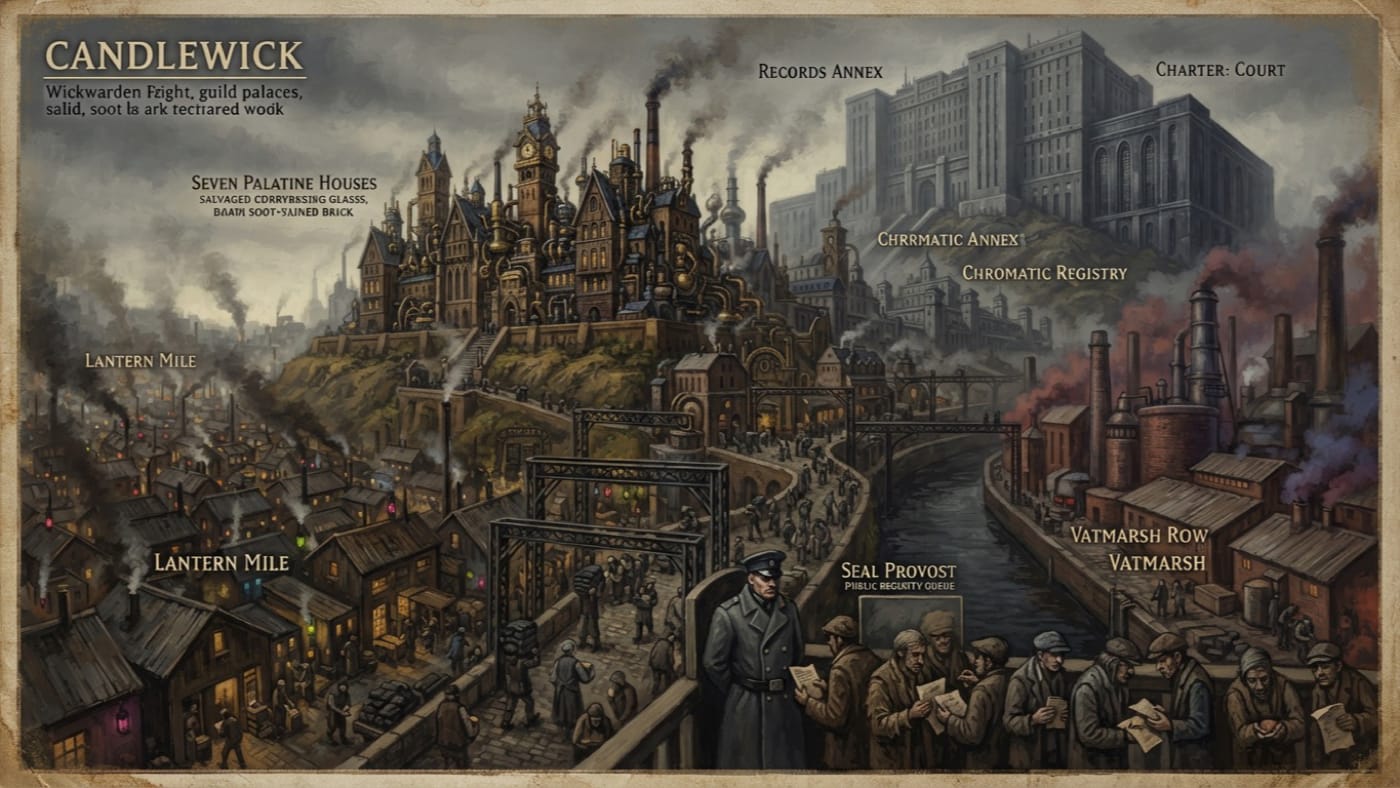
#On the Compact and the Heights
This is a survey of present governance, taken in A.S. 201, of the body that the charter-rolls call the Palatine Guild Compact of Seven Houses and the canal wards call, with less ceremony, the Seven. It is no chronicle of seven bloodlines. The papers consulted name two Houses. House Wickwarden makes the wax, candles and lamp-fuel by which Candlewick is permitted to see after sunset. House Vatmarsh makes the mordant salts and fixing agents that keep ink on paper. Five further Houses sit in the Compact. This survey names none of them, because its sources name none of them, and a Hieromnemon who invents a noble family to complete a list deserves to be entered on it.
The Houses keep their guild palaces on Wickcourt Heights. These are halls of lacquered wood and salvaged glass, and they smell of incense and hot wax polish. From their upper windows a House factor may watch the chandlery smoke of the Lantern Mile and the dye-steam of Vatmarsh Row, the two districts whose labour pays for the polish.
The Synod writes the law. The Houses make what the law is written in and what closes it. A decree without sealing wax is a draft. A warrant in unfixed ink is a rumour with a signature attached. The Bureau of Records has spent the better part of a century trying to forget this. It has never once managed it.
#On the Charter and the Quota
The sequence must be set down in order, since clerks are hanged for less. The Synod's constitutional settlement came with the Concordat of Strasbourg in A.S. 90. The Records Annex was installed at Candlewick and the city's charter ratified in A.S. 92. Within the following decade the old artisan neighbourhoods, the free dyers and printers and chandlers, were absorbed into the Seven House Compact. No day of that absorption is recorded, and no year. The decade is the honest measure, and the Bureau will have to bear the honesty.
The formal machinery has three parts. The Houses vote, and their votes are weighted by quota. The Charter Court of Impressions settles disputes. The Records Annex audits compliance, and its periodic audits may override any local decision the Houses have reached. That is how the constitution works in theory, and the parent survey of the Palatinate is careful to say in theory. I keep its caution. The weighting is reckoned in quota, but no instrument among the sources sets out the formula. Nor do they record a quorum, a presiding chair, a veto, or any article-by-article constitution. Those who claim to know these things are either members of the Compact or selling something, and in Candlewick that is generally the same person.
The Court of Impressions is a chamber of hot wax and cold marble. Its judges keep seal rubbings of the dead. It decides quarrels, and the Annex decides whether those decisions survive the next audit. Each House therefore holds a vote that is sovereign until the auditors arrive. After that it is a recommendation.
#On Wax, Salt, and Compliance
Several powers act on a single document, and each does a different thing to it, so a survey has to keep them apart. The Chromatic Registry is a Records institution. It defines which shades are lawful. High Registrar Sable Vorn heads it, and its vaults hold the phials against which every bureau ink is judged. The Houses manufacture. The Charter Court adjudicates. The Seal Provosts enforce colour-law with raids and seizures. The Registry, the Court and the Provosts are not Houses, and no honest count of the Seven includes them.
House Wickwarden is headed by Lady Maris Wick. It produces in the Lantern Mile and argues on the Heights. Its leverage is literal. Curfew in Candlewick is kept by lantern colour. A Registry counter needs a lamp, a witness must see the seal pressed, and the seal must have wax to press into. When candles fail to arrive, the administration does not fall. It waits, and a waiting administration is a negotiable one. In the eighteen months before this survey, three wax shortages coincided with Records audits. Each ended in concessions that the Records Annex denies making and the Houses deny demanding. The survey records both denials, since they form part of the settlement. Nobody has produced the terms, and I shall not supply any.
House Vatmarsh is headed by a Matriarch whom the public record leaves unnamed, and whose authority, by that House's own custom, rests on custody of its recipes. Its casks of mordant salt leave Vatmarsh Row for the bottling floors. Without them a bureau ink is only a pigment hoping for the best. Vatmarsh has hoarded salts during the present crisis and called it conservation. The Registry can define a shade. It cannot fix one in a dry bowl.
The two Houses are rivals bound together by the page itself. Wickwarden closes a document. Vatmarsh makes it last. Their published records note that Wickwarden's wax shortages and Vatmarsh's salt hoards have sometimes fallen in the same audit season, and both Houses deny any coordination. The survey enters the coincidence of dates and goes no further. A conspiracy needs minutes, and none are on file.
#On the Quotas Below
The Compact enforces debt through quota. A worker who defaults loses guild protection and is reclassified as unlicensed labour. That status takes away mask rations. It takes away shade tokens, the colour-coded scrip that serves at once as wages and as permission to cross a district at a given hour. It also takes away access to the infirmary. The Palatinate calls this soft severance. It takes longer than a hanging and produces a file.
Below the reclassified sit the binding instruments: quota bondage, apprenticeship contracts that work as servitude, and the medical gatekeeping of the Lungward Sisters, who hand out camphor, filters and admission with the same careful hand. On Vatmarsh Row masks are replaced weekly if the House accounts allow it. Lungs are never replaced.
The bargaining on the Heights is paid for here. When a shortage darkens an audit, the chandlers and wick-spinners of the Lantern Mile still owe their quota. When salts are held back, the stirrers and runners on the Row still owe theirs. The quota ledger has no column for politics. It records a shortfall, and a shortfall becomes a default, and a default becomes a reclassification. The House that caused the shortage has meanwhile been paid in concessions it denies receiving.
#On the Fading Winter
The Fading Winter began in A.S. 199, when documents across the River-belt started losing their text. The ink went and the seals stayed. The explanations multiplied faster than the losses. The Chromatic Registry called it a heresy outbreak. House Vatmarsh called it a failure of mordant-salt supply. The Black Canal treated it as a market opportunity, which was at least candid.
The Houses have since added accusations against each other. Vatmarsh has blamed fog exposure during wax overcoating for some failures, and Wickwarden has blamed counterfeit mordants. Some affected pages show the black halos of Hungry Ink. Others simply paled away. The two phenomena overlap in reported cases, but no finding on file shows they are the same thing. An official record of A.S. 143 notes that Hungry Ink correlates with periods of heavy ash. A correlation entered in a register explains nothing about mechanism, and nothing about when the appetite first began.
The Registry answered uncertainty by expanding its own authority. It issued new purity standards and ordered household shade revalidation. It also launched a programme of chromatic reconciliation, carried out under audit cover through Bottle Quay and the Lantern Mile. The parent survey records eighteen workshops closed and forty-seven workers reclassified as unlicensed. Those figures measure consequences. They tell us nothing about how the Compact votes.
Earlier assessments described the Fading Winter as "a contained incident."
Superseded. The Fading Winter continues in A.S. 201. Documents still lose text, at a rate the Registry declines to quantify, and the mordant-salt supply remains compromised. The Registry has eased the symptoms by enlarging its own jurisdiction, which is a little like treating a fever by promoting the physician to the bench.
The Houses read the emergency as an opportunity for leverage. Wax overcoats became required on vulnerable documents, and Wickwarden sells wax. Vatmarsh salts were withheld, and Vatmarsh holds the salts. Each House can argue that it is managing a crisis in the public interest. Each also stands to profit from that crisis continuing at a manageable level. The survey does not find that either House caused the Fading Winter. It finds that neither House has much commercial reason to want it over quickly.
#On Present Authority
The balance in A.S. 201 is a quarrel with no court above it. The Records Annex wants tighter control, and the ambition reported most often is a single source for bureau inks. The Houses want autonomy, profit and the right to name their own price. The Registry certifies what neither can do without. Beneath the canals, the Black Canal circulates counterfeit shades good enough that auditors have certified them as genuine. That makes the Annex's case for central control and weakens it in the same breath.
No party can break the others. The Synod cannot run a war on unsealed paper. The Houses cannot sell wax to an administration that has stopped buying. The citizens of Candlewick stand in the Registry queue with a shade token going stale in the palm, a mask nearly worn through, and a document they pray will still say tomorrow what it says today. They are answerable to both powers and protected by neither.
The Creator has left the sun outside Compact jurisdiction. Everything lit after dusk, and everything sealed, has a supplier on the Heights.