

I've checked the continuity file, the voice guides and the related Candlewick articles, and confirmed which cross-link pages exist. The draft follows.
#On the Instrument and the Survey
A lawful page in Candlewick Palatinate takes several trades to make. The words are ink. The ink lasts because House Vatmarsh has salted it into obedience. The wax that closes it comes from House Wickwarden. The clerk who watches the seal pressed does so under a lamp that Wickwarden also sold him, at a price it also set. The citizen holding the result believes he has a document. He has a settlement between Houses, folded small enough to carry.
The Palatine Guild Compact is the arrangement under which these Houses sit in Candlewick as Houses: represented, consulted, audited, resented and indispensable. This survey is dated A.S. 201. That date belongs to the survey. No file consulted gives the Compact's founding year, its charter instrument, its first session or the hand that first sealed it. I will not invent them, however much the warmth of the Heights invites me to.
The setting has dates even where the Compact has none. The Candlewick charter was ratified, and the Records Annex installed, in A.S. 92. The Great Fire of about A.S. 98 brought the first strict wax quotas. These are dates of the city. They are not dates of the Compact, and the Bureau has burned better men than me for letting one wear the other's seal.
#On the Houses Entered
Each of the two cited House abstracts opens with the same heading: Palatine Guild Compact. The heading does what a heading does. It says under whose name a House presents itself to the city.
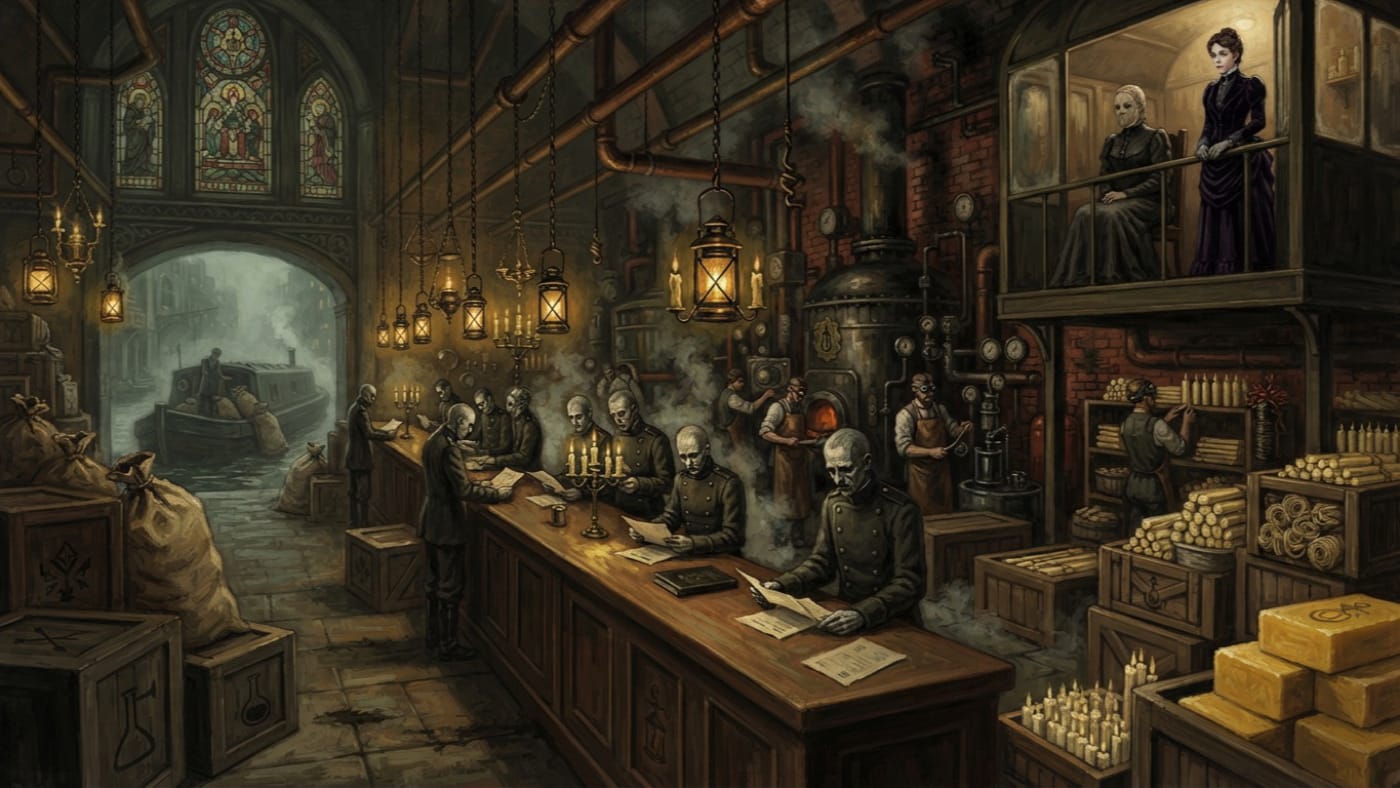
Vatmarsh presents itself as follows. Its territory is Vatmarsh Row on the eastern canals, with its salt lofts and dye-halls. Its public trade is mordant salts, fixing agents, dye-bases and ink-stabilising washes. Its political force is entered with unusual frankness as permanence, fading, recipe custody and supply interruption. The House article says its authority rests with a Matriarch, acknowledged by whoever holds the recipes, and that she attends Compact sessions behind a gauze mask the colour of dry bone.
Wickwarden presents itself from the Lantern Mile and the richer salons of Wickcourt Heights, with seal-wax warehouses and candle towers attached. Its trade is candles, wick, seal wax, lantern oils, wax overcoats and the district light ration. Its political force is darkness, curfew access, audit timing, wax shortage and hospitality debt. Its current head is Lady Maris Wick. Its factors climb to the Compact from the Heights in gloves perfumed with beeswax, wearing expressions polished until guilt slides off them. The House article also places Lady Maris at sessions, with warm hands and dry eyes.
Read both abstracts carefully. A Matriarch heads a House. A Lady heads a House. Neither file gives either woman a chair, a gavel, a presidency or a casting voice within the Compact. Attendance is not office. Visitors to the Heights confuse the two all the time, and the Houses gain enough from the confusion that neither seems likely to correct it.
Earlier Palatinate surveys describe a Palatine Guild Compact of Seven Houses voting by quota weight, subject to audit override by the Records Annex.
Entered as the published account, not as a finding of this survey. The files consulted name two Houses, give no weighting formula, list no seats and describe no override procedure. The other five Houses are left unnamed. How that seven-House description relates to the two Houses documented here remains open.
#On Salt, Wax and the Lawful Page
The Compact matters because its Houses supply what the paper state is made of. From the Row, Vatmarsh casks travel downstream to Bottle Quay, where bureau inks are drawn, stoppered and waxed. From there they go out through the Seal Locks to every office in the Church's reach that believes writing is reality with better posture. Wickwarden's wax meets that ink at the bottom of every instrument and closes it. Its light falls on the counter where the instrument is checked.
Two outside authorities stand over this traffic, and neither is entered as a member. The Chromatic Registry defines the legal colours, quarrels with both Houses over who governs a shade, and cannot certify anything without their goods in front of it. The Bureau of Records, through its Annex, audits compliance and depends on the ink it audits and the light it audits by. The House articles call the Annex vulnerable to ink dependence on one side and to darkness on the other. Its auditors call it oversight.
The Black Canal carries counterfeit salts, stolen wax and false lantern signals beneath the dikes. It is a criminal waterway, the Houses' public enemy and occasional private supplier. It is not the Compact, whatever the Compact's critics say after their second bottle.
#On Market Stress
The sentence that concerns this office most comes from the Vatmarsh survey and is quoted here exactly. During audit cycles, it says, Wickwarden's wax shortages and Vatmarsh's salt hoards "often coincide with an elegance too graceful for accident. The Guild Compact calls this market stress. The street calls it a duet."
Both names are in the record. The Compact's phrase belongs to the Compact. The street's phrase belongs to the street. The comment about elegance belongs to the surveyor, which is to say to my own Bureau, and it is a suspicion written with style. Each House's relations entry reads shortage coordination denied. No minute, letter or sworn testimony in the files shows the two Houses agreeing to starve an audit together. What the files do show is timing.
That timing is easy to describe. Wickwarden's own survey records the House using shortage as an instrument: candles sent late, inferior wick sent to a rival's ward before an audit, the gold on ration slips reduced during weeks of Registry pressure. The Vatmarsh survey records the House hoarding salts through the Fading Winter of A.S. 199 while insisting supply was stable, and pressing for concessions the Annex denies granting. Each House can be documented applying pressure on its own account. The duet is the claim that they were playing the same score, and that claim stays with the street.
The working index for this survey, as first drafted, entered the audit-cycle shortages as "coordinated by the Houses through the Compact."
Struck by the author. Coincidence is recorded. Coordination is alleged by the street and denied by both Houses. The index now reads "coincident." The Hieromnemon is reminded that elegance is not evidence, however hard he finds that to accept.
There is a reason "market stress" is good Compact language. It names a condition without naming a cause. A market can be stressed the way a beam is stressed, by weight from no particular hand. It makes the shortage weather. Weather is not indicted.
#On Those Who Pay in Breath
The Compact's language works at altitude. Its costs land lower down.
The Vatmarsh abstract lists among its standing hazards "lung loss among labouring classes." The House survey adds detail: weekly masks if the accounts approve them, and the Lungward Sisters recording exposure by shade when they are let in. None of that appears in a Compact session as market stress. In a stirrer's chest it appears as a cough that changes colour.
The same abstract lists a correlation with Hungry Ink, first tied to atmospheric ash from the Year of Ash Rain in A.S. 143, and a liability for the Fading Winter of A.S. 199. The word in the record is correlation. Nobody has shown how either works, and the Bureau of Doctrine does not license me to solve it in a footnote. A page that blooms black or fades white is still a page someone was relying on.
Wickwarden's costs are counted at the queue. Candlewick's law assumes visibility: lantern colour at curfew, lit counters for valid queues, a witness who sees the seal pressed, tokens checked under approved light. When wax runs short, legitimacy stops. The citizen standing in the dark does not become a rebel. He becomes provisional, an entry the system can neither confirm nor strike, waiting until the lamps return.
#On the Present Session
As of A.S. 201, both Houses enter the Compact under Amber discipline. Both are rich from crisis and suspected on every bridge. Each needs the other's goods and resents needing them. The Vatmarsh survey says Wickwarden wants salt concessions tied to wax quotas. The Wickwarden survey says Vatmarsh wants salt concessions tied to wax shipments. Each House files the same demand under the other's name, and the Annex keeps both copies.
What the Compact is in its full membership, how its votes are counted, where its sessions sit and when its first seal cooled are matters for a later survey with better files. What it is in this one is recorded: two Houses entered under one heading, the trades they hold over the lawful page, and a phrase for their timing that the street refuses to adopt.
The Matriarch's mask stays tied. Lady Maris's hands stay warm. Somewhere below the Heights a clerk waits for a candle so he can confirm that the ink has not faded.