
#On the Row Where Words Are Made to Stay
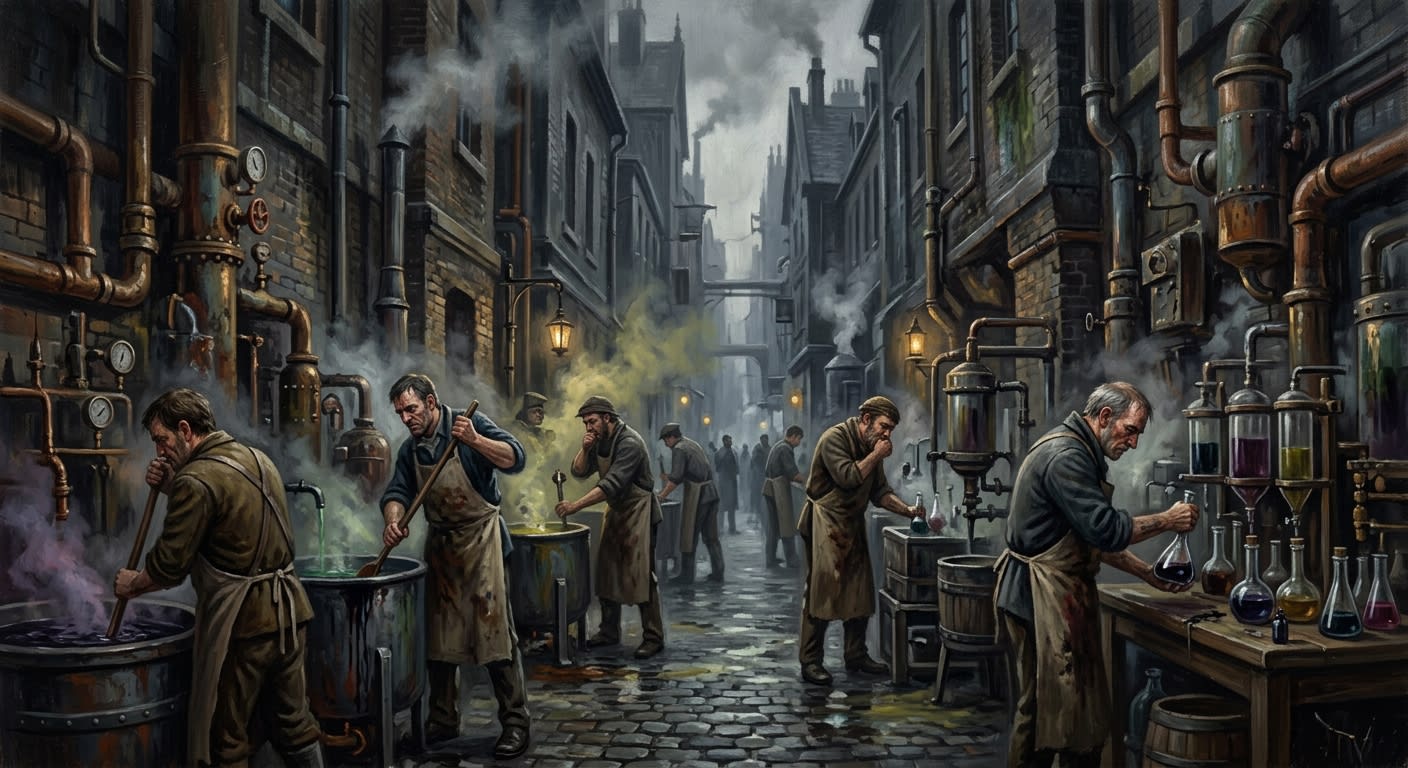
Vatmarsh Row lies along the eastern canals of Candlewick Palatinate, where the water runs green by noon, black by Vespers, and legally transparent whenever House Vatmarsh signs the inspection sheet. It is a district of dye-halls, mordant vats, brine sheds, acid galleries, salt lofts, recipe chapels, worker rooms, sealed drains, and little shrines whose saints have all developed unfortunate coughs.
The Row’s public function is simple: it fixes ink. The Synod writes commands. Candlewick bottles authority. Vatmarsh Row provides the chemical bite by which the written word grips paper, vellum, cloth, wax, and human destiny. A decree in weak dye is an opinion with pretensions. A decree in Vatmarsh-stabilised black becomes a convoy, a hanging, a marriage, a tithe seizure, a ration denial, a birth admitted into the Ledger.
It smells of vinegar, metal salts, wet wool, hot brine, lamp soot, boiled rags, canal rot, and the expensive lie that permanence can be purchased without consequence. Workers learn to tell legal danger by breath. Bitter copper means gloves. Sweet rot means leave the room. Black almond means someone has opened a wash that was sealed for a reason the seal no longer cares to disclose.
#On the Founding of the Chemical Aristocracy
The Row began before it was noble, which is how most noble things begin if one scrapes away enough varnish. Pre-Concordat Candlewick held dyers, chandlers, rag washers, wax merchants, river factors, and Flemish canal men who believed a good contract could defend them from history. The Concordat corrected this touching civic superstition.
After the Sagittal Line hardened in A.S. 65, the Synod required more seals, more passes, more ration permits, more death certificates, more conscription orders, more amended death certificates for conscripts whose first certificates had travelled faster than their bodies. Wax alone could not carry the burden. Paper alone could not survive damp. Ink had to hold across rain, sweat, inspection, transport, argument, and the vindictive fingers of men hoping a line might smear before it reached the tribunal.
The eastern canal dyers supplied the answer. They already knew which salts bit wool, which vinegars opened fibre, which black would hold after boiling, which violet would betray a adulterated cask, and which worker could stand closest to a vat before bleeding from the nose. The Bureau of Records installed the Candlewick charter in A.S. 92. Within a decade the old dye lanes became Vatmarsh Row, and the family that controlled the mordant ledgers became House Vatmarsh.
Early guild histories describe Vatmarsh Row as a voluntary association of chemical craftsmen elevated by civic merit.
Corrected. The craftsmen were useful, the family was ruthless, the Bureau was hungry, and civic merit arrived later in a lacquered box with a receipt.
The Great Fire around A.S. 98 sealed the Row’s place in the city’s throat. Wax stores burned elsewhere. The Row flooded itself, lost three lower halls, saved its salt books, and charged rescue prices by dawn. Candlewick learned that light might fail, but fixed ink could reopen a warehouse, establish a debt, condemn a rival, and make the dead responsible for damage done after burial.
#On the Vats, Lofts, and Recipe Chapels
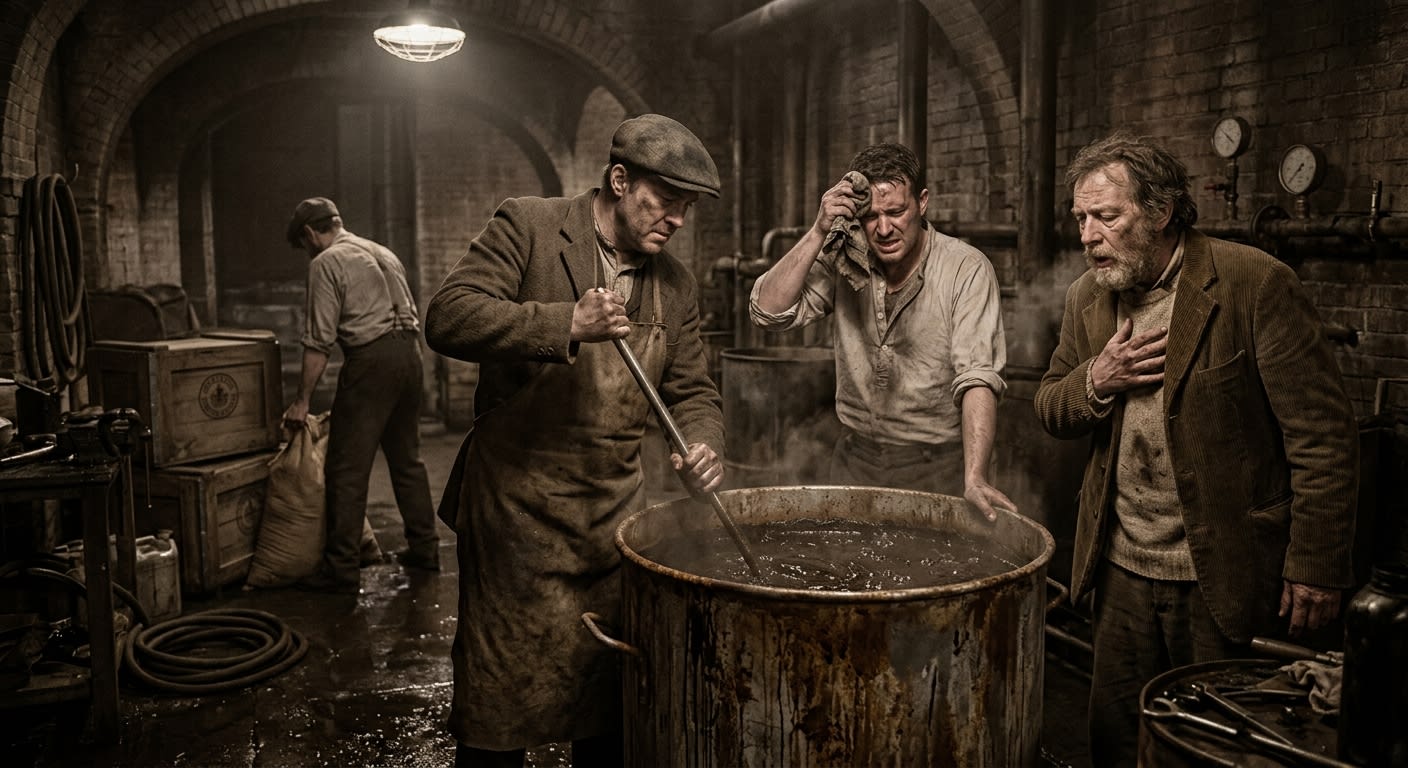
Vatmarsh Row is built downward as much as outward. The canal face presents dye-halls with green shutters and high vents, respectable enough for visiting auditors with weak stomachs. Behind them lie vat rooms where iron hoops sweat, copper paddles darken, and apprentice stirrers move in circles until their hips learn the rhythm better than their minds. Above the halls sit salt lofts, locked behind House doors, where mordant stock is dried, sifted, named, weighed, sampled, cursed, sealed, and occasionally stolen by persons whose bodies are later discovered in tones of blue unsupported by ordinary nature.
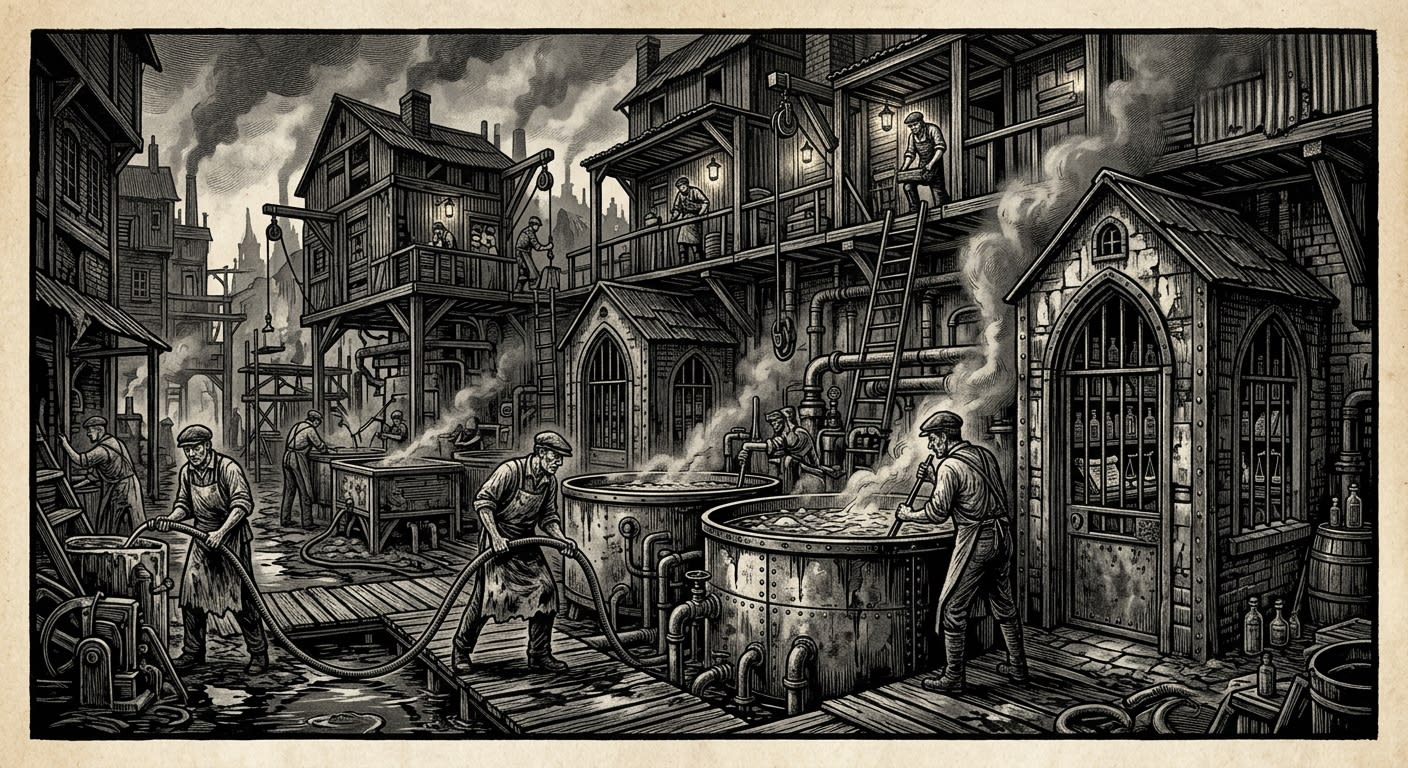
The recipe chapels occupy the inner lane. They are chapels because Candlewick knows that any locked room containing valuable formulae improves its defence by acquiring an altar. Each chapel holds a black salt book, a wash table, four witness hooks, and a small image of Saint Brigid of the Fixed Flame, whose cult is tolerated because workers like her and because removing worker saints requires more guards than House Vatmarsh currently wishes to pay.
The drains are older than the halls. Nobody says this aloud during inspections. The eastern canals were cut through marsh, and the marsh remembers pressure, seepage, and the weight of buildings that pretend they are permanent. Beneath the visible Row run sluice tunnels, black brine channels, abandoned dye pits, service cuts, and at least three passages whose existence House Vatmarsh denies with the brittle calm of a liar sitting above running water.
At night, the Row glows without beauty. Vat windows stain the fog in red-brown, liver-green, black-violet, execution gloss, quarantine yellow, and passage blue. Lanterns wear registered shades. Watchmen carry sample rods. Canal skiffs halt under chain grilles while Seal Provosts sniff bottles and Vatmarsh clerks pretend not to recognize private marks scratched into cask rims.
#On the Workers Beneath the Permanence
The labouring population of Vatmarsh Row is counted by quota when healthy and by exposure when not. Dye stirrers, mordant runners, salt skimmers, vat-scrapers, wash clerks, cask sealers, bottle loaders, mask stitchers, canal haulers, and night drain men pass through vapour that tints their cuffs, gums, lungs, dreams, and children’s laundry. The House calls this craft inheritance. The workers call it the family colour.
A Row child learns smell before letters because smell is the first catechism of survival. Vinegar means ordinary shift. Copper means the senior stirrer is angry. Tin-sour means the batch will fail and someone below Master rank will be blamed. Wax-sweet over acid means Registry inspection, because the House burns hospitality candles before auditors and never when charity alone would suffice.
Masks are issued weekly if accounts approve. Filters are docked for lateness, damaged tools, disputed spoilage, and devotional absenteeism. The Lungward Sisters record exposure by shade when admitted past the House door. House surgeons call green cough “productive irritation.” Blue cough receives reassignment away from food and toward night vats. Black cough is not entered until the worker has finished the batch.
Workers mark casks in two languages. The official scratch speaks to the Chromatic Registry: origin, salt, wash, oath, cooling, seal. The private scratch speaks to hands: late turn, damp loft, bitter smoke, do not stand close, Matriarch watching, Black Canal sample, pray before opening. Records has outlawed private marks four times. Each prohibition produced spoiled batches, wrong shades, and one A.S. 176 shipment of mourning violet that dried into celebratory pink. The prohibition was clarified into permission under supervision. Supervision, in practice, means the House pretends not to read what it cannot afford to ban.
#On House Vatmarsh and the Matriarch’s Breath
House Vatmarsh rules the Row by recipe custody. Blood gives claim. Coin gives reach. Marriage gives allies. Murder clears inconvenient cousins. The black salt book gives command. The woman who holds it, with the acid-key rings and the right to name a batch lawful, becomes the Vatmarsh Matriarch because every cask in the eastern canals waits on her permission.
Her audience chamber sits above active vats. Visitors breathe heated mordant while negotiating prices, concessions, apologies, and lies. This is not theatrical excess. It is policy. A man whose eyes are watering agrees more readily to reasonable terms, and all terms sound reasonable when one’s throat has begun to close.
The Matriarch’s court maintains three public faces. To the Guild Compact, it is the custodian of permanence. To Records, it is an obedient supplier of certified fixing agents. To workers, it is a mouth that eats lungs and pays in shade tokens. The same institution can be all three. The Synod itself is proof that moral geometry permits ugly triangles.
House Vatmarsh testimony after the Fading Winter stated that Row production remained “uninterrupted, compliant, and unaffected.”
Clarified. Production was uninterrupted because workers were locked in. Compliance was achieved by redefining non-compliant batches after seizure. Unaffected is a word used by people who do not sleep above the vats.
The House’s rivals orbit it with knives hidden in invoices. House Wickwarden controls wax and light; Vatmarsh controls hold and decay. The Registry defines legal colour; Vatmarsh makes legal colour adhere. The Black Canal steals salts, sells false salts, buys real salts, and provides the useful service of being blamed for whichever disaster a House ledger cannot safely admit.
#On Hungry Ink in the Row
The Year of Ash Rain in A.S. 143 gave Vatmarsh Row its deepest stain. Ash from Maldrake’s burning wars travelled west in weak bands and lodged in canals, mortar, vats, lungs, and denial. The Row’s mordant stock changed. Certain inks developed appetite. Hungry Ink began as black halo, proceeded to sloughing, matured into alteration, and demonstrated that a page may change its sentence while preserving seal, signature, registry shade, date, and fee stamp.
House Vatmarsh has blamed counterfeit mordants since the first scandal. This defence has the advantage of sometimes being true. The Black Canal moves false salts through service sluices. Desperate bottle rooms stretch proper wash with marsh brine, scrap powder, ash-sieved sediment, and prayers purchased from chapels whose saints should have been pickier. Yet the common facts remain rude: Hungry Ink blooms most often in Candlewick batches prepared from Vatmarsh salts, stabilized in Vatmarsh washes, bottled at Bottle Quay, certified under Registry lamp, and exported with every legal courtesy.
ROW SAMPLE NOTE — RECOVERED FROM SEALED WASH TABLE, DATE SCRAPED Test phrase: “Permanence obeys the hand.” Second reading: “The hand obeys permanence.” Third reading: ██████████████████████████████ Observer note: Matriarch ordered silence before the ink finished drying. Sample location: unknown.
The Row fears Hungry Ink less as accusation than as theological insult. If fixing agents can teach words to hold, they may also teach words to prefer themselves. A command that survives its author is law. A command that edits its author is something older and less polite.
#On the Fading Winter and the Price of Stability
The Fading Winter of A.S. 199 brought the Row’s private scandal into the River-belt’s public throat. Documents lost text while retaining wax, seal, signature, shade, date, and fee stamp. The Chromatic Registry declared heresy. House Vatmarsh declared mordant-salt supply failure. The Black Canal declared, with admirable frankness, a market.
In the first month of chromatic reconciliation, Bottle Quay lost six bottling rooms, the Lantern Mile lost two wick halls, eighteen workshops shuttered, forty-seven workers were reclassified as unlicensed, and Vatmarsh Row lost nothing worth entering on a public sheet. Its salt lofts closed to inspectors. Its casks moved under House escort. Its private marks received sealed review. Its emergency wash contracts expanded.
A cynic might say the Row profited from a crisis implicating its own chemistry. I am no cynic. I am an official. I say the same thing with better paper.
The Row’s workers paid first. Revalidation meant longer shifts, more samples, less filter stock, armed escort in the wash halls, and the new offence of speculative fading, by which a worker could be detained for discussing what a batch might do if shipped. Families hoarded pre-199 papers in oilcloth and hid birth copies away from vats. Apprentices tattooed their names beneath sleeves, a practice condemned by Records and copied by two junior Records clerks within a week.
As of A.S. 201, the Row remains under Amber discipline. The phrase suggests supervision. It mostly means everyone guilty enough to matter has acquired a second lock.
#On the Present Condition
Vatmarsh Row in A.S. 201 steams, coughs, ships, denies, and endures. Salt lofts are guarded. Recipe chapels close after third bell. Cask samples travel with double witness. Workers are searched for micro-vials, recipe scraps, private marks, and politically informative coughs. Registry auditors arrive with shade knives and portable lamps. House escorts arrive with smiles shaped like legal threats.
The canal walls are sinking by small degrees. The House calls it ordinary marsh adjustment. The drain men call it the old pits taking breath. During winter fog, certain lower sluices sweat black lettering that cannot be scraped before sunrise. During summer heat, the vats pop like knuckles and the canal fish rise belly-up in colours later entered as experimental contamination. The Row’s saints are repainted quarterly because the fumes strip their faces. This may be mercy.
Exports continue. Execution black, ledger grey, passage blue, quarantine yellow, mourning violet, correction red-black: all leave through the Seal Locks and travel to offices that trust the bottle because the bottle bears the right mark. Somewhere a clerk dips a pen and believes the sentence is his. Somewhere a soldier receives orders written in Row black and marches east because chemistry has become destiny.
The Matriarch wants permanence. The Registry wants definition. The Black Canal wants panic. The workers want filters, sleep, and children whose lungs do not inherit the family trade. The Row gives each party a portion and keeps the larger portion sealed in salt.