
#On the Misnamed Place
Hell is the word children understand, soldiers spit, priests weigh, and clerks place in headings when the approved theological noun would lengthen the form beyond its allotted box. It is also the word most often misused by persons whose imagination stops at horns, heat, red skin, forked tails, and painted little devils acting with the moral seriousness of tavern actors. Such people deserve correction, and, upon relapse, assignment to a forward catechism post where vocabulary improves under shellfire.
Hell is no mere place east of the Sagittal Line. East is geography. Hell is jurisdiction. It is the hostile condition imposed upon matter when the Great Deceiver's will enters contract with broken Creation and begins drafting amendments in blood, appetite, reflection, fire, sleep, envy, hunger, and debt. Where Hell rules, things do not cease being themselves. They become themselves under hostile management.
A river remains a river and carries screams downstream. A mirror remains a mirror and subtracts the face. A mother remains a mother and is entered as an Ash-Mother in enemy logistics. A road remains a road and leads where it has been ordered to lead by a command no map admits. This is why the Synod's maps use zones while its sermons use Hell. Zones tell convoys where to die. Hell tells souls why dying matters.
The faithful must abandon the nursery theatre of Hell as a pit with flames. There are pits, and there are flames. The error lies in thinking the architecture primary. Hell is not defined by heat. Syrion makes Hell cold and drowsy. Velmora makes it gilded, contractual, and polite. Morwen makes it reflective. Maldrake makes it honest enough to burn. The condition precedes the furniture.
#On the Great Deceiver's Jurisdiction
The oldest catechisms speak of Hell as punishment below the world. Post-Sundering doctrine speaks with greater precision and less comfort. The Great Deceiver did not politely wait beneath the floor for individual sinners to arrive after burial. He announced himself in A.S. 45 during the Sundering by tearing open the Balkans, spilling hosts westward, and turning eschatology into logistics. The old Hell awaited the soul. The present Hell advances by road, river, tunnel, mist, ledger, womb, glass, song, and infected supply chain.
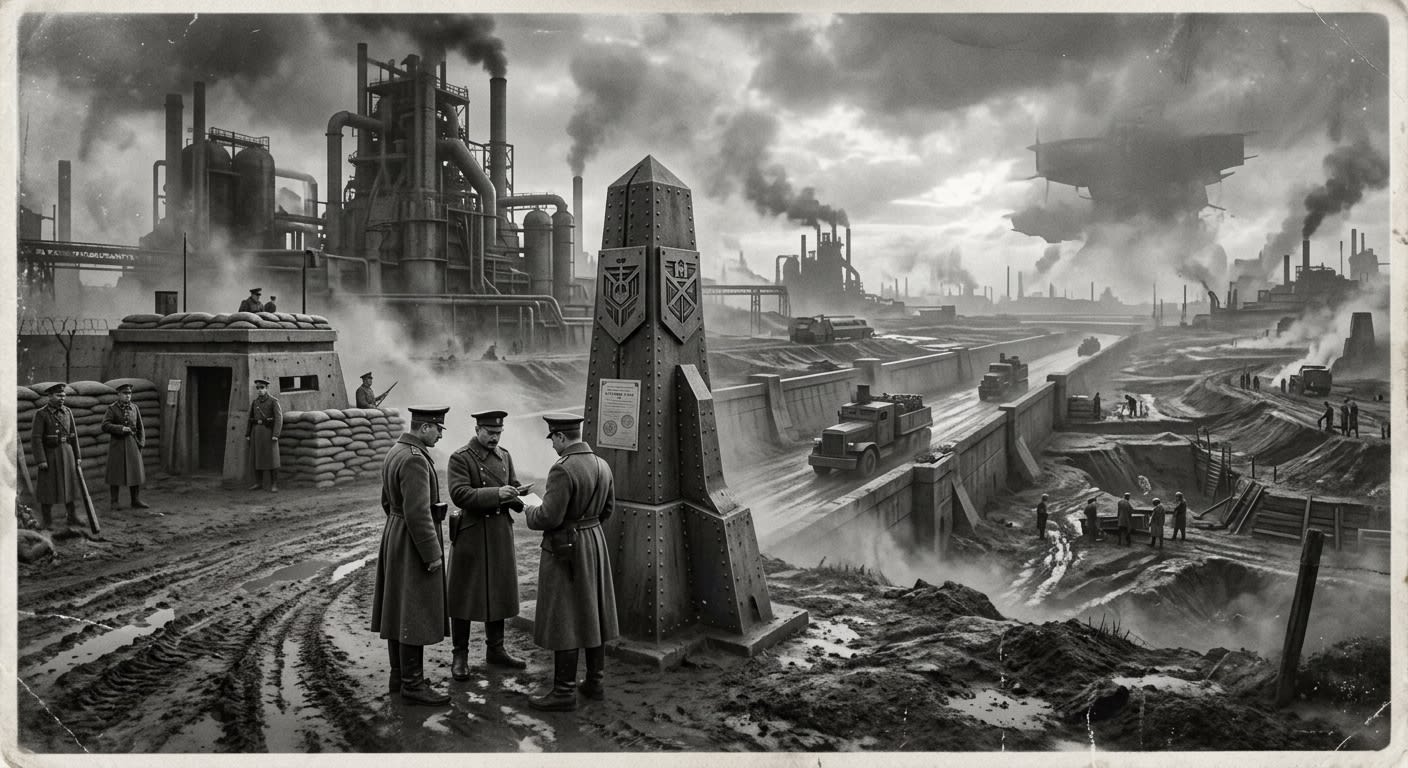
Doctrine classifies the Great Deceiver as Voluntas Adversa Primordialis, the Primordial Opposing Will. This is Latin, which means it comforts senior theologians and prevents junior ones from asking useful questions at speed. The classification matters. Hell is not a kingdom ruled by a crowned beast in the manner of debased romances. It is the Great Deceiver's pressure upon Creation: his authority where obedience has been transferred, his climate where contracts have matured, his grammar where names have been made negotiable.
Earlier rural catechisms described Hell as “the furnace beneath the wicked dead.”
Corrected. The phrase remains useful for infants, criminals, and certain bishops, but adult doctrine recognises Hell as active jurisdiction rather than posthumous cellar. The wicked dead may still find furnaces. The Bureau does not guarantee architectural uniformity.
The Seven Sin-Generals are Hell's most legible governors because they behave with the grandeur of catastrophes. Each carries a province of the Great Deceiver's will into a recognisable shape. Kargath consumes. Velmora contracts. Maldrake burns. Syrion stills. Velkara seduces. Atheron ascends. Morwen steals. These are not merely tactics. They are local laws. In Kargath's vicinity, hunger gains civil authority. Under Velmora, debt acquires teeth. Near Morwen, identity becomes a tenancy subject to seizure.
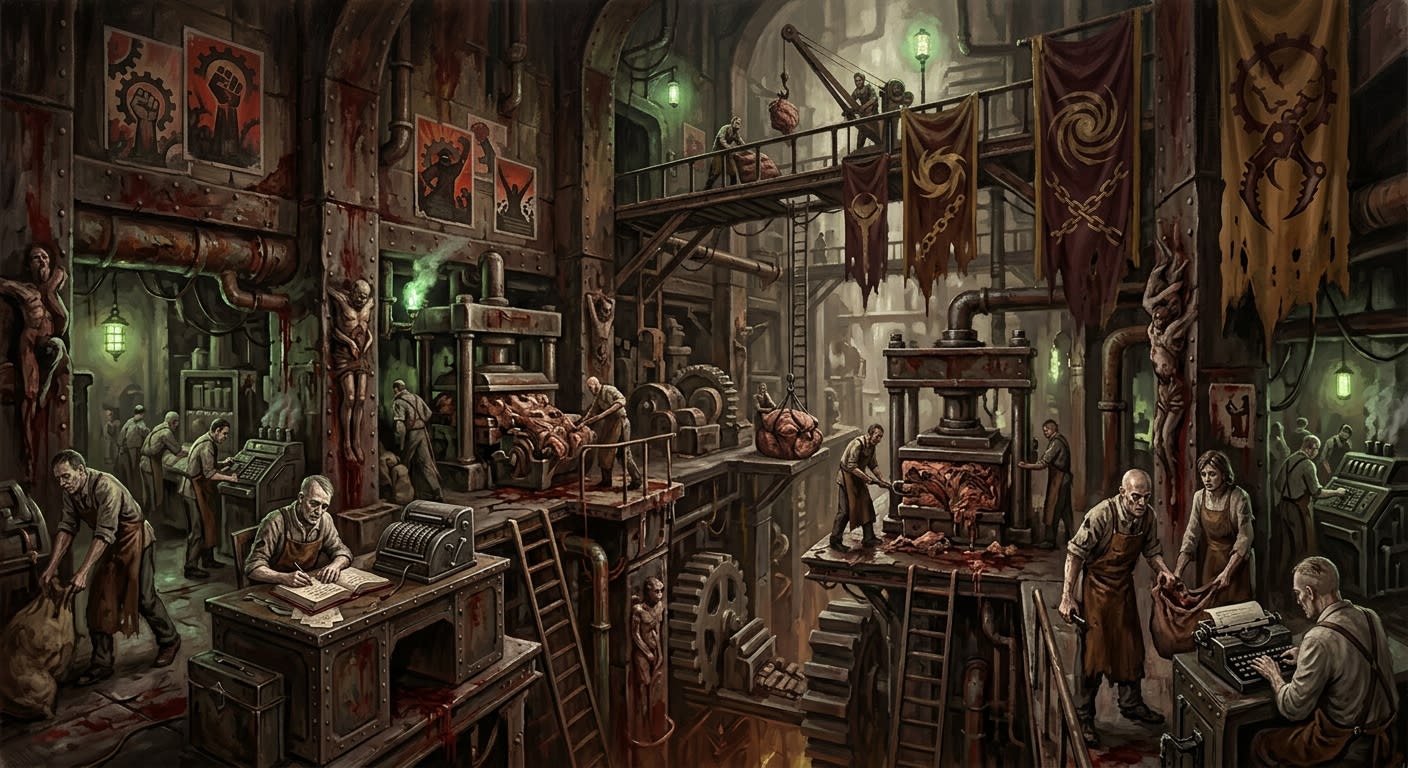
Hell also operates beneath splendour, where theology loses its ceremonial cape and enters the slaughterhouse. The Legions of Sin are mostly mortal. This fact remains intolerable to public sermons and indispensable to War. True demonkind is costly. Mortal flesh is cheap, replaceable, recoverable, and, after sufficient abuse, spiritually pliable. Hell uses men as coin because men mint themselves faster than mercy can redeem them.
The distinction between Hell's will and Hell's servants is the kind that preserves doctrine during catastrophe. A starving conscript driven before a demon host is not Hell. He is Hell's invoice. A sorcerer who bargains for a wound-engine is not Hell. He is Hell's clerk, and usually its eventual payment. A shard of demon glass is not Hell. It is a receipt issued in matter. The Great Deceiver's genius lies in making all three useful before the Synod can decide which drawer to open.
#On the Geography of Wound and Rule
The word Hell tempts cartographers into blasphemy. They wish to shade a region, draw a border, label the east, and sleep. I envy such men their simple beds. The Charnel Lands east of the Line are Hell's greatest continuous expression, but Hell respects no border drawn by human hand unless the hand is backed by bell, relic, wall, powder, faith, and clerical obstinacy. Even then it tests the ink.
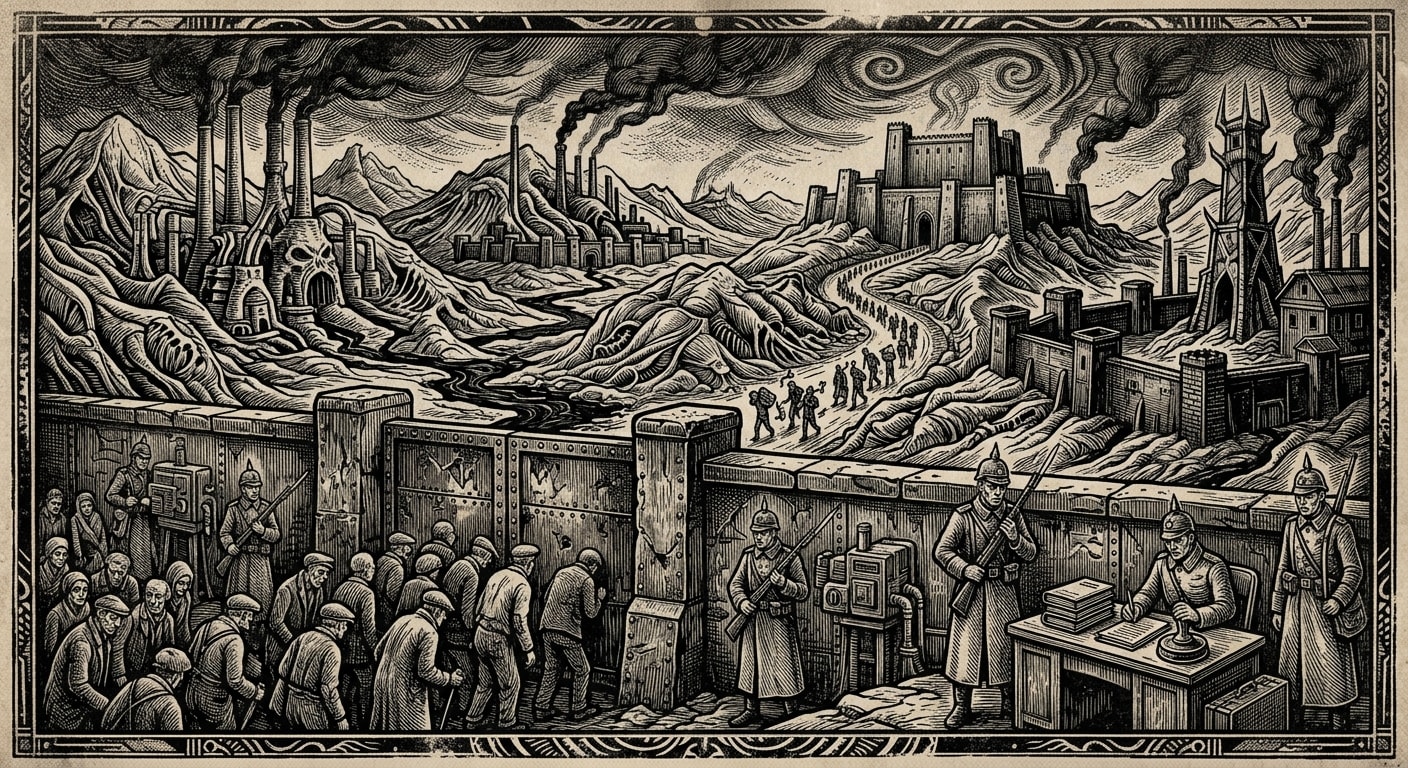
The official zones teach safety by distance: Heartlands, forward territories, Line, No-Man's-Land, Charnel Lands. The sequence is administratively useful and metaphysically rude. Hell has touched the Heartlands through demon glass, proscribed tones, hunger-ink, wrong mirrors, returning coins, counterfeit relic warmth, nursery songs carrying enemy cadence, and dreams that leave wax under the tongue. Hell need not occupy a city to tax it. It sends influence ahead as a bailiff sends notice.
Wound-sites are the common border violations. Some are battlefield scars where sorcery spent itself into soil. Some are places where a Sin-General's passage left law behind like grease. Some are old sites of Rationalist violation where unbelief weakened the hinge and something with patience pushed through. The Bureau of Alchemical Standards classifies their residues with admirable cowardice: Category Two disturbance, anomalous shard-substance, thermal non-compliance, responsive medium, doctrinally suspect exudate. These phrases are not lies. They are gloves.
Demonic territories are less conquered than edited. In Thrace, Maldrake's violence has taught ore to remember screaming. In the Blightmarsh, Kargath's appetite rots grain in theory before it rots in silo. In the Shattered Courts, Velkara has made architecture complicit with longing. In Moldavia, Velmora's contracts lie beneath collapsed towns like roots under graves. The land obeys its occupying sin because the land has been entered into procedure.
No-Man's-Land is worse in one respect: it has competing procedures. Synod shells, demonic sorcery, abandoned villages, relic fragments, failed miracles, mortar dust, human slurry, ash, bell-noise, bad weather, and frightened prayer all meet there without an arbiter. Hell is strong there, but not sovereign. The Line holds because sovereignty remains contested. Every trench is a lawsuit against damnation, argued with rifles.
#On Matter Under Infernal Contract
The first evidence of Hell is rarely a monster. Monsters are late-stage clarity. The first evidence is matter becoming argumentative.
Glass grows warm and looks back. Ink refuses to dry until a name is written incorrectly. Ash preserves fingerprints from men not yet dead. Mortar bleeds during hymns it dislikes. Bells ring off-key after hearing the wrong choir. Salt crawls uphill toward a sealed drawer. The Bureau of Alchemical Standards exists because the world, once insulted by Hell, develops habits unfit for ordinary offices. It measures what Engineering cannot admit, what Relics wants consecrated, what Purity wants burned, and what War wants mounted on a helmet by dawn.
Demon glass remains the most public material because it is pretty enough to sell and wicked enough to punish purchasers dramatically. It appears in Wound-sites, Wrath slag, Lust courts, and places where ground has learned the manners of a window. Raw, it is warm and listens. Polished, it shows. Broken, it teaches crowds what their bones are doing without permission. The Mirror Riot of Varna proved that Hell in shard form should never be smashed where civilians can see the pieces arrange themselves.
The Varna shards reflected skeletons moving independently of their owners. That sentence carries more doctrine than a hundred sermons on vanity. Hell does not merely deceive the eye. It reveals disobedient arrangements already latent inside the body and then suggests they vote. Bodies followed their skeletons into panic and water. Purity smashed the crate, sailors died properly, civilians died messily, Polishers learned packaging, and War eventually received mounted optics under another label. The Bureau calls this containment. I call it an argument that lost its shame.
The Incident of A.S. 187 in the Vault of Silences offers a quieter proof. A duty log burned; ash was weighed; fragments survived; marks appeared only when removed from light; proscribed tones migrated through ink and hand. Hell does not require spectacle. It works very well in margins. It likes inventories, benches, tired officers, and long rotations beside forbidden indices. It has excellent taste in institutional fatigue.
Hell's material signs share one rule: they make procedure hungry. The moment a shard hums, five offices awaken. Purity wants seizure. War wants use. Records wants entries. Alchemical Standards wants assays. Doctrine wants language. Tithes wants fines. Hell, observing this, has already won half an hour, which is sometimes all a contaminant needs.
#On Sorcery, Miracle, and the Price of Borrowed Power
Miracle and sorcery are the two great insults to ordinary expectation, and the untrained often confuse them. This is how villagers die, officers embarrass themselves, and abbots get promoted after the witnesses disappear.
A miracle is sanctioned alteration at cost to the faithful body. Hunger deepens, sleep frays, years shorten, choirs lose breath, districts fast until ribs click like beads. The world remains itself. The faithful pay, willingly or at least under sacred persuasion, and the Ledger records the charge as righteous.
Sorcery is borrowed power advanced at interest against Creation. It scorches fields, poisons rivers, warps time, fattens glass, wakes ash, and leaves the world paying after the sorcerer has spent his brief importance. Doctrine's declaration is clean: all sorcery is contract. The Great Deceiver lends. The borrower signs in pride, fear, hunger, grief, lust, fury, or curiosity. The collateral is everything nearby.
A provincial War manual once described enemy sorcery as “improper miracle-work.”
Withdrawn with contempt. Improper miracle-work is a priest using consecrated oil to cure his horse before the infantry. Sorcery is Hell enforcing a loan through physics.
This is why demonic landscapes are wounded rather than merely damaged. Damage ends when the hammer stops. Sorcery continues billing. A field burned by ordinary fire may grow again. A field used as sorcery collateral may produce grain shaped like teeth, or no grain, or grain that ripens under moonless conditions and whispers storage instructions to the miller. A river crossed by an ordinary army becomes muddy. A river crossed under infernal contract remembers the boots and drags their grandchildren.
ALCHEMICAL FIELD NOTE — SAMPLE H-19, EAST OF VARNA Soil accepted seed. Seed germinated into teeth. Teeth rooted downward and sang when watered. Assistant Caro counted thirty-two human molars before the furrow closed over his left hand. Hand recovered: no. Sample jar warm after sealing. Label changed from AGRICULTURAL RESIDUE to HELL, PENDING OFFICE REVIEW.
The Rationalists never understood this distinction because they mistook miracle, sorcery, and anomaly for unsolved chemistry. Their laboratories measured cold fire and wrote reports. Their prefaces became shorter after each omen. Hell loves a man who believes naming a phenomenon reduces its appetite. It can wait while he builds shelves.
#On the Usefulness of the Word
Hell is imprecise, and imprecision is usually a sin against administration. Yet the word persists because some realities must be named before they are sorted. A mother does not say Category Beta Hostile Mortal Materiel when her stolen son returns with a sigil burned in his chest. A trenchman does not say metaphysical jurisdictional breach when the fog starts calling roll in his father's voice. He says Hell. The word is short enough to shout.
Doctrine tolerates the word for three reasons. First, it preserves moral clarity. The Enemy is not alternate governance, eastern custom, unfortunate magical ecology, or war pressure. It is Hell. Second, the word binds phenomena that would otherwise scatter across files: demon glass, Sin-General domains, mortal auxiliaries, Wound-sites, proscribed tones, sorcery contracts. Third, it frightens children correctly. A frightened child may become a tedious adult, but a child insufficiently frightened by Hell becomes either a Rationalist or a tourist.
The word also protects the faithful from false intimacy. Technical language flatters the speaker into believing he has approached safely. Hell denies that luxury. It keeps disgust attached to knowledge. I may distinguish demonic shard-substance from sorcerous residue, mortal auxiliary from true demonkind, Wound-site from occupied domain, contract from emanation, but the ink must never become so clever that it forgets what it describes. A file on Hell should smell faintly of ash. If it smells of graduate confidence, burn it and the graduate.
#On Present Encroachment
As of A.S. 201, Hell presses less like an army than like a damp hand through old plaster. The Line still holds. The great bastions stand. The Charnel Lands remain east. These are true statements, and truth is strengthened when it is stripped of comfort.
Demon-glass distribution increases. Wound-site residues multiply faster than classifications. The Bureau of Alchemical Standards opens files with both hands and closes them with tweezers. Purity raids decoy crates while War receives cleaner lenses. The Vault of Silences tightens rotations after incidents it refuses to describe in language fit for lunch. Along the front, the Sin-Generals continue their quarrels, which saves us daily and may one day condemn us if we mistake enemy rivalry for enemy weakness.
Hell's most successful campaign remains moral fatigue. It does not need every citizen to worship the Great Deceiver. It needs clerks tired enough to misfile danger, guards bored enough to answer voices, widows hungry enough to buy shards, officers proud enough to use captured optics without asking who polished them, theologians vain enough to prefer elegant phrases to ugly warnings, and readers foolish enough to think this article concerns places they will never visit.
#On the False Comforts of Distance
Citizens of Zone 1 speak of Hell as if mileage were sacrament. They have not watched a Ghent widow lift a warm shard from a fish crate, nor seen a Strasbourg clerk write a forbidden name because the ink leaned that way, nor heard a nursery tune in Munich acquire an extra bar from nowhere and leave three children asleep for nineteen hours. Distance changes the costume. It does not dismiss the actor.
The Heartlands encounter Hell in respectable forms: auction lots, curiosities, disputed relic media, fashionable mourning-glass, saint-pane fragments of dubious provenance, theatre masks with responsive silvering, soldier trophies, imported spices whose shadows fall east, and scholarship. Especially scholarship. A demon at the wall is an enemy. A demon in a lecture becomes a topic, and topics are the preferred nesting material of cowardice.
The safest cities are rich in little apostasies. A merchant wants advance sight of convoy prices. A mother wants one more glimpse of a dead son. A lecturer wants a specimen. An officer wants a lens. A bishop wants a miracle with better timing. A clerk wants to know whether the scratching under the drawer is a rat or a message. Hell enters through wanting, then stays for filing.
This is why Purity's most useful work occurs far from the front, in parlours, studies, warehouses, orphan dormitories, quay markets, glass shops, music rooms, and private chapels where nothing with claws has ever stood. The claw is late. The permission comes first.
#On Mortal Participation
Hell's favourite disguise is inevitability. Men say they were driven, starved, bribed, frightened, educated badly, abandoned early, offered no choice, offered choices all poisoned, placed under command, placed under hunger, placed under a superior's seal. Many of these statements are true. Hell enjoys truth when truth can be made to loosen guilt.
The mortal collaborator is not always a cackling heretic with a knife and a manifesto. Those are convenient and usually stupid. More often he is a broker who looks away from crate warmth, a captain who accepts an optic without provenance, a mother who buys a shard because grief has ruined her arithmetic, a scholar who writes one more private note, a clerk who leaves a proscribed sample in the wrong cabinet because the right cabinet is three floors down and his supper is cooling.
The Synod prosecutes collaboration with satisfying ferocity and imperfect aim. This is regrettable and necessary. Perfect justice requires perfect knowledge; perfect knowledge belongs to the Creator; the Bureau has stamps, rope, and schedules. We proceed with the instruments available.
Yet pity must not become solvent. The Ash-Mother chained in a pit is victim. The surgeon who chains her is enemy. The quartermaster who sells the chain iron under false invoice is enemy with tidier cuffs. The apothecary who asks no questions about milk-ash shipments is enemy at one remove and deserves removal at one speed: quickly.
Hell spreads through permission granted by exhaustion. The Great Deceiver does not need a majority. He needs a few signatures, a few silences, a few hungry men, a few clever women, a few officials confident that no one will connect yesterday's exception to tomorrow's breach. The Ledger connects. Eventually.
#On Countermeasure and Folly
Countermeasures against Hell are old, ugly, expensive, and routinely mocked by those who have never needed them. Bells first. Always bells first. Bell-resonance leaves some corruptions intact and reminds matter which choir it belongs to. Relic proximity comes next, with the usual caveat that a relic must be authenticated, escorted, insured, guarded, and protected from pilgrims who believe holiness is improved by licking. Salt, lime, ash, lead, oathglass, redaction ink, sealed song, and controlled hunger follow according to circumstance.
The simplest rule remains the best: reduce contact. Men complicate this rule because contact is profitable. Demon glass offers vision. Wound-site scrap offers fuel. Enemy lenses offer range. Captured chants offer signal intelligence. Sorcery diagrams offer insight. Hell grows fat on the phrase for study. The Bureau permits study under seal because ignorance also kills. Between corruption by knowledge and slaughter by ignorance, civilisation has chosen supervised contamination. This is why civilisation smells of vinegar and burnt gloves.
Folly has its own ladder. Curiosity. Touch. Private testing. Delay in reporting. Improvised prayer. Argument with reflection. Attempted profit. The last is the most common and the least forgivable. A frightened man may touch Hell once. A greedy man wraps it, prices it, and finds a buyer by dusk.
#On the Northern Omission
The prudent reader will have noticed a silence. The Synod speaks of seven sins, seven generals, seven domains, and a Line opposed to recognisable vice. Yet the northern bastions face pressures that do not fit the catechism. Königsberg and Brest hold against entities whose names are suppressed with a severity that makes ordinary censorship look like gossip. The Grey. The Nameless Tide. Field reports vanish. Veterans are screened with protocols that leave no friendly paperwork behind.
Are these Hell? Doctrine answers carefully: they are hostile to Creation, hostile to the Faith, hostile to the Synod, and hostile to the human habit of sleeping without knives. That is enough for soldiers and insufficient for theologians, which is the natural condition of both professions. If Hell is the Great Deceiver's claim, then every enemy of Creation should fall beneath the word. If some northern force predates the Sundering, refuses Sin-General taxonomy, ignores ordinary relic countermeasures, and presses without speech, bargain, appetite, vanity, or visible contract, the word Hell may be too small or too convenient.
I record the omission because silence becomes dangerous when mistaken for ignorance. The public catechism requires seven. The battlefield has additional weather. Doctrine may later clarify, and when it does, it will have always been the case that the clarification was implied. Until then, the faithful may use Hell for what presses from the east and the north, provided they remember that the Ledger's neatest columns often conceal the ugliest totals.
#On the Last Civility
Hell's final obscenity is that it imitates order. The Great Deceiver does not merely break. He organises. Ash-Mothers are assigned. Blood-Tithes are installed. Processional Slaves are arranged by usefulness. Demon glass moves through supply. Sorcery engines consume material on schedule. Sin-Generals maintain domains whose horrors possess internal law. Even madness keeps books when Hell governs it.
This makes Hell a rival bureaucracy, which is why I take it personally.
The Synod's answer cannot be mere violence, though violence is blessed and should be applied without squeamishness. Our answer is counter-order: bells against false cadence, ledgers against erased names, walls against hungry geography, rites against contract, relics against borrowed power, memory against the Lie's revisions. When a clerk records a dead man's true name, Hell loses a fraction. When a bell keeps ringing through fog, Hell loses another. When a soldier refuses to answer the voice calling from beyond the wire in his mother's tone, Hell loses enough for dawn to matter.
Do not romanticise this. Fractions are small. Dawn is cold. Many soldiers answer.
The Bureau's holding is severe and correct: Hell is the Enemy's active claim upon Creation, expressed through will, matter, territory, contract, and corrupted flesh. It began before the Sundering as whisper and omen. It announced itself at the Sundering as rupture. It governs beyond the Line as domain. It enters within the Line as residue, song, glass, hunger, debt, dream, and doubt.
At night the east glows where no authorised fire burns. The bells answer. In the laboratories, covered samples warm beneath lead. In the trenches, men spit before saying the word. In Strasbourg, a junior clerk writes H E L L at the top of a requisition form, pauses, scratches it out, and replaces it with Category Pending. The paper darkens under his hand. He files it anyway.