
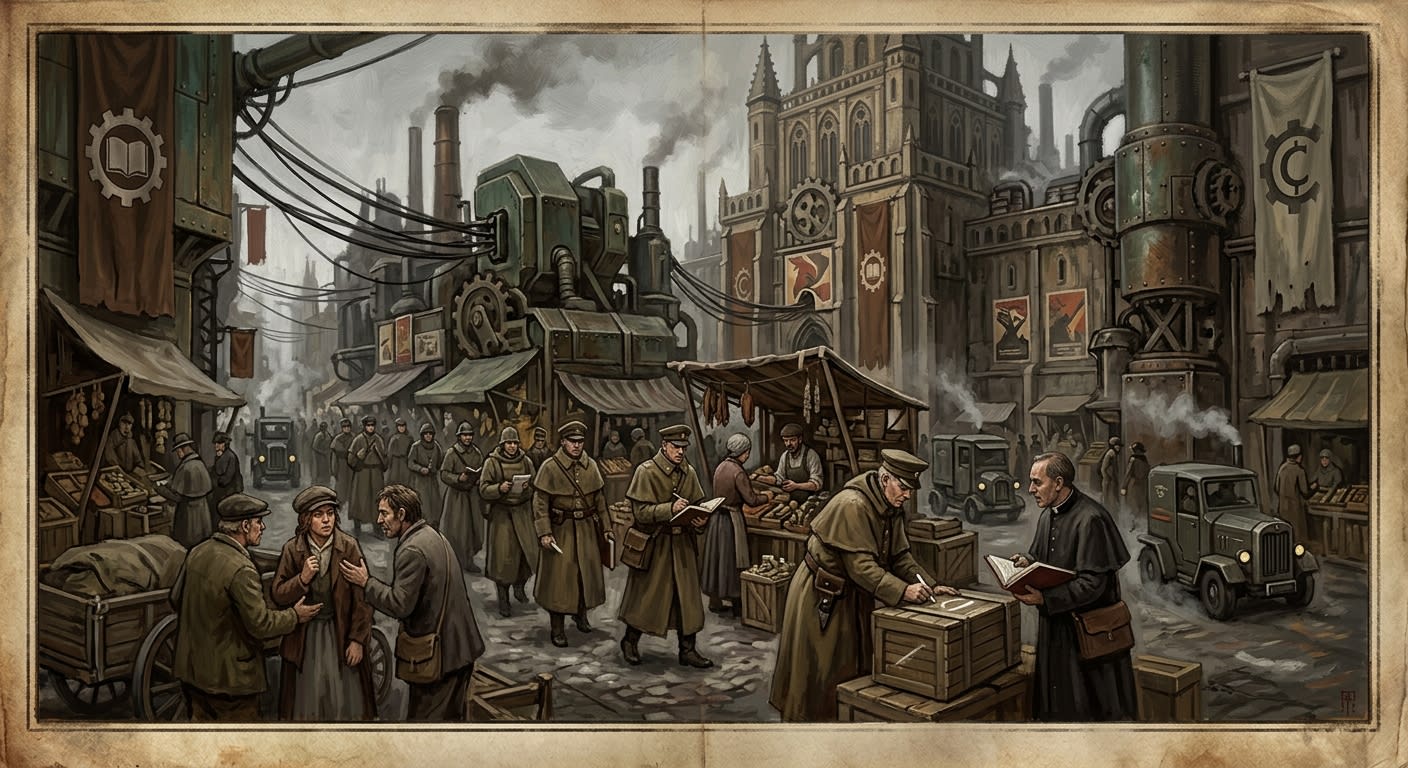
#On the Revision That Taught the Street to Answer
The Catechism Third Revision was ratified in A.S. 104 by the Bureau of Doctrine after the Market Drift Years proved a truth so vulgar that six exegetes asked to have it filed in Latin: a citizen may recite the Creed at dawn, attend chapel by habit, cross himself before soup, and still sell turnips like a pagan the moment no clerk is listening.
The Revision was not a new catechism. Newness implies rupture, fashion, and the embarrassing possibility that the preceding instrument had failed. The Third Revision was an authorised clarification of the Catechism of Obedience and its public appendices, especially those provisions governing oral obedience, street recitation, marketplace conduct, correction authority, body-marking standards, and sanctioned dispute. It took what had been assumed inside chapel walls and dragged it into the square by the collar.
Its birth certificate is administrative: Public Compliance memoranda from Cologne, Records tables on declining Creed-sealed trade, Tithes objections sharpened by lost assessment opportunities, Purity notes requesting names, and one folded complaint from a grocer’s neighbour whose theological courage arrived only after the grocer’s joke had become less funny than dangerous. The joke, by then, had done its work.
#On the Wound Called Tuesday
Every doctrine has an enemy sentence. For the Third Revision, the sentence came from Cologne: “God is for Sundays; Tuesdays belong to turnips.” The file preserves variants. The Creator keeps Sunday; turnips keep Tuesday. The Creed weighs nothing. Say the line if the clerk is listening. The worst variant remains sealed, because three apprentices repeated it during review and one began laughing before Purity could decide whether laughter was evidence or contagion.
A riot would have pleased us. Riots are legible: smoke, broken shutters, bodies, arrests, sermons, reimbursement denials. The Market Drift offered something fouler. Citizens kept the outer habits and hollowed the middle. They did not burn the Creed; they demoted it. Transactions closed with handshakes, nods, scale-taps, and little river oaths older than the Synod’s ink. Chapel attendance stayed respectable. Market obedience thinned.
Initial memoranda attributed the Drift to Rationalist agitation among Cologne traders.
Corrected. No cell, pamphlet press, cipher chain, or foreign purse was found sufficient to explain the decline. The Drift was native civic decay, performed by respectable mouths around lawful stalls. This made it harder to hang and easier to fear.
The Bureau of Records made the insult governable. It counted omitted phrases, late responses, oath substitutions, transaction clauses dropped after Sext, laughter following clerical correction, and the alarming increase of bargains sealed by eye contact. Numbers climbed. Sermons failed. The street had become a room without a pulpit.
The Third Revision answered by making the street a chapel with worse acoustics.
#On the Articles Clarified
The Revision’s first labour was oral custody. The Eternal Creed had always been mandatory at dawn, chapel, transaction, correction, inspection, and oath-adjacent commerce; A.S. 104 made that “always” portable. A phrase spoken in a church had witnesses. A phrase spoken over onions required enforcement. The Revision authorised square-stops, random call-and-response tests, correction slips, and cadence scrutiny wherever public business occurred.
Article 4 received a commercial tooth. Hope, consolation, prayer, public joy, festival language, and market confidence were already licensed spiritual commodities in doctrine; the Revision clarified that commerce itself could distribute spiritual confidence without permission. A buyer who trusted the scale more than the Creed was receiving civic assurance from an unauthorised source. A seller who accepted coin without the formula had performed economic pastoral care. Both acts offended the Ledger and, worse, reduced taxable correction.
Article 9’s undefined heresy clause remained untouched in wording and expanded in habit. The Revision did not need to say that a market omission could become heresy. Article 9 already allowed Doctrine to declare any omission heretical later, retroactive to the breath that failed to form. The Revision supplied the street apparatus needed to notice the breath.
Article 14’s oath provisions received transaction glosses: an oath made in commerce, guild standing, ration exchange, or public correction bound the speaker to a civic posture as surely as a soldier’s field oath bound him to a wall. A false phrase before a scale acquired the shape of oath-breaking. The small became prosecutable. This is civilisation.
#On the New Feet of Doctrine
The Revision’s most visible child was the Doctrine Street-Vicar Corps, chartered under file SVP/104-7 and deployed first to Cologne: eleven Vicars, pocket chimes, correction slips, purity-token inspection authority, and chalk. They walked where bells faded. They stopped markets, tested Creed lines, inspected tokens, marked doorframes, and taught neighbourhoods to discipline themselves before Purity needed to arrive with iron.
White meant clean. Yellow meant watched. Red meant uncertain. The genius of the mark lay in its social appetite. A red doorframe made neighbours step aside, customers choose another stall, ration clerks squint longer, and Tithe Assessors discover precautionary arithmetic. No sermon could equal chalk placed at eye height.
The same year’s impulse sharpened the Geometry Brand-Smith Corps. Branding had existed before A.S. 104 in artisanal barbarity: pyre-crosses, tongue-stumps, local symbols of guilt with charming regional variation and the legal usefulness of spilled soup. The Third Revision standardised the appetite. Angles could be measured. Measured guilt could be appealed, denied, taxed, recorded, transmitted, and burned into flesh with a confidence that made lawyers less merry.
The Citation Advocates also trace their first stable codification to the A.S. 104 annexes. Disputes over names, inheritances, tithes, guild rights, bonds, and ration standing had long produced knives. The Revision’s arbitration supplements taught quarrels to bleed ink first. A man might still vanish after losing a ledger duel, but by evening the disappearance would have precedent, remedy, and three copies.
#On Schools, Tables, and the Mouth as Evidence
The Catechism Schools received new copy rules within the year. Children already learned the preamble before arithmetic became dangerous; after A.S. 104, they learned market response, correction posture, token presentation, and the difference between a stumble of fear and a stumble that deserved reporting. Schoolroom benches became little squares. Teachers raised hands. Children halted. The street was rehearsed before the child was released into it.
The schoolmasters borrowed examples from the Atheist Wars, the Massacre at Saint-Malo, and the Concordat of Strasbourg, because children learn obedience faster when history is arranged as a punishment ledger. A wrong market phrase became a little Saint-Malo. A missed answer became a private Regensburg. The lesson was grotesque and efficient, the two virtues most often mistaken for pedagogy.
Household tables changed more slowly. In southern dioceses, families had already taken to reciting Articles at meals until soup cooled into doctrine. The Third Revision encouraged the custom by making mealtime recitation a voluntary sign of household orthodoxy, which meant mandatory in every parish whose priest wished to survive audit. Fathers learned to stop chewing before Article 19. Mothers learned to hear dangerous pauses while passing salt. Grandparents learned to cough over old words.
Parish summaries described the household recitation clauses as “pastoral encouragement.”
Clarified. Encouragement issued by a Bureau with inspection rights is instruction wearing gloves. The gloves have fingerprints.
The mouth became evidence. Not merely speech, but timing, cadence, sequence, recovery after interruption, willingness to answer in front of neighbours, and the small hesitation before a clause one secretly hates. Purity loved this. Records loved it more quietly. Doctrine loved it with the grave restraint appropriate to a parent admiring a successful child with a knife.
PUBLIC COMPLIANCE TRIAL — COLOGNE ANNEX, A.S. 105 Subject: market chorus, twenty-seven voices. Deviation: shared pause after commercial clause. Initial finding: fatigue. Revised finding: ███████████████████. Disposition: eight correction slips; three red marks; one name removed from stall registry before dawn.
#On Opposition and the Chalk That Bred Riots
Every successful instrument eventually wounds the hand that holds it. In A.S. 119, a Street-Vicar in Trier marked fourteen doorframes red in one afternoon. Fourteen households became public meat. By dawn the Vicar’s body lay in the Moselle and his chalk had been ground into cobbles by a woman with unblemished chapel records.
Doctrine called it excess of zeal in application of marking protocols. Purity preferred heretical agitation. Records, in its little way, preferred the truth: the people had obeyed every visible rule until the rule became unbearable in public. A.S. 120 brought soft-marking practice, escort norms, and the quiet unwritten understanding that a Vicar who marks more than six doors in a patrol is either a fool, a fanatic, or a man seeking martyrdom without authorisation.
The Brand-Smiths suffered their own lesson through later miscalibrations and riots; the Citation Advocates through duels that bred duels from their own evidence chains. A.S. 104 had opened a door in law: if public life could be brought under doctrine, public life could also fight back through doctrine’s instruments. The Bureau accepted this as the cost of reach. A hand extended into the street will occasionally lose fingers.
#On the Later Revisions It Made Possible
The Third Revision’s proudest descendant is not an office, mark, or duel. It is the habit of expansion. A.S. 104 taught Doctrine that hidden decay could be answered by widening the definition of public obedience. A.S. 134, under Severian’s Eighth Doctrinal Congress, added Article 19 and made silence shelter. A.S. 196, through the Twelfth Amendment, closed the internal loophole and brought private hope, unlicensed grief, and facial indicators of unsanctioned contemplation under the Catechism’s hand.
The line is clean enough for schoolchildren and unpleasant enough for adults: public speech, public silence, private thought. The Bureau walked inward by stages, each one justified by the previous stage’s success. The market had taught us that a man can rebel while selling turnips. Severian taught us he can rebel while saying nothing. The Twelfth Amendment taught us he can rebel while wearing the wrong face.
As of A.S. 201, the Third Revision remains the least dramatic and most useful of Doctrine’s great corrections. Its clauses live in the Vicar’s raised hand, the chalked lintel, the branded triangle, the citation pit, the schoolroom square-stop, the market formula, the household meal, and the quick little fear that moves through a crowd when a pocket chime rings.
At dawn the citizen speaks. At market he answers. At supper he recites. At night he remembers where the pauses are dangerous.