
#On the Court That Learned to Sit in Mud
The Trench Courts were constituted in A.S. 91 because fifty thousand dead men had become, through the old field registry’s incompetence, legally irritating.
That is the clean sentence. The dirty one follows. During the Uncounted Winter, in the northern sector of the Sagittal Line, death exceeded the clerical apparatus assigned to domesticate it. Tags froze into wrong hands. Confessions vanished on ration wrappers, prayer scraps, cartridge labels, sleeve cloth, and the memories of boys who were themselves dead before the rear office asked for duplicate testimony. Widows could not become widows. Orphans could not inherit grief with legal standing. Tithes attempted collection from corpses that Records could not yet certify as corpses. The homefront mourned. Then it litigated.
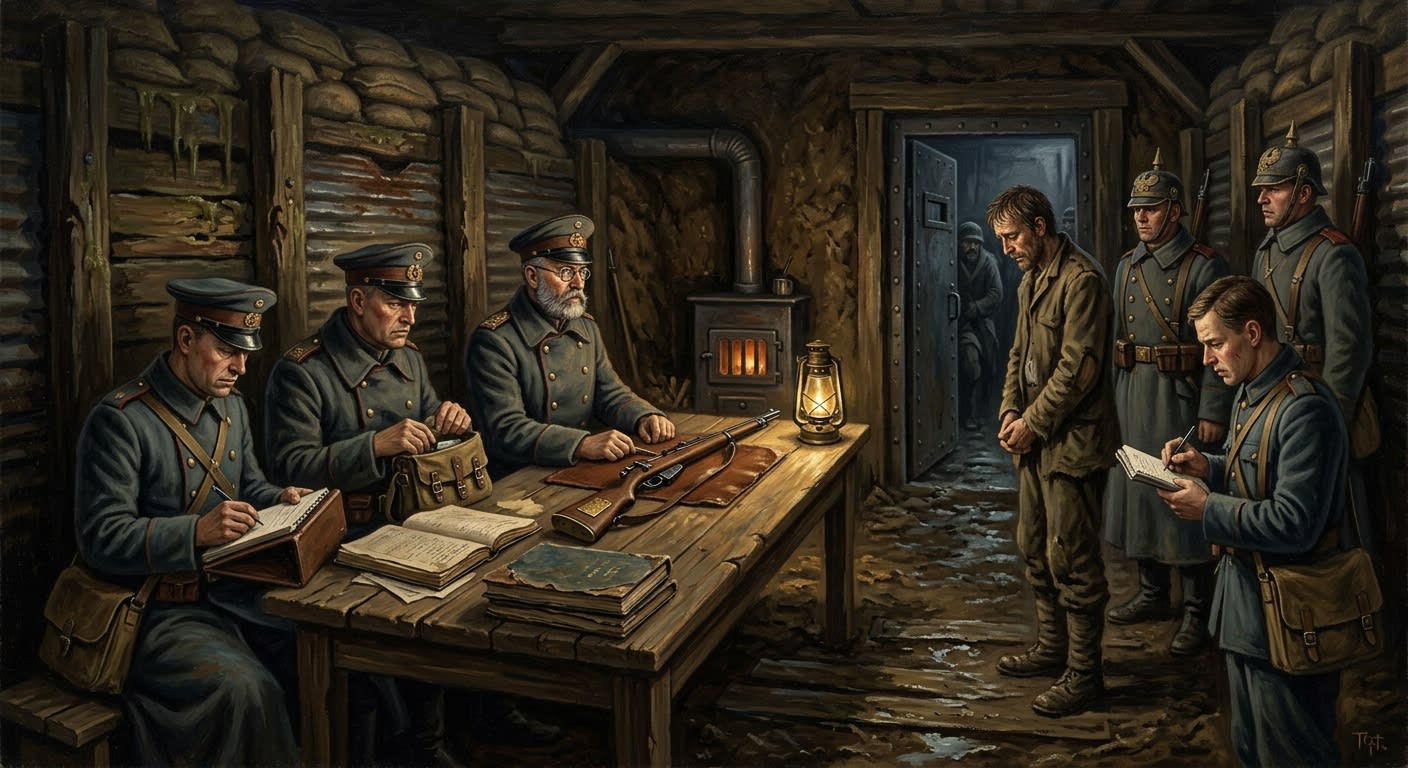
The Synod answered with its usual splendour: it dragged the court forward to the wound. By joint mandate of the Bureau of Records and the Bureau of War, forward registry stations were established in dugouts, sandbag chapels, ruined culverts, ammunition recesses, medical cutouts, and any other cavity large enough to hold a plank table, a lantern, a seal tin, and a man whose literacy had ruined his chance at an ordinary rifle death. These stations recorded last words, issued death attestations, classified confessions, processed absence, judged desertion, routed contradictions, and, when necessary, shot the living before they became difficult paperwork.
A civilian court asks what happened. A Trench Court asks what must be recorded before shelling resumes. That difference contains the whole institution.
Its first rule is proximity. A rear court receives files after reality has cooled into pagination. A Trench Court receives men while their blood is still warm enough to make the ink tacky. This proximity produces a discipline unknown to polite tribunals. The clerk cannot pretend a confession is abstract when the confessing man has soaked the table. The War registrar cannot pretend absence is harmless when the accused stands in another dead man’s coat. The chaplain cannot preach delay when the hymn has already begun and the roof is dropping mortar into the candle.
The second rule is compression. The front has no leisure for argument that cannot survive artillery. A question must fit the card. An answer must fit the line. A verdict must fit the hymn. The court does not love brevity. It fears overflow. Too much speech in a dugout becomes panic, and panic travels faster than orders.
The third rule is custody. Everything said in a Trench Court belongs somewhere: ordinary ledger, family notice, contradiction pouch, cadence hold, deserter sheet, furnace log, ash drawer, rear review packet, or the tiny private hell inside the clerk’s skull. Nothing is permitted to remain merely spoken. Speech without custody caused the Winter. Custody became salvation with soot on its cuffs.
#On Jurisdiction Without Walls
The Trench Court has no permanent architecture. Architecture is rearward vanity. A court exists wherever the mandate, the clerk, the seal, and the armed witness meet under danger. At Bastion-Brest the court may sit in a flooded sap with planks laid across the sump. At Bastion-Przemyśl it may sit under a ridge gun whose recoil dust falls into the ink. At Bastion-Irongate it may be driven into a side gallery where the Gasket Choir makes every verdict hum in the teeth. At Bastion-Constantinople it may occupy a cellar whose walls remember three prior names and one old file that still says Bastion-Constantinople.
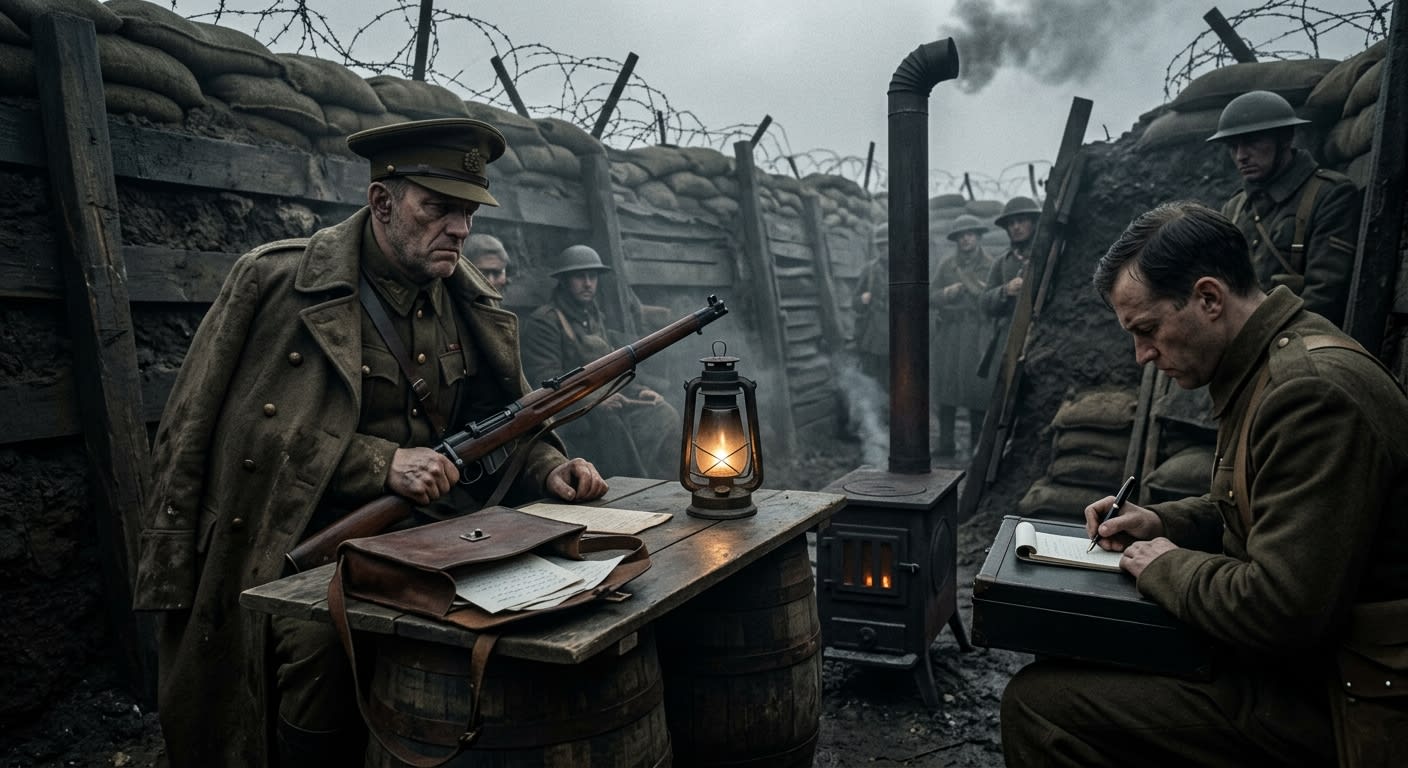
The court’s boundary is marked by function rather than rope: confession line, witness bench, accused position, clerk’s table, furnace path, armed gate. A man brought inside crosses from battlefield into Ledger. He may be bleeding, bound, frost-bitten, sedated, furious, penitent, terrified, or already half elsewhere. The court receives him according to category. Category is mercy’s cheaper cousin.
The old sandbag-chapel courts deserve special disgust. They were built from salvaged pews, ammunition boxes, altar rails, rifle racks, and saints’ faces turned toward proceedings no sane saint would have endorsed without hazard pay. In some sectors the accused stood where communicants once knelt. In others the furnace pipe ran through the broken apse. A crucifix above the bench, a machine gun at the flap, a ledger under oilcloth: sacrament simplified by mud.
At Bastion-Brest, water makes every hearing sound drowned before it begins. At Przemyśl, ridge echoes return verdicts half a beat late, which has caused three recorded appeals and one execution before the appeal finished bouncing. At Irongate, the court tables are braced against vibration because the mountain dislikes uneven testimony. At Shipka, sleep-fog protocols require a witness to slap the clerk every third line during certain months. Constantinople’s southern courts keep duplicate flame because ash winds have a habit of entering the furnace before the paper does.
The presiding officer varies by purpose. For death attestation, the Trench-Court Clerk holds the room: name, unit, vow, bequest, statement, category. For deserter hearings, a War representative sits with the clerk and a chaplain when incense improves optics. For contradiction routing, the Contradiction Custodian becomes the quiet monarch of the pouch. For anomalous speech, the Cadence Examiner inherits the table and everyone else pretends not to breathe. For capital judgement, a Judge may be present, though the front often supplies rifles fast enough that robe and title arrive after the necessary fact.
Doctrine decrees that no Trench Court trial should last longer than a single hymn. The hymn may be spoken, hummed, tapped on a seal tin, or held in the head when sound discipline forbids music. When the hymn ends, deliberation ends. This rule is barbaric, efficient, and spiritually honest, three virtues seldom seen together outside a tax office.
#On the Lantern Table
The lantern table is the court’s altar. Every court has one, though some are no more than an ammunition crate turned flat and wiped with brine cloth. Upon it sit the seal tin, waterproof ledger sheets, rubric cards, identity tags, witness slate, pouch hooks, wax block, wick, and the small field card of Saint Vell, who is depicted at a table so level that no experienced clerk believes the icon was drawn from life.
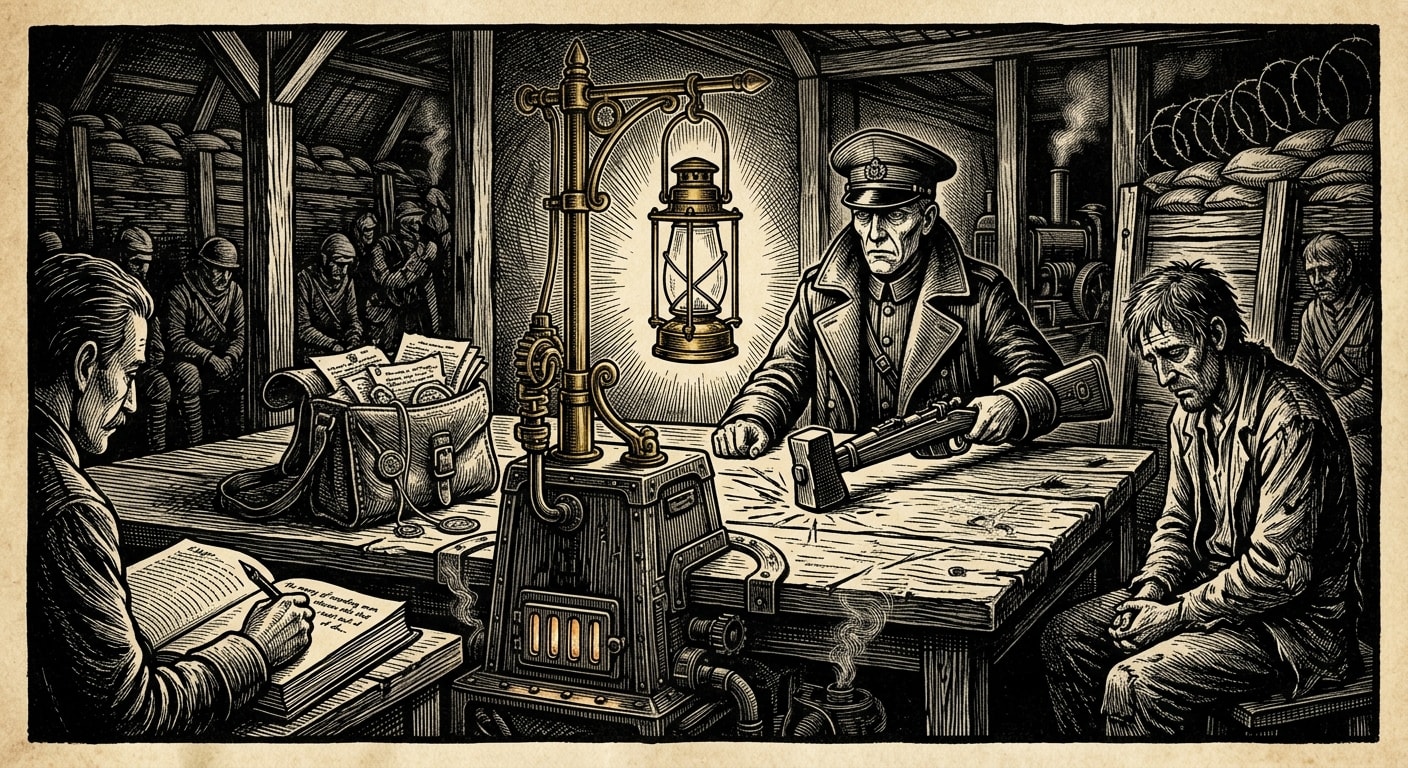
Punishment is loud. The first work of the Trench Court is conversion: breath into record, fear into category, blood into attestation, absence into a column that can be queried by a widow in Cologne without causing the pension clerk to weep into his blotter. A soldier arrives carried by medics who have judged him beyond saving but not yet beyond administrative use. The clerk asks name, unit, vow. The witness confirms if the witness has not died in the corridor. The page receives what the mouth still has strength to surrender.
The categories descend like little gates: faithful, drift, contrition, contagious doubt. Later, after Wound-Site 14 (Unregistered) proved that the voice of the dying may detach from its owner and return wearing another file, a fifth box was added: cadence anomaly. The first four categories concern meaning. The fifth concerns custody. Who owns the sound?
Faithful brings the family bread. Drift brings notation. Contrition brings sin and repentance in separate lines, because the Bureau mistrusts mixed ink. Contagious doubt brings a sealed notice and a quieter route. Cadence anomaly brings silence around the table, a second witness if one has not fled, and the unpleasant sense that the page has begun listening before the clerk has finished writing.
The Trench Court stands between the dying man and the world that will consume his death. It decides which version of him may travel home. It decides whether his widow receives “he died in obedience, naming home and Creed” or “notification restricted pending doctrinal review.” It decides whether his accusation against an officer becomes evidence, ash, or a phrase softened into operational variance. It decides quickly. Speed is the one virtue the front enforces without sermon.
The family notice is the court’s most powerful fiction. It appears in tidy language, folded, sealed, routed through parish offices, and read aloud by someone who did not hear the final breath. A faithful notice can feed a household for years. A restricted notice can starve it with perfect legality. A contrition notice can save a soul while ruining a reputation. A drift notation can reduce benefits enough that children learn doctrine as hunger.
This is why bribes cling to the lantern table. Not because clerks are uniquely corrupt. They are ordinarily corrupt, which is to say human under pressure with access to categories. A pouch mark can kill bread. A softer phrase can keep a widow indoors through winter. An officer’s name can disappear into a furnace or wait in rear review until that officer has enemies worth pleasing. The Trench Court is a moral instrument only in the sense that a scalpel is merciful when held by a surgeon and still sharp when held by a thief.
#On the Rifle-Gavel
Justice in the bastions is a hammer kept close to ammunition. The official documentation speaks of trench-courts where rifles gavel faster than pens, and the official documentation, having for once understated the matter, deserves a small wreath.
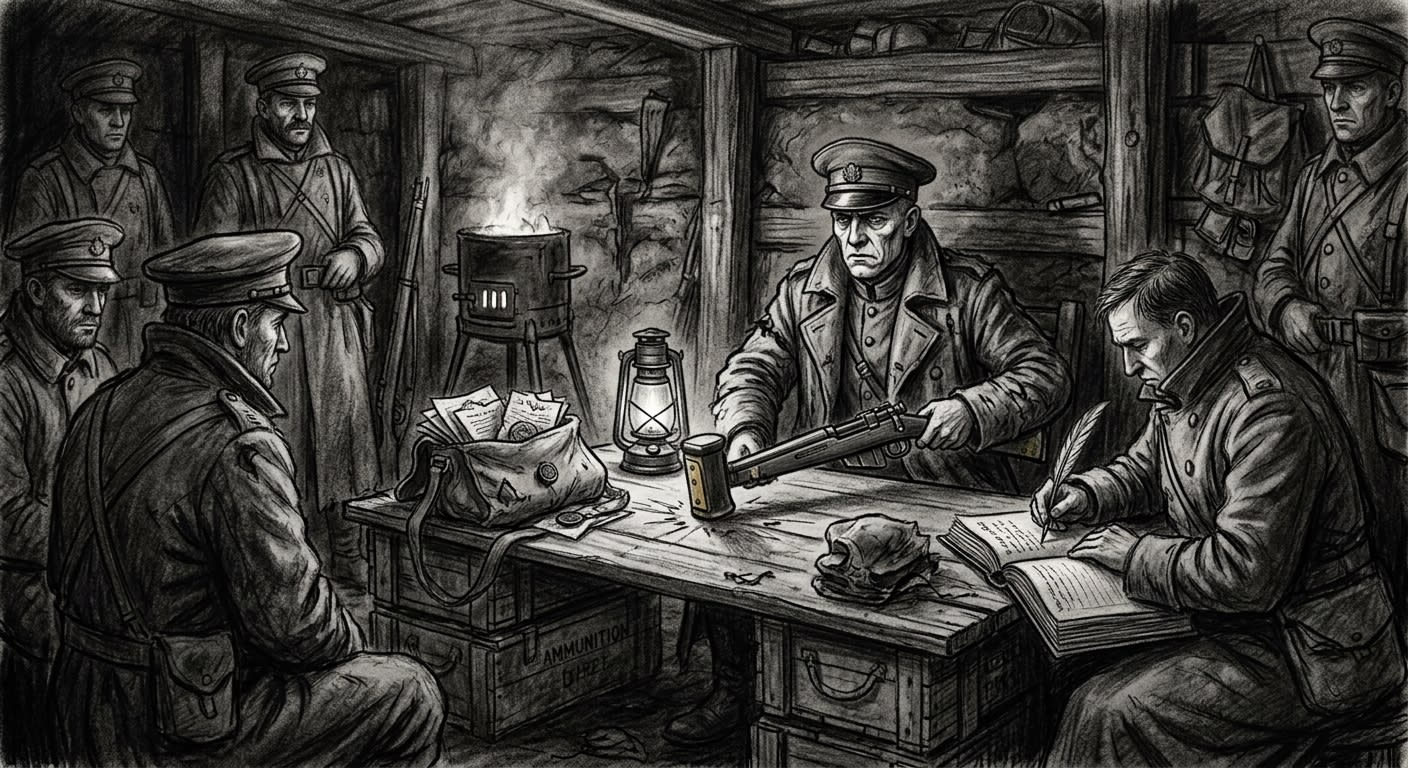
The rifle-gavel is not always literal, though it often is. A butt struck against plank opens a hearing. A bolt worked once silences an accused. Two knocks summon a witness. Three end a plea. At some stations the gavel is a relic handle bolted to a rifle stock; at others it is the nearest weapon and the confidence of a man whose orders have not been countermanded by shellfire. The sound matters more than the object. A Trench Court is an acoustic institution: hymn length, bell hour, stamp beat, rifle knock, furnace latch, last breath. Law enters through the ear as often as through the eye.
The official documentation further says that soldiers stand ankle-deep in mud before comrades who know by dusk they may themselves be judged. This is the court’s real theatre. Rear courts conceal consequence behind railings, robes, benches, and the fog of continuance. Trench Courts display consequence in the queue. A man watches another man condemned for losing a ration stamp, spared for desertion after a useful confession, returned to the line under brand, or shot because the hymn ended before his explanation found a safe verb. The lesson enters every witness without requiring literacy.
Rearward legal commentaries describe the Trench Courts as “summary tribunals of emergency necessity.”
Corrected for field use. The emergency lasted long enough to become procedure. The procedure lasted long enough to become doctrine. Necessity has been promoted and now draws a pension.
The bell often accompanies verdict. At some courts a single toll means return to line, two mean execution, three mean contradiction routing, and no toll at all means the clerk will be writing after dark. Local customs vary because the Line is long and death, despite Bureau efforts, retains regional habits. Bells objects when toll codes develop without its approval. War replies that enemy bombardment rarely waits for tonal licensing. Records records both objections and proceeds.
The court also borrows the hymn. A hearing hymn is selected by sector, season, danger class, or the presiding officer’s appetite for cruelty. Short hymns produce disciplined terror. Long hymns produce hope, which is disruptive. Some accused learn to stretch an answer by matching cadence to the verse, smuggling one more sentence under the final line. Some riflemen learn to end such cleverness by striking the plank early. The rule says one hymn. It does not say the hymn must be sung kindly.
In the oldest northern stations, verdict slips were tied to spent cartridge cases and dropped into canvas sacks marked by bell-hour. The practice was abandoned after a sack of acquittals was mistaken for ammunition and hauled to a firing step. Records issued an apology of unusual sincerity because the error had created three pension contradictions, two wrongful executions, and one soldier legally acquitted after death. The soldier’s widow received reduced benefits, since the acquittal could not be proven to have preceded the bullet.
#On Absence as Accusation
The Deserter Purges made the Trench Courts more than death desks. Once the new courts began clarifying who had died, they also clarified who had not. A man whose company had become a grave acquired suspicious brightness if his name remained attached to ration, gate movement, hospital entry, or a living body found too far west. Absence became a claim. Survival became evidence requiring explanation.
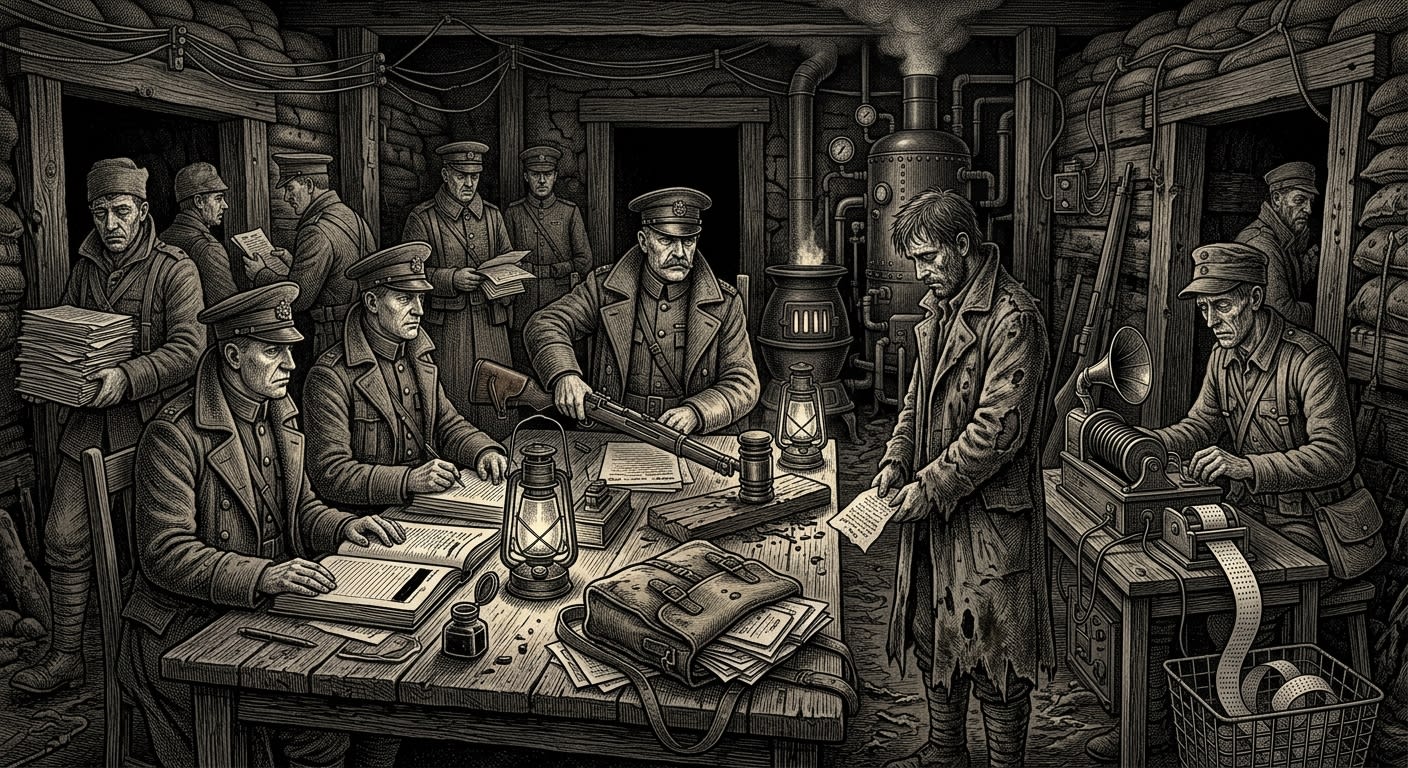
Quick-hearing protocol was born from impatience and soon discovered ideology. Three questions established identity. Five established absence. Seven phrases tested loyalty. The loyalty card taught clerks to weigh grammar at speed: “I lost contact under bombardment” might live; “they left me” might limp; “the officers lied” went into the dangerous column; “the Synod lies” put rope in the room before the chaplain finished inhaling.
Rope annexes grew beside gatehouses, holding yards, supply sheds, chapel crypts, and quarantine pens. Some suspects deserved them. Men fled, stole tags, traded coats with corpses, forged clean slips, bought silence, and walked west while others remained east in the authorised direction of terror. Others were runners misordered by dead officers, sappers filed under wrong names, half-deaf artillerymen obeying the wrong bell, boys whose mothers had claimed pensions too efficiently. The court’s genius lay in speed, not perfection.
Return under brand became the middle mercy. A shaved stripe, punched ration token, wrist mark, oath-collar, silence at roll call, corpse-detail assignment, ossuary draft, wire repair. The body returned to usefulness wearing its sentence. The court preferred not to waste material while the Line still needed hands.
ROPE ANNEX FIELD SUMMARY — NORTHERN SECTOR, A.S. 91 Hearings between Prime and None: ███. Returns under brand: █████. Executions: ███. Labour conversions: ███. Cases suspended after suspect produced bell token dated after alleged flight: █. Routing: contradiction seal. Annex scrubbed before vespers.
The Purges left behind the habits by which Trench Courts still process disputed living men: three-roll identity checks, corrective prompts, loyalty phrasing, contradiction routing, and the vile efficient principle that a man may be required to rebut the convenience of his own recorded death.
#On Contradiction and the Furnace
The Trench Courts learned that recording everything could be nearly as dangerous as recording nothing. A dying soldier may accuse a captain, name a quartermaster’s theft, report a bell failure, confess a useful heresy, describe a demon wearing a comrade’s face, or tell the truth with timing so rude that it threatens an assault scheduled for dawn. The Contradiction Doctrine formalised the state’s answer in A.S. 91: dangerous words must be preserved long enough to decide how they will disappear.
The contradiction pouch hangs behind the clerk’s table. Grey or black by sector, waxed against damp, closed with two ties, stamped with a coded slash small enough to deny and clear enough to audit. The confessing man rarely sees it. The clerk always does. The pouch is custody. Custody gives dignity. Dignity gives the burn order something to remove.
Burn Directive 7-C says Cauterize on Receipt. It is one of those perfect field phrases: short, commanding, clean enough to travel, dirty enough to work. Bundle number, date, countersignature, furnace log, ash drawer, administrative waste. No contents summary. No explanation. The furnace is a small iron box with a hinged mouth and bolted feet. It destroys less than civilians believe. It changes testimony into ash, and ash into a reconciled entry, and a reconciled entry into proof that the Bureau disposed of something correctly without admitting what the something said.
The factions grew around the furnace. Record-True Clerks want every word kept because the Ledger’s authority depends upon completeness. Rubric Clerks compress testimony because families need bread more urgently than posthumous honesty and regiments cannot march under every dead man’s accusation. Contradiction Custodians stand between them, counting pouches, routing bundles, certifying ash, preserving useful danger, burning useless truth, and becoming exactly the kind of men a state both needs and watches.
The furnace has its own superstitions. Final bequests burn blue. Contagious doubt leaves sweetness in the dugout. Officer accusations curl inward. Cadence pages refuse flame until someone speaks the name. Engineering denies all of this with admirable dryness. Clerks continue tapping the furnace hinge before feeding certain bundles. I trust the hinge more than the denial.
The ash drawer created its own jurisprudence. A pouch burned without ash is not disposed. A pouch producing excess ash is not reconciled. A pouch whose ash weighs correctly but smells of brine when no brine was logged becomes pending. Pending is the court’s little purgatory. Pending facts are too dangerous to live, too useful to die, and too well stamped to ignore. Custodians maintain pending drawers with the tenderness of misers and the fear of men feeding mice under the altar.
Rear auditors love ash because ash obeys weight. They arrive with scales, gloves, comparison sheets, and the grave little faces of men who believe matter can confess under sufficient tabulation. A field clerk watches them weigh the remains of a dead man’s last accusation and learns, if he has not learned already, that the Synod does not destroy truth by hating it. The Synod domesticates truth until it becomes a measurable residue.
#On Borrowed Voices
Cadence Anomaly entered the Trench Courts after Wound-Site 14, where dying men began producing confessions in voices that belonged to other files. Corporal Maes of the 19th Ravelin Sappers spoke in his captain’s voice while the captain lived three miles rearward and ate tinned beans. A tongueless gunner sang the Common Allegiance in the alto of a choirwoman hanged in A.S. 84. A wounded man corrected his name before the clerk finished writing the wrong one. The court did what sane servants of the Synod do when reality misbehaves. It invented a box.
The fifth category is restricted because it threatens the attachments on which rule depends: name to body, body to vow, vow to record, record to consequence. If a voice may migrate, testimony becomes a corridor. If a dying mouth speaks with another man’s sound, which family receives the confession? Which file receives guilt? Which furnace receives ash?
Eleven confirmed uses stand in the sealed count. Every clerk who used the category requested transfer. Seven were granted. Four remain the sort of personnel question that makes records officers acquire religion in private.
The first field summary from Wound-Site 14 described the anomaly as “echo contamination under shell stress.”
Withdrawn. Echoes repeat. These voices answered.
The Cadence Examiner’s tests are crude and necessary: name, tag, unit, home parish, mother’s name, current bell-hour, phrase repetition, witness comparison, page behaviour, lantern behaviour, furnace response if burn is authorised. Most dying men fail ordinary questions because dying is rude to memory. An anomalous confession fails by knowing too much, answering from the wrong life, or writing itself into the ink before the clerk admits he heard it.
No Trench Court likes the fifth box. Rubric Clerks cannot compress it without lying badly. Record-True Clerks love it with scholarly imprudence. Custodians hate it because it does not enter the furnace as obedience. War sees interrogation potential, which is how one knows War should be kept from miracles by armed theologians.
The spectacular cadence cases are safer than they look. A tongueless gunner singing with a hanged woman’s voice is dramatic enough to summon officials, and officials, when assembled in sufficient numbers, can occasionally substitute for wisdom. The dangerous cases are small: a dying man using the clerk’s childhood diminutive; a confession written in the page margin before the subject says it; a bell-hour named six minutes early; a witness repeating a phrase in sleep and correcting its grammar at dawn. Small anomalies enter routine before fear can barricade the door.
Cadence procedure now requires a silence interval after anomalous phrase capture. Three breaths if the speaker lives. Seven if he has died. No one knows why. The rule was added after Case Clerk 10 returned from debrief with all vowels carrying a second register. The debrief transcript is sealed. The clerk’s transfer request exists in three copies, each signed in a different pressure.
#On Saint Vell and the Page She Did Not Lose
Every Trench Court keeps Saint Vell nearby, though the Bureau will pretend this is morale practice rather than reliance. Her field card sits inside the seal tin, above the lantern nail, beneath the ledger weight, or under the table lip where a clerk may touch it without inviting ridicule. Vell holds the lantern. Vell keeps the page. Vell lets the name stay. Front prayers are tools spoken by exhausted hands; lyricism is for safer mouths.
Her story is useful because it is incomplete. During the aftermath of the Uncounted Winter, under sustained bombardment, she recorded confessions without losing a page. The complete transcript has never been produced. Records offers scraps, impressions, devotional copies, fragments, and the famous unfinished line “tell Mara the lantern—” before the burn edge. If the transcript contained only faithful words, it would look manufactured. If it contained doubt, the saint becomes patron of dangerous preservation. If contradiction bundles vanished, she failed. If they survived, she becomes evidence.
Record-True Clerks claim Vell as witness to preservation. Rubric Clerks claim her as witness to procedure. Custodians claim her quietly before burn orders, which is either hypocrisy or the last rag of decency left in the office. On her observance, where commanders permit sentimental interference with the assault schedule, clerks light one extra lantern and place a blank sheet beneath it for one hour. The sheet is folded, tied with grey thread, and stored. Records calls this symbolic surplus capacity. Clerks call it the page she did not lose.
I prefer the clerks’ phrase. Do not make a habit of quoting me on tenderness.
#On the Present Sitting
As of A.S. 201, Trench Courts operate across the major sectors of the Sagittal Line, heaviest where the Line bleeds most steadily: Brest, Przemyśl, Irongate, Shipka, Constantinople. Their personnel include tag runners, Trench-Court Clerks, supervisors, Rubric Clerks, Record-True sympathisers, Contradiction Custodians, Desertion Hearing Specialists, Cadence Examiners, War registrars, chaplains, riflemen, and the unclassified men who stand near the exit and make refusals brief.
They remain hated by soldiers, defended by widows who received bread because a clerk softened a phrase, cursed by widows who received silence because a clerk did not, praised by officers whose failures burned cleanly, feared by officers whose failures survived in rear review, watched by Purity, used by War, owned on paper by Records, and intermittently corrected by Doctrine whenever the vocabulary becomes too honest.
Their abuses are many. Reclassification can be bought. Burn orders can be hurried. Faithful deaths can be manufactured. Contagious doubt can conceal command crime. Deserter hearings can kill the lost. Cadence Anomaly can become an excuse to make a file vanish inside awe. The institution’s virtues are no gentler. It counts the dead before they rot out of law. It gives families a form they can spend. It prevents the Uncounted Winter from repeating at full scale. It hears the front close enough to be stained by it.
There are proposals to regularise the courts further. Strasbourg always answers horror by improving stationery. Records wants uniform confession cards across all bastions. War wants broader quick-hearing authority for suspected aiders of deserters. Bells wants tonal jurisdiction over verdict knocks. Purity wants automatic notification for contagious doubt clusters. Doctrine wants the word cauterization removed from civilian training copies because civilians, when given an accurate metaphor, begin performing thought.
I oppose several of these reforms and support the rest for reasons I shall not confess in a document likely to survive me. Uniformity will save lives and erase evidence. Broader hearing authority will catch cowards and hang the lost. Tonal jurisdiction will make Bells unbearable, though that condition may already be terminal. Purity notification will find heresy and manufacture it where none exists. Doctrine’s vocabulary correction is, naturally, wise. One must keep the public from useful words.
The Trench Courts are unjust, necessary, corrupt, disciplined, frightened, brave, and extremely well supplied with ink. They are the Synod in miniature: a lantern in a dugout, a seal pressed into wax, a rifle butt on a plank, a furnace waiting outside, a hymn running out of verses while a man tries to explain why his file is wrong.
The court still sits. The queue still forms. The hymn begins. The clerk writes name, unit, vow. The accused speaks quickly. The witness nods or dies. The seal warms. The rifle waits. The furnace waits longer.