
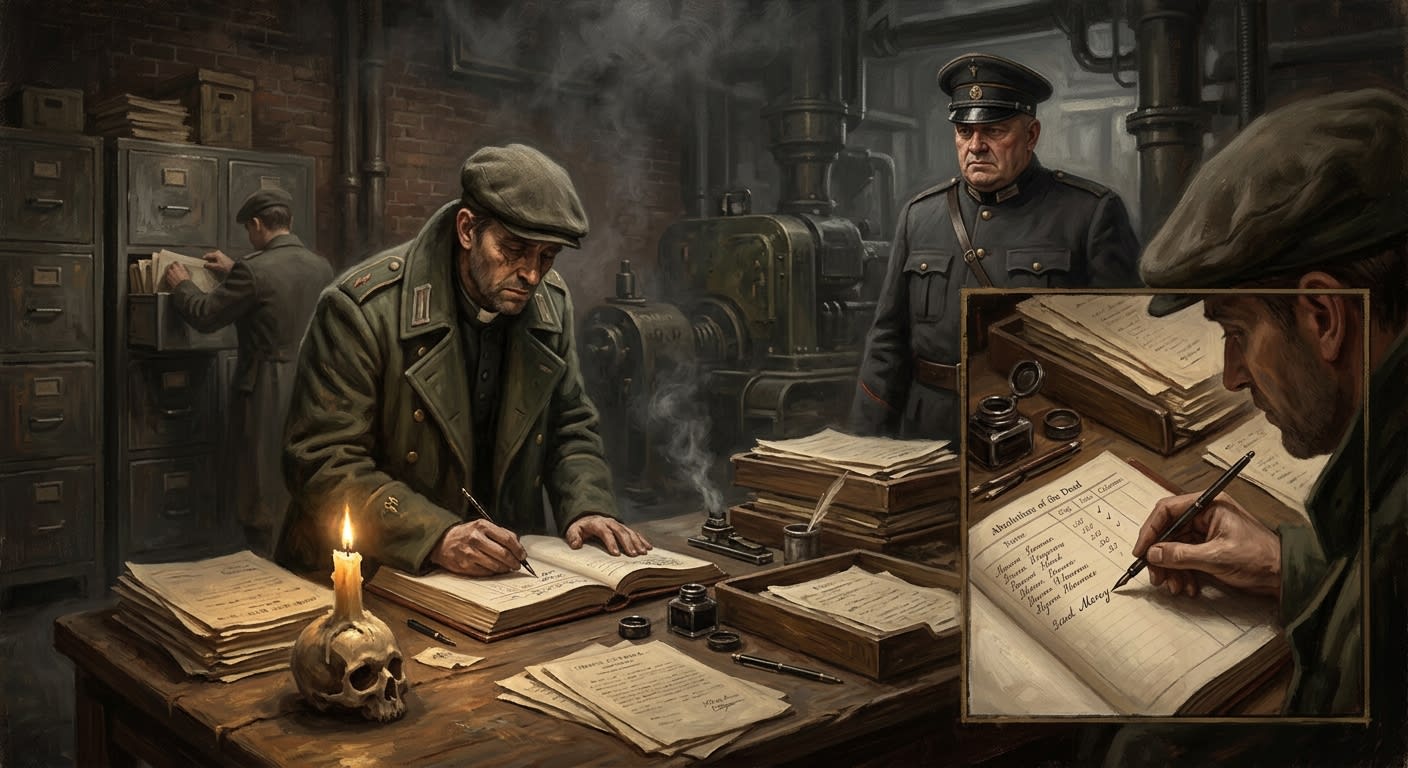
#On the Third Sub-Level
The Absolutions of the Dead occupy the third sub-level beneath the Basilica of the Ledgered Saints, below the Census of the Living and above material for which the Bureau has trained me to use silence as punctuation. The chamber is called a vault by architects, a chapel by Records, and a mistake by clerks who have worked there longer than one rotation. It smells of tallow, old vellum, damp stone, and the soft animal wrongness of breath where no lungs are employed.
The Synod teaches that death closes the earthly account. The Bureau of Records, being less sentimental than doctrine and better funded, keeps the account open for corrections. A dead soul may have confessed poorly, died between booth and stamp, perished under an alias, recanted in a hand no clerk trusted, or been entered twice by competing parishes. The Absolutions exist to tidy such cases. Tidiness, in the Basilica, is a sacrament with teeth.
#On the Rite Itself
An Absolution of the Dead begins with a name, if a name survives. The clerk reads the death entry aloud before a black-veiled confessor, a Records witness, and a candle set into a skull-shaped brass cup. The skull is symbolic, except the oldest cups, which are not. A strip of vellum bearing the disputed sin is folded into thirds, pierced with an ash pin, and placed beneath the ledger weight. The confessor pronounces conditional mercy: if the soul was contrite, if the record is true, if the file belongs to the dead named here. Three conditions. Three locks. One door nobody admits to opening.
The candle flame then gives the ruling. A steady flame means the entry may be absolved. A guttering flame means the confession was incomplete. A blue flame means another name is attached. No flame means the clerk has misread the dead, and every person present must remain silent until the bell above the nave rings. If the bell does not ring, the case is sealed and transferred downward. Downward is not a direction one enjoys in that building.
Popular accounts claim the Absolutions forgive any sin for sufficient fee.
False. Fees purchase petition, candle, vellum, witness time, search labour, and the privilege of being denied in better handwriting. Forgiveness remains, officially, beyond commerce. The offices surrounding forgiveness are taxable.
#On Those Who Petition
The living petition for the dead with motives as varied and dirty as human pockets. Widows seek burial peace for husbands whose final confession was lost on the road to Strasbourg. Regiments send names after battle, hoping a man blown into fragments may still be gathered in ink. Guilds absolve founders before anniversaries. Noble families purchase searches through three centuries to prove that an ancestor died reconciled rather than merely expensive.
Then there are the ugly petitions: a son asking whether his father’s treason can be softened before inheritance; a bishop correcting a predecessor whose recantation would embarrass a current sermon; a Bureau office laundering casualties by posthumous mercy so the living need not explain the deaths. Records accepts all petitions in the same tray. The tray is brass. Brass has no moral sense, which makes it suitable for administration.
The poor petition rarely. They cannot afford the candle. When they do arrive, they bring buttons, hair, ration cards, a shoe tag, the last scrap bearing a hand they recognize. The clerk takes these things with tongs. Sentiment stains worse than ink.
#On the Whispering Files
The Absolutions are quiet until they are not. Certain ledgers whisper when opened, especially those containing mass deaths, disputed identities, or names amended after political necessity has put on priestly clothes. The Bureau calls this parchment settling. Parchment settling does not say “mother” in four dialects. Parchment settling does not repeat a firing order in the voice of the officer who denied giving it.
The most dangerous files are warm. A warm death-file means some part of the record remains contested by whatever survives record-keeping. Clerks test heat with the back of the hand. Palm contact is forbidden after the A.S. 184 incident in which Assistant Mortuary Indexer Pell placed both hands on a famine roll and confessed, for nine straight hours, to eating men he had never met in a town he had never visited.
MORTUARY EVENT — THIRD SUB-LEVEL, A.S. 184 File: Ninth Bell Famine auxiliary roll. Indexer Pell’s statement: “I was hungry in their mouths.” Witness response: prayer, restraint, later transfer. Final file status: ████████████████████
Warm files are placed under stones cut from the old cathedral crypt. Hot files are chained shut and blessed by a confessor who has already written his resignation. Screaming files are referred to the fourth sub-level. There are no screaming files in public inventories. This is because public inventories are written for people who sleep.
#On the Present Abuse
By A.S. 201, the Absolutions have become too useful. Every war office wants the dead tidied. Every noble wants ancestry polished. Every bureau wants its errors buried with a candle and a conditional phrase. The Mortuary Ledger Office is twelve years behind, if one accepts its own arithmetic, and twenty-eight years behind if one counts sealed petitions, which Records does not, because counting them would make them real.
A Bureau of Records notice states that the backlog is “liturgically manageable.”
Corrected by anyone who has seen the carts. The backlog occupies two corridors, one stairwell, and part of a chapel formerly dedicated to Saint Odran of the Clean Index. Saint Odran has been moved to a cupboard.
The rite remains necessary. That is the misery of it. Without posthumous correction, the Ledger would rot from its own omissions. With it, the dead become clerical material, dragged back to the desk for one more stamp. Mercy enters the vault wearing black gloves. So does forgery. So does grief. They sit together and wait their turn.
The dead, having escaped taxation, conscription, hunger, weather, and the opinions of their superiors, still cannot escape Records. Their names descend. Their sins are folded. Their candles burn in skull cups under Strasbourg stone. If mercy comes, it comes with a receipt.