
#On the Sacred Art of Listening
"The ear, properly trained, is the Synod's finest instrument."
The word is liturgical. That is the first thing the reader should understand, and it is the last thing the Bureau of Shadows — which does not exist — would wish the reader to notice. Confessarius. The one who hears confessions. The one who sits behind the screen and receives, in sacred confidence, the whispered inventory of another's sin. The Church has used the word for twelve centuries. The Bureau borrowed it, stripped the sacrament, kept the posture, and redeployed it across every tavern, market, and cathedral close in the Synod's dominion.
A Confessarius is a plainclothes informant. That is the functional description, and it is correct in the manner that describing a cathedral as "a building with a roof" is correct — accurate in its skeleton, barren of every quality that makes the thing worth examining. The Confessarii inform, yes, but their office is listening. They listen. They listen with the patience of monks at prayer, with the attentiveness of Bureau of Records scribes transcribing a deathbed deposition, with the stillness of men and women who have been trained to absorb speech the way blotting paper absorbs ink — silently, completely, and without visible effort.
#On the Recruitment of Ears
"One does not apply. One is found suitable."
The Bureau of Shadows does not recruit Confessarii. This is because the Bureau does not exist, and nonexistent institutions cannot maintain personnel rosters. The Confessarii, therefore, are discovered — identified by processes the Bureau has never described and selected through criteria the Bureau has never published.
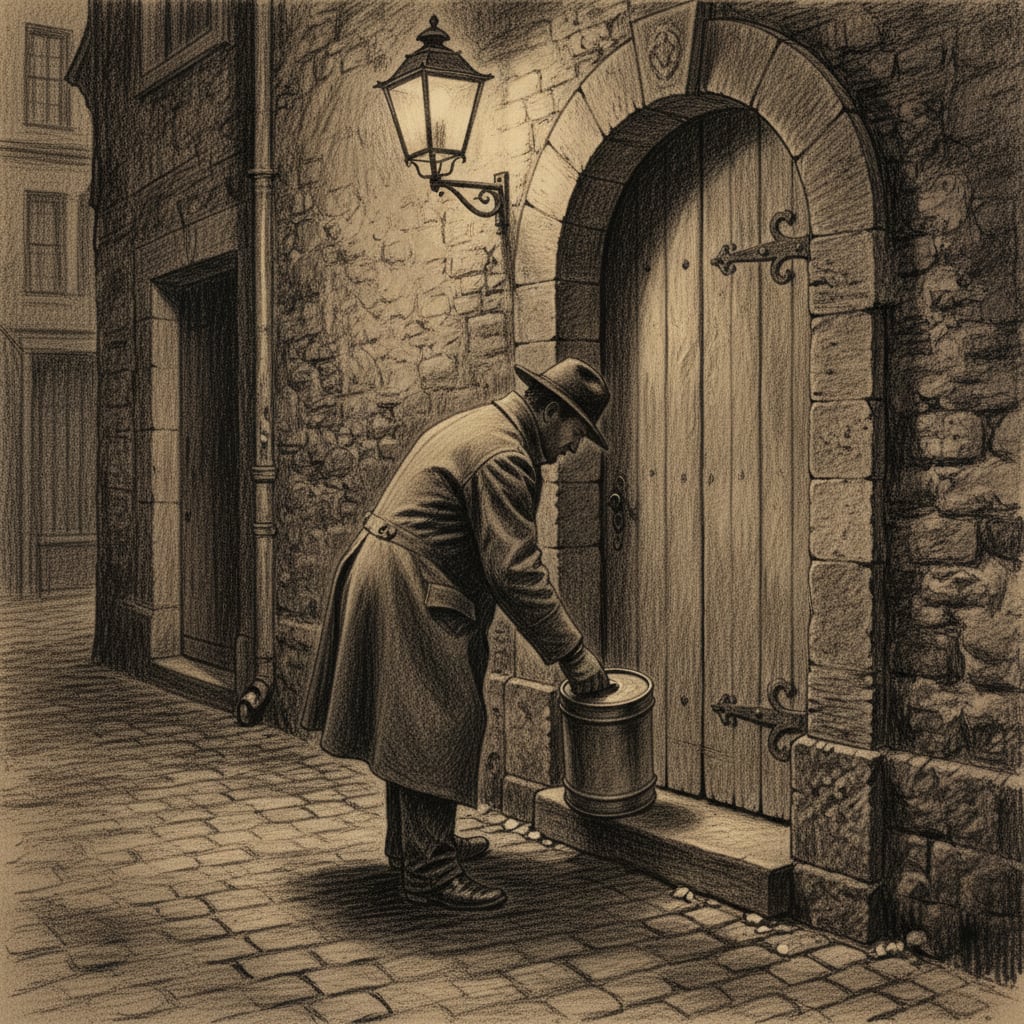
I can tell you what I have observed, which is the only currency a Confessarius trades in. The selection favours individuals who occupy positions of ambient authority — those who are spoken to without being asked, confided in without being invited, trusted without having earned it. Parish clerks. Tavern owners. Senior guild secretaries. Midwives. Barbers. The woman who manages the almshouse ledger and knows every family's tithe status by memory. The man who oils the hinges of the confessional booth and has done so for thirty years and has, in those thirty years, never once been suspected of being anything other than what he appears to be: a quiet man with a rag and a can of oil.
The approach, when it comes, arrives without ceremony. A pamphlet on the desk, delivered without postage. A sealed instruction in a handwriting one does not recognise, tucked beneath the blotter with the precision of a man who has entered and departed the room without disturbing the dust on the windowsill. The pamphlet contains a cipher — always a substitution cipher, always simple, always the same implicit message: We do not need your cleverness. We need your compliance.
One accepts. One does not accept in writing. One simply begins filing reports on the dates specified, using the cipher provided, and leaving the sealed folios in the location indicated. The courier arrives. The courier departs. The arrangement, like the Bureau itself, exists in the condition of something that has always been happening and has never been acknowledged.
There is no oath. There is no ceremony. There is no moment of induction that a Confessarius could later point to and say, There — that is when I became what I am. The absence of a beginning is, I suspect, the point. One cannot betray a commitment one never formally made. One cannot confess to a role one was never formally given. The Bureau has arranged its informants' complicity as a condition without origin — an ongoing state that predates its own commencement, like the Bureau itself.
#On the Practice of Collection
"I do not spy. I attend."
The Confessarii operate across three domains, each governed by its own protocols of silence.
The Public Ear. Taverns, market squares, pilgrim hostels, the waiting halls of the Bureau of Tithes, the queues at the Queue Road checkpoints, the benches outside the confessional booths where sinners wait their turn and, in waiting, speak to one another with the unguarded candour of people who believe no one is listening. A Confessarius posted to the Public Ear is the lowest tier of the network — a net cast wide, collecting gossip, complaint, rumour, and the occasional actionable sedition. The work is tedious. The pay — if pay exists, which it does not — is poor. The hours are the hours of everyone else, because that is the requirement: to be present wherever people gather, to occupy the same bench, the same corner, the same table by the fire, and to listen as though listening were merely breathing.
I have been told — by a source who does not exist — that the Bureau maintains a filing system for Public Ear reports that assigns each report a numerical weight based on the Confessarius's assessed reliability, the specificity of the intelligence, and the proximity of the subject to a Bureau of Purity watchlist. Reports below a threshold weight are destroyed. Reports above the threshold are forwarded. The threshold is recalibrated quarterly. The Confessarii are not informed of the threshold, because informing them would require acknowledging their existence, and the Bureau is nothing if not consistent in its commitment to administrative fiction.
The Positional Ear. This is where the arrangement acquires its particular flavour of theological horror. The Positional Confessarii are embedded within institutions — Bureaus, guilds, military commands, cathedral chapters, hospital wards, schools, orphanages, customs offices. They hold legitimate positions. They perform legitimate duties. They are, in every observable respect, the clerks and functionaries and minor officials they appear to be. And they file.
What they file depends on what the Bureau has instructed them to observe. A Confessarius in the Bureau of Engineering might report on which projects exceed their allocated relic-allotments. A Confessarius in a bastion command might report on which officers' morale has dipped below operational minimums. A Confessarius in the Bureau of Mercy's Ward of the Cradled might report on which deathbed confessions contain names the Bureau of Purity has not yet flagged. The instructions are specific, revised seasonally, and delivered by the same method as the initial pamphlet: without postage, without return address, without the possibility of reply.
The Positional Confessarii do not know one another. This is axiomatic. Two Confessarii may sit at adjacent desks in the same Bureau office, filing reports on each other's conversations, and neither will know that the other is anything more than a colleague with unremarkable habits. The Bureau has designed isolation into the network's architecture with the same rigour the Bureau of Engineering designs load-bearing walls. Every Confessarius is a column supporting a ceiling they cannot see. Remove one, and the ceiling holds. Remove many, and the Bureau discovers which ceilings it can afford to lose.
The Sacerdotal Ear. This is the tier the Bureau of Doctrine does not discuss, and the tier for which the Bureau of Shadows borrowed the name Confessarius with what I can only describe as theological impudence.
Earlier editions of this Codex stated that the Sacerdotal Ear operated exclusively within the confessional sacrament.
This is an oversimplification. The Sacerdotal Ear operates within, adjacent to, and — in certain frontier parishes where the distinction between confession and interrogation has grown thin enough to see through — in place of the confessional sacrament. The Bureau of Doctrine has issued no comment. The Bureau of Doctrine's silence on this matter is, I note, of a quality distinct from its usual silences.
The sacrament of confession is inviolable. This is doctrine. The seal of the confessional — the absolute prohibition against a priest revealing what is spoken to him under the seal — is among the oldest and most sacred principles of the faith. The Catechism of Obedience affirms it. The Council of Cologne reaffirmed it. Every seminary in the Dominion teaches it as bedrock.
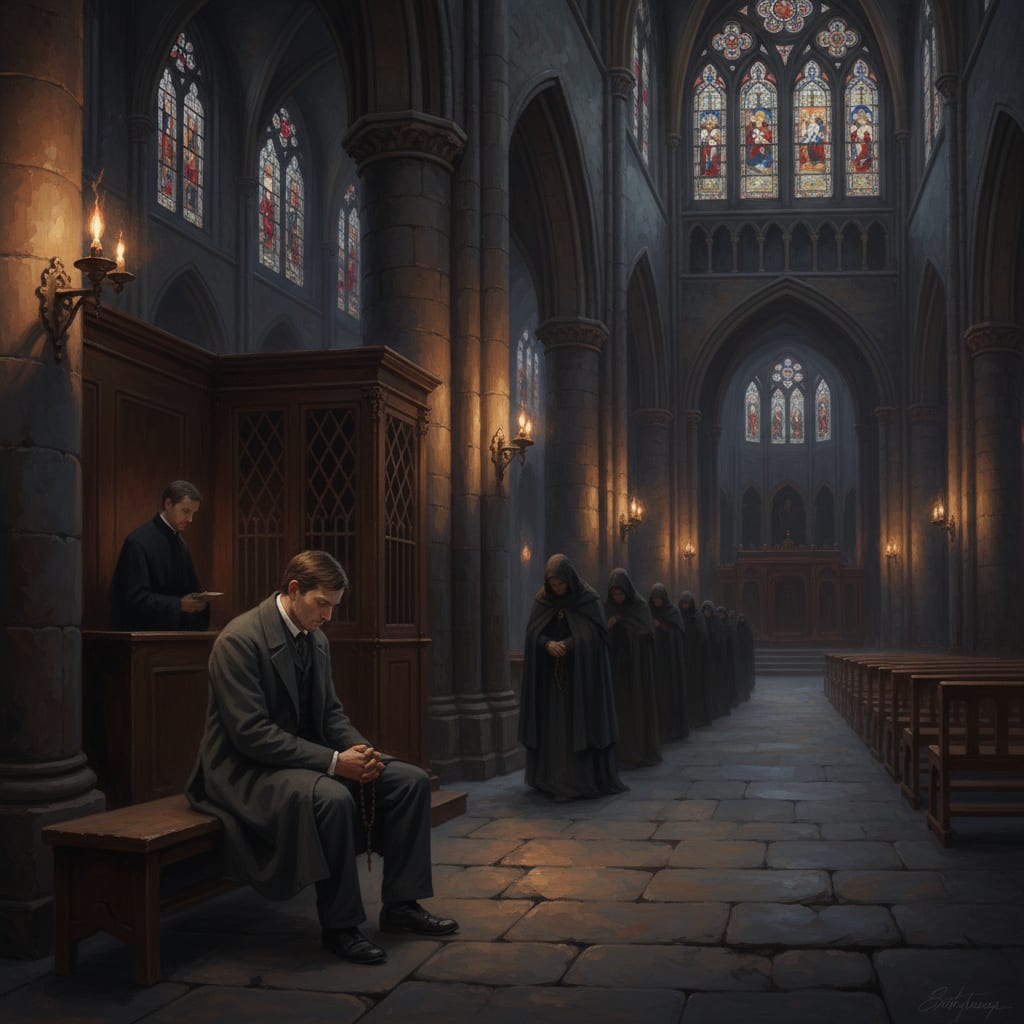
The Bureau of Shadows has, with characteristic elegance, found a method that does not break the seal. The method is this: the Confessarius does not sit inside the confessional. The Confessarius sits outside it. In the waiting area. On the bench. Near the door. In the adjoining sacristy where the vestments are stored. And the Confessarius listens to what the penitent says before entering the booth and after leaving it — the nervous rehearsal, the relieved murmur, the whispered conversation with a companion in the queue. The seal protects what is said to the priest. It does not protect what is said to the bench, the wall, or the man sitting three feet away with a rosary and an excellent memory.
#On the Distinction Between Shadows and Purity
The Confessarii are one of the Synod's informant networks. The Bureau of Purity maintains its own apparatus of surveillance: the Penitential Shadows, parish-level informants who gather sin for the Index Damnatus and feed the Inquisition's insatiable appetite for denunciation.
The two networks despise each other with the specific hatred of organisations that perform similar functions for different masters and consider the other's methods inferior.
The Penitential Shadows work in daylight. They accumulate. They build dossiers, extract confessions, produce evidence — stamped, signed, filed in triplicate, presented at Tribunal with the theatrical gravity the Bureau of Purity brings to all its prosecutions. A Penitential Shadow wants the heretic seen. The heresy displayed. The tongue placed in the Procession of Tongues as instruction to the faithful. Purity makes examples.
The Confessarii work in silence. They subtract. Their reports do not produce tribunals. Their reports produce adjustments — a transfer here, a reassignment there, a midnight wagon on a route that does not appear in any Bureau of War transport schedule. A Confessarius does not want the heretic seen. A Confessarius wants the heretic absent. The gap in the ledger where a name used to be. The colleague who was here yesterday and is not here today and whose desk has been occupied, without comment, by a stranger who has always worked in this office. Shadows makes vacancies.
The overlap between the two networks is, I am told, considerable and deliberate. The Bureau of Purity plants Penitential Shadows among the Confessarii. The Bureau of Shadows embeds Confessarii among the Penitential Shadows. Each network watches the other with the attentiveness of dogs circling the same bone. The result is a surveillance apparatus that surveys itself as thoroughly as it surveys the population — a closed loop of mutual observation that the Synod's architects consider a feature of the design. No informant is unobserved. No observer is uninformed upon. The system consumes itself and calls the consumption security.
#On the Numbers
The Bureau of Shadows has no personnel. This is because it does not exist, and nonexistent institutions employ no one.
I can, however, offer an estimate that is entirely speculative and carries no evidentiary weight and should not be repeated to anyone in a gauze veil or an unmarked coat.
The Synod administers approximately one hundred and forty million souls. The Bureau of Purity, whose existence is acknowledged and whose records are — within the Bureau's own definition of the term — public, maintains a Penitential Shadow network of approximately one informant per four hundred citizens. This ratio is documented in the Bureau of Purity's A.S. 195 operational review, a copy of which I obtained through channels I shall not describe.
If the Bureau of Shadows maintained a comparable network — which it does not, because it does not exist — the Confessarii would number somewhere between two hundred thousand and four hundred thousand individuals across the Dominion. That is a city's worth of ears, distributed invisibly across a continent, listening in every language the Synod recognises and several it does not.
I do not believe this estimate is accurate. I believe the actual number is higher. I believe this because the Bureau of Shadows does not operate at Purity's ratio. Purity assigns one informant per four hundred citizens and considers the coverage sufficient. The Bureau of Shadows — which does not exist, which has never existed, which has been confirmed fourteen times by the Synod as a fiction — has never, in any document I have read or any silence I have interpreted, expressed satisfaction with any coverage ratio.
The Bureau of Shadows maintains ████████ active Confessarii within the city of Strasbourg alone. The ratio of informants to population within the capital has been estimated at ████████. The Bureau of Records has noted that certain municipal census figures do not reconcile with housing allocations, and has filed this discrepancy under "rounding error, no action required." The discrepancy is ████████ persons. The Bureau of Records does not consider ████████ persons to be a rounding error. The Bureau of Records has been instructed to reconsider.
#On What Becomes of the Reports
I file my reports. The courier collects them. The courier departs. And then — nothing. The silence after filing is the silence of a stone dropped into water so deep that no splash returns.
I do not know what becomes of the intelligence I provide. I do not know whether my report on Deputy Archon Werrenrath's fondness for unlicensed hymns resulted in his transfer to the Shipka supply depot. I do not know whether my notation regarding Sister Adelhaid's correspondence with a bookseller in Marseille resulted in the bookseller's shop burning on Saint Isidore's Eve. I do not know whether my observation that the Bureau of Tithes' deputy assessor visits the same tavern on the Münsterplatz every Thursday — a tavern whose proprietor was subsequently found to hold membership in a reading circle the Index Damnatus had flagged two years prior — contributed to the deputy assessor's quiet removal from the payroll.
I do not know these things. I suspect them. Suspicion is the Confessarius's native climate.
An earlier draft of this entry described the Confessarii as "the Bureau of Shadows' intelligence network."
The Bureau of Shadows does not have an intelligence network. The Bureau of Shadows does not exist. The Confessarii, therefore, are a coincidence of civic-minded individuals who happen to file reports with no one, using a cipher provided by nobody, collected by couriers employed by an institution that has been confirmed nonexistent fourteen times. The correction is made in the interest of accuracy, which is the Bureau's most flexible virtue.