
#On the Last Office
The Rite of Passing is the Synod's lawful arrangement with death: breath witnessed, Creed supplied, confession harvested where the mouth permits, body displayed, neighbours summoned, bell struck, name entered, remains routed, and the soul released from temporal custody under a quantity of paperwork that would make a Rationalist pray for extinction.
The catechism says the Rite comforts the dying. This is true, provided one understands comfort as a hand on the brow, a clerk at the elbow, a priest near the right ear, a witness ribbon tied before the family has finished weeping, and a small black line in the Book of Departures without which grief becomes litigation. The Bureau is merciful. It allows no citizen the vulgar loneliness of an undocumented end.
The Rite predates the mature Holy Bureaus as habit and belongs to them as machine. Village priests once whispered the Creed into dying ears because piety required it. Families once displayed the body because custom expected it. Neighbours once came to bear witness because the dead have always needed the living to say: this one existed, this one is gone, this one may be prayed for without starting a property quarrel. Strasbourg did not invent those instincts. Strasbourg improved them by adding custody.
#On the Right Ear and the Open Ledger
The dying person is placed, where architecture and injury permit, with the head slightly raised and the right ear exposed. Bureau Circular 88-D names the right ear as the proper channel for the Creed and the left as doctrinally vulnerable. I have read the circular. I have read the commentary. I have read the commentary on the commentary. None improves the proposition. The right ear remains law.
Kin may stand near the bed. Clerks stand nearer. A priest or licensed rite-speaker whispers the Creed until the breath catches against it. If the patient can answer, the answer is recorded. If the patient cannot answer, compliance may be inferred from prior parish standing, visible effort, witness testimony, or, in one Marrowgate annex, a thumb twitch later litigated for eleven months because an inheritance depended on whether the twitch meant amen or soup.
The Rite is frequently mistaken for last rites alone. This pleases Rites and irritates Records, which is why I repeat the correction with a certain charitable relish. The sacramental act is only one portion. The Rite of Passing is larger: a transfer of custody from household to ward, from ward to ledger, from ledger to ash, from ash to place, from place to permitted memory. It tells the dying how to leave. It tells the living when to stop arguing with the bed.
The Deathbed Confession Harvester enters when speech remains and the death occurs in a licensed ward, hospice, infirmary, bastion casualty room, or any place sufficiently bureaucratised to possess a stool. The Harvester turns the minuteglass, takes names first, authenticates with witness and bell-time, and divides the last words into three appetites: clean copy for consolation, internal copy for Records, sealed addendum for Purity. A dying man may believe he is making peace. The Bureau knows he is making evidence.
Older parish primers described the Rite as “the family's sacred farewell.”
Corrected. The family is admitted to the farewell under clearance. The farewell belongs to the Church, the Ledger, the attending witnesses, the body-route office, and the family in that order. Sentiment is permitted where it does not obstruct custody.
#On the Body Display
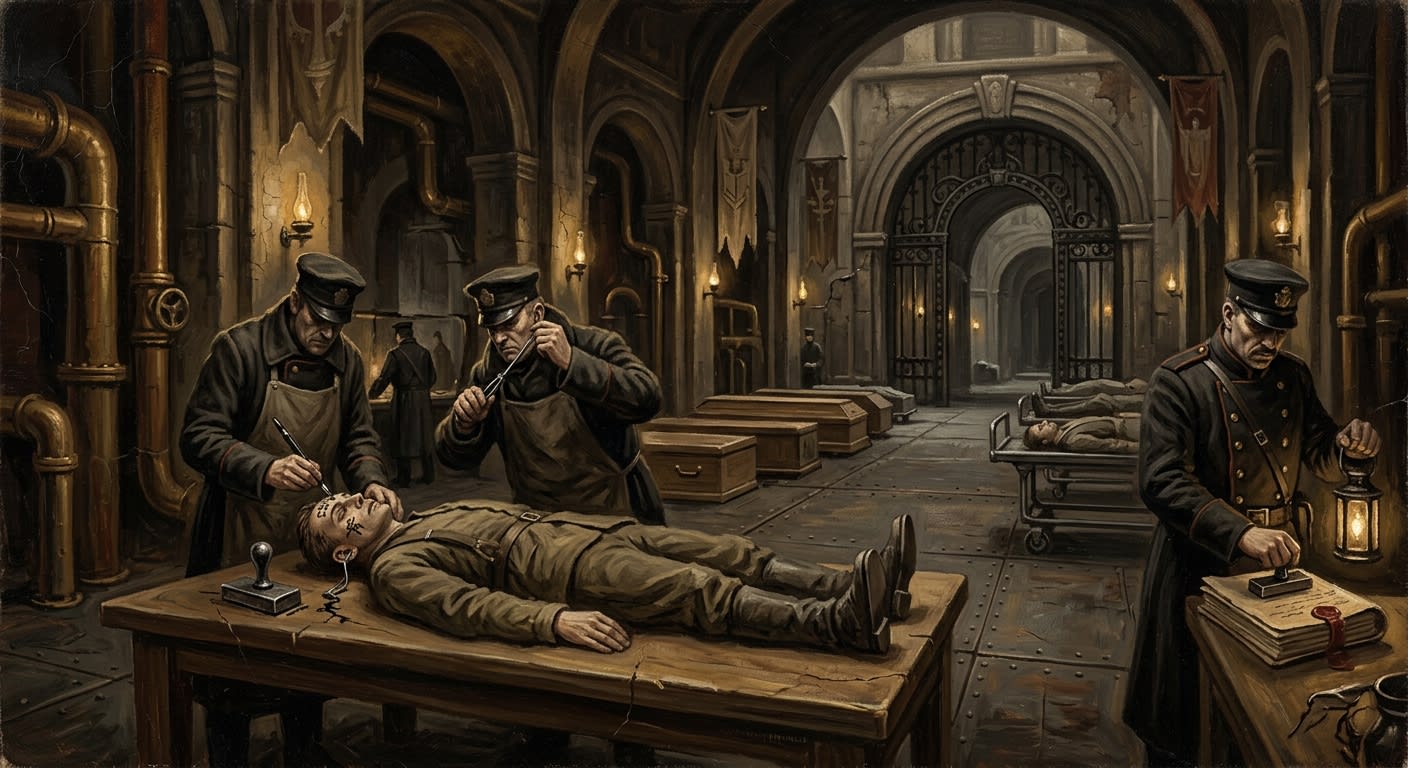
After cessation, the body is not hurried into earth or fire like a shameful object. It is displayed. The display is brief in plague wards, longer in villages, ceremonial in noble houses, improvised on the Line, and exquisite in the Hospices of Departure where the linen is so clean it becomes accusatory. Neighbours bear witness that the dead did not vanish, that the Creed touched the ear, that no one smuggled the body past debt, accusation, heresy, contagion, inheritance, or marital inconvenience.
The face is washed. The mouth is closed unless testimony requires an exception. The hands are arranged according to status: folded for ordinary faithful, open for clergy, bound for condemned persons granted partial Passing, covered for contamination, absent and noted where artillery has simplified the anatomy. The witness clerk reads the name aloud. A bell answers. The household hears itself become past tense.
The display serves Heaven, public order, and the neighbours' appetite for certainty. It prevents substitution, concealment, premature burial, fraudulent survival, duplicated widowhood, and the popular little fraud by which a family keeps collecting ration for a man whose bones have already begun contributing to architecture. The Bureau is not suspicious by temperament. It has merely met people.
RITE OBSERVATION MEMORANDUM — BASTION-BREST, A.S. 199 Body displayed under shell lull. Witnesses: six. At second bell, deceased opened left eye and recited a confession already sealed in Booth 214. Harvester noted variance. Priest attempted Creed correction. Family removed. Disposition: ███████████████████. Body entered as passed; addendum retained under acoustic seal.
#On Ash, Bone, and Entry
The Rite does not end when breath ceases. Breath is only the loudest witness. The body must be routed: burial, ash, ossuary, transport, salvage, contaminated hold, sealed classification, or, for the very unlucky, administrative uncertainty. The Book receives the name in black ink. The Great Ledger closes the living account. Tithes adjusts claims with indecent speed. Records assigns death its address.
For ordinary faithful, Ashbinders carry the remains to flame. Ash may go to sanctuary mortar, family reliquary, field blessing, bastion wall, or the cheap communal sack whose purchasers are assured that collective sanctity is spiritually equivalent to private grief. In ossuary districts, skulls are stamped, bones sorted, grid references assigned. The dead prefer order. This is not doctrine's favourite sentence, but it is the sentence borne out by every competent report the Bureau has tried to mislay.
The Dead settle more reliably when the Rite is performed with conviction and accuracy. Bone-stamps reduce disturbances. Bell-schedules quiet rooms that should otherwise remain noisy. Names read aloud calm the year's accumulation during the Festival of Departed Flames. The Bureau calls this divine benevolence. I call it divine benevolence also, because I am not a fool, and because a definition that keeps the dead from crowding one's bedroom need not be insulted before breakfast.
A Records training slate once claimed: “Entry alone completes Passing.”
Amended. Entry completes legal death. Passing requires witness, speech or certified incapacity, rite, body disposition, and acknowledged name. A line without a body-route is ink pretending to be mercy.
#On the Lull and the Clamp
The Rite grew teeth after the Lull of Names. A.S. 78 taught the southern trench wards that the dying, left uncaught, carry useful matter out of reach. Fourteen heresy cells survived because the dead had not named them on paper. Estates failed. Debt chains broke. Stores vanished into mouths already shut. Records wrote the famous line in A.S. 79: more intelligence lost to silence than to enemy action.
A.S. 80 produced Standing Order 22-C, the clamp that closed around the deathbed. No soul departing a licensed ward without terminal confession. No terminal confession without witness, bell-time, and seal. No sealed addendum delayed for family consolation. Unfiled death became dereliction under the Rite of Passing, a phrase so cold one may chill wine against it.
The Confession Reform of A.S. 104 later gave Harvesters their six-step practice: access, stabilisation, framing, extraction, authentication, packaging. The Hospices of Departure refined the final chamber. The Ledger Laws made death measurable by body, measure, bell-hour, accountable hand, ration class, confession packet, death tag, and witness sign. Every reform claimed to protect the soul. Every reform also protected property, evidence, staffing, ward capacity, and the Bureau's right to know what the dying had tried to take with them.
#On Failures of Passing
A failed Passing is grief with jurisdiction. Sadness is abundant and administratively weak. A failed Passing is dangerous. The unpassed dead persist in the wrong places: in household arguments, inheritance rolls, cold rooms, muttering walls, confession echoes, ration disputes, and the little pressure behind the eye that makes a clerk check a name twice at midnight.
Causes vary. Battle fragments the body before witness can gather it. Plague takes the mouth before the Harvester arrives. Families hide the dying to avoid confession, debt, seizure, or the old shame that comes when a grandmother names the second husband in front of the first husband's sons. Purity may deny full rite to the condemned. Records may omit a line, mishear a name, or file a living person dead with the calm of a saint stepping on a beetle. Each failure leaves residue.
Erasure is the black cousin of failed Passing. A person struck from the Ledger cannot be buried cleanly because the Rite has no line on which to rest. The body rots; bodies are vulgar democrats and rot under any government. The soul, the social fact, the name by which neighbours are permitted to pray: these remain unresolved. That is why erasure terrifies more efficiently than execution. The scaffold kills once. The missing line continues.
#On the Present Practice
As of A.S. 201, the Rite is universal in law and uneven in practice, which is to say human beings remain involved. Strasbourg performs it with cathedral precision and vicious queue discipline. Marseille performs it with salt air in the ledger rooms and Pilgrimage clerks objecting to delays. Marrowgate performs it as triage with candles. Brest performs it under acoustic suspicion. Przemyśl performs it in tunnels where dust falls into the ink. Shipka performs it with windows sealed because fog has been known to whisper postponements.
The front has strained the Rite almost past its ordained posture. Casualty volume rises. Harvesters are too few. Bone-stamp clerks work in shifts that make their convictions thin. Hospices fill. The Dead are restless. Rites requests more bells. Records requests more clerks. Mercy requests more linen. Purity requests access to everyone, preferably before death but will accept after. Doctrine, with its customary brilliance, requests better phrasing.
The Rite holds because it must. The faithful fear unrecorded death with a purity they rarely grant doctrine. A poor household may curse Tithes, dodge Purity, cheat Pilgrimage, water soup, hide sons, misname pigs as nephews, and still scrape coin for a proper Passing. They know what the Bureau knows and pretends to have taught them: a name spoken at the end may rest. A name lost at the end may come looking.
At the bedside, the stool waits. The priest bends to the right ear. The Harvester watches the mouth. The family learns the chalk line. The bell holds its breath in bronze. The Book opens to black ink.