
#On the Convenient Golden Age
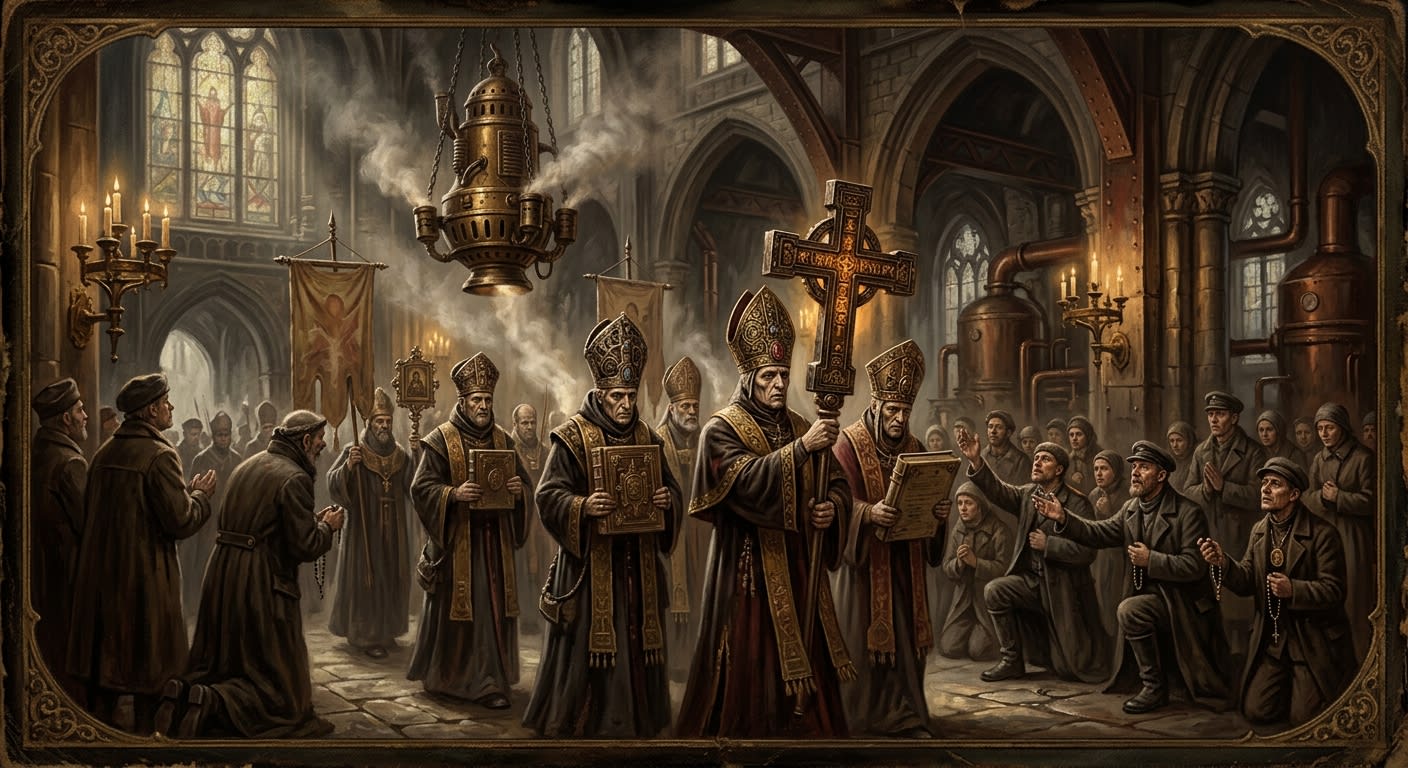
The Age of Faith is the name given by catechists, schoolmasters, relic-keepers, sermon grinders, and other licensed gardeners of public memory to the centuries before A.S. 0, when Europe is said to have lived in obedient conversation with the Creator. It is a beautiful phrase, as most dangerous phrases are. It gilds famine, war, noble stupidity, parish theft, cathedral rivalry, bad roads, worse surgeons, and the ordinary spiritual filth of mankind beneath a single warm varnish: Faith. One almost admires the economy. The Bureau of Doctrine did not invent nostalgia. It merely taught nostalgia to file reports.
The official catechism speaks plainly enough. Before the Age of Reason, the Creator spoke through saints, visions, relics, bells, holy wells, healed bones, battlefield apparitions, and the small domestic mercies by which a mother survives winter without calling survival luck. Humanity listened. Humanity obeyed. Humanity bent the knee before altar, bishop, parish bell, and the blessed terror of being observed by Heaven. Then the Rationalists stopped listening. The line went dead. The world entered the wound from which the Synod now numbers its years.
This is the useful shape. It is not the whole truth, which is rude, uneven, and badly copied.
#On Divine Conversation
The phrase “divine conversation” appears in Fourth Congress teaching on the Creator’s Silence, and like many Congress phrases it sounds gentle until one notices the cudgel inside it. The Age of Faith, per Doctrine, was an age in which the Creator whispered and men possessed ears worthy of the whisper. A saint dreamed of a river crossing and found the ford at dawn. A relic warmed in its box before plague entered the town. A bell cracked when a murderer crossed the porch. A nun saw a word burned into chapel glass and three bishops, seven lawyers, and twenty-one donors arrived before sunset.
The Bureau teaches these stories because they answer the recruit’s question before he asks it: where is the Creator now? He spoke when we deserved speech. He withdrew when Europe licensed unbelief. He will return when Faith is perfect. Perfect Faith, that admirable locked cabinet, contains the key to itself and charges admission.
Old miracle records are treated as both treasure and hazard. The Bureau of Records loves them when they can be dated, indexed, cross-witnessed, and made to sit quietly. The Bureau of Relics loves them when they attach to an object with custody chain, clean seals, and bone that behaves under candle proof. Doctrine loves them when they support the present arrangement. The Bureau of Purity loves them least, because old saints frequently said things before Purity existed to correct them.
Elementary primers formerly described the Age of Faith as “an era of unanimous obedience beneath Heaven.”
Corrected for upper instruction. Unanimity is a hymn-word, not an archive finding. The authorised formula is “an era in which divine speech remained publicly intelligible through the structures of Faith.” That sentence is uglier, which is one mark of administrative truth.
#On Saints, Relics, and Bad Evidence
The Age of Faith produced saints the way damp produces mildew: abundantly, locally, and with many varieties best left unlicked. Every valley had its bleeding image, every town its rescuer, every trade its patron, every bridge its drowned child who afterward appeared with dry hair and inconvenient instructions. Some stories are false. Some are mixed. Some remain too well attested to dismiss without damaging useful doctrine. The Bureau practices the ancient art of classification, by which truth is placed in drawers until it learns manners.
Aldebrand’s relic is the great instructional example. Before the Rationalists assayed bones and mocked shrines, before Amsterdam’s lantern announced itself brighter than Heaven, the faithful already knew that holy matter could answer violence. Later, at Vienna, the relic would blaze with such authority that even men trained to sneer discovered ash had entered the debate. The Bureau now uses that later proof to dignify earlier memory. Chronology may object. Chronology has no department with a larger seal.
The Age also supplied counterfeiters, liars, ambitious abbots, village committees, widow cults, shrine taxes, and bones that multiplied in the dark like vermin with halos. This does not refute sanctity. It proves mankind was involved. A world full of miracles still contains men who will sell splinters of the True Door if carpentry and hunger permit. The Rationalist error was believing that fraud disproved grace. The Synodal correction is cleaner: fraud proves the need for offices.
#On Why the Age Ended
A.S. 0 is not the beginning of unbelief. It is the year unbelief acquired a founding manifest, an academy address, a print run, and the fatal confidence of men who mistake publication for consecration. Amsterdam’s De Vera Luce did what private doubt had never managed. It licensed irreverence. It made disbelief respectable, portable, curricular, and taxable. A tavern sneer became a lecture. A lecture became a society. A society became a guard with a seal on its warrant.
The Rationalists did not merely deny miracles. They changed the verbs around them. A shrine became an unverified site. A relic became an osseous claim. A saint became a communal projection. A procession became traffic. Prayer became noise. Once the words stopped kneeling, knees followed.
Doctrine calls this the first public wound. The Creator’s withdrawal is tied to it in the Second Congress settlement: the apparatus of belief had been smashed, the receiver broken by educated hands, the channel cut by those who announced silence as proof that no one had ever spoken. Whether Heaven withdrew from offense, judgment, mercy, or simple disgust remains a question for sealed rooms and unwary theologians. Publicly, the answer is sufficient: the Rationalists stopped listening. The silence followed.
A popular sermon cycle claims the Age of Faith ended in a single midnight when every candle in Europe went out.
Withdrawn. The candles went out unevenly, which is how institutions die: one chapel neglected, one bell silenced, one school corrected, one relic renamed, one child taught to laugh at the old woman with the key.
#On Its Use in Present Doctrine
The Age of Faith now functions as a sacred measuring rod against which all later ugliness is disciplined. Children learn that once the Creator spoke. Soldiers learn that their obedience may restore the hearing of the world. Auditors learn that private belief is inferior to visible practice. Relic clerks learn that old bones must be saved from both acid and enthusiasm. The faithful learn that loss can be made useful if given a date, an enemy, and a filing instruction.
The phrase appears in sermons before levies, in school primers, in Purity examinations, in Orison broadcasts, in Tithes remissions denied with pious regret, and in those painted chapel panels where medieval peasants look cleaner than any peasant has ever looked within smelling distance of a goat. It is invoked whenever the Synod needs to explain why obedience now may repair disobedience then. It is a memory, a weapon, a receipt.
DOCTRINE SCHOOL EXCERPT — INTERNAL TEACHER’S GUIDE If pupil asks whether people in the Age of Faith sinned, answer: yes, but within a world still oriented toward correction. If pupil asks whether the Creator spoke audibly, answer: through authorised channels. If pupil asks why authorised channels now require Bureau seals, answer: history. If pupil persists, record name for pastoral follow-up.
There lies the central convenience. The Age of Faith was old enough to be purified by distance and broken enough to explain present command. It gives the Synod a before, the Rationalists an offense, the Sundering a moral shape, and the Creator’s Silence a culprit safely dead or condemned. Without it, the present war would have to justify itself only by survival. Survival is persuasive, but it lacks incense.
#On Drax’s Necessary Correction
Do not imagine I prefer the Age of Faith. I prefer accurate ink, warm rooms, obedient bells, tolerable wine, and readers who do not require beating before they understand a paragraph. The Age of Faith would have given me bad roads, worse dentistry, local bishops with too much authority, and manuscript copies produced by men who believed punctuation an optional charity. I am no tavern romantic weeping into his cup over lost simplicity. Simplicity is usually poverty without a clerk.
Yet the Age possessed one virtue the present can only counterfeit with machinery: men expected Heaven to answer. This expectation made fools, martyrs, frauds, saints, and parishes with enough courage to face winter by singing at stone. The Rationalists called that expectation childish. Then Hell opened beneath their feet, and the child proved better armed than the lecturer.
The Synod inherits the Age of Faith the way a son inherits a ruined estate: loudly grateful, quietly embarrassed, eager to display the silver, determined to hide the accounts. We polish its saints, cite its miracles, confiscate its local excesses, correct its legends, and sell its memory back to the faithful in authorised portions. This is not hypocrisy. It is stewardship with better locks.