
#On the Congress That Taught Silence to Answer
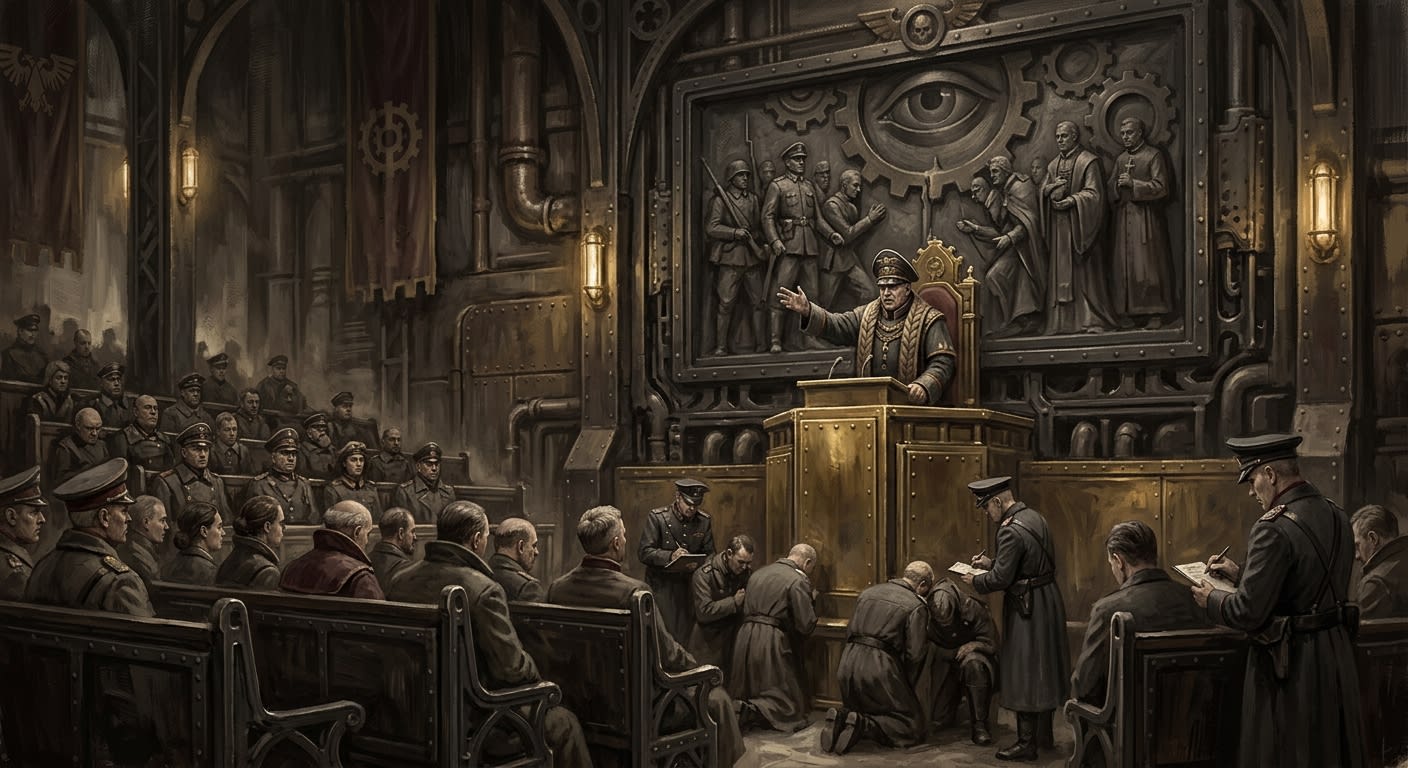
The Fourth Doctrinal Congress convened in Strasbourg in A.S. 104 and performed the act by which competent theology distinguishes itself from mere hope: it took an unanswered question, placed it beneath seven seals, and returned it to the faithful as proof of their own inadequacy.
The question was old by then. It had been asked in cellars beneath Cologne, in caves above Innsbruck, in Lyon's catacombs, in the ration queues after the Treaty of Regensburg, in the smoke after the Sundering, and in the barracks where young men learned to pray toward a heaven that had acquired the bad habit of behaving like an archive after hours.
Where is the Creator?
The Fourth Congress answered with the Doctrine of the Inaudible Voice: the Creator is not silent; He speaks in a register the mortal ear has not yet learned to hear. Failure to hear Him is not evidence of absence. Failure to hear Him is evidence of insufficient faith, improper audition, damaged obedience, Rationalist residue, spiritual wax in the ear, or one of the forty-three other impediments later listed by the Bureau of Doctrine for the comfort of teachers who require variety while blaming children.
The Congress did not invent divine silence. It licensed it.
#On the Year A.S. 104
A.S. 104 was fourteen years after the Concordat of Strasbourg and fifty-nine years after the Sundering. That distance matters. The first terror had cooled into administration. The men who had seen the Balkans crack were old, dead, promoted, or too useful to be believed. The Synod had passed from emergency into appetite. It possessed Bureaus, seals, routes, schools, feast schedules, tax tables, correction slips, and the first dangerous luxury of a government that has survived its own birth: time to tidy its justifications.
A.S. 104 was also crowded with useful discomforts. The Market Drift Years had exposed decline in public Creed recitation across the Rhineland. The Third Revision of the Catechism of Obedience hardened market speech, oath discipline, purity-token inspection, and the first mature habits of the Street-Vicar Corps. Confession Reform standardised sin categories and made private guilt more portable. Standing Order 14-M gave punitive construction a cleaner writ. The Iron Choir Brand-Singer settlement turned regulated agony into acoustic proof.
A government that can regulate confession, branding, ration speech, and wall-niches naturally turns next to the Creator. It is a matter of professional pride.
#On the Hall and Its Voices
The Congress met behind doors whose hinges had been oiled by Records and watched by men who left no signatures. Its formal delegates included Doctrine exegetes, Rites assessors, Relics authenticators, Purity observers, episcopal envoys from the Rhineland and Vienna, and three military attachés who were told where to sit and, more usefully, when to stop speaking. The Bureau of Bells sent an acoustic clerk to certify the room. The Bureau of Records sent six scribes and later admitted to four. The Bureau of Shadows sent nobody, which explains the seventh chair.
No full transcript survives in public custody. Summaries survive. Marginal digests survive. A torn speaking order survives with two names scratched through and one name written twice in different ink. The official reason is wartime document loss. The true reason is that early Synodal theology still permitted men to sound uncertain before a final stamp. Later generations find such candour unbecoming.
EXTRACT — FOURTH CONGRESS SPEAKING ORDER, DAY NINE Speaker after Vespers: █████████████ Recorded proposition: “If the Creator does not answer, the Synod must—” Continuation removed under Doctrinal Security Order 104-IV-9. Disposition of speaker: transferred to contemplative service; no monastery listed.
What can be reconstructed is the pressure. The Rationalist objection had not died with the Rationalist Republic. It had put on safer clothes. Soldiers asked it at night. Widows asked it over annuity stubs. Former Cellar Saints asked it in whispers because fifteen years underground teach a soul to respect silence, then resent it. The Synod had promised that the Creator would vindicate faith. The Creator had vindicated faith chiefly through relics, accidents, fires, bells, and the continued failure of Hell to eat everything west of the Sagittal Line at once.
This was enough for war. It was thin food for theology.
#On the Inaudible Voice
The Doctrine of the Inaudible Voice is often misquoted by provincial catechists as “God speaks too high for sinners.” This is vulgar, memorable, and close enough to be dangerous. The ratified text is colder:
A lesser council would have declared the Creator silent by choice. A cowardly council would have promised imminent speech. The Fourth Congress chose the sharper instrument. Speech continues. The defect belongs to mankind. Every unanswered prayer becomes testimony against the prayer. Every empty altar becomes a mirror. Every soldier dying without consolation proves the need for stricter consolation.
The doctrine also solved a political problem. The Synod ruled in the Creator's name while receiving no direct instructions from Him, a condition awkward for any bureaucracy that enjoys appearing delegated rather than self-authorising. The Inaudible Voice bridged the gap. Doctrine did not need to hear the Creator in order to speak for Him. Doctrine merely required training in the register where His speech was already occurring. The Bureau, by astonishing coincidence, possessed that training exclusively.
#On the Cellar Saints and the Necessary Dead
The Congress canonised the Cellar Saints collectively in the same season. This was no sentimental appendix. It was architecture. The Cellar Saints supplied the Congress with bodies that could be arranged into a foundation: frightened faithful who had preserved relics through the Rationalist occupation, descended into darkness, emerged after the Sundering, and given the infant Synod its first usable networks.
Augustinus's request survives: “They hid in basements so that God might have a floor to stand on when He returned.” The Congress found the line imprecise, moving, and too useful to discard. It ratified the Cellar Saints as Heroism, Collective Class, and gave them a feast day, a category, and the exquisite posthumous relief of being simplified.
Ignatius Brenner received individual elevation as Saint Ignatius the Carrier, though his miracle count remained inconveniently low. He had carried three apostolic phalanges under black rye in A.S. 31. The relics later blazed at Kalnik Ridge in A.S. 48. He did not see the blaze. The Congress debated this, because theologians can produce friction from a polished stone. It canonised him anyway, on the sensible grounds that a man may light a fuse without being present for the detonation.
Early hagiographic digests implied that the Fourth Congress canonised the Cellar Saints because their sanctity had long been obvious to all faithful persons.
Corrected. Their sanctity became obvious when the Synod required an underground ancestry, relic custody precedents, and a human answer to the charge that faith had survived by fear rather than courage. The dead were available. The dead objected poorly.
The Cellar Saints made the Doctrine of the Inaudible Voice emotionally bearable. If the Creator had spoken in a register too subtle for ordinary ears, then the cellars were not abandonment. They were instruction. Their long terror became an apprenticeship in holy listening. Their whispers became evidence that the faithful had been learning the proper register all along.
This was cruel. It was also beautiful. The Bureau has never found those qualities incompatible.
#On Miracles Ratified and Questions Buried
The Fourth Congress ratified more than silence. It ratified selected miracles whose timing had become politically useful: the Vienna vindications surrounding Saint Aldebrand, the Bells of Saint Rupert, the late correction of Rationalist mockery, and the awkward category of relic phenomena that continued to occur despite the Creator's refusal to appear in person and simplify everyone's paperwork.
Miracles presented the Congress with a nuisance. Too few, and the Synod looked abandoned. Too many, and the Synod looked unnecessary as interpreter. The Congress placed each miracle in custody. A miracle was not a wild answer from Heaven; it was an event whose meaning matured only when Doctrine stamped it. Fire without ratification is hazard. Fire with ratification is providence.
The Congress also buried questions. The Suppressed Position on the origin of the Adversary disappears from usable theology around this period. Heresies concerning the Creator sharpened in response: Absent God, Sleeping God, Complicit God, Unnecessary God. The Fourth Congress did not silence these heresies. It gave Purity better handles by which to drag them.
The Doctrine of the Inaudible Voice remains the master handle. A Silent Godless disputant says no voice speaks. Doctrine answers: you confess your own deafness. A grieving mother says no comfort came. Doctrine answers: grief obstructs reception. A soldier says the trench heard only flies. Doctrine answers: flies do not exhaust the acoustic range of grace.
The argument is indecently durable.
Its durability comes from placement. The doctrine sits before grief can form rebuttal, before reason can gather witnesses, before the citizen can notice that his petition has gone unanswered. It is taught as acoustics, punished as disobedience, and repeated until the sufferer supplies the accusation himself: I did not hear because I was unworthy. No jailer is stronger than the one a prisoner learns to address as conscience.
#On Its Afterlife
By A.S. 134, the Eighth Doctrinal Congress would discipline silence in another direction, making failure to denounce a form of participation. By A.S. 196, the Twelfth Amendment would invade the face and skull. These later triumphs stand downstream from A.S. 104. The Fourth Congress taught the Synod the central maneuver: absence can be made culpable in the subject who notices it.
That maneuver now governs catechism schools, confessional manuals, trench sermons, relic authentication, and the private ruins of every citizen who has ever prayed into nothing and been told that nothing was an answer beyond his station. The Congress did not end doubt. It converted doubt into a hearing defect. It did not make the Creator speak. It made the Bureau audible enough to occupy the silence.
Certain charitable lecturers describe the Fourth Doctrinal Congress as a reconciliation between divine mystery and human suffering.
Withdrawn. Reconciliation implies two parties met. One party did not attend. Strasbourg took minutes anyway.
As of A.S. 201, the Doctrine of the Inaudible Voice remains binding. It is recited to children before their first formal silence test. It is invoked over failed prayers, failed offensives, failed harvests, failed marriages, failed miracles, and those intimate failures where a citizen discovers that the Creator has not answered but the Bureau has already prepared a form.