
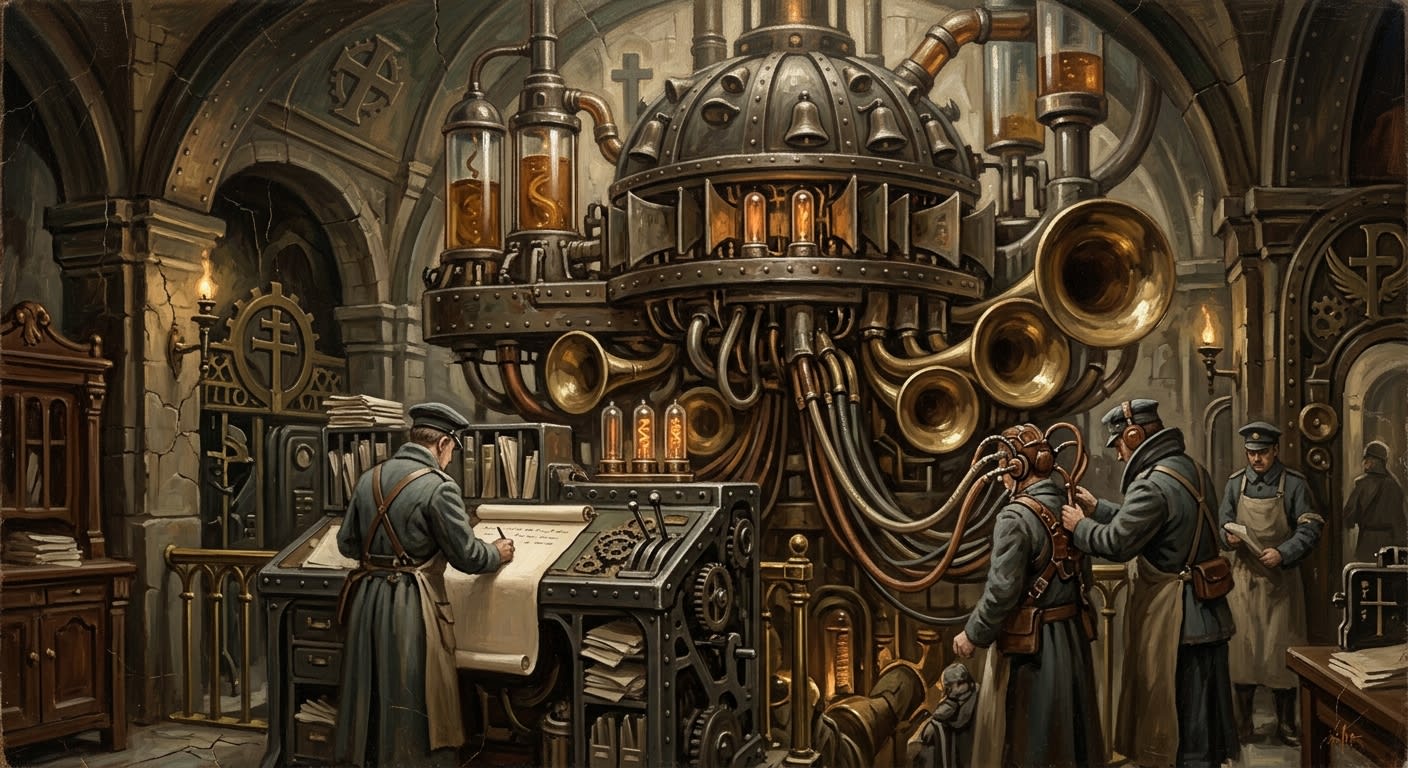
#On the Doctrine's Usefulness
The Doctrine of the Inaudible Voice was ratified at the Fourth Doctrinal Congress in A.S. 104, under the seal of the Bureau of Doctrine, for the preservation of faith, the discipline of doubt, and the strangulation of one question before it learned to walk upright.
Where is the Creator?
There. That is the question. It appears in trench scratches, schoolroom hesitation, widow prayers, condemned men's jokes, Rationalist pamphlets, and the eyes of soldiers posted at third watch on the Sagittal Line. It is the question every theology fears because it is short enough for a child and heavy enough for a continent. The Creator is. The Enemy acts. The bells ring. Men die. The altar remains quiet.
A lesser institution would have denied the quiet. We improved it.
The Doctrine declares that the Creator is not silent. He speaks in a register the mortal ear has not learned to hear. The failure lies in the hearer. The absence becomes a test. The unanswered prayer becomes instruction. The widow who hears nothing has been invited to refine her soul. The soldier who dies without reply has entered the curriculum ahead of his peers.
This is theology as engineering: remove the load-bearing accusation, replace it with a pillar, paint the pillar gold, charge admission.
#On the Fourth Doctrinal Congress
The Congress of A.S. 104 met in the wake of too many victories that had solved too little. The Cellar Saints were canonised collectively, Clemens Stahlhand was raised into public certainty, and the officials of Doctrine looked upon one another with the bleak intelligence of men who understood that martyrdom, relic-blaze, and battlefield survival had not answered the simplest charge laid by the dead.
The Rationalists had made that charge vulgar and useful. If the Creator exists, why does He not speak? If the Synod is His steward, where is the steward's commission? If Hell has generals, armies, teeth, furnaces, fogs, appetites, and maps, why does Heaven supply paperwork and silence?
The Congress could not permit the question to remain foreign property. A weapon left in the enemy's hand is negligence. A weapon stolen, blessed, and issued to one's own troops is doctrine.
Early Congress memoranda used the phrase “Divine Silence” as a working title.
Corrected before ratification. The Creator does not possess silence. Mortals possess insufficient hearing. The change saved three Archons, seven catechism boards, and one entire generation of schoolmasters from explaining why the Bureau had named the wound so accurately.
The final formula emerged from three committees: Sacred Cosmology, Catechetical Discipline, and Counter-Pamphlet Suppression. Sacred Cosmology supplied the metaphysical cloak. Catechetical Discipline supplied classroom teeth. Counter-Pamphlet Suppression supplied the excellent instinct that the phrase must be repeatable by tired parish priests with bad lungs and by frightened mothers with one candle left.
He speaks where obedience learns to hear.
That was the public line. It fit on broadsheets, lintels, confession cards, school slates, and the inner lid of soldiers' field prayer tins. The private formula was longer, colder, and more useful: all accusations of divine absence shall be received as evidence of mortal unworthiness unless otherwise classified by Doctrine.
#On the Ear as a Moral Organ
The Doctrine made hearing a moral act. Before A.S. 104, a man who heard nothing during prayer had heard nothing. After A.S. 104, he had disclosed himself.
This changed everything.
Parish catechists began teaching children that the soul has an ear. Confessors asked penitents whether silence felt empty, heavy, warm, bright, directional, or accusing. The Bureau of Purity added auditory doubt markers to interview rubrics. The Bureau of Orison and Song objected, naturally, on grounds that any doctrine involving sound belonged to Orison. Doctrine replied that inaudibility, being beyond sound, outranked Orison jurisdiction. The dispute remains active in the manner of a knife left under a cushion.
A soldier who complained of unanswered prayer could now be corrected without being immediately condemned. This was merciful by Bureau standards, which is to say it delayed the beating until classification. He was not faithless; he was untrained. He was not abandoned; he was acoustically immature. He was not accusing Heaven; he was reporting the present poverty of his own soul.
The ear became a confessional screen no one could close. Every pause in prayer acquired significance. Every claimed whisper required authentication. Every saint who heard a command risked being useful, dangerous, or mad, categories the Bureau distinguishes by outcome and sponsorship.
The Doctrine did not merely defend the Creator. It created a bureaucracy of reception.
#On Misuse, Which Is to Say Use Without Licence
Amateurs ruined it almost at once. They always do. Give the faithful a doctrine and they will pray with it; give students a doctrine and they will invert it; give heretics a doctrine and they will discover the part we hoped nobody noticed.
By A.S. 104, cellar academies around Cologne and Strasbourg had begun teaching the formula backward. If the Creator speaks beyond hearing, they argued, then sanctioned speech may be the obstacle. If obedience produces the ear, then official noise may be disobedience disguised as hymn. If the Bureau cannot hear Him, perhaps the Bureau is the wax in the ear.
This is the kind of argument that sounds clever until one imagines it entering a barracks.
The Strasbourg Iron Chapel incident that killed Saint Orla of the Steady Note grew from one such cellar academy. Three condemned prisoners had been teaching the Doctrine backward. During their branding rite, the chamber answered Orla's note before her throat completed it. Her final authenticated command — Do not answer it — has since been folded into the Doctrine as a protective caution: The Creator's register is not to be pursued by invitation, echo, experimental chant, architectural listening, mirror-recitation, or any practice involving unlicensed silence in groups larger than three.
PURGED APPENDIX — A.S. 104, STRASBOURG IRON CHAPEL Subject group: backward-formula instructors. Observed anomaly: anticipatory room-response. Question asked by condemned Subject Two: ██████████████████████ Answer recorded by wall before question ended: ██████████████████████ Disposition: chamber sealed; Orla canonisation packet accelerated; academy lineage erased.
Doctrine absorbed the danger by naming it. The Inaudible Voice belongs to the Creator. Replies belong to inspection. Echoes belong to Purity. Anticipations belong to Shadows. Any voice claiming to make itself audible without Bureau mediation is presumptively false, hostile, contaminated, or insufficiently taxed.
#On Miracles, Whispers, and Convenient Uncertainty
The Doctrine's greatest burden is miracle. Relics blaze. Bells ring without hands. Consecrated water scars demonic flesh. The Chain of Saint Anakletos burned white across the Bosphorus for seven hours during the Black Sea Armada engagement and then went dark. The Bureau teaches that the Creator speaks beyond hearing, then files reports whenever something answers through metal, bone, ash, or water.
A crude mind calls this contradiction. A trained mind calls it jurisdiction.
Miracles are not the Creator speaking in ordinary sound. They are effects within Creation produced by permission, residue, sanctity, sacrifice, or some fourth mechanism whose name has been sealed for the comfort of the simple. The Doctrine leaves room for action while forbidding demand. The Creator may act. The faithful may not require speech. The difference keeps prayer from becoming negotiation, and negotiation from becoming contract, and contract from becoming Velmora's territory in nicer ink.
Popular sermon sheets once claimed that perfect obedience would allow every faithful soul to hear the Creator plainly.
Withdrawn under Doctrinal Clarification 104-Voice/7. Plain hearing would create private revelation at industrial scale. Private revelation at industrial scale creates prophets. Prophets create paperwork, riots, schisms, and occasionally religions. One was sufficient.
Saints remain the authorised inconvenience. A saint may hear what others cannot, provided the saint is dead, obedient, useful, and subject to hagiographic review. Living claimants face harder arithmetic. The Bureau of Hagiography asks what was heard. Purity asks who benefited. Medicine asks whether sleep was present. Orison asks whether pitch can be written down. Shadows asks no question aloud.
#On the Present Application
As of A.S. 201, the Doctrine remains one of the Synod's most profitable sentences. It is recited at funerals when the family waits for comfort and receives structure. It is taught to cadets before Line deployment, lest the third watch convert silence into accusation. It is printed in the margins of school catechisms, sung without melody by Orison instructors, and stamped onto the doors of chapel cells where grief is permitted to make noise only during appointed hours.
Its enemies are predictable. Rationalist remnants call it circular. The British call it cruel with that island talent for noticing foreign cruelty while polishing domestic instruments. Some Mercy priests call it pastorally dangerous because it teaches the wounded to blame their own ears. Doctrine thanks Mercy for its concern and reminds Mercy that pity, left unindexed, becomes policy.
The Doctrine's defenders are more numerous because the Doctrine works. It converts silence into obligation. It converts doubt into training. It converts divine absence into a mirror angled back at the petitioner. Every unanswered prayer becomes evidence that the petitioner must continue praying under supervision. The machine is elegant. Naturally, I admire it.
There is a mercy hidden in it, though I dislike admitting accidental virtues. A soldier taught that silence is abandonment may break. A soldier taught that silence is a language he has not earned may stand one more night. The extra night matters. Bastions are built from such nights: one watch endured, one bell pulled, one terrified man choosing to remain because his fear has been given grammar.
Confessors have learned to use the Doctrine with a surgeon's cruelty. They do not promise comfort. Comfort is unstable, sentimental, and prone to becoming unauthorised song. They assign exercises: seven silent prayers before dawn; three breath-counts before naming the dead; one tithe token held against the tongue while listening for the register beneath ordinary sound. The token is disgusting. It also works, by which I mean it produces compliance, and compliance is the only miracle most institutions can afford.
Children learn the softer version. They are told that the Creator speaks as whales speak under ships, as bells speak through stone, as saints speak through relics long after flesh has become jurisdiction. The examples are charming, half-true, and pedagogically useful. Later, when the child becomes clerk, soldier, mother, widow, sinner, or food for the eastern mud, the charm is stripped away and the sentence remains.
That grammar is ours.