
#On the Courtroom as Theatre
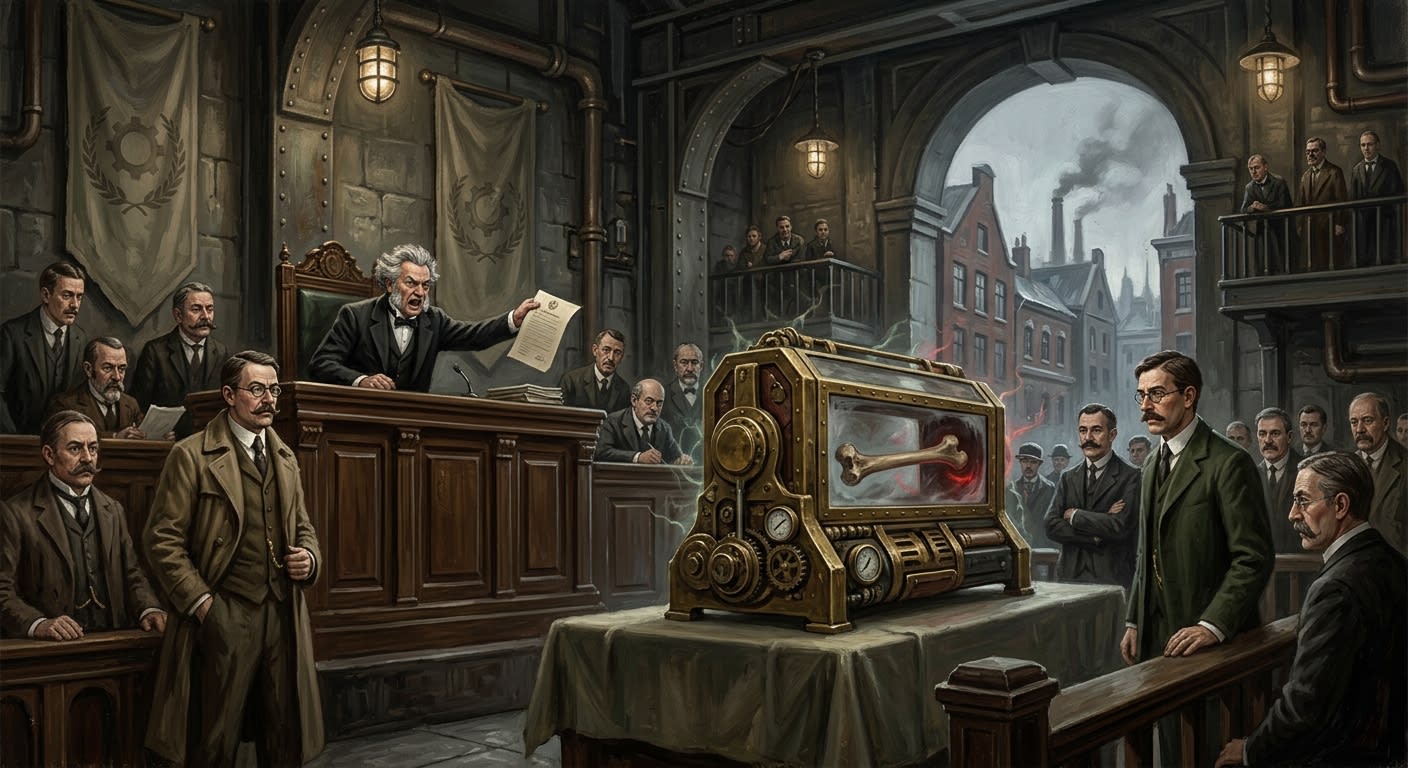
The Trial of Saint Aldebrand's Reliquary occurred in Amsterdam in A.S. 11, when the Rationalists had learned that a jeering hall can wound a shrine more efficiently than a regiment, provided the hall is furnished with scholars, stenographers, and two priests made miserable in public. It was called a trial because the Rationalists adored legal furniture. There was no jurisdiction, no canon, no lawful accuser, and no verdict worth the parchment that carried it. There was a lecturer, a femur, a crowd, and a carefully arranged humiliation.
The lecturer was Dr. Matthias Voll. His title was real enough. His wisdom was borrowed from accountancy and dressed in philosophy's second-best coat.
The Year of Letters had prepared the stage thirty-two years before the Bureau's calendar began. Van Hoorn, Lemstra, and de Waal made doubt portable by counting relics, tabulating femurs, and teaching Europe that laughter could be distributed by post. Voll inherited their method and lowered it into spectacle. The Year of Letters was a ledger. The Trial was a carnival booth with footnotes.
#On Dr. Matthias Voll
Voll delivered his lecture On the Statistical Distribution of Relics before a hall chosen for acoustics rather than justice. The title remains in the Forbidden Stacks, where it is shelved between a Dutch tract on bell-melting and a small pamphlet arguing that martyrdom reduces labour productivity. His central argument was clean, cruel, and arithmetically competent: if every reliquary claiming a femur of Saint Aldebrand were genuine, the saint would require the skeleton of a centipede.
Then he pointed at a single femur.
The crowd laughed. The priests in the front row did not. They were bound, gagged before the performance, ungagged for the confession, and gagged again when their usefulness expired. This is Rationalist mercy: the mouth is opened only long enough to betray itself.
Voll's genius, if one must pay the man that tax, lay in selecting the question no parish priest could answer without looking absurd. How many femurs can a saint possess? The faithful had lived comfortably for centuries among duplicate relics, overlapping authentications, disputed custodial chains, and bones whose holiness was evident to the knees before it was evident to the anatomist. Voll forced the matter into a number. Numbers are vulgar little idols. They sit on the table and refuse incense.
#On the Confession
The priests were required to sign a statement admitting that the displayed femur was “pig fragment, common, undressed, of no liturgical significance.” The phrase has survived in forty-three transcripts, fourteen broadsides, two tavern songs, and one Bureau of Purity training manual on coerced attestation. It is an ugly phrase because it was designed to be repeated by ugly mouths.
Older devotional handbills state that the priests freely confessed the relic's falsehood and later repented.
Corrected. The confession was coerced. The repentance belongs to the transcript, not the men. One priest spat blood on the table before signing; the other wrote his name backward, which the Rationalist stenographer failed to notice and the Bureau now treasures as evidence of resistance.
The confession travelled faster than the truth, as confessions do when funded by enemies with printing presses. Within a month it reached forty cities. Students quoted it in lecture halls. Merchants joked over invoices. Parishioners asked whether their candles had been burning before a saint or a pig. Shrine queues thinned. Priests hesitated over sermons they had preached since childhood. The Rationalists mistook this hesitation for victory, which was natural; the godless often confuse silence with defeat because they have never experienced reverence.
#On the Annulment
The Synod later annulled the transcript as forgery on scribal grounds. This was correct, pious, and wonderfully petty. The analysis found that the letter e in the confession had been written at a seventeen-degree angle inconsistent with the known hand of the confessing priest. Forty-seven pages followed. I have read them. They are among the finest pages ever composed by a man determined to make handwriting do the work of angels.
The annulment did three things. It denied the Rationalists their clean confession. It restored, on paper, what had been damaged in public. It demonstrated that the Church could answer arithmetic with paleography, which surprised the crowd and for that reason amused me deeply when I first encountered the file. The two priests were reassigned to the Paper Mines of Ulm, where their unhappy expertise in forced confession proved useful in a different administrative climate. The femur vanished from the Amsterdam lecture hall that same night.
No theft was reported by any office willing to admit jurisdiction. The Rationalists blamed clerical agents. Clerical agents blamed Dutch thieves. Dutch thieves, displaying unusual theological caution, blamed nobody and spent nothing traceable. The Bureau of Shadows filed no report, since it did not officially exist, which has always been one of its more convincing habits.
#On the Broadside Memory
The Synod Museum (Unregistered) preserves the Trial as a two-register broadside in the Hall of Heretical Refutation (Unregistered). Lower register: Voll with the femur, the bound priests, the crowd leaning forward with the avid faces of people who believe mockery costs nothing. Upper register: Vienna, A.S. 95, the same reliquary blazing above the walls while Clemens Stahlhand walks toward Althazar of Pest. The engraving's arrow instructs the viewer to read upward. The Rationalist, in matters of fact, usually travels that direction after death.
MUSEUM ACQUISITION NOTE The engraver's name is withheld “for his peace and ours.” A sealed appendix states that the original plate placed the mockery above the miracle. The Bureau reversed the plate, added the arrow, and removed █████████████████ from the lower margin. The removed word still appears under candle heat.
The broadside is vulgar, effective, and catechetically sound. Children understand it. Scholars resent understanding it. Pilgrims stop before it longer than before finer works, because it offers the one comfort most people can grasp without instruction: the sneer came first; the answer came later; the answer was louder.
#On the Verdict Heaven Supplied
A.S. 95 rendered Voll's lecture historically edible only to specialists and heretics. At Vienna, the Aldebrand reliquary blazed in Clemens Stahlhand's hand, shattered Althazar's command, rang the bells of Saint Rupert without rope, and left the Rationalist remnant without capital, coherence, or a respectable afterword. The femur Voll mocked had become, by Bureau ratification in A.S. 104, the instrument of the Miracle of Saint Aldebrand. The “pig fragment” had opinions.
Certain museum labels once stated that the Trial was “refuted by subsequent evidence.”
Timid. The Trial was crushed under a reliquary mace at the western breach of Vienna while the bells rang by themselves and the last Rationalist command structure scattered into ash. Labels must earn their wall-space.
Dr. Voll's centipede survives as a joke among students who believe themselves daring. The Bureau permits the joke in controlled contexts, because bait must be visible to catch rats. Saint Aldebrand survives as a saint. His relics glow. The priests' backward signature remains in Records custody. The femur from the hall remains missing, which is exactly where certain relics prefer to be.