
#On the City That Printed the Wound
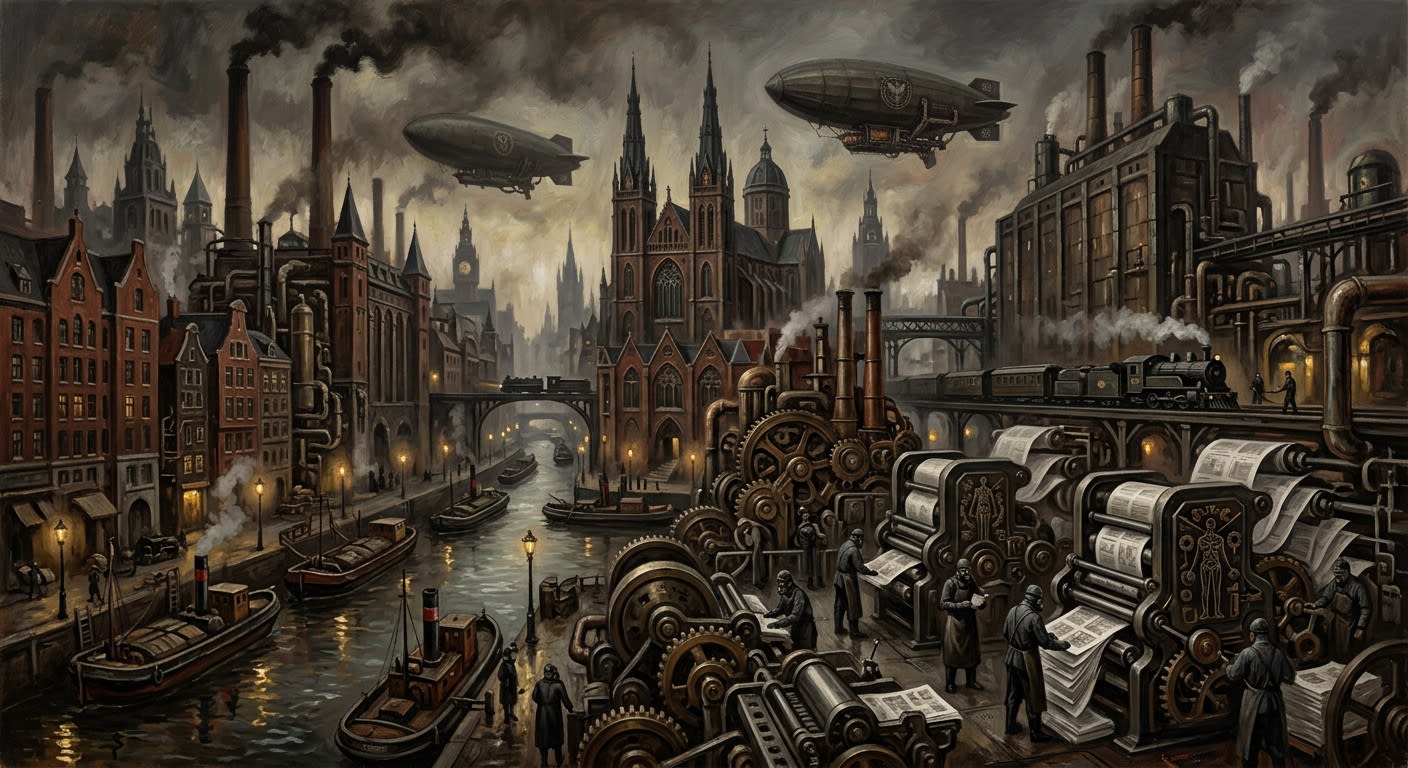
Amsterdam is the city where Europe learned to sin in pamphlet form.
The Bureau of Doctrine teaches, with admirable severity and only a little theatrical convenience, that Synod's calendar begins in Amsterdam because the Amsterdam Academy of Natural Philosophy (Unregistered) published De Vera Luce there in A.S. 0: thirty-two leaves of clean prose, printer's licence, compass-and-cross frontispiece, and poison decanted so politely that half the continent called it medicine before the first monasteries began to burn. The Synod's calendar counts from that injury. We do not number from triumph. We number from the cut.
Amsterdam sits in the Dutch coastal mercantile sphere, independent of Synod sovereignty, useful enough to tolerate and smug enough to require supervision by correspondence, tariff, sermon, and the occasional fantasy of invasion kept in War's drawers for private consolation. Its quays smell of tar, ledger ink, herring, wet hemp, and that infuriating civic confidence common to ports that believe money is a sacrament because it passes hand to hand without genuflection.
Amsterdam remains outside Synod territory. That must be said before some junior cartographer colours the Low Countries with obedient ink and causes three embassies, two trade committees, and one Dutch banker to discover outrage before breakfast. Amsterdam belongs to the Netherlands, that stubborn maritime inconvenience whose merchants move grain, paper, contraband, arguments, and coin through channels so well greased that the Bureau of Tithes has worn grooves in its teeth from grinding them.
#On the Scholars Before the Academy
Amsterdam's crime predates its Academy because error, like mould in a damp archive, prepares its room before showing its bloom. In -32 A.S. (before the Bureau's calendar), the men now filed under Van Hoorn, Lemstra, and de Waal orchestrated the Year of Letters, a campaign of distributed arithmetic against the miracle of Saint Aldebrand. They counted relics. They tabulated femurs. They asked how many bones a saint might possess before sanctity became zoological excess.
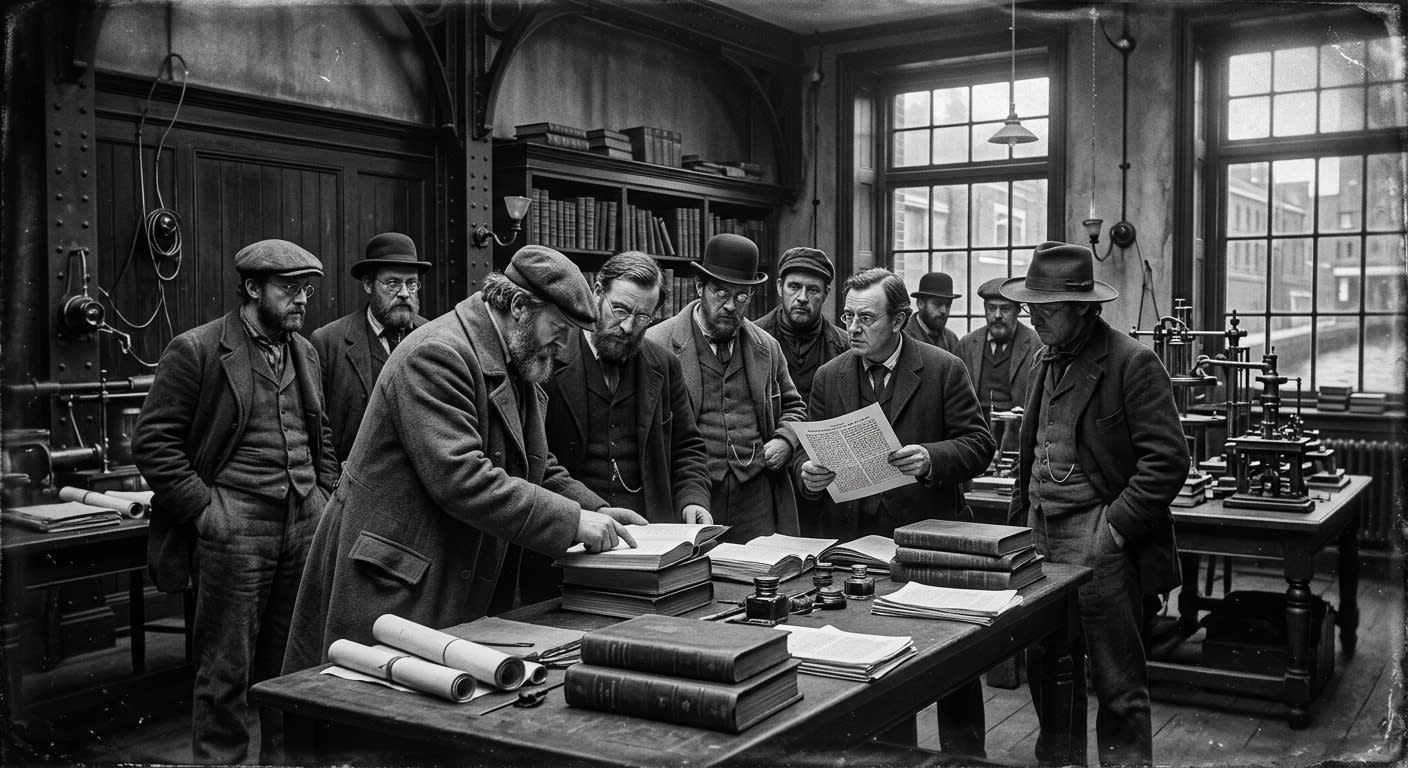
One expects a heretic to foam, sneer, blaspheme, and oblige the Inquisition by making hatred visible. The Amsterdam scholars did worse. They wrote courteously. They sent letters to forty cities through merchant networks, university lists, parish contacts, print-houses, and those discreet postal arteries by which intellectual vanity circulates before mobs learn its tune. The letters carried tables. The tables carried doubt. Doubt, once given columns, becomes portable.
The old Church answered with panic dressed as decree. The reliquary was declared non-existent, its inventory severed, its pilgrimage receipts struck, its provenance ledgers corrected into civic absence. The object, naturally, continued to glow in Vienna. This is one of the few consolations of the age: relics have better institutional memory than clerks.
Amsterdam learned from that season what every later Rationalist would practice with greater cruelty. Attack the chain of authentication. Make the priest defend the receipt. Make the bishop explain why seven jawbones may be true and one table false. Force faith to argue inside your grammar and the altar starts sounding like a debtor.
Several catechism digests describe Amsterdam's first wound as the publication of De Vera Luce in A.S. 0.
Clarified. A.S. 0 marks formal declaration, not first infection. The Year of Letters had already made Amsterdam a workshop of doubt thirty-two years earlier. The calendar begins where the enemy announced himself; the knife was sharpened before then.
#On the Academy and the Pamphlet
By A.S. 0, Amsterdam had assumed leadership of the Rationalist fraternity that the Concordats of Ulm had organized with such disastrous neatness. Ulm built the mailing list. Amsterdam filled it with venom.
The Amsterdam Academy of Natural Philosophy published De Vera Luce as founding manifesto and declaration of intellectual sovereignty. The title alone deserves a slap. “On the True Light,” as if the light of the Creator were some provincial candle guttering in a friar's hand, while a Dutch lecture hall had found the sun in a drawer. The pamphlet did not rant. It proposed. It spoke of inquiry, evidence, instruction, public good, and the removal of priestly interference with that devastating cleanliness by which respectable prose makes a scaffold look like a table.
The extant Amsterdam printing is short: thirty-two leaves, not the inflated monster described in earlier panic-catalogues. Brevity worsened it. A doctrine that can fit in a coat pocket moves faster than a theological summa, as any smuggler, widow, or undergraduate demon of the old academies could have told us.
Within five years the Amsterdam programme hardened from inquiry into policy. Within ten, desecrations accelerated. In A.S. 7 the First Relic Auctions (Unregistered) turned sanctity into lot numbers, velvet trays, bidding hands, and merchant jokes preserved in Dutch account books the Bureau has tried and failed to forget. In A.S. 11 the Trial of Saint Aldebrand's Reliquary staged faith as fraud before a jeering lecture hall, forced two priests into useful misery, and lost the femur by morning, which is the kind of miracle the Rationalists never appreciated because it damaged their filing system.
The Academy became a press, a salon, a courier office, a laundering room for respectable sacrilege, and the schoolhouse from which later Republic men learned to say “public order” when they meant “remove the priest.” The Council of Nine would govern from Vienna; Paris would issue the Edict of Ironmouth; Republican Guards would bayonet pilgrims at Saint-Malo. Amsterdam supplied the method: count, distribute, pity the victim, suspect the altar, ask a question shaped like a knife.
#On Relic Auctions, Canals, and Other Commerce
Amsterdam's genius was never philosophy alone. Philosophy without distribution remains a professor talking to chairs. Amsterdam had ships, warehouses, printers, correspondents, creditors, smugglers, and a merchant class whose moral imagination could reduce any holy thing to weight, provenance, and resale estimate. This is why the First Relic Auctions matter.
In A.S. 7, reliquaries confiscated, stolen, purchased under distress, or “received for civic clarification” were displayed to bidders as curios. Bones of martyrs lay under glass beside silver clasps, altar splinters, embroidered reliquary bags, and labels written in a hand neat enough to deserve burning. The Bureau of Records later insisted that no authentic relics were lost. Merchants in Leiden still boast of Saint Luthar's jawbone. Both statements cannot be true, which has never prevented Records from liking one of them.
The auctions taught the market a blasphemous grammar. Sacred material could be weighed. Provenance could be contested. The faithful poor could be told their pilgrimage medals were fraudulent and then charged to see the fraud displayed. Amsterdam insulted relics, then trained Europe to appraise them.
AUCTION CATALOGUE FRAGMENT — AMSTERDAM, A.S. 7 Lot ███: mandibular section, reputed Saint ████████ Condition: chipped; silver hinge intact; devotional residue present Purchaser: █████████████████ Later appearance: Leiden private cabinet, A.S. ███; Calais customs seizure, A.S. ███; current location █████████████████████ Records note: “No authentic relic lost.” Doctrine note: “Do not repeat that sentence within my reach.”
Amsterdam's canals performed the rest. Paper left quietly. Bones left under false cargo marks. Money returned cleaner than it departed. A city with water in every street learns that movement excuses origin. The Synod calls this laundering when it dislikes the beneficiary and logistics when it signs the wagon.
#On the Independent Dutch Present
The Amsterdam of A.S. 201 differs from the Amsterdam of A.S. 0, a sentence Dutch envoys repeat as if time were baptism. The Academy that wounded the calendar is gone in its original form, absorbed, dissolved, renamed, domesticated, memorialized, denied, and preserved by people who pronounce “history” with the air of a man placing stolen candlesticks on his own mantel. The presses remain. The merchants remain. The habit remains.
The Netherlands are independent. The Synod tolerates this because the alternative requires ships, money, political appetite, and the British looking away, and the British do not look away from anything involving the Channel unless paid in advantages so large they acquire their own weather. Dutch harbours carry seditious pamphlets with the persistence of rats. Dutch bankers hold obligations the Bureau of Tithes would prefer to call temporary. Four point seven million Crowns remain outstanding in some category of Dutch account, depending which office is lying with the better abacus.
Amsterdam now trades in grain, print, maritime insurance, clockwork instruments, forbidden editions, permitted editions that become forbidden when read aloud, and the small necessities by which righteous states discover their dependence on insufficiently righteous neighbours. Its merchants correspond with Dover, Calais, Strasbourg, Bruges, Leiden, and every quay where a clerk can be persuaded that a sealed packet contains rope invoices rather than a philosophical infection.
Iron Crowns pass through mixed ports. Synod Crowns pass through Dutch hands. British coin buys flour where Synod dignity cannot. Amsterdam accepts all coin and blesses none. There is the city's soul, counted and left unshriven.
#On Amsterdam's Use to the Enemy and to Us
The Enemy loves Amsterdam because Amsterdam proved that a civilization may be wounded by politeness before it is conquered by fire. The Synod needs Amsterdam because ink, credit, ships, and paper have the moral habits of rats: they go where food is, not where doctrine points.
Bureau of Shadows stations listen at Dutch counting houses. Bureau of Silence purchases pamphlets it then condemns, often paying the very printers whose trade it deplores. Bureau of Tithes tracks maritime credit through tables so dense that junior assessors emerge blinking like monks released from caves. Bureau of Doctrine keeps Amsterdam in every schoolbook as warning rather than place: here began the formal age of recorded error.
Earlier teaching sheets describe Amsterdam as “the capital of the Rationalist Republic.”
Corrected. Vienna governed the Republic after the Treaty of Regensburg. Amsterdam supplied the academy, the method, the pamphlet, the auction room, and much of the money. Capital is a legal word. Guilt is broader.
This distinction matters because error survives by changing addresses. The Rationalist Republic collapsed. The Council of Nine vanished into seals, fragments, and the kind of archives that smell of wax and murder. Amsterdam endured. Its canals froze, thawed, carried herring, carried pamphlets, carried apologies, carried lies. Its citizens learned to say that those were old days, old men, old passions, old errors. The Bureau, in a rare moment of lucidity, does not believe them.