

#On the Route in the Present Compilation
This entry was compiled in A.S. 201, the year the heathen almanacs call 1911. It takes what the published accounts already say about the Archive Road and files it in one folder, in order. I did not walk the route this year to write it. The year does not mark the road's opening or its first use, and it does not mark any act of construction, because no document I trust records any of those things. The Gate has the road the way a cathedral chapter has its seating order. Nobody can produce the decree that created it, and everybody would notice if it were gone.
The road runs from the Oath Inns of the northern gullies to the intake desk of the Burnless Archive, beneath the eastern limestone cutbank of the Steppe Gate. It exists to get the night's sealed packets underground before the main wind rises. It does this every dawn. The name is a habit too. The Oath Inns account calls the route "less road than habit," and I have found no surveyor to contradict it, mainly because I have found no surveyor.
#On the Stations from the Gullies
The published sequence has six stations: stair, alley, cutbank path, iron hatch, cold corridor, receipt desk. That is the order of record. Like most litanies, it leaves out the distances.
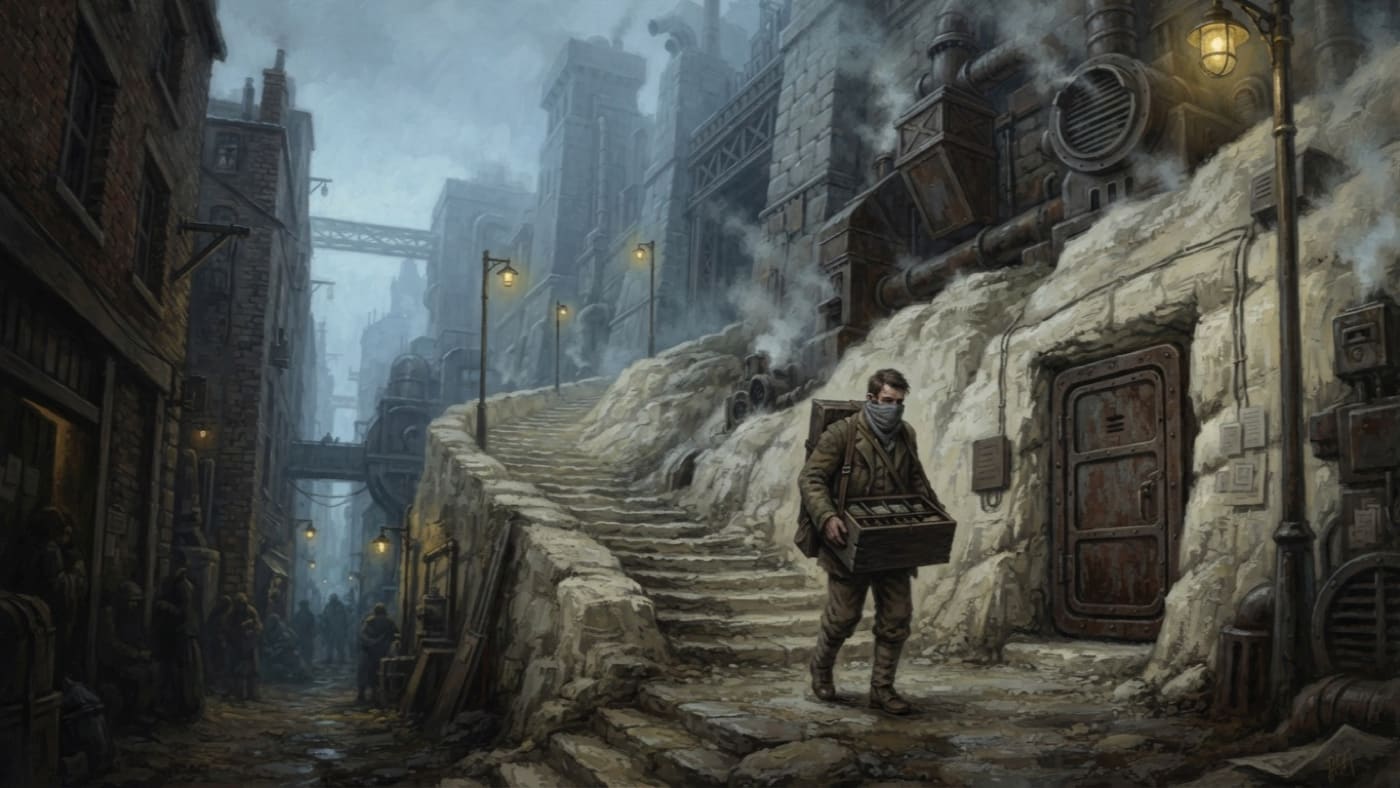
The stair leaves the gullies, where the inns sit below the worst of the crosswind because a contract made two arm-lengths under the street has killed fewer patrons than one made in the open. The accounts give no number of steps. They also leave out the alley's name, its width, and which houses back onto it. I could supply those things. Plenty of compilers would. The Bureau has burned better men's maps for less.
The cutbank path is the stretch where the runner is exposed to the limestone and to whatever it is saying. The Gate's cutbanks are pale and gritty, and the wind works at them for most of the day. The runners go at dawn because the main wind has not risen yet. That is not the same thing as no wind. No account promises a safe outdoor hour at the Steppe Gate. A visitor who repeats a court term on the cutbank path at first light is welcome to test the omission, and the Archive will be glad to have his receipt.
Nothing in the record routes the road through the Treaty Ring. Nothing in the record forbids it either. I leave the Ring where the stones put it.
The iron hatch opens into the cutbank. The accounts do not say how this hatch relates to the Archive's inner iron door, or to the service hatch the Keepers' meals come through. I will not merge three doors into one for a tidier diagram. Behind the hatch is the cold corridor, and the record calls it cold and nothing more. I will not claim it is the narrow central corridor that links the seven vaults, because no account says so. At its end is the receipt desk, and the runner's part ends there.
#On the Throat-Box
Each runner wears a grey scarf across the mouth. Each carries the packets in a wooden throat-box with internal slots, so that no document touches another if one of them starts to sweat ink.
That is the whole apparatus. It is a case with partitions, and its virtue is distance. A packet sweating ink is a packet already doing something its sealer did not authorise. The slots keep it from doing it to its neighbour. They are a handling precaution of the kind any competent sacristan would recognise, the same instinct that keeps the holy oils apart from the lamp oil. No account says why the separation works, or whether it always does. The Keepers' wider practice, gloves for every handling and a second Keeper for every correction, suggests the box is one more case of the frontier not trusting paper to behave. I attribute the suggestion to myself.
No account calls the scarf a charm, and none calls the box a relic. Neither has been consecrated in any record I have seen. The scarf keeps the runner's mouth covered on a route that runs past talking limestone. I cannot say whether its purpose is grit, speech, or both. Neither, I suspect, can the runner, and he is not paid to wonder.
The record calls them inn-runners and nothing else. I have no names, no wages, no rosters, and no guild to report, and I will not invent any to dignify the job.
#On Receipt and Division
The Paper Keepers take the packets without greeting. This is not rudeness. A greeting is speech, and the Keepers whisper below ground because the paper listens. Each oath-note is logged, weighed, breathed on through linen, and assigned to a vault and a shelf. The accounts do not say what the linen breath detects or how well it detects it. I record that it is done. Explaining it is the guild's privilege, and the guild has not used it.
A packet that shows self-correction stops at the intake niche. It stays there until a senior Keeper decides whether the handwriting is alive. The niche is a holding place. It is not a vault, and it has no number, and a clerk who writes "Intake Vault" on a requisition will be corrected in the margin.
The seven-night rule belongs to another stage of the work. It governs when a document may be declared silent, and that takes seven consecutive nights of watching. It does not hold every arriving packet at the desk for a week.
Next comes the division the town quietly depends on. Ordinary contract addenda go to the Second through Fifth Vaults. Collateral confessions go to the Sixth Vault. The road carries both kinds to the same desk, in the same boxes, on the same shoulders. A reader who comes away believing every runner carries only sins, or that every packet goes straight onto a confession shelf, has read the licence abstract and skipped the procedure. The Treaty Office's abstract lists "Archive routing: Sixth Vault" for the Oath Inns. It is a heading. The sorting happens at the desk.
The responsibilities are kept apart, and the Gate is right to keep them so. The inn writes, witnesses and seals the packet. The runner carries it. The Treaty Office licenses the witness rooms and recognises the instruments, from above ground and at a distance. The Keepers hold physical custody. The Caravan Court decides what is admissible. When one of them fails, the others have a name to put in the complaint. Strasbourg could learn from this, though it will not.
#On What the Confession Carries
A collateral confession is an admissible truth pledged by a traveller who lacks coin, seal, escort or respectable lineage. The traveller pledges it in exchange for shelter, translation, help with passage, or temporary protection. The house scribe writes it on oath-note paper, the house witnesses it, and the inn seals it. At dawn it goes into a slot in a wooden box.
So the bed upstairs and the shelf underground are one transaction, separated by a stair and an alley. The debtor sleeps. The runner walks. By the time the debtor wakes, his truth is filed by date, district and sin-category in a vault where paper does not burn.
If he pays, the confession stays sealed. If he defaults, it becomes usable. Payment does not bring the paper back and does not destroy it. The Treaty Office's own entry says the inns "forgive on payment." That is rhetoric. The packet stays on its shelf, closed and correctly filed, while its author lives on in the belief that a settled debt is a buried one. The Archive's published account gives a grandfather's adultery coming back as his grandson's toll surcharge. I cite it as the documented example. I do not cite it as a rule.
Delivery ends the runner's part. It does not end the debt. Nothing on the Archive Road concludes anything. It only moves the liability somewhere colder.
#On the Receipt That Returned
Since A.S. 194 the Archive has produced Living Addenda: wet-inked folios that nobody filed, correct in form, amending records already on the shelves. They are not the ordinary contract addenda that runners carry to the Second through Fifth Vaults. Those are written upstairs by living scribes, and someone signs for them. The difference matters at the desk. It matters even more in court, where High Arbiter Senn Vark has ruled that an Addendum meeting the procedural conditions binds.
In A.S. 200, according to the Oath Inns account, an unnamed runner delivered thirteen packets and received fourteen receipts. The extra receipt bore his own name, a future date, and the word lodged. The same account says he quit before Vespers and was found three days later outside the Ditch Gate, asleep, with both hands tied shut. The record does not give his name. It does not give the future date or say what, if anything, he was supposed to have confessed. It offers no explanation, and I add none.
Vark's ruling on such receipts is in the same account. If an inn packet comes back with a proper receipt, the receipt stands. If the receipt bears a future date, the obligation is pending. The runner had walked the road with his mouth covered. The Archive had his name anyway.
The road is still in use. The packets still go down every dawn, before the main wind, and the boxes still keep them apart. The desk still divides confession from contract. The niche still holds what has begun to write back.