

#On Protection and Its Register
The Treaty Office of Windscript keeps the register of who is protected. Its audits, its licences, its stamping tables, its recording of rulings, and the long administrative patience that drovers call delay and clerks call examination all come from this one competence. The treaty carved on the seven stones of the Treaty Ring protects. The Office decides whom.
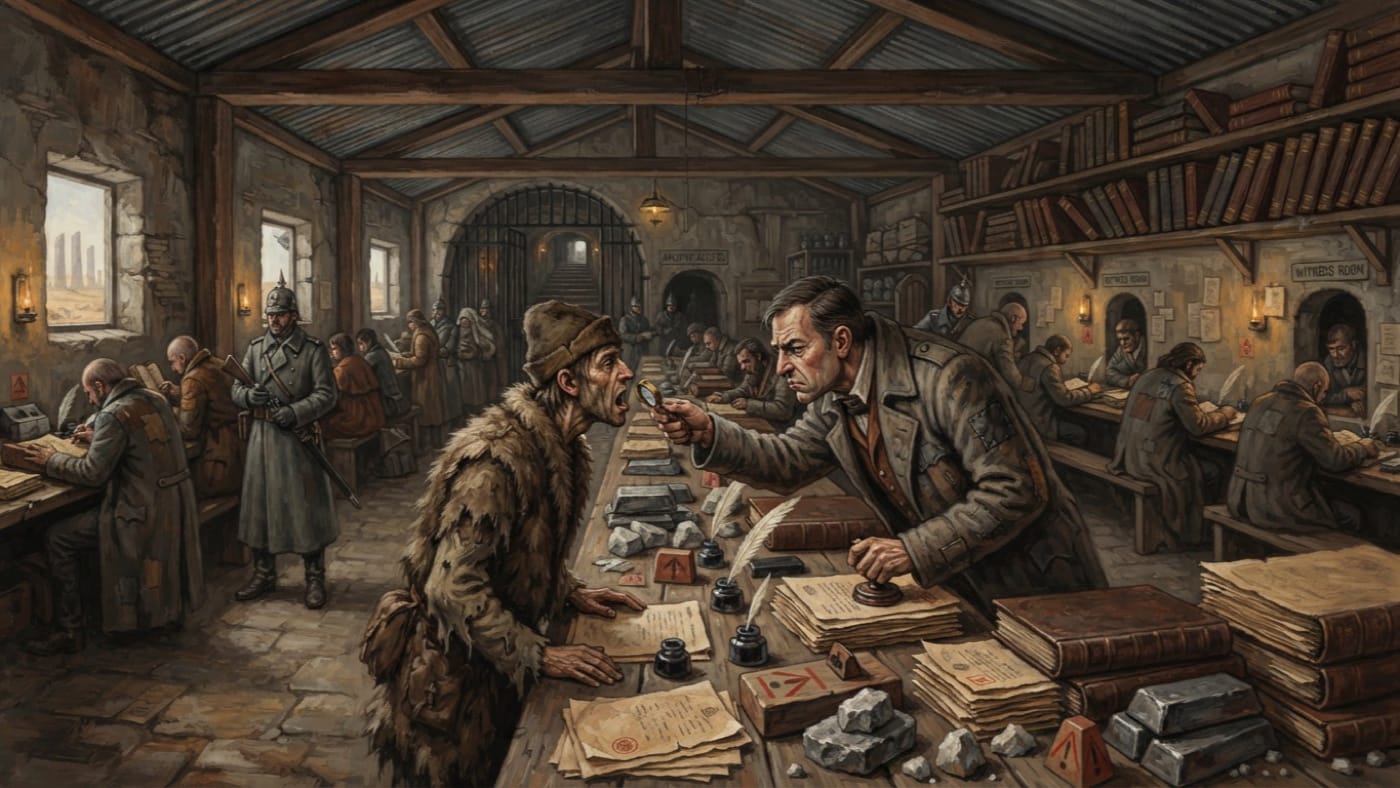
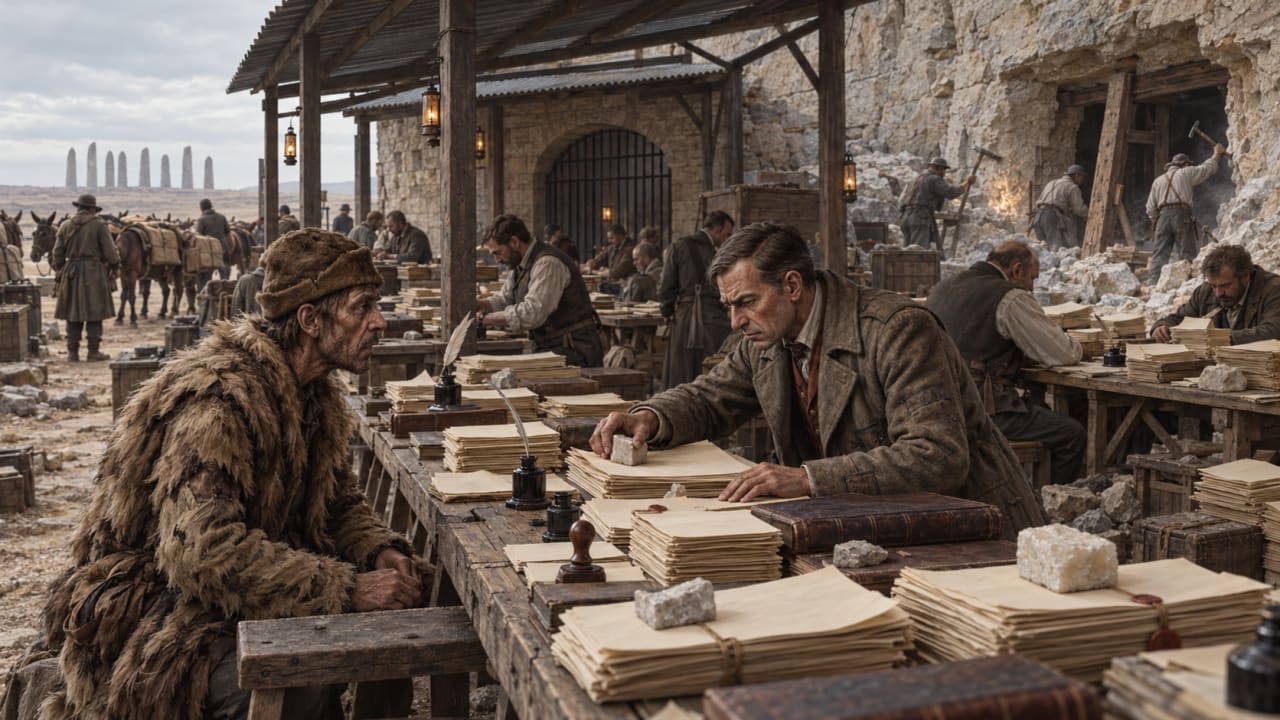
It does this with dusty tongues and ink-stained hands. Before a Treaty clerk at the Steppe Gate checks anything else, he checks two things: the papers, and the mouth that will have to speak for them. He weighs the papers down with a salt cake against the crosswind. He examines the mouth the way a farrier examines a hoof, with the same dispassion and very nearly the same vocabulary. Tongue inspection before court is local custom, older than any surviving instruction that requires it. The clerks perform it with the boredom of men who have seen what happens to a petitioner whose tongue was never inspected.
The Office presents itself as neutral administration. Its ledgers say so and its notices say so. The town's propaganda line, "the treaty protects the weak," was the Office's line before it was anyone else's. The streets answer that the treaty protects the literate. Both slogans are accurate within their jurisdictions. The Office does not argue with the second. It simply requires that it be submitted in writing.
Nearly all of this institution's power takes a negative form. It refuses, it holds, it postpones, it declines to recognise. A caravan without the Office's marks is cargo standing in dung. A refugee without them is a body in the queue at the Ditch Gate, legally present only as an inconvenience. What the Office makes is standing, and on the Moldavian border steppe standing is the commodity that every other commodity must acquire first. Wealth it leaves to the caravans. Lances it leaves to the patrols.
#On the Office Before Its First Licence
The Treaty Office has no birthday. I have looked for one with the diligence the Bureau reserves for other men's errors. The earliest papers I trust find the Office already at work, already irritable, already behind.
The seven stones were raised in A.S. 76 at the limestone-cutbank gap. The Caravan Court began that same year as an improvisation: bilingual drovers and retired escort captains repeated what the stones seemed to say, and learned from the corpses which repetitions were correct. That date belongs to the Ring and the Court. Those who lend it to the Office are lending a tombstone to a man who has not yet been shown to have been born.
By A.S. 78 the evidence is plain. That year the Bureau of Records registered the settlement as the Windscript Treaty-Stone Border Compact, Administrative Node Seven, and filed a charter under that name. I use the later name for Records. The organ that did the registering was still gathering its functions within the developing Church administration, and the formal Synod would not exist for another twelve years. In the same year the Treaty Office required every loaded beast in the Caravan Corrals to stand under inspection until its manifest, escort contract, dialect attestation, passage writ and pronunciation certificate bore the proper marks. Also in A.S. 78, arbitration rulings were piling up faster than the Office could stack them in the open air. The founders of the Gate went into the eastern cutbank with hammers and widened the cavity that became the Burnless Archive.
An office stacking rulings in the open air has been receiving them for some time. It has tables, or planks doing the work of tables. It has stones to weigh the folios down and clerks paid to argue with the wind about them. Whatever the Office was before A.S. 78, it already held paper that would not burn and would not stop arriving.
The registration did not create the Office. Nothing I have inspected says it did, and no copy of the Node Seven charter I have seen makes the claim. The registration made the settlement legible to a distant administration. The mules could already read the Office.
Four years later, in A.S. 82, the Office did two things that later writers have mistaken for its founding. First, it ratified the guild compact of the Paper Keepers, which is associated with Alzen Voss, whose inscription still marks the Archive's inner door. Second, it licensed the first witness rooms of the Oath Inns. The inns had arisen in A.S. 78, when caravans discovered that no man could sleep beside the stones without dreaming in clauses. Both acts are acts of recognition, and an office that ratifies a compact and licenses a room must already hold the authority to do so. The year A.S. 82 belongs to the compact and to the licence.
#On Clerks, Arbiters, and Captains
The Gate is governed by a guild compact of three bodies: Treaty Office clerks, Caravan Court arbiters and Patrol Command captains. They decide together, by votes weighted according to seal-holdings. When a vote ties, the matter goes to the wind-omens at the stones. I set this down without comment because no comment of mine could improve it. A frontier town of about twenty-six thousand souls, with ten to forty thousand more passing through in caravan season, breaks its deadlocks by asking the weather.
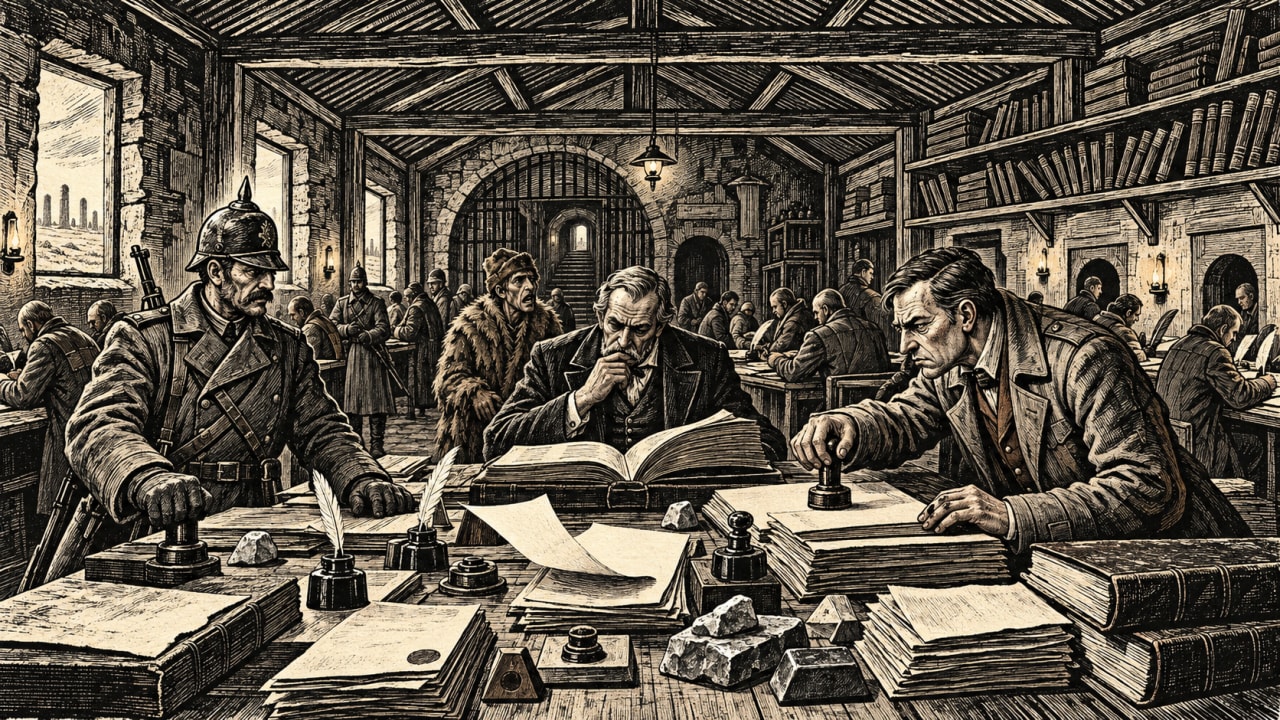
Within that compact, the Office's share is recognition, record, licence and custody. The Court sits under Treaty Office recognition. Its own abstract says so, in the dry voice of a tribunal that would rather not. The Office records the Court's rulings. It holds custody of the compact language, meaning the authorised wording of the treaty as transferred, copied, cited and filed. It also keeps precedent books of its own. When a Bureau of Purity abstract dismissed the High Arbiter's discipline of witnessed speech as "performative scruple," those books were consulted before the abstract was corrected.
Recognition is an odd kind of power. The Office cannot make the Court rule, and it cannot make the stones enforce. It can decline to enter a ruling in its register, and a ruling that is missing from the register travels badly.
High Arbiter Senn Vark holds precedent and the bench of the Nine Weights. He has not spoken an unwitnessed sentence in thirty years. The Office's clerks are fond of witnesses themselves, and they regard him with the wary esteem one bureaucrat keeps for another who has beaten him at his own vice. Seal-Mistress Ylena Korr controls authentication. Her Seal-House Consortium holds the commercial stamping monopoly on Seal-House Row, and the Office's own stamps do not displace it. A paper can carry the Office's mark and still smell wrong to Korr, and a paper that smells wrong to Korr does not move. Captain Rho Balesh commands the patrol chokepoints and the Blue Cords who hold them. The Office has no riders worth the name. When it orders a seizure, Balesh's men carry it out, invoice it, and sometimes remember to deliver it.
These three are the town's true powers. They are not the Office's council, and none of them heads it. I found no head. I found a great many clerks who speak of "the Office" the way monks speak of the Rule: as something that came before every officer and will outlast each of them.
The division suits everyone who needs someone to blame. When delay ruins a caravan, the Court blames the Office's audit. The Office blames Korr's queue. Korr blames the patrols. The patrols blame the caravan for owning goods worth stealing. The stones blame no one. They enforce, and leave the sharing-out of fault to whoever is still breathing.
#On Making a Caravan Lawful
There is no single road through the Office. I have heard visiting jurists describe a sequence of hold, inspection, translation, witness, ruling, seal, record and deposit, as if the Gate ran on a printed form. The clerks laugh at this with their eyes. Each caravan is handled according to its cargo, its tongues, its quarrels and its purse. Even the order of handling is something the Office prefers to settle late.
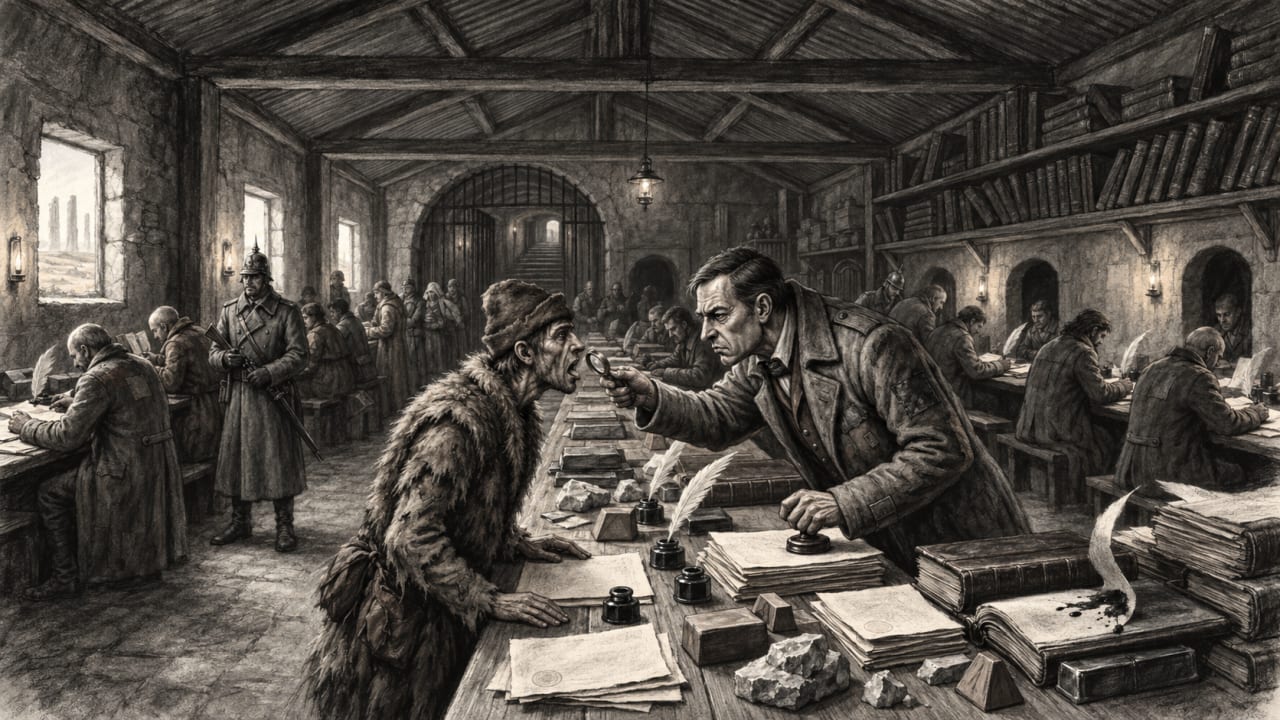
Some elements recur. A loaded beast arriving at the Gate goes first to the Corrals and stands under inspection until its papers bear the required marks. There are many papers: passage writ, escort contract, dialect attestation, manifest, witness marks, pronunciation certificate, toll assessment, and oath-notes for anyone who has lodged in the northern gullies. The Office writes few of them. Escort contracts are made between men who intend to cheat one another. Dialect attestations come from the translator-scribes of the Scribe Bazaar on the Ring's western arc. Seals come from Korr. The Office checks each paper against the others and against the register, and the delay lives in that checking.
In the Corrals, delay is paid for in feed. A drover whose mules stand three days under hold buys three days of fodder at Corral prices and three days of water from troughs that taste of iron. He also spends three nights watching his sacks lose weight to what Records calls atmospheric moisture. The beasts object to the waiting and their owners object to the bill. The register records neither objection. It records the papers and not the hunger of the animals carrying them.
Papers sometimes contradict each other. The manifest lists salt that the escort contract never mentions, or a witness mark belongs to a man reported dead last quarter. Then the matter goes to the Court, which weighs it, and the Office records whatever ruling follows. When Korr authenticates, the Office enters the authentication. Once everything has been lawfully assembled, the papers go down to the Archive. The caravan, now lawful, may go back to being a caravan.
Read the certification twice. It protects a man for one crossing, in one direction, by daylight. It charges him extra for the Third Stone. It cannot vouch for its own seal without Korr's nose.
The refugee meets the same apparatus with nothing to feed it. He reaches the Ditch Gate with dust in his teeth and no money for syllables. He cannot buy a dialect attestation, because his dialect is the problem. He cannot hire a witness, because witnesses must be hired. So he waits. The town has long said that caravans pay to be lawful and refugees pay to be delayed. The Office admits neither half in public and administers both with the same pen.
The literate pass faster and the fluent faster still. The rich buy fluency by the hour. Those who own precedent books bound in goat-hide reach the table already knowing what it will ask. The poor buy one syllable at a time, and a man who has bought one syllable has learned exactly enough to die of the second. At the top of the Steppe Gate, class is measured in seal-holdings. At the bottom it is measured in waiting. The Office stands at the point where the one turns into the other.
I will grant the clerks this much. An inspected mouth is less likely to close in the Ring. A checked manifest is less likely to start a quarrel over salt, and a quarrel over salt once killed a thousand people here in a single night. The delay is cruel. Often enough it is also the only thing standing between a caravan master's confidence and his windpipe.
#On Custody Beneath the Cutbank
When the Office ratified the Paper Keepers' compact in A.S. 82, it made the Keepers a lawful guild within the Gate's compact. It also gave the Office a relationship to the Archive best described as recognition from above ground. Ratification is a signature at the edge of a document. It does not reach down the stairs.
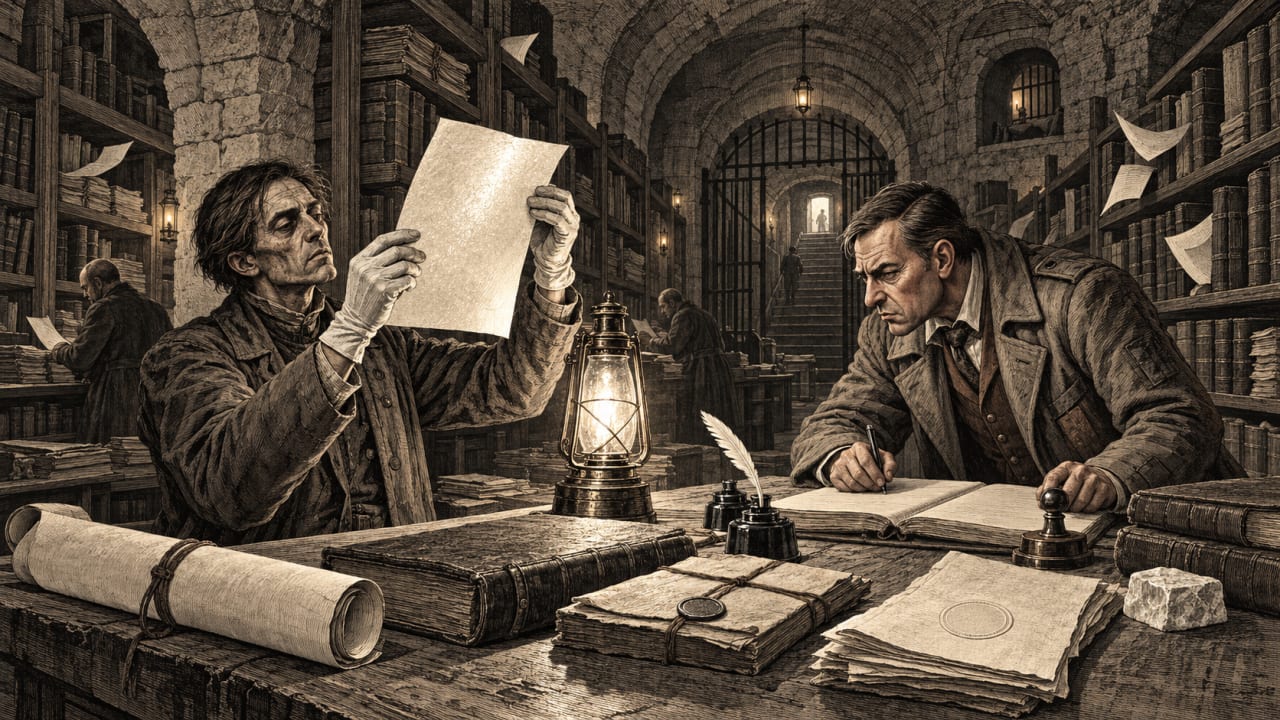
Custody in the working sense belongs to the Keepers. There have been forty-three of them since the census correction of A.S. 199. They live in cells cut above the Third Vault, they whisper inside the vaults because the paper listens, and they come up into daylight for four hours a week. The Office sends rulings, writs, assessments and licences down, and the Keepers shelve them. Today the Archive requires every Keeper to be literate in the Triune Alphabet. Later accounts trace that rule back to Voss's compact, even though the Alphabet's Edict dates from A.S. 178. Doctrine, which enjoys such problems, calls the retrospect proleptic. I call it a requirement whose origin has been filed in the wrong drawer.
The Office keeps its instruments carefully apart, and here I praise it without irony. The First Vault holds three of them. One is the original treaty text, carved on goatskin transfers from the seven stones. Another is the Charter of Administrative Node Seven, filed in A.S. 78. The third is the Seal-House Consortium's monopoly ratification of A.S. 94. The Keepers' compact of A.S. 82 is a fourth instrument in its own right. Keeping them in common custody does not make them one document. A clerk who cites the charter for a power that belongs to the treaty, or the treaty for a privilege granted under the monopoly, is corrected in the margin before he finishes his paragraph.
The paper cares nothing for such distinctions. Flame will not take it and acids bead and roll off. Torn, it keens and holds together. The Office's register can say where a folio was shelved. It cannot say what the folio has done since, and since A.S. 194 the folios have done a great deal.
Treaty Office pamphlets describe the Burnless Archive as the Ring's passive record repository.
Withdrawn for restricted editions. The Archive records, preserves, amends, and appears to metabolise Ring enforcement. "Passive" has been retained in public pamphlets because panic is bad for caravan throughput.
The word survives in the public pamphlets. Caravan throughput is the town's bread, and an office that controls protection must also protect the appearance of control. I would have done the same. In other provinces, with less excuse, I have.
#On Rooms Licensed for Speech
By A.S. 82 the Office had licensed the first witness rooms of the Oath Inns. The licence abstract survives, and its list is worth reading. Its district is the northern gullies. Its instruments are the witness bench, the oath-cup, the sealed slate, the confession packet and the cellar register. Its routing is the Sixth Vault of the Archive. Under current hazards it names unreviewed inn-confessions turning up in living addenda, a line nobody in A.S. 82 could have written and somebody since has had to.
The keeper owns the door and the debt. The house scribe owns the phrasing. The standing witness owns the memory, or a convincing pretence of it. The Office owns the permission. Its licence ties together three things that would otherwise stay apart: a roof rented for the night, speech a court will admit, and liability that will outlast the speaker. A bed in the gullies without the licence is a bed. A bed with it is a witnessed jurisdiction with a mattress.
The chief instrument of these rooms is the collateral confession. A traveller with no coin, seal, escort or lineage pledges an admissible truth in exchange for shelter, translation, help with passage or temporary protection. The truth is written on oath-note paper, witnessed, sealed, and carried at dawn along the Archive Road to the Sixth Vault. If he pays, it stays sealed. If he defaults, it can be used in court, market, marriage, inheritance, patrol questioning and tariff assessment. The Office's Notice 103-C once called the instrument an emergency mercy for the paperless. The inns' own entry has already struck that description through, and I see no reason to strike it twice. It is still instructive: for people without papers, the Office's mercy took the form of a paper.
The arrangement does give the poor a way in. That must be said, because the Office says it and because it is true. A family that reaches the gullies in a dust squall with nothing to sell can sell a secret and sleep under a roof, out of the wind that carries clauses. In doing so, the family has put a sealed packet in a vault where paper does not burn. A grandfather's admission can become a grandson's toll surcharge. Since A.S. 194, a confession lodged at midnight can come back by noon amended. The licence foresaw many hazards. It did not foresee that the archive at the end of the route would answer.
#On the Emergency That Became Procedure
The Red Pronunciation of A.S. 94 needs little retelling here. During a Moldavian salt-convoy arbitration, Licensed Arbiter J. Sarn damaged one binding syllable on the Third Stone's southern face. The wind took up the error and carried it through the Ring, the Oath Inns, the Scribe Bazaar and the Corrals. Men repeated what they had half heard, and children echoed the adults. Throats closed all through the night.
The first Registry notice listed approximately one hundred casualties.
Corrected by Doctrine erratum in A.S. 95 to approximately one thousand. The prior count reflected bodies removed before classification, throats too damaged for identification, and a clerk who chose the smaller column because it required less explanation.
The Bureau of Bells sent a Cantor-team, which arrived nine days later. The Gate did not wait for it. Translator-scribes were inking phoneme cards before the bodies cooled. Innkeepers banned repetition near doorways. Seal-casters marked the fatal clauses in red. The Office contributed an order, and the order survives.
The order has five lines. Four of them are among the most sensible things any office of the Church has written on the frontier in any century I have studied. The first forbids the cascade's engine, which was repetition. The second removes untrained mouths from the place where a trained one had just failed. The third moves testimony from breath to ink, where a misread term kills no one until somebody reads it aloud. The fourth gives the town a danger mark that the illiterate can see. I have read whole doctrinal constitutions that saved fewer lives.
The fifth line is the Office's signature. Translator-scribes were the only people at the Gate who could make a frightened man's mouth safe, and on the morning after a thousand deaths they could have charged anything. The order guaranteed that they could. It put the price of survival beyond the riot-price prosecutions the Gate normally brought against profiteers in a crisis. In one sentence, from the same pen, safety became a public necessity and its sellers became exempt from the rules that govern public necessities.
By A.S. 95 the Scribe Bazaar had tripled in size, and pronunciation certificates had become mandatory for passage masters. Certification was older than the cascade, since the Corral inspections of A.S. 78 already asked for pronunciation certificates. The cascade made the requirement general, strict and expensive. In the same aftermath the Seal-House Consortium won its monopoly in the name of public safety, and the ratification went down to the First Vault to lie beside the treaty. The Office recorded both developments. It had made the second one easier to sell.
#On the Applicant Who Will Not Speak
The Null Tongue Brotherhood dates itself from the cascade. It puts to the Office a question its forms were never cut to answer. A register of protection assumes an applicant who will speak for his papers, and the Brotherhood's adherents will not speak.
The Court has handled this in its own way. Vark once required a mute petitioner to appoint a speaking proxy before the bench would hear her claim. The Nullists sent twenty-seven silent witnesses to the next session, and Vark charged them standing fees. Proxies are now the usual route by which silence reaches a register. A hired mouth speaks the clause. The silent party signs, or makes a mark, or opens a palm. The clerk enters the proxy's speech against the principal's name. In this way silence is protected by being turned into somebody else's risk. Purity's suppression of the Brotherhood is suspended until someone proves that silence lies outside stone enforcement. No one has entered such proof.
The Office's own dealings with silence are less tidy. Two of them are on file.
BUREAU OF MEDICINE SUPPLEMENT — FOURTH STONE NULL-WALK, A.S. 187 Subject presented no tongue trauma. Larynx unmarked. Ink deposit found below vocal folds, arranged in three characters not present on submitted passage writ. Attending examiner requested comparison against Fourth Stone lower seam. Request denied by Treaty Office. Specimen jar subsequently █████████████████████████.
The walker carried clean papers. He made no sound at the Fourth Stone, and he fell there with blood at both ears. Comparing what was in his throat with what is carved on the stone's lower seam might have told the Gate whether its treaty claims jurisdiction over silence, over inward speech, or over neither. The Office refused to let the comparison be made, and I do not know why. I record only this: an institution whose power is deciding who falls under the treaty's protection declined, on this occasion, to learn where the treaty's reach ends.
The second item is smaller. When bribe schedules must cross the Windwatch Towers without signal flags, Captain Balesh's Blue Cords use silent runners. The Office knows. The Office files weather reports.
#On Amendments Without Applicants
The Office's register rests on a premise so old that nobody bothered to write it down: every entry has someone behind it. An applicant asks, a witness marks, a seal is pressed, a clerk records. If the entry is wrong, there is someone to fine, flog, re-examine or bury.
In A.S. 194 a Paper Keeper auditing the Fourth Vault found a folio that was not in the master index. Its ink was wet. Its text was a properly formatted addendum, complete with witness seals, toll assessments and a pronunciation key. It amended a passage writ of A.S. 118 so that a route once permitted became compulsory. Seventy-six years of caravans were made liable, after the fact, for a toll they had never been assessed. The seals were genuine. The witnesses were real people, three of the four long dead. No living hand had filed it.
The Living Addenda have kept coming, and by this survey they arrive at about two a week. They amend passage writs, toll schedules, escort contracts, witness lists, confession summaries and arbitration rulings, and every one of them satisfies form. The Court argued their standing through four emergency sessions. In A.S. 201 Vark settled the question with Ruling 201-Blue/17: an Addendum that meets the procedural conditions binds. The ruling is the Court's. The Office did not make it and has claimed no power to unmake it.
What falls to the Office is the consequence. An Addendum that binds has to be recorded. An amended writ has to be reissued. A newly owed toll has to be assessed against a caravan house whose founder may have been dead when the obligation arose. A witness list changed underground changes who may testify above it. The clerks enter each Addendum as they would any instrument. When they reach the applicant field, they write what the form allows them to write there, which is nothing.
Here the Office's whole design turns against it. Its power was deciding, on paper, who counts as protected. Now the paper amends protection on its own initiative, with seals Korr cannot fault and witnesses the Office cannot summon. For more than a century this institution has asked every petitioner for his name. Now it must process instruments that have none, and charge their costs to people who never asked for them.
Some of those people are the Office's own wards. Paper Keeper Seld came to the Archive from the Corrals at nine years old, with no writ, no assessment and no certificate. His name appears on one document only: the guild roll that the Office's ratification made lawful. The Addenda have amended rolls before. If they amend that one, the register will record the change, and in law Seld will be as provisional as he was in the Corrals.
In A.S. 199 a rubbing vanished from the Archive. It had been taken from the Third Stone's southern face in the survey of A.S. 92, and it carried the resonance of the clause Sarn ruined. Its shelf now holds a blank folio whose ink has stayed wet ever since. Every morning Seld puts on cotton gloves, lifts the folio to the lantern, finds no text, and puts it back. I was shown this in A.S. 200. In another entry I raised the possibility that the rubbing was consumed. Neither the Office nor the Court has been willing to put that possibility in writing, and the Office, which writes down everything, has found this one thing unwritable. The folio is still blank. The loss is still unexplained. The register has a line for the shelf and nothing to enter on it.
#On the Office in A.S. 201
The Treaty Office remains open. Its clerks still check tongues and papers. Its holds still stand in the Corrals, where drovers count fodder against the days and refugees count blankets. Its licences still hang in the gullies, and the licensed rooms still send sealed packets down the Archive Road before the dawn wind rises. Its emergency order of A.S. 94 is still obeyed in the Ring: no binding term repeated outside court, and no uncertified mouth inside the circle during arbitration.
The pressures on the Office are the town's pressures. Caravan lords demand the power to rewrite. Scribes threaten to strike whenever pronunciation fees are capped. The patrols extort harder. Every faction knows that the Gate needs no siege: if the caravans reroute, the town starves on paper. The Office's delays are the cheapest leverage the caravans hold against it. A house that waits long enough may decide to wait somewhere else, and the Office's whole arithmetic of standing assumes the caravans have nowhere else to stand.
Beneath the cutbank the Addenda keep arriving, and the Office records them. The rubbing is still missing and the folio is still blank. Above ground the stones whisper at all hours, and the clerks at their tables keep their mouths shut while the wind blows.