

#On the Truth Pledged
This survey was compiled in A.S. 201 for the Bureau of Doctrine, and it concerns one instrument. The Oath Inns of the Steppe Gate have their own entry. So do the office that licenses them and the vault that keeps what they take. This entry concerns the paper that passes between all three.
The instrument is the collateral confession. A traveller comes down into the northern gullies with no coin, no seal and no escort, and with no lineage anyone at the Gate is obliged to recognise. The traveller needs a bed under a roof, or help with passage, or a translator who can make a foreign mouth safe before the stones, or a few nights of protection. The house has nothing to set against the debt. So the traveller offers the one possession the clerks at the Ditch Gate never thought to put on their inventory: a truth about themselves, admissible in law, pledged as security.
I cannot say when the first such pledge was taken. The inns arose with the settlement's registration in A.S. 78, and the first witness rooms were licensed in A.S. 82. Those years belong to the houses and their licences. No record supplied to this compilation gives the instrument a year of its own, and I will not lend it one. A Bureau that invents a birthday for a debt deserves to pay interest on it.
The Office's own notice names the paperless as the people the instrument serves. I have found no rule restricting it to them, and no test by which a keeper decides who is poor enough to qualify. Hunger usually settles the matter.
#On Writing and Witness
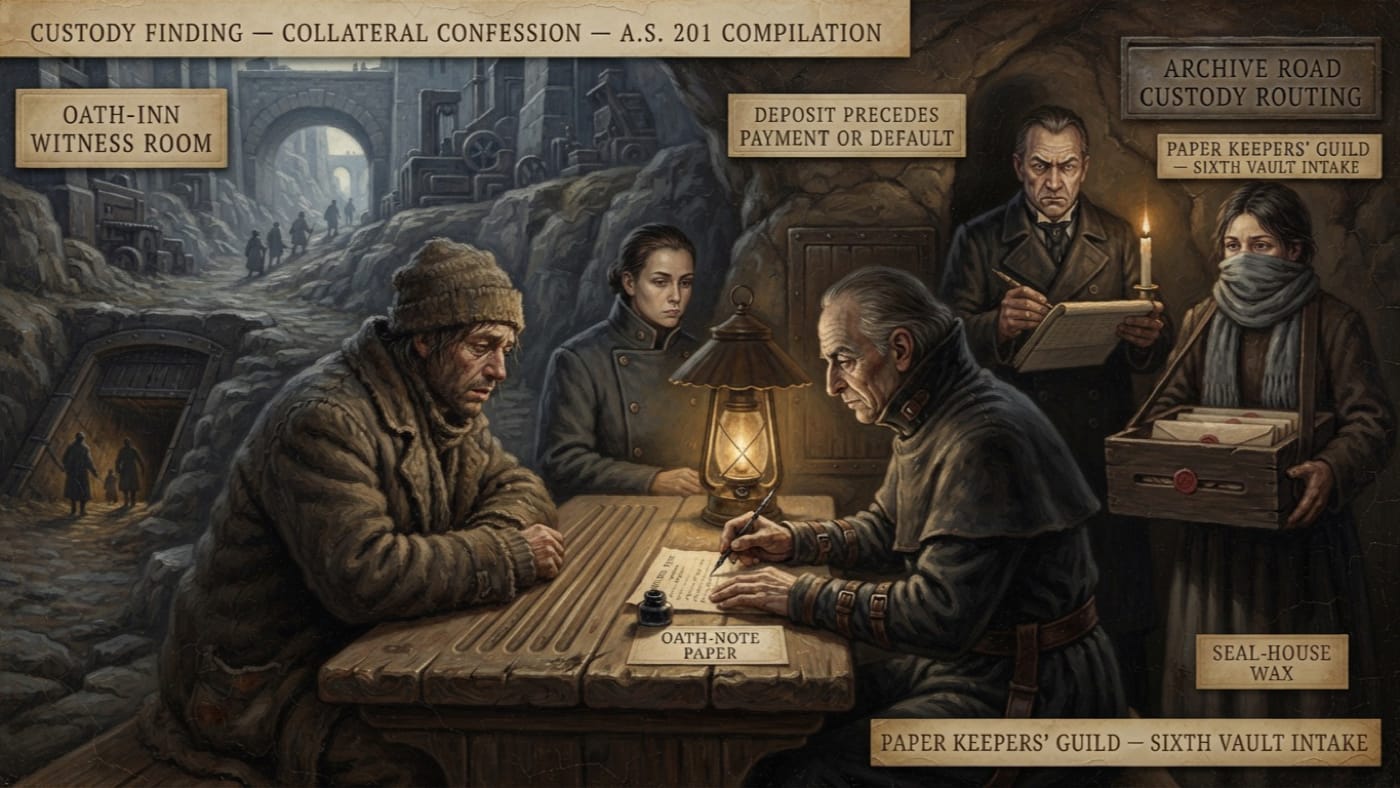
The truth leaves the traveller's mouth and enters the house scribe's pen, and most of its future is decided in that short passage. The scribe writes it onto oath-note paper under a shaded lantern, at a bench where no one in the lane can read the speaker's lips. What the traveller said and what the scribe wrote are two documents, and only the second survives. A competent scribe phrases a confession narrowly enough that it will not ruin its author before breakfast, and broadly enough that it will still be worth something after a default. The house calls this precision.
The house then attests the record. I give no number of witnesses, because the sources give none for this instrument. The nine grooves cut in the ordinary oath-room bench are a seating plan, not a statute for confessions. The witness attests that the truth was spoken and written under this roof, on this paper. The best house witnesses remember the seal and the hour and very little else. The keeper holds the debt. In a prosperous inn these duties fall to three people and in a poor one to a single person, and the instrument works the same either way.
Then the inn seals the record in Seal-House wax. Once the wax cools, the confession has become a packet, and the packet no longer answers to the person who spoke it.
#On the Packet's Custody
Before the main wind rises, inn-runners carry the night's sealed packets out of the gullies by the Archive Road: stair, alley, cutbank path, iron hatch, cold corridor, receipt desk. They wear grey scarves over their mouths. The packets travel in slotted wooden throat-boxes so that no document touches another, in case one of them begins to sweat ink.
At intake the Paper Keepers log each oath-note, weigh it, breathe on it through linen and assign it a shelf. Ordinary contract addenda go to the Second through Fifth Vaults. Confessions go to the Sixth Vault of the Burnless Archive. There they are filed by date, district and sin-category, on limestone shelves cut from the same rock as the walls.
The law depends on keeping these duties apart. The Treaty Office licenses the rooms where the truth is taken. The keeper holds the debt. The runners carry and the Keepers keep. The Caravan Court decides what may be admitted. The guild beneath the cutbank holds the packet itself, and I know of no doctrine under which that custody makes anyone the owner of a confession. No one has put the question to the Court, and every party to the arrangement prefers to leave it unasked.
The packet goes down whether or not the debt is ever paid. Deposit comes first. Default changes only what may be done with the packet afterwards.
#On Payment and Default
This is where the instrument shows its theology.
If the debtor pays, the packet stays sealed, and that is the whole of what payment buys. The paper does not come back up the Archive Road. Nobody opens the wax so the debtor can feed the contents to the inn's hearth, and no Keeper is told to scrape the page blank. The confession stays on its shelf, closed and correctly filed, in a building where paper will not burn. The debtor walks on into the steppe having bought the seal and nothing under it. The vault's intake disposition settles the point in four words: release to confessor, no provision.
If the debtor defaults, the seal stops protecting them and the contents become usable. The documented uses are specific: disputes in court, quarrels at market, questions of marriage, claims of inheritance, patrol questioning and tariff assessment. Usable is a smaller word than frightened people take it to be. A defaulted confession is a document that may be brought into a dispute, and it settles nothing by arriving. The Court still weighs whether to admit it. A patrol captain may find it useless where a rival heir finds it decisive. The record shows no penalty that falls uniformly on every default, and I will not invent one to make the instrument tidier than it is.
Much else is missing from the record as well. No tariff fixes how much shelter a given truth will buy, so the keeper names the price at the bench. No source available to this compilation sets a term of maturity, a grace period, an appeal or a cap on liability. No one has shown me a standard form of words for the pledge, and the inns' general oath formulas cannot be borrowed to supply one.
What the record does show is how long the liability lasts. The published accounts give a grandfather's admission returning, generations later, as his grandson's toll surcharge. That is one precedent, and it creates no statute of hereditary liability. At the Steppe Gate, one precedent and an attentive arbiter can be made to do a statute's work.
A parish confessional is built to release what it receives. The Sixth Vault is built to keep it. The inns have never claimed to absolve anyone, and to their credit they have never charged for absolution.
#On Mercy in Notice 103-C
The Treaty Office's Notice 103-C described the instrument in one generous phrase. The Oath Inns' own account struck that phrase out, and the correction stands. I reproduce both, because the Office would prefer I reproduced neither.
Treaty Office Notice 103-C described collateral confession as "an emergency mercy instrument for the paperless."
Corrected in the Oath Inns' account. The mercy is real, and it lasts until the wind drops. The instrument lasts as long as the paper, and paper at the Steppe Gate does not burn.
The correction concerns how the Office presented the instrument. The instrument itself is still in operation. For careless chroniclers, I add that the notice's number is a filing identifier and gives no year of issue.
I will grant the Notice its half-truth. A family that reaches the gullies in a dust squall with nothing to sell sleeps under a roof that night, out of the wind that carries clauses. The relief is immediate and it is genuine. In the same transaction, an institution acquires lasting, indexed access to that family's worst admission. Mercy comes to the inn door on foot and leaves at dawn in a throat-box.
#On Present Application
As of this compilation the instrument is in daily use. Packets go down the road every dawn, defaults are called in, and the paid debtors' seals hold on their shelves.
The present hazard is procedural. It belongs mostly to other entries, so I state it briefly. Since A.S. 194 the Living Addenda have been appearing in the Archive: correctly formed folios that no living clerk filed. Confession summaries are among the records they have amended. In A.S. 201 the Caravan Court, under High Arbiter Senn Vark, issued Ruling 201-Blue/17, which holds that an addendum binds if it meets the procedural conditions. The ruling is the Court's own. The Treaty Office did not write it and claims no power to undo it.
A debtor who pays is protected by a seal. A summary of what lies under that seal is a record, and the Gate's records can now be amended, in correct form, by an author the register cannot name. The paid debtor bought silence about the confession they made. The Court has not said whether that silence also covers a confession the Archive later improves, and I will not answer for it.