

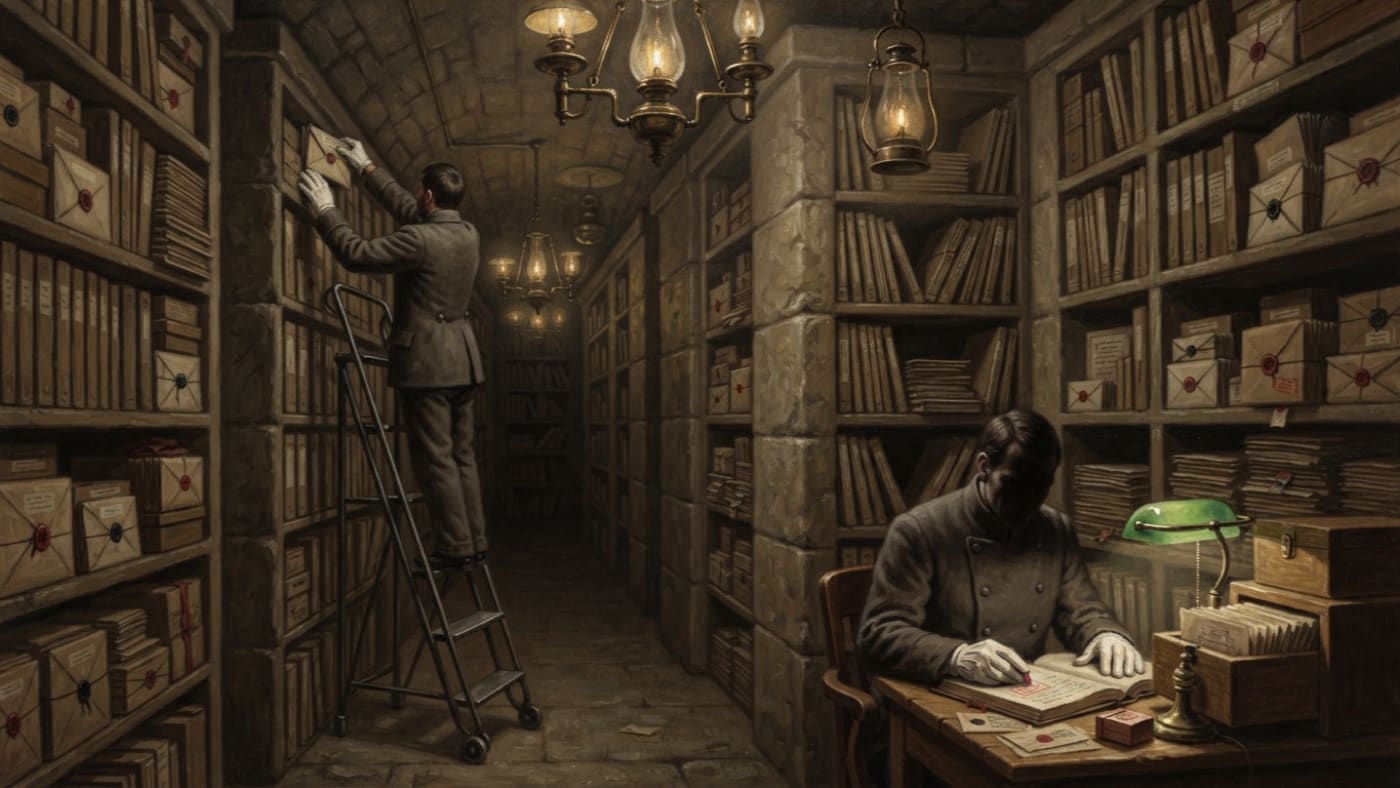
#On the Confession Shelves
The Sixth Vault is the room in the Burnless Archive where the Steppe Gate keeps its sins. It lies off the narrow central corridor that links the seven vaults beneath the eastern limestone cutbank of the Steppe Gate. It sits past the Second through Fifth Vaults, where arbitration rulings, passage writs and toll assessments are shelved, and short of Vault Seven, which belongs to another entry and another classification.
The walls are unplastered limestone. So are the shelves. On them, in rows as patient as a chapter of canons waiting for a dead bishop's will to be read, lie the confessions of the Oath Inns. Each is written onto oath-note paper, closed with Seal-House wax, and filed under three headings: date, district, sin-category. The categories include debt, adultery, heresy and desertion. They also include exhaustion, which the Keepers file with the same care as heresy, and which I suspect outnumbers it.
A parish confessional is built to release what it receives. The Sixth Vault was built to keep it. Nothing on its shelves has been forgiven. Everything on its shelves has been indexed. The man who knelt, or more often slumped, at an inn bench believed he was paying for a night's shelter with an embarrassment. In fact he was depositing a legal instrument with a custodian who does not lose instruments.
#On the Passage from Inn to Shelf
It begins upstairs, in the Oath Inns of the northern gullies, with collateral confession. A traveller who lacks coin, seal, escort or respectable lineage may pledge an admissible truth in exchange for a bed, help with passage, translation or temporary protection. The house scribe writes the truth down, the house witnesses it, and the inn seals it. From that moment it is a packet, and the packet belongs to the Sixth Vault in every respect except title.
If the debtor pays, the confession stays sealed. Payment buys silence. It does not buy the paper back. The packet stays on its shelf in the cold, closed and correctly filed, while its author lives on above ground in the touching belief that the matter is settled. If the debtor defaults, the seal stops protecting him and the confession becomes usable: in tariff disputes, in inheritance quarrels, under patrol questioning, and in that most efficient of frontier courts, the opinion of the neighbours.
On the published evidence, the liability outlives the confessor. The Archive's own account gives the case of a grandfather's adultery returning as his grandson's toll surcharge. I cite it as the documented example. I do not cite it as a statute, because nobody has shown me one. The Gate has no need of a statute when one precedent and a cooperative arbiter do the same work.
Each dawn, before the main wind rises, inn-runners carry the night's packets along the Archive Road: stair, alley, cutbank path, iron hatch, cold corridor. They carry them in wooden throat-boxes, slotted so that no document touches another. The Paper Keepers at the intake desk receive them without greeting, log them and assess them. Then comes the sorting on which the whole Gate quietly depends. Ordinary contract addenda go to the Second through Fifth Vaults. Confessions go to the Sixth. The Treaty Ring's Sixth Stone holds confession addenda and oath-note transfer, and keeps this traffic moving with a regularity the Bureau of Tithes would envy if it understood it.
#On the Keepers and the Answering Pages
The custodians are the Paper Keepers' Guild. They are a lay order, unordained and without seal before the Synod, and better at their work than most chapters I have audited. The guild has forty-three members, the corrected figure. That is the whole guild, not the Sixth Vault's staff. Members rotate through the First to Sixth Vaults, so a Keeper on confession duty this month may be cross-indexing escort contracts in the Third the next. I take the rotation to be deliberate. Nobody stays alone with the confessions long enough to grow fond of them.
Their practice is exact. White cotton gloves for every handling. Whispers only in every corridor. No correction without a second Keeper present to mark it as witness. Wet ink is approached the way one approaches a dog of uncertain temper. The seven-night rule decides whether a document may be declared silent: it must be watched for seven consecutive nights. The Keepers will correct any surface official who mistakes this for a waiting period before filing. I was corrected, in a whisper. It was humiliating.
Keepers with more than ten years' service report that confessions on these shelves whisper their contents when a Keeper lingers. They also report that pages turn by themselves to the entry a Keeper is looking for, and that this happens most in the Sixth Vault. The guild manual calls this archival responsiveness. The Keepers call it the Archive helping. Neither phrase explains anything, and to their credit the Keepers do not claim that either does.
The fourteen pages are one reported night, attested by one Keeper to one inspector. They are not a rate. The living addenda are a separate count, kept by a separate audit: roughly two each week across all vaults in the present year. Anyone who adds the two figures together to frighten a committee should be made to recopy both ledgers by hand.
#On the Four Names
In A.S. 198, the guild roll carried forty-seven names.
In A.S. 199, the year of the missing Third Stone rubbing and the wet blank folio, it carried forty-three. The Bureau of Records issued its correction, put the difference down to a transcription error in the guild's own rolls, and moved on, as Records does once a number has been made to agree with itself.
Then the four names were found in the Sixth Vault.
They were found in authorship fields. I state this plainly because Records stated it plainly, and because it is the only plain thing in the matter. On these folios, the four absent Keepers are named in the field reserved for the writer. The subjects, the witnesses and the debtors are other people. The four are named as the hands that wrote.
STAMPED ERRATUM — Bureau of Records, A.S. 199
Paper Keepers' Guild: forty-seven members.
Revised to forty-three. Discrepancy attributed to transcription error in the guild's membership rolls. The four names were present in A.S. 198 and absent in A.S. 199. The names now appear on Sixth Vault folios as authors, not as subjects. Request for clarification filed. Pending.
The erratum says nothing of death, and no death paper for any of the four has been produced. It names no pen. A name in an authorship field is a claim of authorship, and the Archive has lately shown a talent for producing correctly formed claims. The four may have written the folios. Someone may have written over them. Or the folios may have been written by nobody the Synod has a category for.
The official explanation stands, and it explains the roll. It explains nothing on the shelves. A clerk's slip may drop four names from one document. It does not usually carry them down a corridor and set them at the head of another.
The guild did not protest the correction. Surface officials call this cowardice, generally from the safety of the surface. I call it filing discipline under terror, which is rarer and better.
#On Present Custody
As of A.S. 201, the Sixth Vault is working. Packets arrive each dawn. Confessions are logged, assessed, and shelved by date, district and sin. Defaults are called in. Seals hold. The Bureau of Doctrine keeps the Archive at Amber, its word for a building it cannot close and will not fully enter.
The danger sits one door upstream, in the Caravan Court. High Arbiter Senn Vark accepts an amendment when its form meets the conditions of witness, seal, pronunciation and archive. The living addenda can reach a confession summary as easily as any other record. A correctly witnessed, correctly sealed folio is admissible paper whether or not anyone remembers writing it. That does not make every strange confession law. It makes every correctly formed one a candidate. And in a room whose authorship fields have begun naming the missing, correct form is exactly what one has stopped trusting.
Elsewhere in the Archive, Seld lifts the blank folio to the lantern every morning. Every morning the ink is wet and the page is empty. It is a separate specimen, and nothing yet connects it to the four names. The Keepers know where it lies all the same, and they rotate through the Sixth Vault knowing it.