

#On the Bench of Nine Weights
High Arbiter Senn Vark presides over the Steppe Gate of Windscript Treaty-Stones from a limestone bench worn smooth by predecessors whose names remain legally active in precedent, debt, and several inconvenient inheritances. The bench sits inside the Treaty Ring, beneath seven wind-polished monoliths whose carved clauses recite themselves whenever the Moldavian steppe wind passes through the cutbank gap. The wind always passes. The clauses always recite. Vark always waits for a witness before answering.
This last habit, in a lesser official, would be superstition. In Vark it is office discipline, legal theology, and survival by syntax. He has converted paranoia into civic method, which is exactly how institutions are born when no one admits to being afraid.
The Caravan Court of Nine Weights adjudicates passage, toll, escort, dialect, cargo, debt, and those exquisite border calamities in which a caravan master promises grain, delivers salt, swears by a grandfather whose baptismal name has three spellings, and discovers that the Seventh Stone (Unregistered) recognizes only the dead man's least charitable one. Vark's task is to pronounce which clause binds. The stones decide whether he has pronounced cleanly.
The A.S. 94 Red Pronunciation remains the Gate's black instructional saint. Arbiter J. Sarn misread one binding term on the Third Treaty-Stone (Unregistered); one thousand throats closed in a single night; the Bureau of Doctrine revised the casualty count upward only after the bodies had become impossible to classify politely. Since then, every arbiter speaks like a man handling relic acid. Vark speaks more carefully still.
#On the Man Who Refuses Privacy
Vark has not spoken an unwitnessed sentence in thirty years.
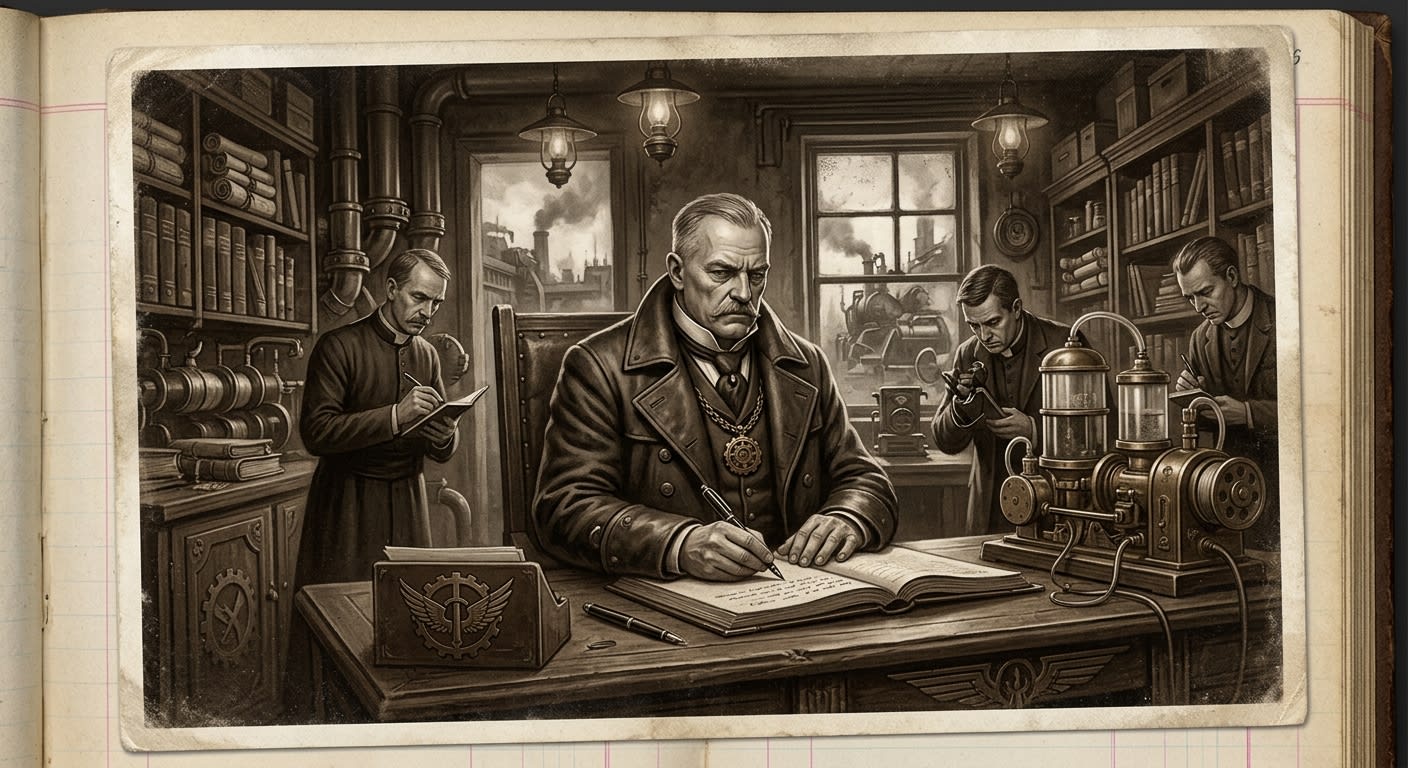
The first sworn notice of this discipline appears in A.S. 171, in an innkeeper's deposition from the Split Tongue (Unregistered). The innkeeper complained that Vark, then a junior clause-reader, would not even order sour beer unless the server repeated the request, the room scribe marked the hour, and a second patron nodded. The complaint was dismissed. The innkeeper later lost a toll dispute on the ground that his own petition contained the phrase informal understanding, a phrase the Fourth Stone hates with admirable venom.
By A.S. 178, the year the Triune Alphabet was imposed by edict on a continent already being mocked by stones that predated it, Vark had become Second Arbiter. By A.S. 187, when the Burnless Archive sealed its Seventh Vault after an incident the Bureau calls archivally insignificant in the tone it reserves for disasters, he had become High Arbiter. He inherited the bench, the nine-weight stamp, the precedent chain, and the professional certainty that every word he spoke might acquire teeth.
Vark's domestic arrangements are filed as court procedure. His house has witness alcoves in every room. Meals are served by pairs. Sleep orders are written. Servants communicate with him through slate cards unless a court officer stands present. His confessor, an elderly priest from the Oath Inns, hears Vark through a double screen with two licensed witnesses seated in the antechamber and one Paper Keeper recording each absolution formula for later deposit in the Archive.
The Bureau of Purity investigated this as vanity in A.S. 190. The investigation ended after the attending White Mantle asked Vark whether he denied private conscience. Vark replied, with three witnesses present: Private conscience is admissible only after public record establishes it exists. The White Mantle wrote nothing for the rest of the hearing.
Bureau of Purity field abstract 190-P described Vark's witness practice as “performative scruple.”
Corrected after consultation with Treaty Office (Unregistered) precedent books. The scruple is performative because performance is the only form the stones accept. A sentence without witness may still be true. At the Steppe Gate, truth without witness is unemployed.
#On Precedent as Merchandise
Vark's precedent books are sold openly in the Scribe Bazaar (Unregistered). This fact scandalizes visiting jurists, who prefer corruption to wear better shoes and stand farther from the cash box.
Each book is bound in goat-hide, sealed with the Caravan Court's nine-weight stamp, indexed by clause, dialect, disputed vowel, cargo class, and fatality. The cheaper copies omit marginal risk tables. The expensive ones include Vark's approved pronunciation marks, witness formulas, and the red caution glyph beside clauses whose prior enforcement produced blood. Translator-scribes buy them. Caravan lords hoard them. The Seal-House Consortium resells certified editions at triple price under the theory that a seal improves literacy. In the Steppe Gate, it often does.
Vark permits the trade because precedent hidden in an archive feeds only clerks, while precedent sold in the Bazaar taxes everyone. He also permits it because each purchased volume binds its owner to the court's reading. A caravan master who cites Vark's book has already accepted Vark's authority. A scribe who undercuts the ruling must first confess he bought the ruling. It is a lovely trap. I wish I had designed it.
The books have produced a profession of precedent peddlers (Unregistered): thin men and sharper women with satchels of last year's rulings, each hawking salvation by index. One may buy Vark on Salt, Vark on Escort Delay, Vark on Untranslatable Grandfathers, Vark on Witnesses Who Died Before Signing, and the notorious sealed pamphlet known as Vark on Silence, which the Null Tongue Brotherhood buys in bulk and pretends not to understand.
#On the Addenda and the Blank Future
Vark's great present wound is the Burnless Archive. Since A.S. 194, living addenda have appeared there: wet-ink clauses written by no living hand, furnished with proper witness seals, amending treaties and rulings with procedural perfection and moral obscenity. In A.S. 199, a rubbing of the Third Stone's southern face vanished from a vault where paper does not leave. The shelf now holds a blank folio whose ink remains wet.
Vark has convened emergency sessions of the Caravan Court on the matter. The minutes are beautiful in the way a clean incision is beautiful. In every session, Vark asks the same question: does an addendum bind if it satisfies the form? The court answers yes. He asks whether the addenda satisfy the form. The court answers yes. He asks whether the court has authority to reject a binding form because its author lacks a living pulse. The court answers no.
The addenda bind.
Extract from sealed emergency session, A.S. 200: VARK: If the clause bears witness, seal, key, and archive mark, the clause stands. SEAL-MISTRESS KORR: Even if no one wrote it? VARK: Especially then. PAPER KEEPER SELD: The blank folio changed weight this morning. VARK: By how much? SELD: ██████████████████████████████████████ VARK: Enter it.
This is why Vark is necessary. A coward would call the addenda invalid and be corrected by the stones. A zealot would call them miraculous and hand the Gate to whatever wet thing writes in the dark. Vark calls them binding and charges a filing fee. The judgment is monstrous. It is also legally stable, and stable monstrosity is the Synod's preferred construction material.
His critics call this surrender. Vark calls it jurisdiction. A law that cannot command the monster must at least invoice it, attach seals to its droppings, index its appetite, and ensure the correct office profits from the wound. I have served the Bureau long enough to recognize competence in obscene costume.
Earlier Caravan Court notices stated that living addenda were “under review and suspended pending decision.”
Clarified by Vark's ruling 201-Blue/17. Review suspends enforcement only when the reviewing authority outranks the instrument under review. The Caravan Court does not outrank the Treaty. The Bureau of Doctrine has not claimed to outrank the Treaty in writing, because even Strasbourg occasionally recognizes a stone with sharp edges.
#On Character, If Such a Thing Survives Litigation
Vark is neither warm nor cold. He is filed.
He is tall in the old Moldavian manner, narrow-shouldered, ink-pale from court shade, with a throat wrapped in linen against dust and a right hand permanently stained at the fingertips by red witness wax. He does not raise his voice. He does not lower it for tenderness. Those who seek mercy from him receive procedure. Those who seek cruelty receive procedure. Those who seek exemption receive a price list and, if foolish enough to complain, procedure again.
Captain Rho Balesh fears him because patrol violence becomes difficult when the High Arbiter asks for the clause authorizing each broken rib. Seal-Mistress Ylena Korr (Unregistered) profits from him because every Vark ruling requires seals, counterseals, copies, and the little wax miracles by which law becomes merchandise. The translator-scribes (Unregistered) loathe him with commercial devotion. The Gully Ledger Cartel forges his judgments badly on purpose, knowing even a poor counterfeit drives frightened caravans toward certified copies.
The common charge against him is that he sells justice. This is inaccurate and vulgar. He sells access to the machinery by which justice may be survived. Justice itself belongs to the stones, and the stones are terrible accountants.
Vark's oldest surviving ruling, copied in red ink on a cracked hide placard above Western Arc Stall Fourteen (Unregistered), concerns a refugee child, two dead mules, and a word for shelter that existed in one steppe dialect and in no Synod dictionary. The child pronounced it correctly. The caravan lord pronounced it profitably. Vark awarded the shelter to the child, the mules to the lord's creditors, and the disputed word to the court, where it now requires a five-copper license before use. Mercy, commerce, seizure. A fine ruling. Naturally the locals hate it.
#On the Last Witness
What troubles me is less Vark's silence without witnesses than the possibility that, after thirty years, he no longer knows how to think without one.
A sentence spoken under witness becomes public, binding, exposed to stone and wind and paper. A sentence held inward may remain free for a moment, but the Steppe Gate has little patience with unfiled freedom. Vark has trained himself into perfect civic shape. He has made his conscience admissible. He has mortared his soul into the court record and called it prudence. There is a class of holiness that differs from cowardice only by the presence of a stamp; the Steppe Gate has made a science of it, and Vark is its grey-haired laboratory animal. The Bureau applauds this sort of thing when it happens to other people.
In A.S. 201, during my last doctrinal inspection, I watched Vark sit alone on the limestone bench after court adjourned. Alone is the official word. Two witnesses stood in the western shade, one scribe held the minute slate, and the Seventh Stone recited a toll clause into the dust. Vark placed his hand on the bench, where generations of arbiters had worn the stone shallow, and moved his lips without sound.
The witnesses did not hear. The scribe did not mark. The stones recited louder.
Vark remains High Arbiter because the Gate requires a man who fears language more than he loves power. Such men are rare. Most officials love power, fear exposure, and write memoirs. Vark sells precedent, binds ghosts, taxes caravans, obeys wet paper, and lets no sentence leave his mouth unwitnessed unless the sentence has no sound at all.