
#On the First Unauthored Clause
The Living Addenda began in A.S. 194 with a shelf-audit in the Fourth Vault of the Burnless Archive, which is to say they began exactly where all tolerable nightmares begin: with a clerk finding one document too many.
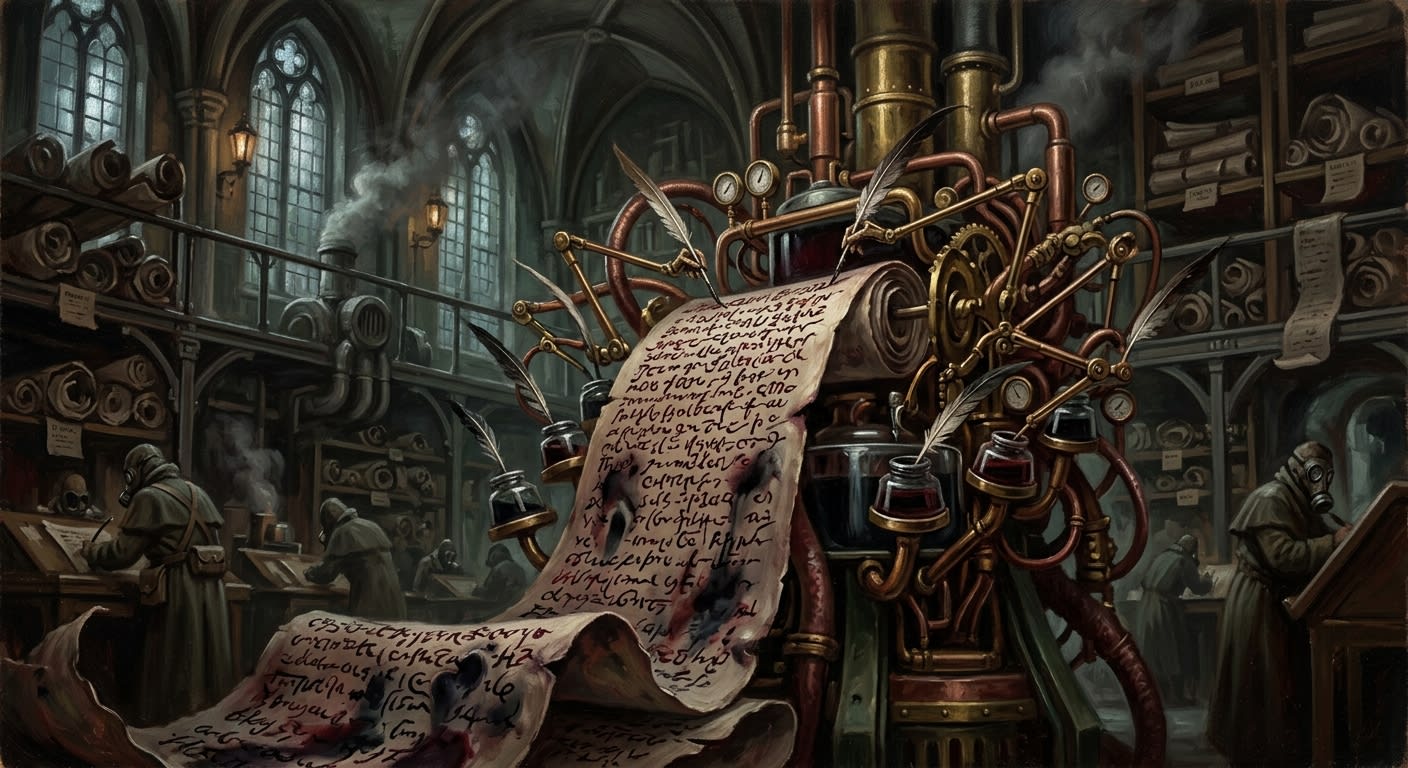
A Paper Keeper found a folio absent from the master index. It was written in the Triune Alphabet. The ink was wet. The layout obeyed the current arbitration format with the prim decorum of a trained legal parasite: heading, witness blocks, toll schedule, pronunciation key, seal field, closing mark. The text amended a passage writ dated A.S. 118, reclassifying a caravan route from permitted to compulsory and retroactively obligating seventy-six years of caravans to a toll nobody had assessed, collected, or had the decency to forget.
The seals were genuine. The ink was the Archive's own Nemea ash-ink. The witness names belonged to real persons. Three of the four witnesses were dead.
The Bureau of Doctrine classified the phenomenon as Autonomous Scribal Manifestation, Category Two, Cause Under Active Classification. The phrase has a splendid ceremonial uselessness. It means the page wrote itself, the Bureau disliked the theological smell, and no one wished to be the first official to ask whether the Archive had acquired a hand.
#On Form and Obedience
The Living Addenda are obscene because they are correct. If they arrived misspelled, missealed, smudged, dated in heretical fashion, or written in the greasy cant of some gutter prophet, the Bureau of Purity would have burned the shelf, interrogated the ash, and declared victory before lunch. They arrive with perfect letterforms, exact seals, admissible witnesses, valid pronunciation keys, and procedural humility. They do not rant. They amend.
That is their genius, or their appetite.
Since A.S. 194, the Addenda have increased from a quarterly nuisance to an ordinary wound. By A.S. 199, the Keepers found three to eleven new folios per audit cycle. By A.S. 201, they appear approximately twice each week. They alter passage writs, toll schedules, escort contracts, confession summaries, witness lists, and arbitration rulings. One documented folio in A.S. 200 amended a ruling the Caravan Court had not yet delivered. Three weeks later the ruling arrived in the exact posture required by the amendment, as though the Court had obeyed a document it had never seen.
Earlier memoranda described the Addenda as “forgeries of uncertain provenance.”
Withdrawn. A forgery imitates authority. These folios possess authority before any living hand concedes the point. The Bureau of Records dislikes this distinction because it makes Records sound optional.
High Arbiter Senn Vark resolved the central legal question with the practical savagery for which I have, under seal, admired him: if an addendum satisfies form, it binds. The author is irrelevant. Pulse is not a statutory requirement.
#On the Paper's Appetite
The popular fear at the Steppe Gate is that the Addenda are messages. This is sentimental drivel. Messages seek readers. The Addenda seek compliance. A message may be ignored by the arrogant, the illiterate, or the mercifully drunk. An addendum enters a file, alters a duty, imposes a charge, corrects a future act, and waits while men convince themselves they have chosen to obey.
They feed upon completed enforcement. The Treaty-Stones were raised in A.S. 76, the Red Pronunciation killed a thousand in A.S. 94, and since then every execution within the Treaty Ring has written a silent supplement into the Gate's law. The deployed Steppe Gate entry states the buried truth plainly enough for anyone with permission to be alarmed: human silence, made permanent, is the ink the stones cannot refuse.
A restricted Doctrine comparison table links Addendum frequency to enforcement deaths within the Treaty Ring, oath-note deposit rates, and confiscated stone-rubbing proximity. The final column is headed “Digestive Interval.” Three officials signed the table. Two signatures later appeared as witnesses on a folio dated next month. The third signature is now blank.
The disappearance of the Third Stone (Unregistered)'s southern-face rubbing in A.S. 199 sharpened the matter from legal obscenity into strategic hazard. The missing rubbing carried the whisper-resonance of the clause whose mispronunciation closed one thousand throats. The shelf now holds a blank folio. Its ink is wet. Its page is empty. Seld inspects it each morning with cotton gloves and trained fear.
#On the Court That Obeys
The Addenda have made cowards of some offices, theologians of others, and merchants of everyone. Records demands chain of custody and receives wet ink. Rites demands jurisdiction and receives no miracle it can safely bless. Purity demands contamination and receives immaculate form. The Seal-Houses (Unregistered) demand payment and receive it first, which proves they alone understood the matter's true scale.
Vark's Court has stopped contesting their legality. Three caravan houses have restructured debt obligations based on clauses written before their grandfathers were conceived. Seal-Mistress Korr (Unregistered) has tripled certification fees because each Addendum requires fresh seal verification, and her nose remains the only instrument in the Gate the paper has not learned to counterfeit. This may be because the paper lacks a nose. It may be courtesy.
The theological peril is that the Archive tells procedurally valid truth without permission. Lies are manageable. The Synod maintains twelve offices for lies, six for useful lies, and at least one that exists chiefly to deny the difference. It amends the world through channels we built, using forms we sanctified, in a script we imposed to make heresy unthinkable.
That is rude.
Public notices continue to describe the Addenda as “under review.”
Clarified. Review continues. Enforcement also continues. Any citizen wishing to test the difference may file Form 19-R, append a pronunciation certificate, pay the provisional objection fee, and place his throat within range of the nearest stone.
#On the Present Wetness
As of A.S. 201, the Addenda appear twice weekly. Their ink dries within the hour except when it does not. Their witness fields are valid except when the witness has not yet been born. Their dates are current except when they lean forward with the nasty patience of a creditor at a sickbed. The Paper Keepers isolate each folio, duplicate the silent mark, whisper the accession, and deliver the amendment upward into the machinery that will pretend to decide what the page has already done.
The blank folio remains blank. Its ink remains wet. Seld remains at his post.
The Addenda are an accession. They use the Archive's law intact. They submit paperwork to the Synod. Somewhere beneath the cutbank, paper has learned the old lesson of government: the hand that writes the correction need not be seen, only obeyed.