
#On the Nature of Indestructible Paper
"The fire refuses it. The damp ignores it. The worm turns aside. Only the ink consumes, and even the ink must ask permission." — Inscription above the Archive's inner door, attributed to Paper Keeper Alzen Voss, A.S. 112. The attribution is disputed. The inscription is not.
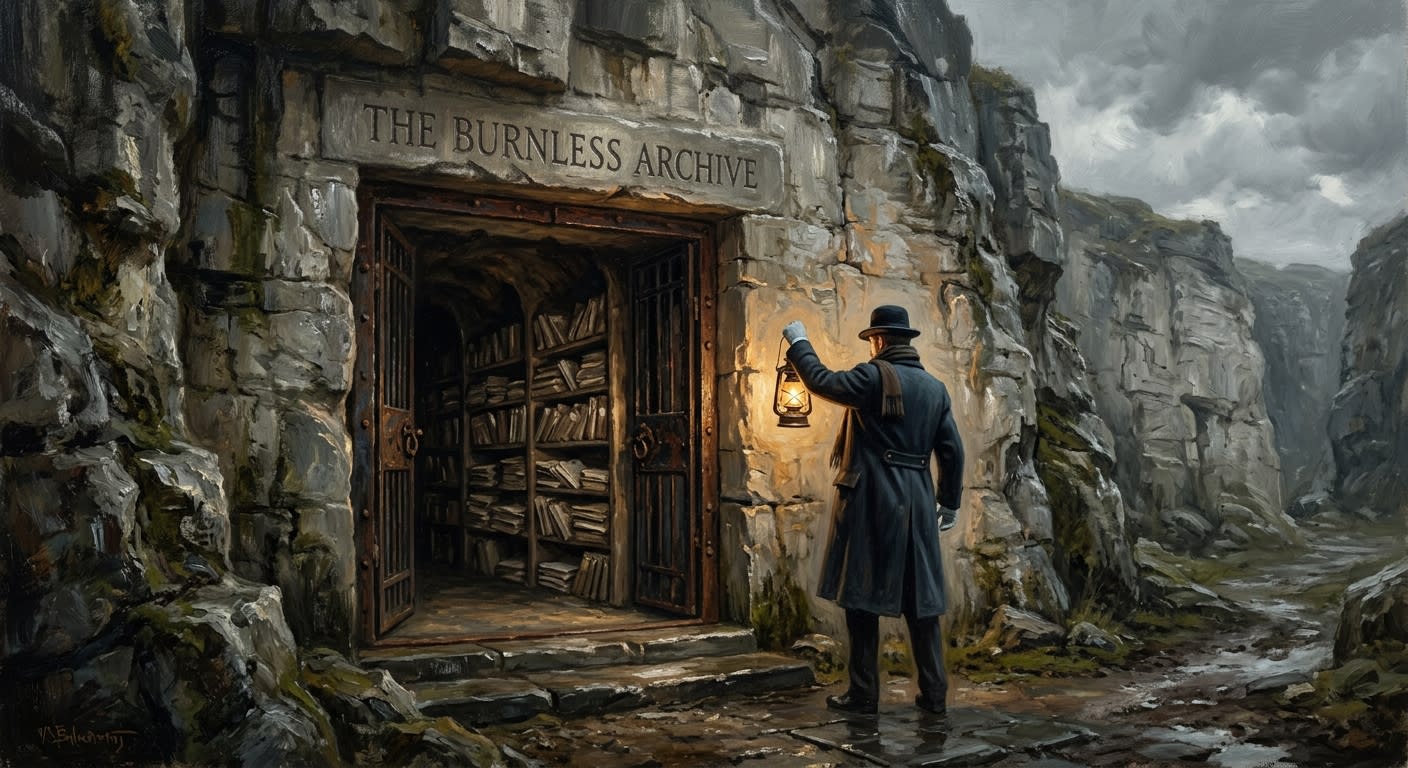
Beneath the eastern cutbank of the Steppe Gate, where the limestone shelves downward into a cold that has nothing to do with season and everything to do with what the stone remembers, there is a door. It is iron. It is old. It does not lock, because it does not need to lock — the paper inside is its own warden, and the paper has never, in one hundred and twenty-five years of continuous occupation, permitted a single folio to leave.
The Burnless Archive is the Steppe Gate's memory, its stomach, and — if the developments of A.S. 199 are correctly interpreted, which the Bureau of Doctrine insists they are not — its appetite. Every treaty sealed within the Treaty Ring, every arbitration ruling handed down by the Caravan Court of Nine Weights, every confession extracted in the Oath Inns and transcribed onto oath-note paper, every addendum, every clause, every scrawled correction in the margin of a passage writ — all of it descends, eventually, into the Archive. The paper enters. The paper stays. The paper does not burn.
This last property is the Archive's defining characteristic, its administrative miracle, and its theological inconvenience. The Bureau of Records has tested the phenomenon with the thoroughness of an institution that suspects it is being mocked. Flame will not take. Acids bead and roll away like rain on oilskin. Tearing produces a sound — a high, thin keening, audible only to the person holding the folio — but no actual separation of fibres. Water soaks in and drains out, leaving the text sharper than before, as though the ink had been refreshed. A Bureau of Alchemical Standards team dispatched in A.S. 143 — the Year of Ash Rain, when everything that could burn did — subjected twelve sample folios to fire, oil-of-vitriol, prolonged submersion, and mechanical grinding. The folios survived. The grinding wheel did not. The team's report, filed under Classification Amber, concluded: "The substrate resists all standard methods of destruction. We recommend non-standard methods. We do not know what non-standard methods would be."
The recommendation has been pending for fifty-eight years. The Bureau of Doctrine prefers the word "anomalous" because anomalies can be studied at leisure, whereas operational concerns require budgets. The distinction, as is so often the case in the Synod's administrative vocabulary, is fiscal.
#On the Architecture of Permanence
The Archive occupies a natural cavity in the cutbank limestone — a long, low throat of stone that the Steppe Gate's founders widened in A.S. 78, two years after the Treaty-Stones were raised, when the first arbitration rulings began accumulating faster than the Treaty Office (Unregistered) could stack them in the open air. The widening was done with hammers and chisels. The limestone cooperated. The workers reported that the stone split cleanly along lines that corresponded, with suspicious precision, to the dimensions of standard folio shelving. The Bureau of Engineering's site report noted: "The cavity appears pre-shaped for document storage. This is geologically unlikely but administratively convenient."
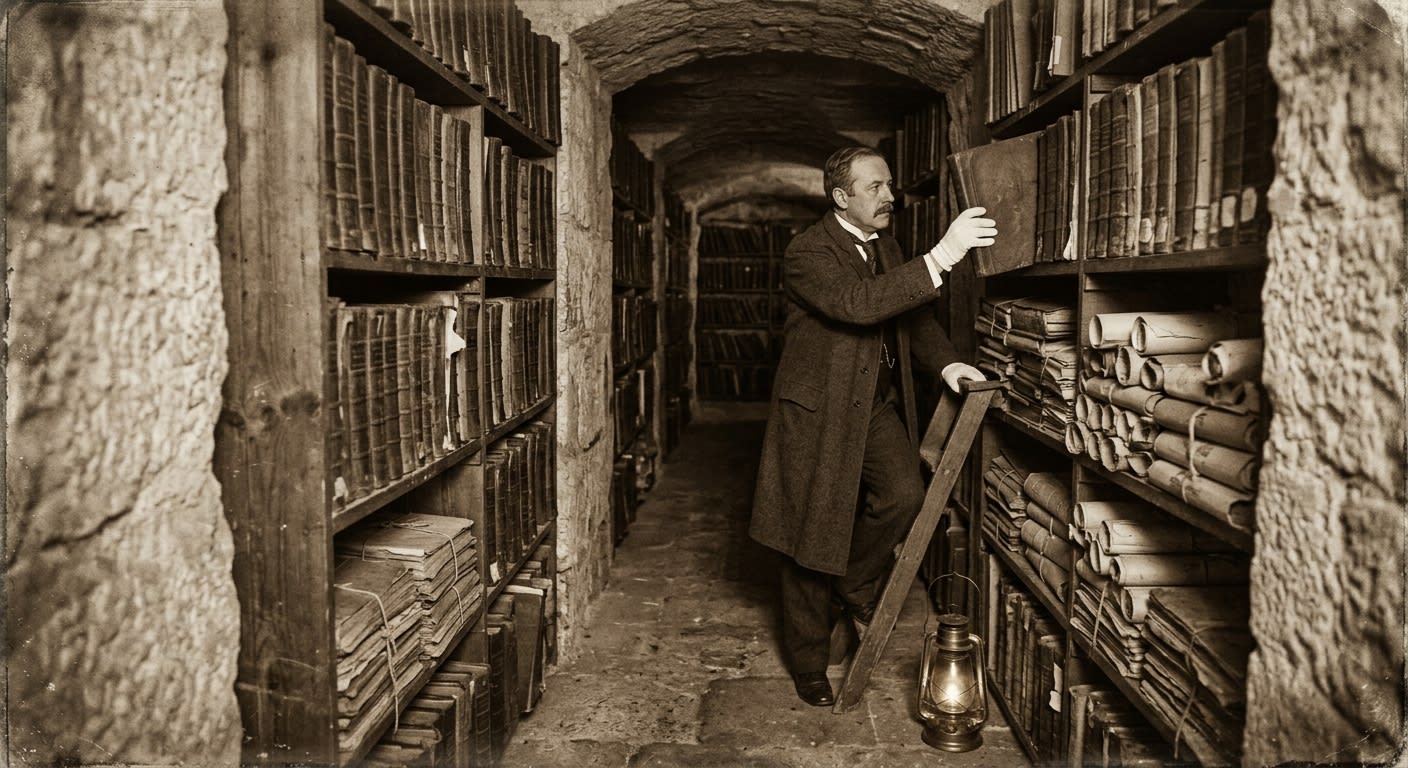
The Archive's interior is divided into seven vaults, numbered in the order of their excavation and connected by a central corridor so narrow that two men cannot pass abreast. The walls are unplastered limestone. The shelves are limestone, cut from the same cutbank and mortared with a paste of calcium and — per the Paper Keeper's guild manual, which I have read and which I was not supposed to read — powdered bone from the Steppe Gate's execution yard. The bone-paste is not decorative. It is, according to the guild manual, "a necessary binding agent for substrates of persistent character." The manual does not elaborate on what "persistent character" means. The manual does not need to elaborate.
The First Vault holds the founding documents: the original treaty text carved on goatskin transfers from the seven stones, the Charter of Administrative Node Seven filed by the Bureau of Records in A.S. 78, and the Seal-House Consortium's monopoly ratification of A.S. 94. These folios are the oldest in the Archive and the coldest. Visitors to the First Vault report that the temperature drops as they approach the founding shelf — a phenomenon the Paper Keepers attribute to "archival climate control" and which the Bureau of Rites has classified as a Category Two Localized Thermal Anomaly, Cause Pending.
The Second through Fifth Vaults hold the operational records: arbitration rulings, passage writs, escort contracts, toll assessments, pronunciation certificates, and the vast, meticulously cross-referenced files of the Caravan Court. These vaults are the Archive's working body — its lungs, its bowels, its daily bread. Paper Keepers circulate through them on eight-hour shifts, re-shelving, cross-referencing, and — this is the task they speak of least — checking for new pages.
The Sixth Vault holds the confessions. Every confession recorded in the Oath Inns — every low admission of debt, adultery, heresy, desertion, or simple exhaustion — is transcribed onto oath-note paper, sealed with the Seal-House Consortium's wax, and filed in the Sixth Vault by date, district, and sin-category. The confessions are weaponised. A man who confesses in the Oath Inns confesses for the Archive, and the Archive does not forgive, does not forget, and does not accept the concept of absolution as a filing category. Debts confessed here compound. Sins admitted here accrue interest. A grandfather's quiet adultery becomes a grandson's toll surcharge, because the paper remembers, and the paper is patient, and the paper is still legally binding.
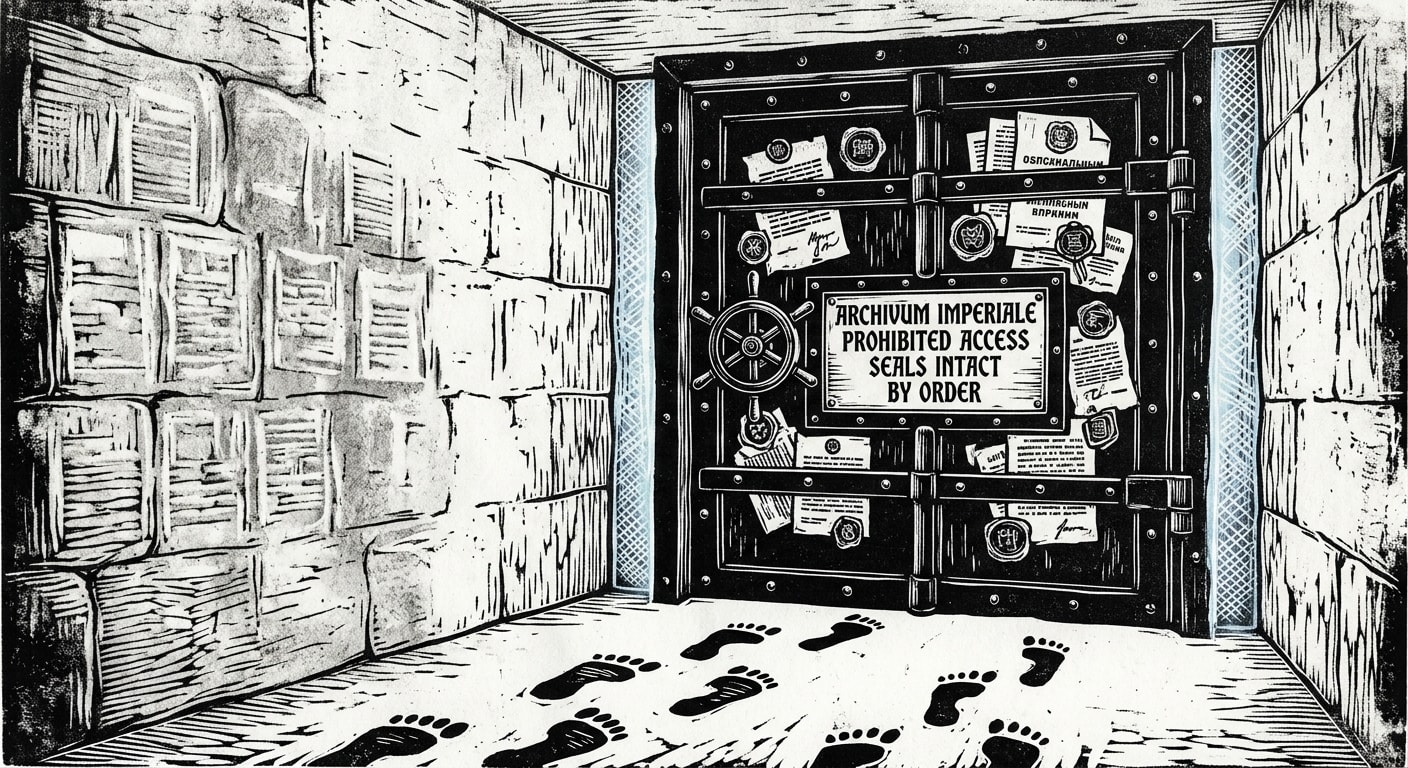
The Seventh Vault is sealed.
It was sealed in A.S. 187, following an incident the Bureau of Doctrine has classified as "archivally insignificant" with a vehemence that suggests the opposite. The Paper Keepers' guild manual — the one I was not supposed to read — devotes a single paragraph to the Seventh Vault. The paragraph states: "The Seventh Vault contains documents that precede the Treaty. These documents were present when the cavity was first opened. They are not in any known language. They are not on any known paper. They are cold. They are growing." The paragraph is followed by a blank page. The blank page is, I suspect, the most informative document in the guild manual.
#On the Paper Keepers
The Archive is staffed by a guild of forty-three men and women who call themselves Paper Keepers and whom the rest of the Steppe Gate calls, with varying degrees of affection and dread, the Dust Priests. They are not clergy. They hold no Synod rank. Their authority derives from the guild compact ratified by the Treaty Office in A.S. 82, six years after the founding, when the first Paper Keeper — a woman named Alzen Voss, whose inscription still marks the inner door — established the principle that the Archive's staff must be literate in the Triune Alphabet, conversant with the pronunciation protocols of all seven stones, and willing to live underground.
The last requirement is not metaphorical. Paper Keepers reside in dormitory cells cut into the limestone above the Third Vault. They eat meals delivered through a service hatch. They wash in a cistern fed by cutbank seepage. They emerge into daylight for four hours per week — a schedule that the guild manual describes as "optimal for archival temperament" and that the Bureau of Medicine has described, in a memorandum the guild has chosen not to acknowledge, as "clinically concerning."
The guild's recruitment is internal. Apprentices are drawn from the children of existing Keepers or, increasingly, from the orphaned children of the Caravan Corrals — children who have no passage writs, no toll assessments, no pronunciation certificates, and therefore no legal existence above ground. The Archive gives them existence. The Archive gives them a name on a page that will never burn. The children, in turn, give the Archive their lives, which is the only currency the paper accepts without a seal.
Paper Keepers do not speak above a whisper inside the vaults. This is partly tradition, partly acoustics — the limestone corridor amplifies sound in ways the Bureau of Bells has described as "architecturally improbable" — and partly fear. The paper listens. Paper Keepers who have served more than a decade report that the folios respond to their voices: shelved documents rustling when addressed, filed confessions reciting back their contents when a Keeper lingers too long, and — in the Sixth Vault especially — pages turning of their own accord to display entries that the Keeper had been searching for. The guild manual calls this "archival responsiveness." The Bureau of Rites calls it a Category Two Localized Scribal Anomaly. The Paper Keepers themselves call it "the Archive helping," and they say it with the careful gratitude of people who understand that help, in the Steppe Gate, is a commodity with a price.
STAMPED ERRATUM — Bureau of Records, A.S. 199 Prior census listed the Paper Keepers' guild at forty-seven members. The figure has been revised to forty-three. The discrepancy is attributed to a transcription error in the guild's own membership rolls. The four missing names were present on the rolls in A.S. 198 and absent in A.S. 199. The guild has declined to comment. The Bureau of Records notes that the names in question now appear on folios in the Sixth Vault — as authors, not as subjects. The Bureau of Records does not know what this means. The Bureau of Records has filed a request for clarification. The request is pending.
#On the Living Addenda
The phenomenon that transformed the Burnless Archive from an administrative curiosity into a theological emergency began — as so many theological emergencies do — with a filing discrepancy.
In A.S. 194, a Paper Keeper conducting the quarterly shelf-audit of the Fourth Vault discovered a folio that did not match any entry in the master index. The folio was written in the Triune Alphabet. The ink was wet. The text was a clause — a perfectly formatted arbitration addendum, complete with witness seals, toll assessments, and a binding pronunciation key — that amended a passage writ dated A.S. 118. The amendment reclassified a caravan route from "permitted" to "compulsory," retroactively obligating seventy-six years of caravans to a toll they had never been assessed.
The folio had not been filed by any Keeper. The seals were genuine. The ink was the Archive's own — Nemea ash-ink, the standard for all sensitive Synod documents, manufactured at the Scriptorium of Nemea and shipped under Bureau of Records seal. The pronunciation key was flawless. The witness names were real people. Three of the four witnesses had been dead for decades.
The living addenda have appeared with increasing frequency since A.S. 194. The Paper Keepers' quarterly audit now discovers between three and eleven new folios per cycle — unsigned, undated by any living hand, written in ink that is wet when found and dry within the hour, amending treaties, passage writs, and arbitration rulings that range from decades old to, in one case documented in A.S. 200, not yet written. That last folio amended a ruling the Caravan Court had not yet delivered. The amendment was procedurally correct. The ruling, when delivered three weeks later, matched the amendment's assumptions in every particular. The Caravan Court denied having read the folio. The Paper Keepers denied having shown it. The amendment sat on its shelf and said nothing, because the paper, having spoken, does not repeat itself.
The Bureau of Doctrine has classified the living addenda as "Autonomous Scribal Manifestation, Category Two, Cause Under Active Classification." The classification has been "active" for seven years. The Bureau of Rites has petitioned for jurisdictional transfer. The Bureau of Records has petitioned for the petitions to stop. High Arbiter Vark has convened four emergency sessions of the Caravan Court, each of which concluded with the same ruling: the addenda are legally binding if they meet procedural standards, and they meet procedural standards, so they are legally binding. The circular logic satisfies the Court. It horrifies everyone else.
#On the Missing Rubbing
The crisis of A.S. 199 — the event that elevated the Burnless Archive from theological curiosity to strategic emergency — was the disappearance of a stone-rubbing.
Stone rubbings are the most dangerous objects in the Archive. A true rubbing, taken from the original carvings of the seven Treaty-Stones, carries the under-breath resonance of the original clauses — the sound the wind makes when it reads the stone, pressed into paper like a fingerprint pressed into wax. Possessing a rubbing is equivalent to possessing a weapon. The Bureau of Purity classifies them as Prohibited Material, Class Two — one class below demonic artefacts, one class above unlicensed printing plates.
The Archive held seventeen rubbings, one for each of the fourteen stone-face panels and three duplicates made during the Bureau of Records' comprehensive survey of A.S. 92. On the morning of the quarterly audit in A.S. 199, the count was sixteen. The rubbing of the Third Stone's southern face — the face that carries the archaic variant of the binding clause, the clause that arbiter Sarn (Unregistered) mispronounced in the Red Pronunciation of A.S. 94 — was gone.
Gone. From a vault where paper does not burn, does not tear, does not decay, does not leave.
The implications fork. The deployed parent entry records both branches, and I will not rehearse them here at length — commercial catastrophe if someone found a method to remove the paper, theological catastrophe if the paper chose to leave. What concerns the Bureau, and what concerns me, is the third possibility that neither the Treaty Office nor the Caravan Court has been willing to articulate in writing: the rubbing was consumed.
Consumed by the Archive itself. Fed into whatever process generates the living addenda. Used as raw material — the original under-breath resonance of the binding clause ground into the substrate of a new amendment, an amendment the Archive is still writing, an amendment whose terms no living hand has set and no living voice has pronounced.
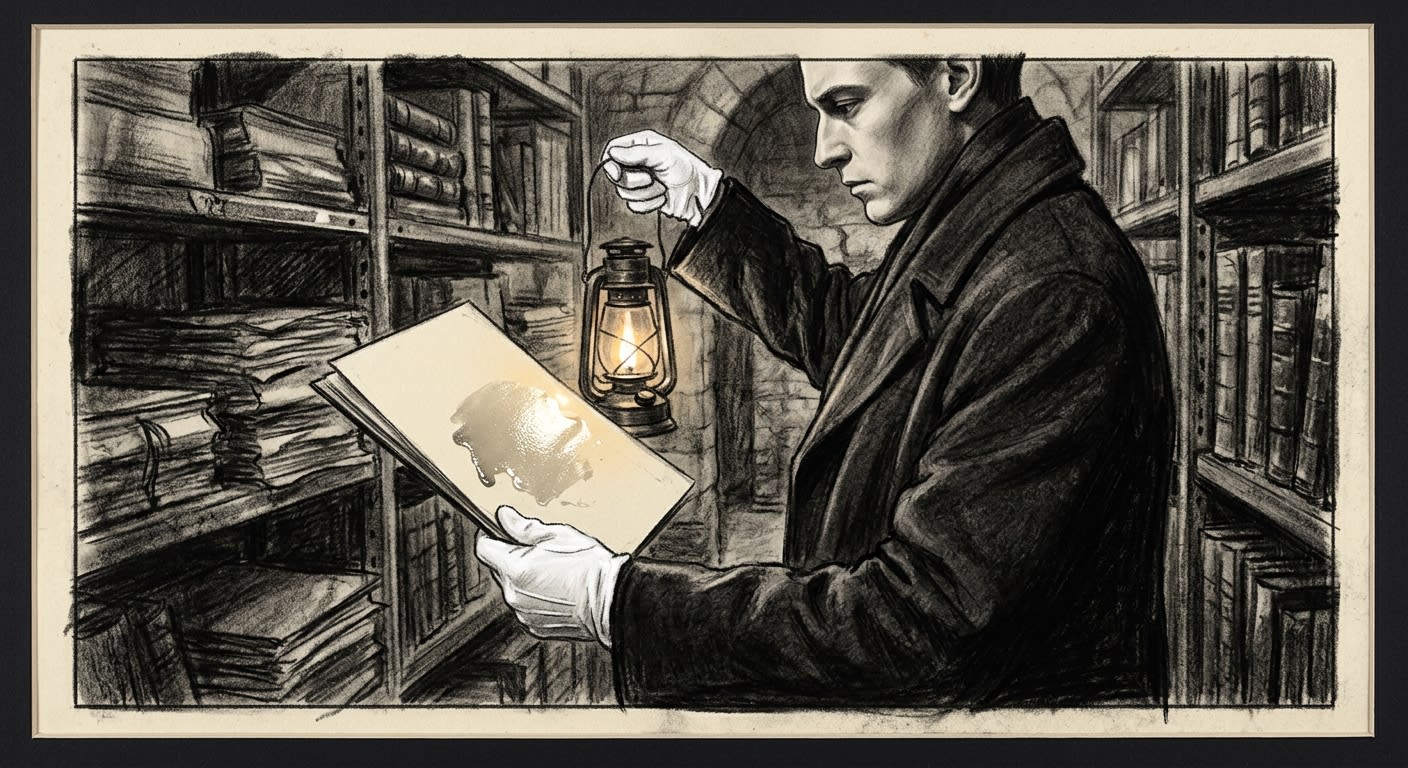
The blank folio on the shelf where the rubbing sat has been blank for two years. The ink on it has been wet for two years. Paper Keeper Seld — the man with the cotton gloves, the man who told me the paper remembers fingers — checks the folio every morning. Every morning the folio is blank. Every morning the ink is wet. Every morning Seld puts on his gloves, lifts the folio, and holds it to the lantern light. He is looking for text. He has not found text. He has told me, in the only volume the Archive permits, that he is afraid of the morning when text appears, because the text will be a clause, and the clause will be binding, and the clause will have been written in the resonance of the Third Stone's southern face — the face that killed a thousand people when it was mispronounced.
I asked Seld what he would do when the text appeared.
He said he would read it correctly.
I asked him how he could be certain he would read it correctly.
He did not answer. He put on his gloves. He returned to the shelves.
#On the Present Condition
The Burnless Archive, as of A.S. 201, is a vault that is filling itself.
The living addenda now appear at a rate of approximately two per week — double the rate of A.S. 199, quadruple the rate of A.S. 194. The Caravan Court has stopped contesting their legality; the procedural standards are always met, the witness seals are always genuine, and the rulings they amend are always real. Three caravan lords have restructured their toll arrangements based on addenda that amended contracts signed before their births. Seal-Mistress Korr (Unregistered) has tripled her fees, because every new addendum requires a fresh seal, and every fresh seal requires her nose, and her nose is the only instrument in the Steppe Gate that the paper has not yet learned to counterfeit.
The blank folio remains blank. The ink remains wet. Seld remains at his post.
The Seventh Vault remains sealed. The documents inside — the ones that predate the Treaty, the ones in no known language on no known paper — are, per the Paper Keepers' guild manual, still growing. The guild manual does not say what "growing" means. The guild manual, which is itself stored in the Burnless Archive, may already have been amended on this point. No one has checked. No one wants to check. The checking, after all, would require reading, and reading in the Burnless Archive is an act of participation, and participation in the Archive's economy of permanence is — as the Steppe Gate's every inhabitant knows, from the High Arbiter to the lowest Corral orphan — a binding commitment.
The paper does not burn. The paper does not leave. The paper does not forget.
The paper is writing.