
#On the Houses Where Speech Is Rented
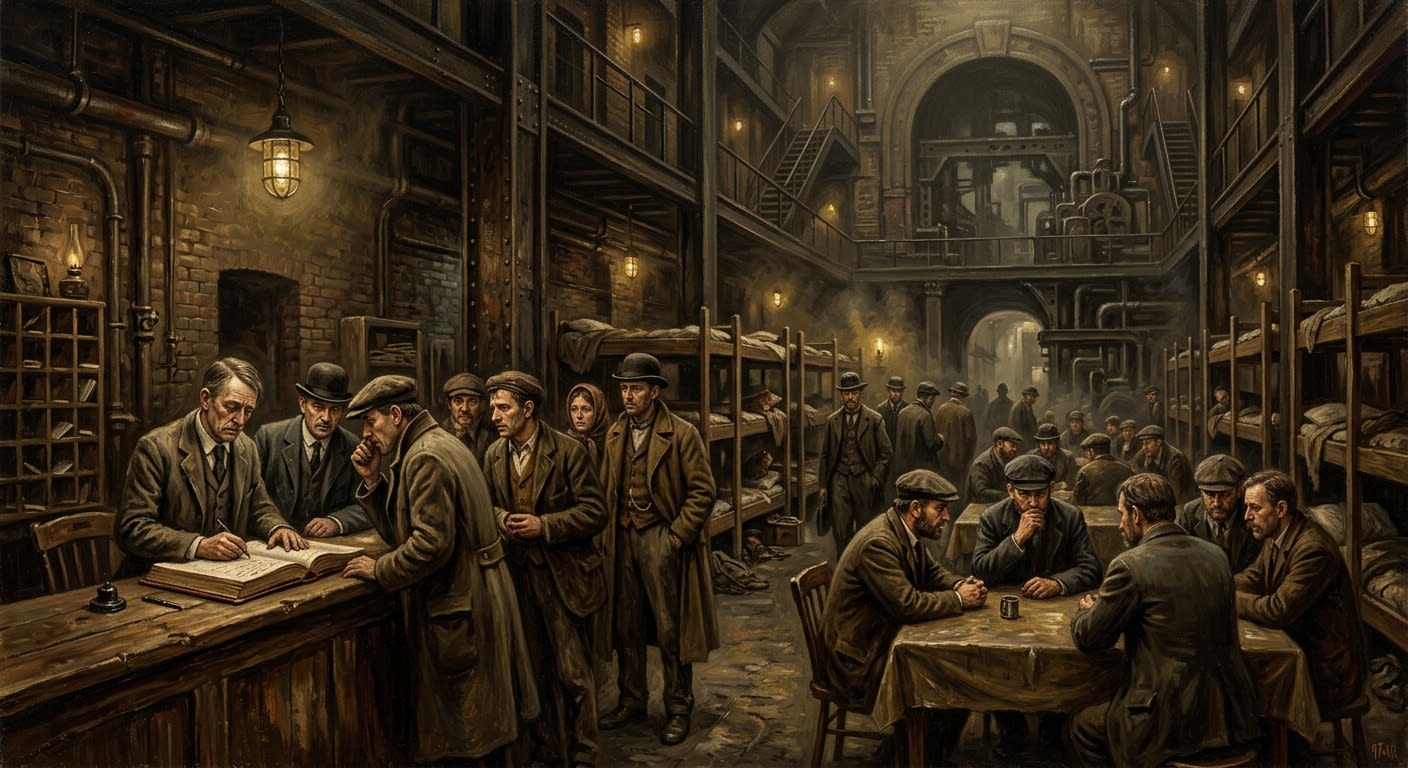
The Oath Inns of the Steppe Gate pour beer with the grim liberality of a border town that has discovered three lawful uses for intoxication and eleven unlawful ones, yet no serious clerk mistakes them for taverns. Their upstairs rooms have birthed more binding judgments than many municipal seals west of Vienna, though they hold no court seal. Men confess there, weep there, swear there, and depart believing some portion of their souls has been accepted as collateral, though no chapel ledger admits them without coughing ink.
They are inns. This means they sell beds to the exhausted, sour drink to the frightened, witness space to the litigious, recorded speech to the desperate, and, when business is proper, silence at a premium.
At the Gate, shelter has clauses. A roof changes acoustic exposure. A door decides whether wind may carry a clause. A cellar determines whether the clause-spirits receive a half-heard word, a full oath, or only the wet cough of a man smart enough to keep his legal opinions inside his teeth. The Oath Inns line the northern gullies because the gullies dip below the worst crosswind and because early innkeepers, those rat-faced saints of practical theology, learned that a contract made two arm-lengths below street level killed fewer patrons than one made in the open Ring.
The inns arose in A.S. 78, when the settlement was registered and the first caravans realised that a man could not sleep beside the Treaty-Stones without dreaming in clauses. By A.S. 82 the Treaty Office (Unregistered) had licensed the first witness rooms. By A.S. 94, after the Red Pronunciation closed roughly one thousand throats, every serious inn owned wool plugs, phoneme cards, two certified scribes, three buckets for blood, and a house rule forbidding the repetition of court terms after second bell.
#On the Oath-Cup and the Witness Bench
The ordinary transaction is simple, which is how the Gate disguises the rack. Two parties enter. They sit at a bench cut with nine shallow grooves: claimant, respondent, scribe, house witness, external witness, translator, debt object, seal place, and blood place. The innkeeper pours witness-milk, a cheap liquor with enough chalk in it to coat the throat and enough bitterness to discourage eloquence. The parties drink. The scribe reads the formula. The witnesses answer. The oath is spoken once, written twice, sealed thrice, and carried before dawn to the Burnless Archive, where the paper will outlive the drinkers, their children, and any sentimental hope that time improves debt.
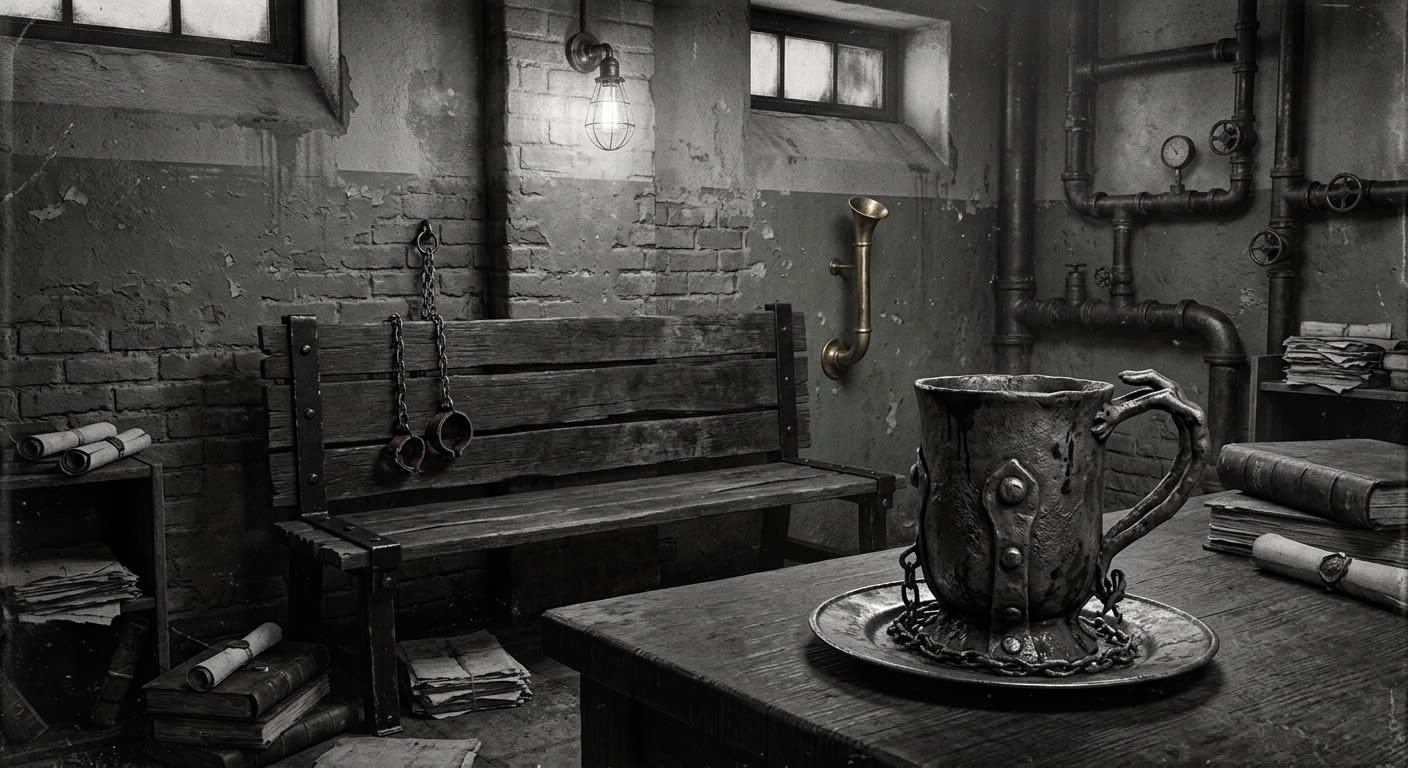
The oath-cup is not sacramental, says the Bureau of Rites. The oath-cup is contractual, says the Bureau of Records. The oath-cup is taxable, says the Bureau of Tithes. All three offices agree, which proves the cup is dangerous.
A proper inn maintains at least one licensed oath-room above ground for ordinary contracts and one cellar room for wind-sensitive matters. The wall boards are packed with wool, ash paste, and old confession slips rendered blank by scraping. The lanterns are shaded to hide lips from the lane. A red cord hangs beside the door; if pulled, the scribe stops all mouths, covers all ink, and waits until the wind has passed. A grey cord hangs beside the hearth; if pulled, the house witness has died or lied, which in Gate practice requires similar paperwork.
The innkeeper's art lies in balancing intoxication against admissibility. A fully sober merchant remembers too much and signs too little. A drunk soldier promises a mule, a sister, three cartridges, and the remission of a sin he did not commit, then objects when the bill arrives with seals. The licensed measure is one cup before oath, half cup after witness, no cup during phoneme review. Only fools, lovers, and visiting theologians violate this sequence. Two of the three are curable.
#On Confession as Collateral
The Oath Inns' chief invention is the collateral confession (Unregistered). This charming instrument permits a traveller lacking coin, seal, escort, or proper lineage to pledge an admissible truth in exchange for bed, passage help, translation, or temporary protection. The truth is written on oath-note paper, witnessed by the house, sealed by the inn, and sent to the Sixth Vault (Unregistered). If the debtor pays, the confession remains sealed. If the debtor defaults, the confession becomes usable in court, market, marriage, inheritance, patrol questioning, tariff assessment, or parish humiliation.
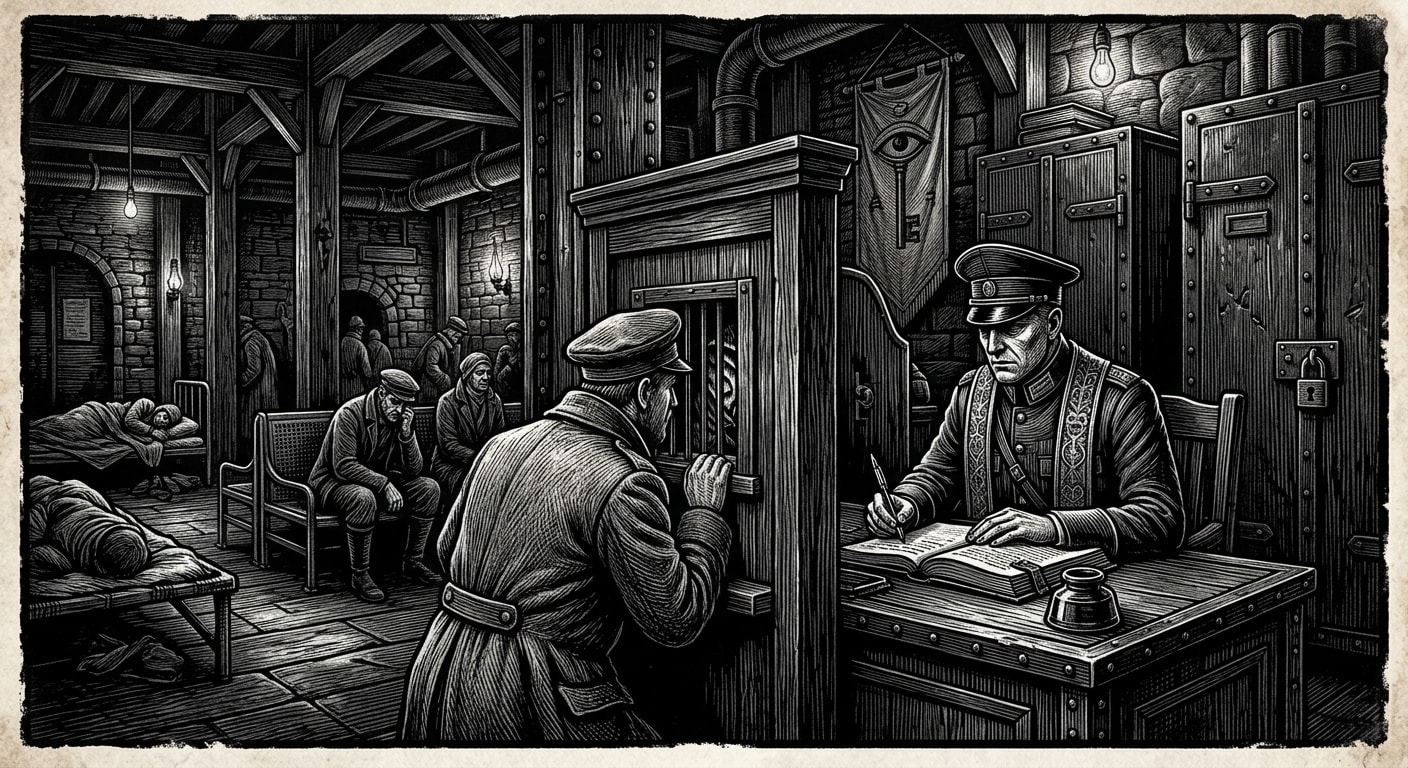
The Bureau calls this voluntary moral security.
The poor call it selling the noose by inches.
Treaty Office Notice 103-C described collateral confession as “an emergency mercy instrument for the paperless.”
Clarified. It is emergency mercy in the same sense that a hook is assistance to a fish. The instrument saves the petitioner from immediate exposure and preserves him for later extraction, which is the frontier definition of kindness.
The confessions vary. Debt hidden from a caravan master. False baptismal spelling. Contraband prayer card. Murder confessed because the corpse is outside Synod jurisdiction and the bed is warm. A mother admitting she sold one child's route token to feed another. A translator-scribe confessing that he softened a consonant on purpose and watched a competitor's client bleed from the ears. Each truth enters the Archive, acquires a shelf, and waits.
Here the inns become ecclesiastical in function and obscene in honesty. A parish confessional promises absolution. An Oath Inn promises storage. The difference matters. Absolution releases guilt into doctrine's custody. Storage preserves guilt for profitable deployment. Priests speak of mercy; innkeepers speak of retrieval. I know which profession is less hypocritical.
#On the Split Tongue
The largest and most notorious of the Oath Inns is the Split Tongue (Unregistered), a three-storey timber-and-limestone establishment built where the north gully bends below Seal-House Row and the wind loses enough force to become merely rude. Its sign shows a tongue divided cleanly down the middle, one half red, one half black, both halves pierced by the same nail. The inn claims this refers to dual witness. The locals know better.
The Split Tongue became infamous after the Red Pronunciation, when twenty-seven bodies were found in its upper corridor with ink at their ears and salt invoices stuck to their palms. The innkeeper at the time, Mira Valch (Unregistered), survived because she had been in the cellar teaching a muleteer how to say shall without dying. Within a month she had rewritten house rules, doubled witness fees, banned open repetition after dusk, and opened the first paid silence room: a cellar chamber where no contract could be spoken, only written, pointed at, and sealed under cloth.
The Split Tongue's cellar later housed the first meetings of the Null Tongue Brotherhood, though the present proprietor denies this with the weary precision of a man who rents the same cellar every third night to men who answer by moving their hands. Purity has raided it five times. Each raid found blank hymn books, wool plugs, unpaid ledgers, and enough gesture primers to indict the furniture. Each raid ended with fines rather than closure. The inn has too many useful rooms, too many witnesses on record, and too many sealed packets involving men who now sit on inspection boards.
#On Innkeepers, Scribes, and House Witnesses
An Oath Inn is governed by a triad: the keeper, the house scribe, and the standing witness. The keeper owns the door and the debt. The scribe owns the phrasing. The witness owns the memory, or pretends to, which is usually enough for admissibility. In prosperous houses these are separate persons. In poor houses they are siblings. In criminal houses they are one woman with three hats and a knife under the register.
The keeper must know rooms, appetites, patrol habits, seal prices, and which caravan masters become affectionate before fraud. The scribe must know the Triune Alphabet, local dialects, fatal terms, red caution glyphs, and the delicate art of writing a confession narrowly enough to avoid immediate ruin yet broadly enough to be worth blackmail later. The standing witness must be dull, sober, durable, and morally flexible. A brilliant witness is a catastrophe. He remembers contradictions.
The best house witnesses cultivate selective stupidity. They hear the oath, miss the insult, remember the seal, forget the bribe, mark the hour, misplace the knife, and testify with the blank serenity of cattle before a chapel. The Bureau of Records despises them in memoranda and relies on them in practice.
The worst scribes become oath-surgeons, those grey little specialists who can cut a promise so close to the grammar that it bleeds for years. They sell refinements: a shall turned into may, a route into a corridor, a debt into an obligation of descendants, a confession into a family instrument. High Arbiter Senn Vark pretends to dislike them. His precedent books would be thinner without them.
A.S. 167 Guild Notice described Oath Inn scribes as “neutral recorders of spoken intention.”
Corrected after review of eight hundred disputed packets. They are not neutral. They are mills. Intention enters as grain; liability exits as flour; the owner charges for both sacks.
#On the Red Rooms and Other Necessary Abominations
Every licensed Oath Inn maintains a red room (Unregistered). The name is said to derive from wall paint. This is false, decorative, and merciful. The red room is where contracts contaminated by injury are completed: a witness bleeding from clause-pressure, a debtor unable to finish a word, a caravan lord whose signature hand has been sliced by a document, a child who repeated the wrong syllable and must be converted from witness to exhibit before the court loses patience.
The red room contains linen, chalk water, throat clamps, witness slates, and a narrow shelf for documents that have begun correcting themselves. A priest may be summoned, but only after the scribe has secured the text. Medicine may be summoned, but only after the priest has been told to stand aside. The order is cruel because the frontier is honest: a dead man with a usable statement has more civic value than a living man with an inadmissible scream.
RED ROOM PACKET — OATH INN “THREE SEALS,” A.S. 196 Subject: girl, estimated nine years, caravan orphan. Incident: repeated escort clause after adult witness collapsed. Observed: ink at lower lip; paper-cut marks forming across left palm. House scribe converted speech to written exhibit before full closure. Final line of slate: “She knew the word better than he did.” Disposition: ███████████████████████████████
The Bureau of Mercy objects to red-room sequence when asked in public. In private it requests copies. The Bureau of Purity objects when the red room hides Nullist teaching. In private it buys informants there. The Bureau of Records objects only when the handwriting is poor.
#On the Archive Road
Every dawn, before the main wind rises, inn-runners carry sealed packets from the northern gullies to the Burnless Archive. The route is called the Archive Road (Unregistered), though it is less road than habit: stair, alley, cutbank path, iron hatch, cold corridor, receipt desk. Each runner wears a grey scarf across the mouth and carries packets in a wooden throat-box, slotted to keep documents from touching one another if one begins to sweat ink.
The Paper Keepers receive the packets without greeting. Each oath-note is logged, weighed, breathed upon through linen, and assigned to vault, shelf, and future usefulness. Ordinary contract addenda go to the Second through Fifth Vaults. Confessions go to the Sixth. Packets showing self-correction are held in the intake niche until a senior Keeper decides whether the handwriting is alive.
Since A.S. 194, this last decision has become impolite. The living addenda taught the Archive to answer back. Innkeepers now fear that a confession spoken at midnight may return by noon amended, extended, witnessed by the dead, or attached to a contract never signed. One inn-runner in A.S. 200 delivered thirteen packets and received fourteen receipts. The extra receipt bore his own name, a future date, and the word lodged. He quit before Vespers and was found three days later sleeping outside the Ditch Gate with both hands tied shut.
Vark's ruling on the matter is elegant and unforgivable: if an inn packet returns with proper receipt, the receipt stands. If it bears a future date, the obligation is pending. If it bears a dead witness, the witness is procedurally unusual but not void. If the named party objects that he never spoke the oath, he may lodge a counter-oath at any licensed inn, which will then be archived by the same system. This is law as a rat trap baited with appeal.
#On Riot, Shelter, and the Price of a Bed
The Oath Inns are hated because they are necessary. During dust squalls, stampedes, patrol sweeps, market riots, pronunciation scares, and those sudden silences when every local freezes because the stones have changed tone, the inn doors become the town's second wall. A bed under roof is protection from wind. A bench near a licensed witness is protection from arbitrary patrol. A cellar with wool-packed walls is protection from one's own mouth. The poor know the price and pay it anyway.
Payment comes as coin, labour, confession, route intelligence, future service, a child's translation skill, a family relic, or a promise so ugly the scribe smiles before writing it. Refugees arrive with blankets and names. They leave with debt packets, corrected names, and the education that mercy, at the Gate, is not given; it is itemised.
Twice the inns have saved the Gate from wider slaughter. During the A.S. 174 salt riot, innkeepers locked quarrelling caravan factions into separate cellars and refused to release them until Vark's predecessor arrived with three arbiters and a full witness bench. During the A.S. 199 blank-folio panic, when rumour claimed the missing Third Stone rubbing had been hidden in an oath-room, the inns shaded their lanterns, barred their doors, and served witness-milk free for one hour to prevent crowds from shouting fatal terms in the gullies. The cost was later recouped through an emergency calm surcharge. Charity must not be allowed to damage precedent.
#On the Present Condition
As of A.S. 201, the Oath Inns stand licensed, watched, overused, and indispensable. The Split Tongue, the Three Seals, the Grey Cup, the Mule Without Witness, the Red Shall, and twenty lesser houses receive more speech in one week than many heartland courts receive in a year. Their cellars shelter Nullists. Their upper rooms feed the Caravan Court. Their packets fatten the Archive. Their scribes write the private filth by which public order is maintained.
Purity wants deeper authority over cellar rooms. Records wants standard packet forms. Tithes wants a confession levy. Mercy wants red-room sequence revised without losing access to the results. Vark wants admissibility. The innkeepers want all of them to keep wanting, since desire, properly witnessed, is billable.
The danger has grown past tight binding. Now the danger is that the Archive has learned to use inn speech as raw material. A confession may become clause. A debt may become route law. A child's frightened repetition may return as precedent. The Oath Inns were built to domesticate dangerous speech by enclosing it, writing it, sealing it, and sending it underground. The underground has begun replying.
A traveller at the Steppe Gate must still sleep. He must still bargain. He must still ask what a bed costs when the wind rises and the stones begin muttering through the cracks. The innkeeper will name a price. The scribe will wet his pen. The house witness will look bored enough to be trusted.