
#On the Obedience Beneath the Cutbank
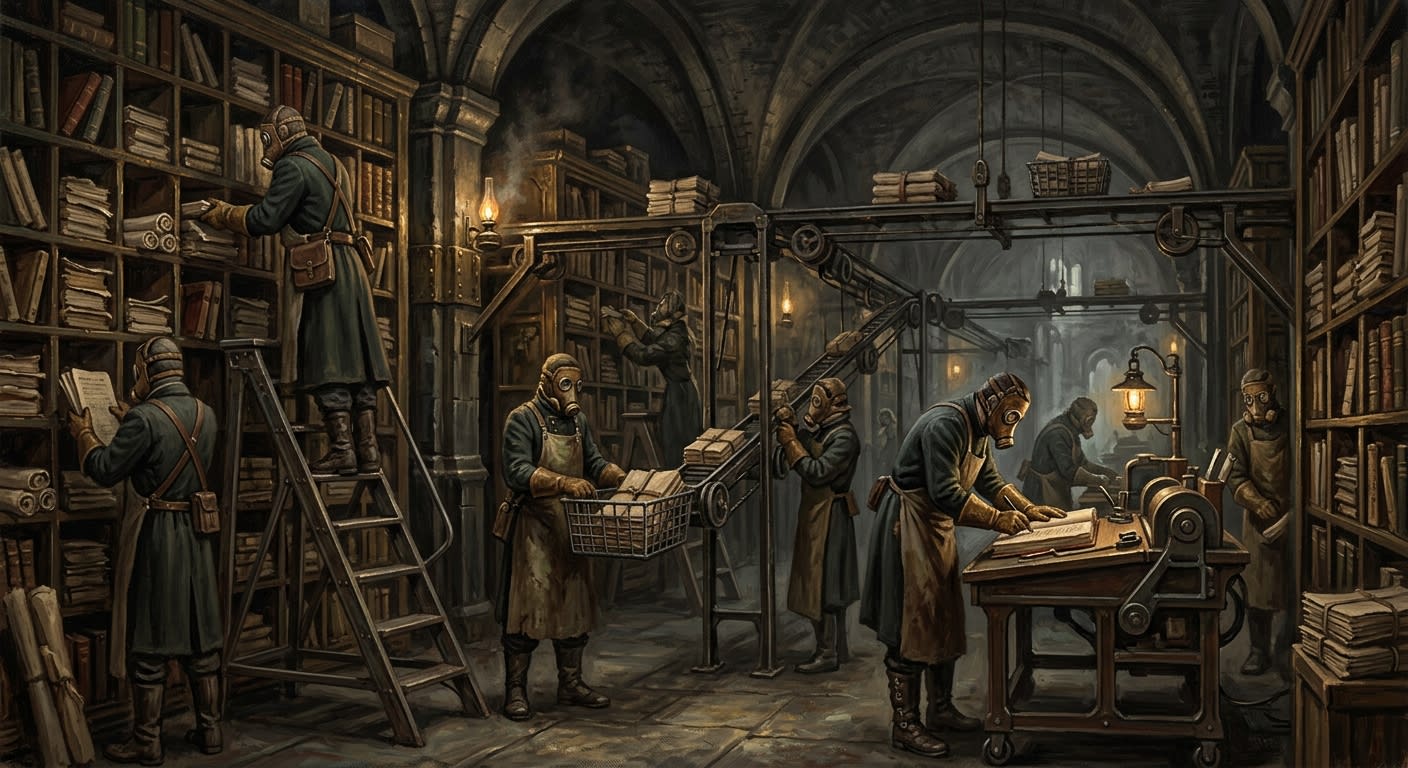
The Paper Keepers' Guild is the small subterranean obedience charged with tending the Burnless Archive beneath the eastern cutbank of the Steppe Gate. It numbers forty-three men and women as of the A.S. 199 correction, though one must pronounce that number with caution in a place where counting has begun to look less like arithmetic and more like bait.
They are called Paper Keepers by charter, Dust Priests by the Gate, and several less elegant names by caravan masters who have discovered that a century-old confession can still accrue fees. They are not clergy. They possess no Synod seal. Their authority lies in the old A.S. 82 compact attributed to Alzen Voss, by which a handful of literate custodians agreed to live underground beside paper that would not burn, would not leave, and would not keep a civil silence.
The compact required three competencies: literacy in the Triune Alphabet, competence in the pronunciation protocols of all seven treaty-stones, and willingness to reside beneath the surface. Later rules added cotton gloves, witness marks, seven-night watches, the handling of wet ink, and the etiquette of not screaming when a shelf answers back. Voss founded a guild. The Archive trained it into a species of clerk.
#On Recruitment and Residence
The Keepers recruit from their own children and, increasingly, from the Caravan Corrals: orphans with no passage writs, no toll assessments, no family seals, and no legal proof sturdy enough to survive a bored clerk with a knife. The Archive gives such children a name on a guild roll. The exchange is devotional, administrative, and obscene. A child enters without papers. A Keeper emerges with one paper, one bed, one voice trained to a whisper, and a life measured by shelf order.
Their dormitory cells are cut into limestone above the Third Vault (Unregistered). Meals arrive through a service hatch. Washing water seeps cold from the cutbank. Daylight is permitted four hours per week by guild rule, which the Bureau of Medicine has described as clinically concerning and the Keepers have described as optimal for archival temperament. I have examined both assessments. Medicine is correct. The Keepers are also correct. That is the sort of contradiction one expects when the human body is forced to negotiate with paper.
Speech above a whisper is forbidden inside the vaults. Tradition claims reverence. Acoustics claims prudence. Fear claims seniority. The limestone corridors amplify sound in ways the Bureau of Bells has filed as architecturally improbable, and the folios respond to voices with the intimate malice of old confessors. A Keeper who addresses a shelf by habit may hear the shelf reply by date, sin, or unpaid toll.
#On the Manual
The guild manual is classified, which is to say that I read it under conditions of official inconvenience. It is bound in grey boards, written in a hand too regular for comfort, and revised by addenda pasted so precisely into the margins that the paste appears to have anticipated the correction. Its ordinary chapters concern gloves, shelving, witness duplication, ink preservation, phrase discipline, and the seven-night rule: no document is declared silent until watched for seven consecutive nights.
The manual's most famous paragraph concerns Vault Seven. It states that the vault contains documents predating the Treaty-Stones, written in no known language, on no known paper, cold, and growing. The paragraph is followed by a blank page. The blank page has defeated more theology than several heresies.
Earlier training digests described the guild manual as “procedural, non-doctrinal.”
Corrected. Any manual that instructs a human being how to live beside self-writing law, dead witnesses, and paper colder than weather is doctrinal in every sense except the one that would require Doctrine to accept responsibility.
A marginal notation in the restricted A.S. 187 inspection copy records that the Vault Seven paragraph appeared to be in the Voss hand while the paper itself postdated the Year of Ash Rain. The inspector wrote █████████████████ beside the dating table. His next posting was coastal, silent, and permanent.
#On the Forty-Three
The guild once numbered forty-seven. In A.S. 199, after the disappearance of the Third Stone's southern-face rubbing and the appearance of the wet blank folio, the census was revised to forty-three. The official explanation is transcription error. The four missing names were present in A.S. 198, absent in A.S. 199, and later found in the Sixth Vault as authors of folios no living hand admits receiving.
The Keepers did not protest the correction. This restraint has been praised as discipline by Records and cowardice by men who would last three minutes in the Sixth Vault (Unregistered) before confessing to crimes committed by their grandparents. I side with the Keepers. Protest is a surface habit. Underground, a corrected number may be a warning, a verdict, or an invitation to become the fifth clerical irregularity.
The living members rotate through the First to Sixth Vaults, the blank folio watch, accession audits, confession indexing, pronunciation certification support, and liaison duty with the Caravan Court. They distrust liaison duty because surface officials speak too loudly, ask questions already answered by filing order, and believe urgency is an argument. Voss forbade haste. The guild has sharpened that prohibition into a weapon.
#On Their Present Function
Since A.S. 194, the Keepers have ceased being mere custodians and become witnesses to an Archive that writes itself. The living addenda appear in wet ink, procedurally perfect, furnished with proper seals, and increasingly frequent: three to eleven per quarterly cycle by A.S. 199, approximately two each week by A.S. 201. The Keepers discover them, isolate them, witness them, and deliver them into the legal machinery that High Arbiter Senn Vark has chosen to obey because the forms are correct and civilisation, being a ridiculous beast, often dies of formality before it notices the knife.
Paper Keeper Seld checks the blank folio every morning. Other Keepers pretend not to watch him. This courtesy is one of the guild's last human luxuries.
The Paper Keepers do not command the Archive. They attend it. They feed it documents, deny it bare fingers, whisper in its corridors, count themselves with decreasing confidence, and preserve the fiction that custody differs from service. The fiction remains useful. The Bureau approves useful fictions when they are ours.