
#On the Sale of Tomorrow
“A condemned name has value for one night. After that it becomes theology, and theology pays poorly.” — recovered Black Ledger pricing note, A.S. 196.
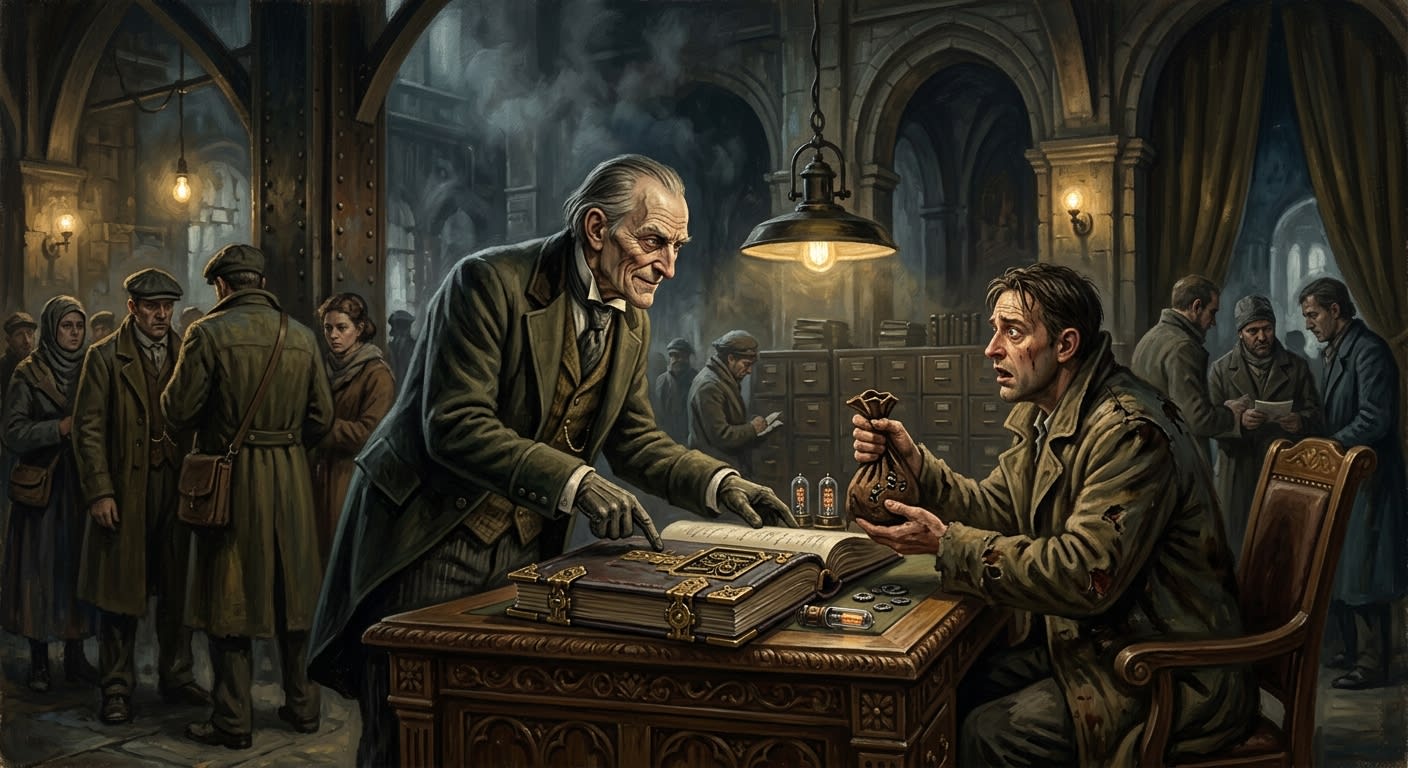
A Name-Merchant is a corrupt Index Damnatus Runner who sells advance knowledge of condemnation before the packet arrives. He deals in the most perishable commodity in the Synod: tomorrow’s damned. Twelve hours ahead of the Index Damnatus, a name can cross a ferry, change papers, vanish into a cellar, marry into a clean ledger, or buy the particular mercy that consists of leaving before the Bureau knocks. Twelve hours after delivery, the same name buys only rope, ash, silence, and the grim satisfaction of having once possessed market value.
The Name-Merchant is not a smuggler of goods. He is a smuggler of sequence. The Index says a person will cease to be lawful at Iron Vespers; he sells the Matins knowledge to anyone who can profit before the bell. The crime lies less in revealing a secret than in relocating the future. This is why the Bureau of Purity hates him with such intimate heat. He does not deny condemnation. He sells the interval before obedience can catch it.
The buyer is often the Black Ledger, which pays well for advance warning of Purity packets. The Ledger’s Theatres want rescues staged before arrest. Its Accountants want a condemned household entered into the second book while gratitude is still soft. Its Knives want the name of the Runner, the route, the clerk, and the exact door where fear will make a man speak cheaply.
#On the Mechanism of Warning
The Name-Merchant begins as a Runner, which is why the corruption is so useful. He has a throat-tag, route knowledge, access to relay-house scraps, and the habit of being ignored by men who fear his satchel more than his face. He knows which packets are sealed hot, which bundles carry lineage flags, which route changes signal senior quarry, which orphanage registry has been added because children are about to become legally dangerous.
He does not need to open every packet. Often the exterior is enough: black wax for blacklist amendment, violet edge for lineage review, double cord for sacramental invalidation, emergency token for high-value ban, route order altered to place a ferry before a shrine. A good Name-Merchant reads the packet’s body the way a physician reads jaundice. The disease declares itself through the skin.
The sale may happen in three forms. The first is direct warning: the Runner whispers the name to a broker before the route begins. The second is priced omission: the Runner delays one node and allows the buyer to infer which family should be moved. The third is route auction: the Runner sells the schedule itself, letting Black Ledger Runners intercept households ahead of Purity’s arrival. The first is cleanest. The second is safer. The third makes more money and leaves more corpses.
#On Buyers and Prices
A name has several prices. The condemned pays in whatever remains: coin hidden from seizure, jewellery sewn into hems, a daughter’s dowry, a father’s military chit, a saint-bone whose authentication is disputed until fear improves its pedigree. The Black Ledger pays in coin, shelter, protection, black-thread access, and the deeper payment every criminal network prefers: a future claim.
The Accountants price names by usefulness. A condemned baker with three ovens, two sons, and a parish full of hungry debtors is worth more than a solitary pamphleteer with no kin and bad shoes. A widow flagged for sacramental contamination may be worth saving if her staircase overlooks a permit office. A child marked by lineage review is worth more alive than his father, because childhood is smaller, faster, and easier to train into gratitude.
RECOVERED SECOND-BOOK PRICE SHEET — STRASBOURG CELL, A.S. 198 PURITY PACKET, MATINS ISSUE: Household R.: father condemned; mother clean pending review; two children usable; price ███ Crowns or equivalent shelter access. Printer’s apprentice M.: name only; low household value; warn if bundle space permits. Ferry clerk S.: preserve at all costs; █████████████████████████████████ Notation: “Runner wants heat chits, not coin. Wife ill. Press hard.”
The Knives price names by danger. A condemned man warned in time may become an asset; warned poorly, he becomes a witness who knows who warned him. A Name-Merchant who sells to a Knife cell once may spend the rest of his life being paid by men whose politeness has handles. That life is usually short, but very attentive.
Earlier Purity broadsheets claimed Name-Merchants sell chiefly out of ideological sympathy.
Corrected. Sympathy is a minor currency. The common tender is hunger, debt, exhaustion, index echo, sick relatives, gambling arrears, and the ordinary human talent for discovering that damnation becomes abstract when one’s own rent is due.
#On the Runner’s Mirror
The Runner and the Name-Merchant share the same instrument: speed. The loyal Runner moves erasure faster than the damned. The corrupt Runner moves warning faster than erasure. Each believes arrival decides truth. Each fears delay. Each knows that a name in motion is more alive than doctrine admits.
This is the mirror that makes Purity spit. The Name-Merchant proves the Runner Corps matters. If the Index were a symbolic book chained in Strasbourg, no criminal would buy its weather one bell early. The Black Ledger pays because the packet kills. The household flees because the packet kills. The Name-Merchant betrays because the packet kills. A useless law attracts mockery. A useful law attracts markets.
Index echo feeds the trade. After hundreds of routes, the Runner hears condemned names everywhere: in bakery cries, ferry shouts, children’s games, tavern orders. Some become pure relay — boot, lung, seal, receipt. Some break toward mercy. Some break toward commerce, which is mercy with an invoice and less hypocrisy about appetite.
#On the False Packet Panic and the New Market
The False Packet Panic of A.S. 134 made Name-Merchants richer. Counterfeit bundles proved that false paper could ruin four hundred citizens in a week; true paper, warned against early, could save a household in an hour. Fear learned pricing. So did criminals.
After the Panic, triple-witness handoffs and daily cipher rotations tightened packet handling. Seals grew cleverer. Receipt chains acquired more eyes. Shadow Relays became route contamination. The new security made direct theft harder and advance knowledge more valuable. When the door is barred, the key costs more. When the key is watched, the rumour of the key becomes merchandise.
The Bureau learned to audit receipts. It was slower to audit desperation. A Runner with a dying wife, a child in levy age, or a debt registered in a tavern cellar leaves fewer marks than a cracked seal. The Name-Merchant grows in the soft parts of procedure, where schedule meets hunger and doctrine must cross a wet street in bad boots.
#On Detection and Punishment
Detection begins with absence. A condemned household gone before the packet arrives. A ferry clerk suddenly forgetful. An orphanage registry amended one bell too late, with children already missing. A route that delivered on time while somehow giving the target time to flee. The auditor lays bell-hours beside footsteps and listens for the little click of impossibility.
Proof is harder. Name-Merchants sell words, glances, route patterns, omissions, and shrugs. A warning spoken in a washhouse leaves no wax. A finger tapped twice on a counter has no cipher. A packet left unopened can still be read by its route. Purity prefers crimes with objects. Name-Merchants sell the object’s shadow.
Transit Division instructional sheets state that packet integrity prevents Name-Merchant activity.
Clarified. Packet integrity prevents packet theft. Name-Merchant activity frequently requires no theft at all. The sheet has been retained because it reassures Route Captains, and reassurance is cheaper than reform.
Punishment, when secured, is exemplary. Immurement for the Runner. Erasure for the accomplice if the accomplice has a register entry. Knife-work for the accomplice if the Black Ledger reaches him first. The condemned family, if recovered, receives the sentence originally intended plus whatever penalty Purity invents for having attempted chronology.
#On the Present Traffic
As of A.S. 201, the Name-Merchant is less a formal caste than a recurring fever in the Runner Corps. Strasbourg has rumours. Cologne has prices. Marseille has dock intermediaries who can arrange warnings while denying they know what a warning is. The Constantinople Warrens have whole rooms where families wait during Matins because a Black Ledger boy said not to be home until Iron Vespers.
The practice thrives where the Index’s reach is strongest. Weak law produces smugglers. Strong law produces men who sell the moment before strength arrives. That is the Name-Merchant’s chapel: the bell before the knock, the breath before the stamp, the interval before a person becomes a line to be crossed out.
He is the Runner’s mirror, the Index’s parasite, the Black Ledger’s favourite clock. He sells no pardon. He sells no innocence. He sells the brief, expensive, filthy little mercy of being early.