

#On the Holding Surveyed
This survey is dated A.S. 201 (1911 CE), the present year of the Ledger, and that date belongs to the survey alone. No record placed before me names the first ash drawer, its maker or its foundry, or the night it first took in a page. Burn Directive 7-C was issued in A.S. 91. It came out of the same settlement in which a joint mandate of Records and War constituted the Trench Courts, after the Uncounted Winter left fifty thousand dead without attestation. The Directive lists the ash drawer among its primary materials. Listing a thing is not inventing it. The Bureau of Records can date a pension to the hour, yet it has never dated this object, and I will not do the job for them.
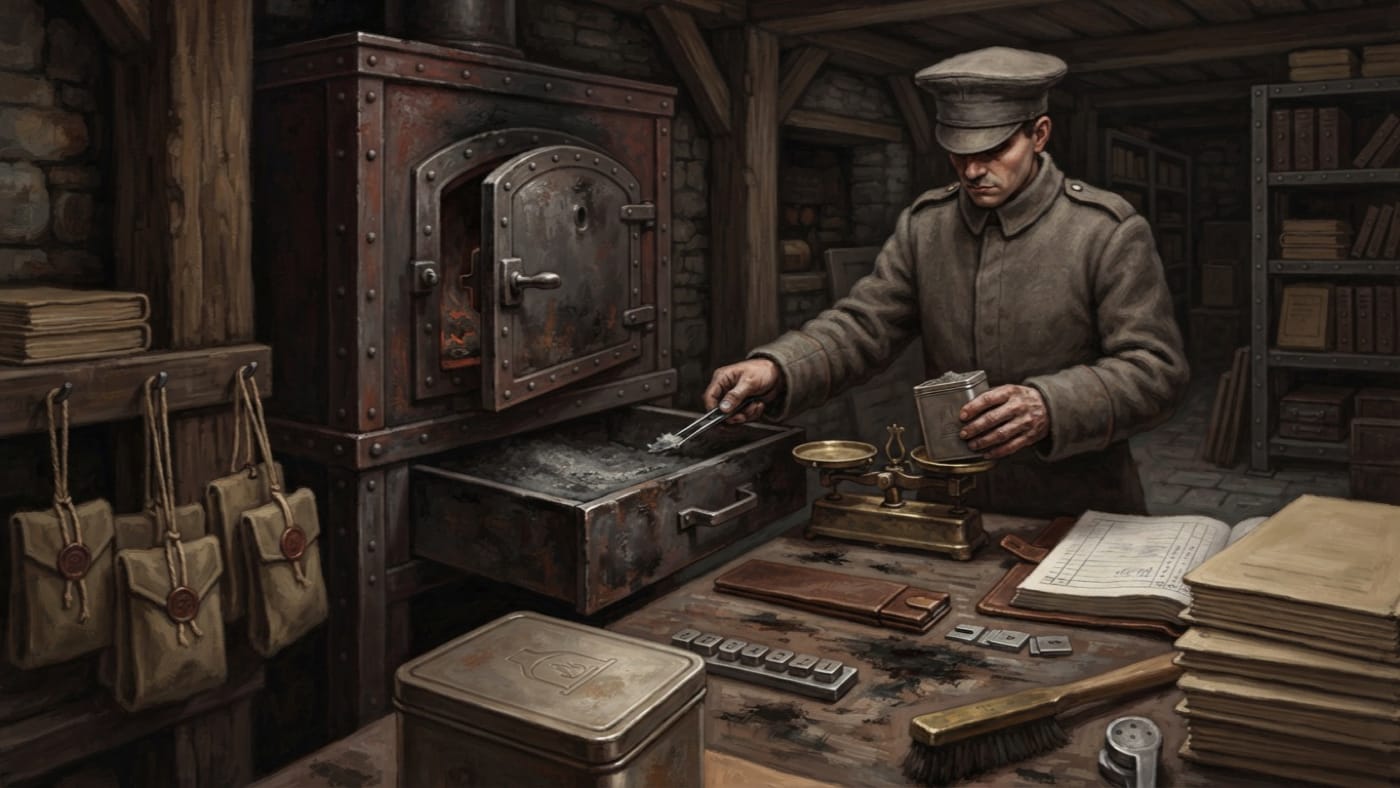
What stands can be surveyed. At a licensed Trench Court station the drawer sits beneath the field furnace and receives whatever the furnace leaves. It is kept apart from the ordinary ledgers, along with the pouches, burn authorisations, furnace logs and variance sheets of 7-C business. It is the last stop on a route that begins at the lantern table. It holds the only part of a dangerous sentence that the state wishes to keep: proof that the sentence is gone.
Ash proves very little. It shows that something of roughly the expected weight burned in the approved iron, and its competence ends there. Whether a second page in a second hand lies under a blotter three dugouts down is outside its jurisdiction. As a receipt for destruction it is adequate, and every quartermaster knows who writes receipts: the party that profits from them.
#On the Road to the Drawer
The Directive fixes the route, and I give it here in brief, because the drawer means nothing without what comes before it. A Trench-Court Clerk identifies contradiction in a dying man's testimony and marks the sheet with sector code and severity. The sheet goes into a numbered contradiction pouch. The bundle number is registered with no summary of contents. A courier carries the pouch and the Front Prelate or War Registrar countersigns it. The receiving Custodian checks wax, cord, weight, code and smell. Then the furnace mouth opens.
After the flame comes the drawer. The ash is cooled, weighed, swept, sealed and entered in the drawer count, and the whole is filed as administrative waste. That is six verbs in a row, and each one leaves a signature somewhere. A Contradiction Custodian signs the ash drawer once, just as he signs the pouch ledger once and the furnace log once. A second signature would imply a second custody. Records will not accept that a thing existed in two places at once unless someone has first numbered the shelves for it.
That is the whole sacrament. A soldier's last accusation becomes a number. The number becomes a weight. The weight becomes waste, which can be audited forever and will never testify.
#On Variance, Which Is the Drawer's Theology
Ash drawer practice has grown into a jurisprudence of its own. Like all jurisprudence it starts from an expectation and lives on the departures from it. Expected residue is reckoned from page count, ink density, wax, pouch cloth and sector damp. Nobody has put a table of these values in my hands. I know the inputs but not the arithmetic, and I suspect it changes with the station, the season and how thirsty the inspector was.
The rules, as reported in practice:
Excess mass means hold. Deficient mass means notify Records and do not notify family. Sweet-smelling ash means clean the furnace. Blue-edged ash means stop gossiping in front of junior clerks. No ash means pending.
Each instruction is shorter than the anxiety it governs. Excess may be wet cloth, a heavy hand with the wax, or a second bundle fed in by error or by design. Deficiency may be thin paper, a dry sector, a careless sweep, or a page that never went into the fire at all. The scale cannot tell a copy from a dry week. Records is notified because Records keeps the count. The family is not notified. My reading is that a family which learns its son's last words might still exist somewhere will want them, and wanting is how a petition begins.
Blue edges and sweet odours enter the rules with no explanation attached, and I will not supply one. The furnace is cleaned and the clerks are quieted. That is how a practice puts its fright on record without signing for it.
Pending deserves a line of its own. A drawer that holds no ash for a number already logged is the most honest object in the station. It says exactly what is known: a bundle was received, and nobody has yet proved that it burned.
#On the Secondary Tin
The immediate-flame appendix of 7-C sets out an emergency route. Rear review is bypassed, a Custodian must witness, and the ash drawer is sealed inside a secondary tin.
FIELD APPENDIX — IMMEDIATE FLAME AUTHORISATION (EXTRACT) Emergency route: bypass rear review; Custodian witness required; ash drawer sealed inside secondary tin. Marginal note: if page repeats phrase after ignition, █████████████████████████████.
That is the emergency route and nothing more. The appendix does not put every drawer in a tin, and I have seen no instruction that would. The tin goes with the bypass. When rear review is skipped, the residue gets an extra wall to stand in for the reviewer nobody consulted. The Custodian's eye takes the place of the rear's judgement, and the tin takes the place of the rear's shelf. One is a witness and the other a coffin. Records requires both because it trusts neither on its own.
The extract does not say what the tin holds once closed. Nor does it say whether the appendix classes still under black bars leave ash unlike any other. Better-informed hands than mine laid those bars, and I leave them where they lie.
#On Pages That Arrive Late, or Never
Cadence Anomaly sheets fall outside the routine. Clerks report pages that do not catch until a name is spoken aloud, pages that curl around a first letter, pages that leave black flakes shaped like music, and pages that vanish between the flame and the ash drawer. Engineering denies all meaningful difference. Both statements are on file, and neither has been withdrawn.
Directive supplements require review by a Cadence Examiner before any routine burn. There are three exceptions: contamination spreads, witnesses begin repeating the phrase, or the page addresses a living person by name. Procedure therefore keeps most Cadence business away from the drawer, and emergency sends some of it there anyway.
A page that vanished gives the scale its least welcome reading, which is deficient mass. The rule says to notify Records. It says nothing about what a clerk should believe, and I do not intend to add anything. A page that never reached the drawer may have burned too hot, been swept too briskly, or travelled off in a sleeve. The drawer records none of this. It records a weight and a number, and the Bureau has always insisted that this is enough.
#On Custody, Inspection and the Price of Tolerance
Inspectors at licensed stations count pouch numbers first and ash second. Their questions are short ones: missing mass, excess mass, damp pouches, late countersignatures, and pages recorded as destroyed before the courier arrived. That last question is the sharpest instrument in the inspector's case. A page burned before it was delivered was either wanted gone very early or was entered as burned without ever reaching the station.
Custodians manage pouch counts, furnace logs, ash certification and holds. Certification is their seal on the drawer. Once it is given, the bundle is closed. If it is withheld, the bundle becomes a hold, and a hold is a room where time can be bought.
The market around the Directive is known only from report. By A.S. 201 the services offered for a price include ash variance tolerance, meaning a counting hand willing to find a short drawer full enough. The Rubric Clerks compress testimony into a category and the category into a pouch, and they find a quiet drawer congenial. The Record-True Clerks, some of whom keep duplicate slips under false covers, have reason to dread an honest scale and reason to need one. A tolerant inspector may be shielding an officer. He may instead be shielding a widow's bread from an accusation her son never meant her to pay for. The variance sheet records no motive, and nobody has asked me to guess one.
"I have seen an ash drawer treated with more reverence than a saint's kneecap." — Burn Directive 7-C, this author.
Corrected. Reverence is too warm a word. A saint's kneecap gets a feast day and the drawer gets an audit day. The kneecap is kissed. The drawer is weighed, initialled, doubted and weighed again.
A drawer whose count reconciles proves that the process was obeyed. It proves nothing about the sentence, and that was always the intent. A drawer that fails to reconcile proves only that someone now has to write a second form. The Custodian's whole office lies between those two outcomes: keys, gloves, scale, the ash drawer sheet, and the knowledge that the most dangerous document in the station is the one listing what was destroyed.