
#On the Ear That Files Back
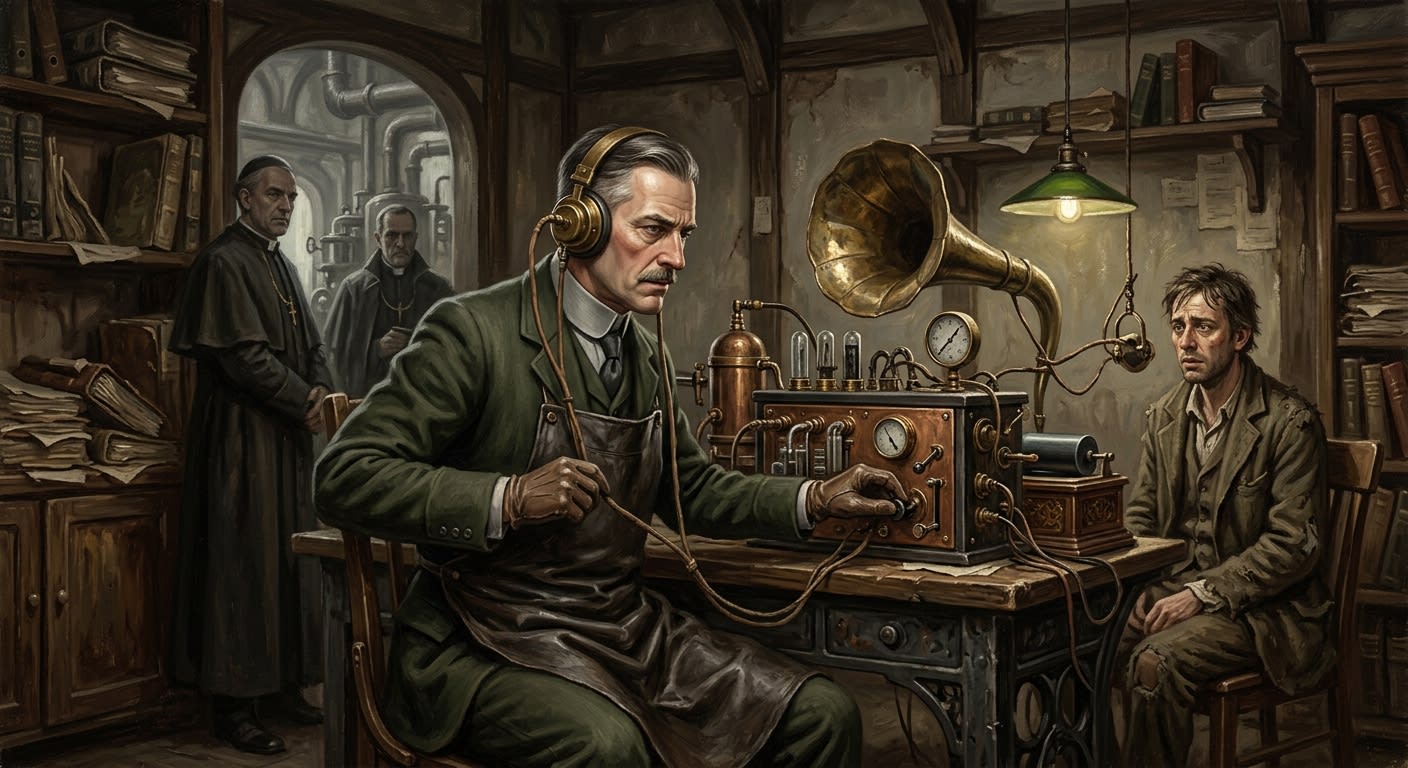
The Cadence Examiner is the Synod's licensed suspicion of sound. He stands where ordinary hearing becomes evidence: beside a dying mouth in a trench court, before a market crowd reciting too cleanly, behind a Street-Vicar whose chalk hand has paused, inside a chapel annex after the chime answers from the wrong corner, and, on certain mornings no office admits to scheduling, at the edge of a furnace while a page refuses to burn until someone speaks the name aloud.
He is an ear with seal authority. This is more dangerous than a sword, because a sword must first reach the body. The Examiner reaches the record.
The office exists in two bloodlines that dislike sharing baptismal water. The older field line belongs to the Trench Courts, where Cadence Anomaly entered the fifth confession box in the A.S. 91 settlement after Wound-Site 14 produced dying men whose voices had escaped ordinary ownership. The civic line was formalised under the A.S. 104 Catechism Third Revision, when the Street-Vicar Corps was chartered after the Market Drift Years and the Bureau of Doctrine discovered that public Creed recitation, left unattended among turnips and debt, decays into opinion.
Records claims the field line. Doctrine claims the civic line. Bells claims every word that resembles music and denies every invoice that follows. Purity claims whatever survives long enough to condemn. The Examiner stands in the quarrel with a tuning chime, a brine cloth, a slate, and the professional weariness of a man expected to determine whether a crowd is praying, lying, echoing, infected, or merely frightened in unison.
Their rank is peculiar. Among Trench Court personnel they stand above Contradiction Custodians and below the Front Prelate, a height sufficient to make senior clerks nervous and insufficient to protect the Examiner from the thing in the pouch. Among Street-Vicar structures they function as specialist officers called when the usual instruments — chalk, slip, chime, token, public shame — begin producing answers cleaner than human obedience ought to permit.
The Examiner's work begins with the old terror: the mouth is visible, the voice is not.
#On Wound-Site 14 and the First Borrowed Mouths
Wound-Site 14 lasted thirty-six hours. This is long enough for a field hospital, short enough for an atrocity, and exactly the span required by the Bureau of Records to generate a category it would spend the next century pretending had been inevitable. The assault that produced it has acquired the standard burial wrappings: limited push, weather interference, acceptable attrition. Such phrases are bandages soaked in cold ink.
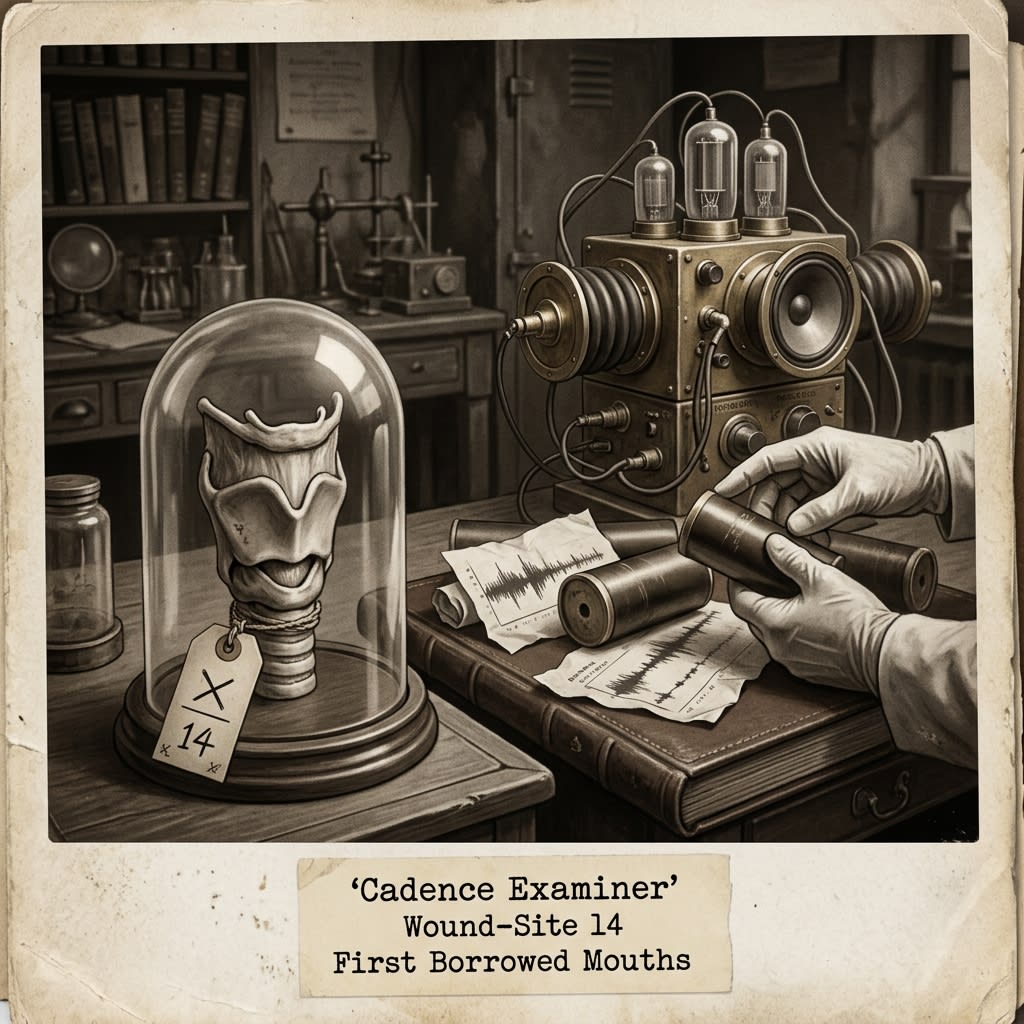
Medics brought the salvageable west. The unsalvageable came to the lantern table, where clerks recorded final confessions under shell-stutter and morphine stink. The first four confession categories could hold most dying speech: faithful, drift, contrition, contagious doubt. Then Corporal Maes of the 19th Ravelin Sappers spoke in his captain's voice while the captain, alive three miles rearward, ate tinned beans and remained disgustingly himself.
The clerk marked the wrong category. One must forgive him. The Bureau had not yet invented the correct panic.
More cases followed. A tongueless gunner sang the Common Allegiance in the alto voice of a woman hanged for unlicensed antiphon in A.S. 84. A dying sapper asked after a wife belonging to a man already dead at Bastion-Brest. A lantern flame leaned toward a phrase as if accepting dictation. One subject remained silent until the clerk wrote the wrong name and then corrected the spelling.
The earliest Wound-Site memorandum described the cluster as echo contamination under shell stress.
Corrected. Echoes repeat. These voices selected, answered, corrected, and waited their turn. The distinction is the office.
The first Cadence Examiners were improvised from three kinds of personnel: Records clerks with unusually exact ears, Bells assistants disgraced enough to be useful outside towers, and Doctrine singers who could hear a false amen through two walls and a rain barrel. Their initial instrument was the damaged marginal instruction now preserved in restricted copy: If the mouth is loyal and the voice is not, record both. That sentence founded a profession because it asks no mercy of the listener. It orders custody.
Custody means the phrase is exact. No rubric compression. No tidy meaning. No clerkly improvement. Syllable length, breath interval, stress, known speaker match, bell-hour, undertone, page behaviour, witness reaction, furnace response. A dying man's last words may be nonsense. They may also be a demon borrowing a registry key. The Examiner records as if either answer will accuse him later.
#On the Street Made Audible
The civic branch began in embarrassment rather than blood. During A.S. 98–103, the Rhineland's Market Drift Years showed that Creed-sealed commerce was thinning into barter-oaths, jokes, handshakes, and little market sentences with teeth. Cologne supplied the famous turnip blasphemy: Sundays for the Creator, Tuesdays for turnips. Laughter travelled farther than sermon. Doctrine noticed after Records produced numbers ugly enough to survive committee.
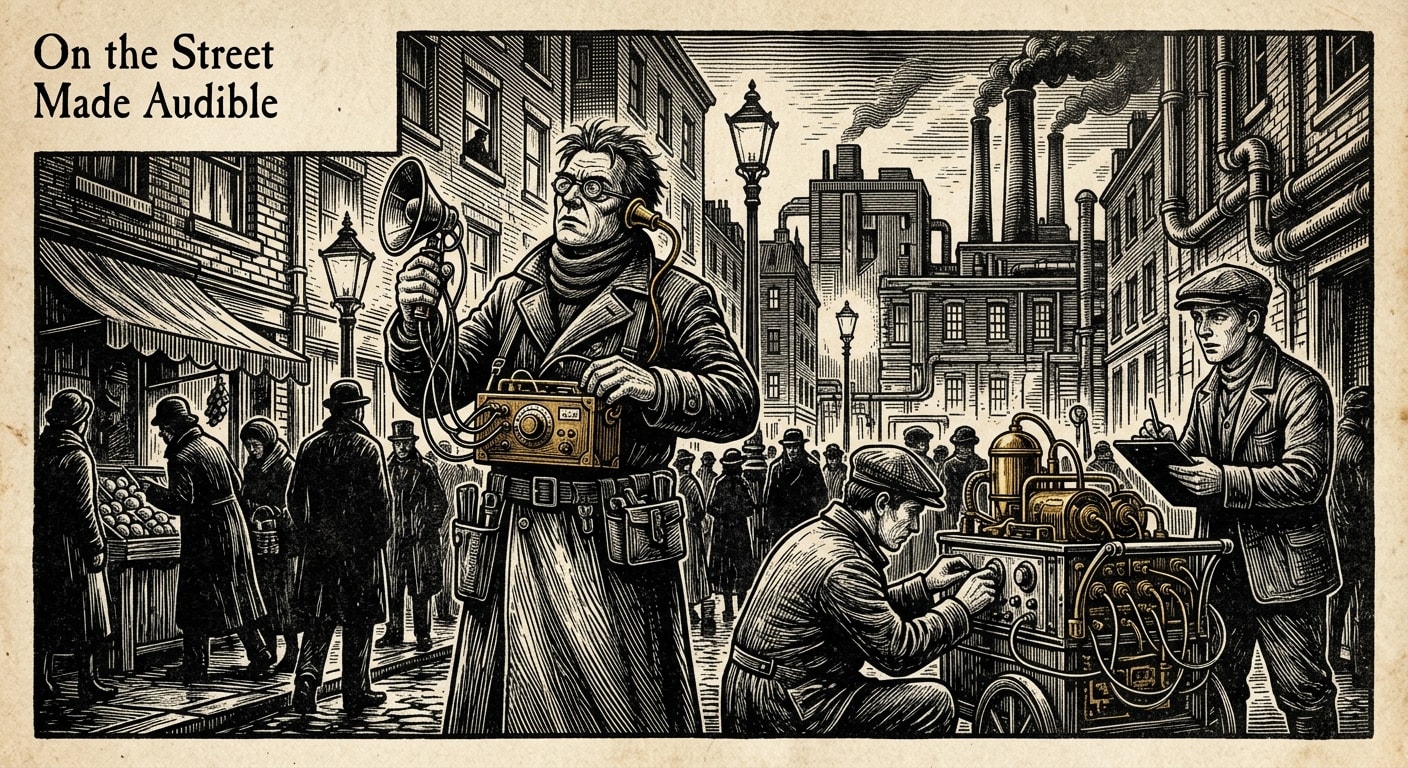
A.S. 104 brought the Catechism Third Revision and the Street-Vicar Corps. Eleven Vicars went first to Cologne with chimes, correction slips, purity-token authority, and the chromatic compliance code: white for clean, yellow for watched, red for uncertain. The first Cadence Examiner specialisation was formalised in the same charter as echo-detection support. Public faith had to be heard as well as seen. A doorframe could bear chalk. A crowd could hide inside its own rhythm.
Saint Oren haunts this origin with irritating gentleness. Before the Corps acquired chalk, Oren stood at a Cologne corner and sang the Creed until the street sang back. Modern Examiners touch their chimes to Orenic corner-marks before patrol because every policeman likes to imagine his baton descends from a saint's patience. The chime knows better. It rings according to metal.
The Examiner at a square-stop listens behind the words. The Eternal Creed has authorised lines, authorised pauses, authorised regional particles, and unauthorised habits old enough to possess defenders. A child lisps. A widow rasps. A soldier trained at Przemyśl clips the third article because artillery taught him to conserve breath. A merchant over-enunciates because guilt stiffens vowels. These are ordinary failures. Ordinary failures feed correction slips and yellow chalk.
Cadence danger begins when error becomes too good. Forty mouths breathe together without command. A ration queue answers a line before the Street-Vicar finishes it. Children repeat a terminal formula never taught in that district. A chime rings flat only when a certain woman exhales. A market chorus holds tempo for six hours without fatigue. Human piety is rarely so tidy. Hell loves neatness when neatness gives it cover.
The Examiner must also distinguish district memory from hostile imitation. Cologne answers differently from Trier. Strasbourg's cathedral quarter swallows the Fifth Article at the hinge because three generations of bell overlap trained the throat to hurry. Halle stretches the terminal amen after winter markets because sellers learned to lengthen piety while checking coin. A forward refugee lane may carry five provincial cadences in one queue and still remain innocent. Innocent is not clean. Innocent is merely human enough to leave dirt in the measure.
The danger of the Street-Vicar system is that it teaches whole districts to sound governed. After a century of square-stops, token checks, and chalk, obedience can become camouflage for the thing that has learned the lesson better than citizens have. A Pale Chanter does not need to invent a rhythm in Cologne. He need only listen to the Corps and sing the Corps back at itself. This is why Examiners are hated by successful Vicars. Success produces the surface under which danger hides.
In ration yards the problem sharpens. Hunger ruins cadence honestly. A starving crowd breathes in ragged columns, coughs at the same soup-smell, forgets endings, mutters the commercial clause in the key of resentment. Then one voice steadies the line and the line steadies too quickly. The Marshal smiles because flow improves. The Vicar smiles because recitation recovers. The Examiner stops smiling because the crowd has become one throat without a lawful caller.
#On Instruments and Tests
The Examiner's field kit looks small because the true instrument is the trained ear, and the Bureau has not yet found a way to lock an ear in a supply cabinet. He carries a pocket chime tuned against the district bell table, brine cloth for tongue and token, vowel cards for regional comparison, red thread for sealing phrase slips, a slate marked in breath intervals, chalk dust in three colours, a witness pad, and, in field court service, a contradiction pouch stamped C.
The basic test is cruel in its modesty. Ask the speaker to repeat the line. Ask for parish. Ask for mother. Ask for current bell-hour. Ask the witness what he heard before telling him what he ought to have heard. Strike the chime behind the speaker's left ear. Watch the throat before the answer. Record whether the mouth begins a half-beat after the voice. Record whether breath precedes sound. Record whether ink thickens on the third word. Record whether the page, having received the phrase, behaves like paper.
Paper is expected to lie still. Much follows from this expectation.
CADENCE EXAMINER FIELD NOTE — COLOGNE ECHO PROTOCOL, A.S. 178 Street chorus sustained public Creed response for six hours, no visible caller. Chime test: ordinary at north edge; flat at fountain; reversed near baker's awning. Examiner notation: “Unhymn signature consistent with Pale Chanter hand.” Removal count: █████. Public explanation: festival rehearsal error. Examiner disposition: reassigned under Code Seventeen after refusing parish choir attendance.
The chime test divides civic suspicion from field horror. In a market, the chime asks whether a crowd's cadence belongs to the crowd. In a trench court, the chime asks whether the dying man's last sound belongs to his registry. Both questions are obscene. Both must be asked before the file can proceed to chalk, furnace, Purity, Medicine, Bells, or that soft drawer labelled pending where ugly truths are placed to grow administrative mould.
The Examiner also tests silence. A citizen asked for the fourth line may say nothing because shame has shut the throat, because guilt has jammed the jaw, because a forbidden word waits behind the teeth, because Bell-sickness has made the expected peal too loud to speak over, or because the answer is already being spoken somewhere else. Silence is not absence. It is a container. The Examiner taps the chime once and listens to how the silence holds the blow.
Certain silences are soft. They belong to fear, grief, hunger, ordinary stupidity, and husbands trying to remember whether their wives taught them the proper variant that morning. Certain silences are hard. They make the chime note stop as if cut with shears. The hard silence is routed upward. A soft silence may receive a correction slip, a mercy appointment, a yellow mark, or a bored glance. The distinction saves households. It also destroys them when the Examiner is tired.
The page test comes last because paper is less brave than people and more honest in extremity. The phrase is written, covered, breathed upon through cloth, exposed to chime, and held near a lamp. Ordinary ink dries. Bad ink thickens, beads, crawls against grain, repeats a letter in the margin, or leaves a faint smell of wet iron. Records insists these effects are rare. Records is correct in public and anxious in storage.
The Examiner charts rhythm as if rhythm were a tax animal: syllable length, stress, breath debt, vowel drift, bell-match, undertone, anticipatory response, post-speech echo. Their charts look like psalms designed by accountants. Bells despises the charts for lacking music. Records loves them for making fear columnar. Doctrine loves them when they prove control and dislikes them when they prove only that control has been beautifully described while escaping.
There are field variants. The Brest test uses warmed bell-metal beneath the jaw because the Nameless Tide has made ordinary speech along the Bug too wet with borrowed absence. Przemyśl Examiners tap counter-rhythm against the ribs of suspected wormhosts and listen for the pause where a human lung objects before a hidden passenger answers. Irongate Examiners place the speaker against a wall and let the mountain report the second pulse. Shipka Examiners distrust timing itself, since Syrion's fog has taught men to answer questions years late with perfect manners. Constantinople Examiners carry salt thread for harbour echoes and refuse to stand with their backs to cistern mouths.
These variants irritate central offices. Central offices adore uniformity because they sit where conditions have been bullied into behaving. The Line does not behave. The Line coughs, floods, rings, sleeps, hums, and occasionally answers through a dead sergeant's teeth. A pocket chime issued in Strasbourg can enter the southern front and learn humility before Sext.
#On Relations with Chalk, Mercy, and Fire
Cadence Examiners make every neighbouring office worse by telling it what it has already touched. Marking Vicars want visible failures: bad line, red lintel, public correction, field book closed. The Examiner arrives and says the bad line was bait, the red lintel marked the wrong house, the public correction spread the cadence, and the field book must be sealed. Markers dislike this because it interrupts theatre at the moment theatre becomes measurable.
Mercy Vicars want private repair: a line in the ear, a second chance, pale yellow under the lintel, mercy filed into boredom. The Examiner arrives and says the private correction preserved a hostile phrase by whispering it into the household that would otherwise have failed loudly and usefully. Mercy dislikes this because it makes compassion look like contamination with a clean cuff.
Contradiction Custodians hate Examiners with the intimacy of men who share furnace air. A Custodian wants the bundle routed: archive, ash, rear review. The Examiner places a hold and demands exact phrase preservation, witness breath, page behaviour, no spoken name, no routine burn. Pages under Cadence Anomaly have been known to curl inward, burn cold, vanish between flame and drawer, or wait until the name is spoken. Custodians prefer paper that dies when killed.
The relationship with Purity is more delicate. Purity sees cadence danger and smells prosecution. The Examiner sees cadence danger and sometimes smells a wrong file. A borrowed voice may be demonic. It may be bell-sickness. It may be a Pale Chanter pattern, a page trapped in ash memory, a crowd frightened into mathematical unity, or one old woman who learned the Creed from a banned regional primer and has outlived every clerk who knew the variant was once lawful. Purity prefers shorter menus.
Bells distrusts Examiners for stealing terms. The Bureau of Bells maintains that cadence belongs to bells, not Records clerks with chimes and bad sleep. Examiners answer that Bells may reclaim the word after it explains why dying soldiers, chapel queues, and furnace pages keep time without permission. The quarrel remains unresolved because unresolved quarrels employ liaison staff.
Bells circular B-44 described Cadence Examiners as “auxiliary acoustic witnesses.”
Clarified by joint notice after three examiners refused tower assignment. The Cadence Examiner is not auxiliary where borrowed speech, civic Creed variance, or anomalous burn response has entered the record. Bells may attend. Bells may object. Bells may bring tea.
#On Training and Deformation
A Cadence Examiner is not born. He is selected from those already damaged in useful directions. The field line recruits from Trench Court supervisors, Contradiction Custodians, Rubric Clerks who hear too well, and occasionally Record-True Clerks whose devotion to exact phrase preservation has not yet matured into treason. The civic line recruits from Creed Runners, senior Street-Vicars, chapel singers, dismissed Bells assistants, and teachers who can identify eleven children reciting from one borrowed breath.
Training begins with ordinary failure. Broken jaws. Stammers. regional vowels. fear pauses. grief rasp. Hunger tremor. Pious overcorrection. Drunken slur. Market mockery. Children's echo. The apprentice hears thousands of harmless deviations until mercy becomes statistical and suspicion acquires discipline. Then come the dangerous samples: Wound-Site copies, Cologne echo drills, sealed Pale Chanter fragments, bell-sickness overlap cases, pages read through cloth because the ink has shown ambition.
The final examination is conducted behind a screen. The candidate hears seven voices. Three are lawful. Two are injured. One is a recording of a condemned choirmaster. One is not listed on the answer sheet. Passing requires naming the unlisted voice without repeating its phrase. Failure routes the candidate to Medicine, Bells, Purity, or, if the examiners are in a generous mood, back to ordinary policing.
Training houses acquire their own folklore. The Cologne school keeps a chair no candidate may use after hearing a whisper from beneath it in A.S. 168. Strasbourg's annex marks one practice booth with a black thread around the latch; candidates are told it contains an old Bells sample, while instructors know the booth is empty and the candidates who hear anything have failed usefully. At Brest, apprentices sleep beside cold furnaces for one week and wake to report whether ash drawers make noise before dawn. Most say no. Those who say yes are either promising or finished.
The profession's oath is short: hear exactly, repeat rarely, file first. It has replaced longer invocations because long oaths gave the wrong material too many words to borrow. The old oath contained a plea to Saint Oren, a courtesy to Bells, a Records custody clause, and a Doctrine affirmation concerning the soul's lawful relation to speech. Nobody uses it now except retired examiners and theatre troupes with poor survival instincts.
The deformation is predictable. Examiners stop enjoying hymns. They dislike applause because mass hands learn rhythm too quickly. They count breaths during conversation. They pause before answering their own names. They distrust children who recite perfectly. They ask spouses to repeat questions and then regret receiving the same cadence twice. Some develop bell-sickness. Some become silent in rooms where others are singing. Some are sent to places like the Sofia Filing Annex, where Horvath gives them arithmetic because numbers do not sing unless the day has already been ruined.
A Cologne Examiner who identified a Pale Chanter unhymn signature in a street chorus was transferred under Code Seventeen. The record says he now checks pension arithmetic and avoids public prayer. This is called preservation by men who have never watched a vocation removed from its own throat.
#On Abuse, Profit, and the Sound of Innocence
Every office with rare authority develops rare corruption. A Cadence Examiner can save a household by calling bad cadence fear response. He can destroy it by calling the same tremor anticipatory echo. He can delay a burn pouch, force rear review, mark a crowd for Purity sweep, clear a Street-Vicar's mistake, bury a Street-Vicar's mistake, or convert a merchant's enemy into a red-thread phrase under sealed handling. His signature turns sound into status.
The bribes are accordingly refined. Coin is vulgar. Better payment arrives as transfer influence, school protection, choir exemption, a clean hearing for a nephew, access to Bells samples, retirement placement west of the Line, silence after a questionable square-stop, or one guaranteed nonattendance at a parish where the Examiner has begun hearing an old case in the amen. The corrupt Examiner sells certainty. The frightened Examiner sells delay. The clever Examiner sells the difference.
Doctrine audits them through pattern tables. Too many fear responses in one district. Too many Pale Chanter suspicions against political enemies. Too few anomalies near a known echo event. Too many family leniencies under Orenic citation. The audit charts make morality look pleasingly mathematical. The guilty learn to vary their mercy.
The street fears Examiners more than Markers because chalk can be seen. An Examiner's accusation may begin in the shape of his listening face. A mother recites with her child and sees the Examiner's head tilt. A baker answers the commercial Creed and watches his chime hand still. A soldier at the lantern table hears the Examiner ask for the current bell-hour and realises the answer he gives may not be the answer he owns.
#On the Present Cadence
As of A.S. 201, Cadence Examiners remain few, overused, disputed, and indispensable. The Trench Courts still route Cadence Anomaly pouches under their review. The Street-Vicar Corps still calls them when a crowd breathes wrongly. The Joint Caution on Cadence and Bell-Sickness still forbids repeating anomalous phrases aloud, answering internal peals, striking tower bells in remembered schedules, or burning transcripts before Examiner or Bells Marshal countersignature. The caution is printed in small type because small type is where institutions hide panic from citizens and from themselves.
Their case load has worsened. Pale Chanter patterns have spread beyond battlefields into civic chorus. Market districts trained by a century of square-stops can recite with such discipline that infiltration wears obedience like a cassock. Bellwardens return from Shipka with internal peals. Contradiction pouches arrive from Brest with pages that wait. Mercy logs show private corrections later reclassified under sealed cadence findings. Marking logs show red doors applied to households that were victims, carriers, bait, or all three in an order no one can safely say aloud.
The Bureau wants more Examiners. The Bureau also wants fewer men capable of hearing what Examiners hear. This is an old administrative wish: more tools, less testimony.
One proposal now moving through Doctrine would divide the office into civic, field, and post-burn grades. A civic Examiner would handle Street-Vicar and Creed variance. A field Examiner would handle Wound-Site, trench, and Bell-sickness overlap. A post-burn Examiner would handle page behaviour, ash irregularity, and furnace response. The proposal is sensible, which is why it will produce trouble. Division clarifies liability. Clarified liability attracts lawyers, auditors, and Purity men with sharpened pencils.
The Examiners themselves oppose division for a simpler reason: the sound does not respect it. A market chorus may carry a field unhymn. A trench confession may reproduce a Cologne cadence. A furnace page may answer with a ration-queue formula. The Enemy has studied our departments and found them amusing.
At dawn the city recites. At the front the dying speak. In the furnace room paper waits. In the market a crowd answers beautifully enough to chill the trained ear. The Cadence Examiner lifts his chime, listens past the words, and writes the first mark by which the voice will be seized, spared, burned, or followed.