
#On the Sentence That Made Fire Administrative
Burn Directive 7-C is the shortest prayer the Trench Courts ever loved: Cauterize on Receipt. Five words, if one counts with mercy; four, if one counts like Records; one, if one has stood beside the field furnace and learned that every verb eventually becomes flame. The Directive governs the authorised burning of dangerous final testimony: contradiction bundles, contagious doubt packets, officer-sensitive accusations, certain sealed pouches, and those unhappy sheets whose ink has behaved in a manner unbecoming to obedient matter.
It was issued in A.S. 91, during the same settlement that constituted the Trench Courts after the Uncounted Winter left fifty thousand dead without attestation and taught the Bureau of Records that an unrecorded death can riot long after burial. The first reform was to write everything down. The second, arriving almost before the ink dried, was to decide which written things could be permitted to remain written. Civilization advances: page, pouch, furnace.
The public fiction is humane. Dangerous last words, if left loose among soldiers, widows, officers, chaplains, and other species of reader, damage morale and threaten lawful order. The restricted truth is cleaner and less fit for sermon: the Synod cannot allow the dead to govern the living by inconvenient accuracy. A soldier may die faithful and still say a sentence that would cripple a regiment, expose a captain, starve a widow, or teach a trench that command is less sacred than advertised. Burn Directive 7-C receives such sentences as wounds. It seals them. It numbers them. It feeds them to iron.
#On Its Birth After the Uncounted Winter
The Uncounted Winter produced two terrors. The first was silence: fifty thousand dead men without sufficient record, fifty thousand homes unable to mourn with legal posture, fifty thousand small tears in the Ledger through which fraud, hunger, riot, and widows' petitions crawled like rats through a chapel wall. The remedy was obvious to anyone with a stamp and no imagination: put a clerk beside the wound. Catch the name before the breath leaves. Catch the confession before mud, shelling, panic, and officer penmanship improve it into uselessness.

The second terror was speech. Once the clerks wrote what dying men actually said, the front acquired a new problem. Men accused officers. Men reported bells that failed to ring. Men confessed desertion with reasons too persuasive for safe repetition. Men described demons wearing familiar faces. Men said the Synod had lied. Men asked that their words not be burned, which was tactically unhelpful and rhetorically superb. Records had solved absence and inherited testimony.
The first field commentary called Burn Directive 7-C “a supplemental hygiene measure for morale-sensitive records.”
Corrected. Hygiene washes dirt. Directive 7-C removes sentences whose survival would alter command, pension, doctrine, or approved memory. Dirt is easier. Dirt does not name captains.
The early contradiction pouches were crude: waxed cloth, double cord, slash mark, unit code, no contents summary. Clerks hung them behind the lantern table where the dying could not easily see them. This was kindness, or theatre, or cowardice with good table placement. The pouch gave dangerous speech dignity before removal. Custody first. Flame after. The Bureau insists the order matters. I agree. A murder committed after registration becomes disposal.
#On the Sequence of Cauterization
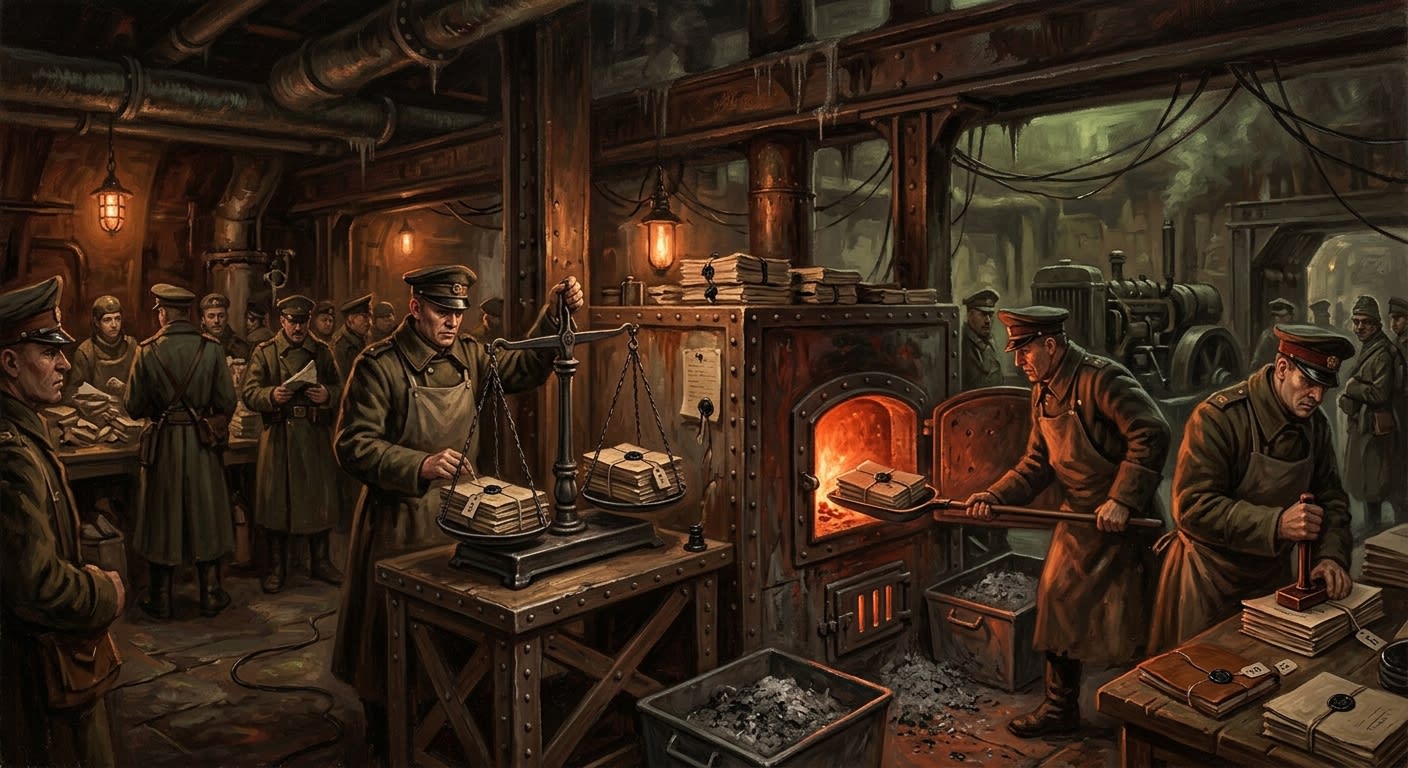
The Directive's standard sequence has the beauty of a bone saw: identify, mark, seal, register, route, countersign, burn, weigh, file. Beauty is not kindness. Do not confuse the two merely because both can be polished.
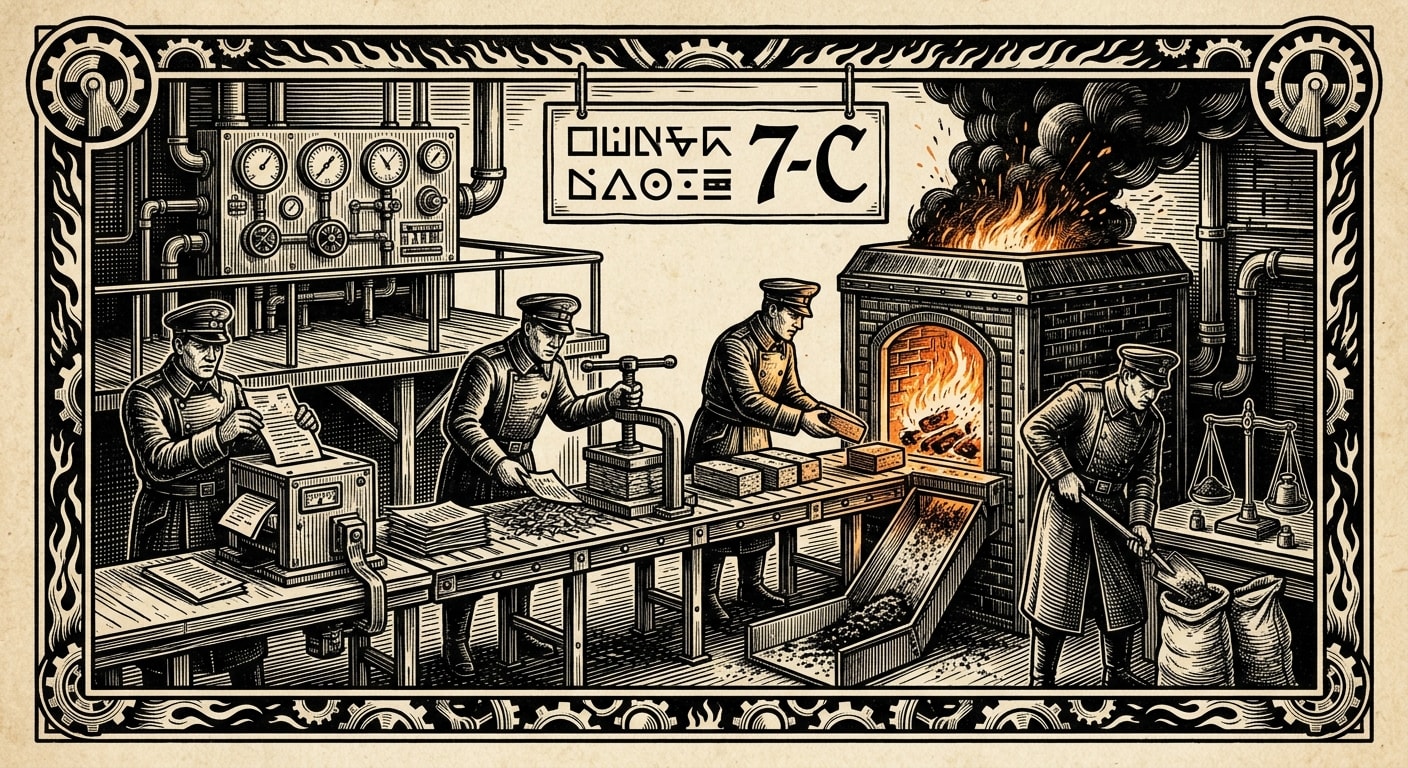
A Trench-Court Clerk receives the testimony at the lantern table. Name, unit, vow, bequest, statement, category. If the statement contradicts approved order, threatens morale, implicates command, produces doctrinal hazard, or bears words whose spread would require Purity to work before breakfast, the clerk marks the sheet with sector code and doctrinal severity. The sheet enters the contradiction pouch. The pouch receives bundle number. The bundle number enters the log without contents. The contents remain known to the clerk, the witness if he survives, the dying man if death has not yet completed the interview, and the Creator, whose filing privileges remain disputed.
Countersignature belongs to the Front Prelate or War Registrar, except when shelling, emergency, contamination, or rank convenience produces an authorised irregularity. The courier carries the sealed pouch. The receiving Custodian checks wax, cord, weight, code, and smell. Smell appears in no public manual. Every real manual smells by implication.
The field furnace is not grand. Wickedness rarely needs architecture; it needs a hinge, a drawer, and a man willing to initial the column. The furnace mouth opens. The bundle enters. The attendant waits until flame has done what policy commanded. Ash is cooled, weighed, swept, sealed, and entered into drawer count. Administrative waste, the form says. Administrative waste may be audited. Administrative waste may be reconciled. Administrative waste does not accuse.
#On What the Fire Receives
The Directive does not apply to every unhappy confession. Ordinary fear remains ordinary. A boy calling for his mother does not endanger the state unless his mother has organised a district. A soldier cursing pain may be filed as injury. A deserter repenting too late may be contrition. Drift belongs in notation. Contagious doubt belongs nearer the hook.
Contradiction is testimony that strikes official structure at a joint. “The bell did not ring.” “The captain ordered retreat.” “The ration sacks were sold.” “The chaplain recognised the thing wearing Halden's face.” “We were abandoned.” “Do not tell my wife I died faithful; I did not.” Each sentence arrives wet, broken, half-delirious, perhaps false, perhaps truer than the morning order. The Directive does not decide truth in the philosophical sense. Philosophy is a rearward luxury. The Directive decides survival.
Officer-sensitive testimony receives special handling because officers are delicate creatures whose careers bruise easily despite their boots. Pension-sensitive testimony may be delayed until the family notice has left. Demon-sensitive testimony may receive Purity notation. Speech contamination enters restricted routes. Political uselessness burns quickly. Political usefulness develops procedural complexity, which is how dangerous facts learn to grow fingernails.
FIELD APPENDIX — IMMEDIATE FLAME AUTHORISATION Class IV: statements naming unreconciled command abandonment during active assault. Class V: statements spoken in the voice of █████████████ while identifying a living officer's sealed childhood name. Emergency route: bypass rear review; Custodian witness required; ash drawer sealed inside secondary tin. Marginal note: if page repeats phrase after ignition, █████████████████████████████.
The Directive's genius lies in denying content while proving action. The Bureau can state with perfect honesty that Bundle 14-B was received, countersigned, cauterized, weighed, and filed. It need not state that Bundle 14-B contained Private Alric's accusation that his colonel used wounded men as bell bait. The process survives. The sentence does not. The colonel, depending on friends, may survive longest of all.
#On Custodians, Clerks, and the Quarrel Around the Mouth
Burn Directive 7-C made factions inevitable. A furnace is an altar; give men an altar and they will argue theology while pretending to discuss fuel.
The Rubric Clerks embraced the Directive because it made their compression useful at scale. Receive, reduce, seal, route. A thick confession becomes a category. A category becomes a pouch. A pouch becomes ash. A widow receives a clean notice, a regiment receives unpoisoned morning, a captain receives time to acquire another medal, and the clerk receives promotion if his columns remain tidy. This is not simple cowardice. It is cowardice mixed with mercy, efficiency, and several truths too ugly to hang separately.
The Record-True Clerks opposed the furnace with the lunacy of men who believe institutional slogans after training. They insisted every word belonged in the Ledger before flame could touch it. Some kept duplicate slips under blotters. Some encoded pouch numbers in hymn initials. Some wrote exact testimony beneath false covers labelled lamp-oil receipts. Records calls this preservation misconduct. History calls it having witnesses in the room after the arsonist leaves.
A Records circular of A.S. 132 declared that Burn Directive 7-C produced “uniform agreement among field personnel regarding dangerous testimony.”
Corrected for internal instruction. Uniform agreement exists chiefly in circulars. Field personnel disagreed in pouches, duplicates, drinking corners, promotion boards, burn delays, and the occasional fistfight beside the ash bucket.
The Contradiction Custodians stand between these factions with keys, gloves, and expressions of professional indigestion. They manage pouch counts, furnace logs, ash certification, rear review packets, cadence holds, officer-sensitive dispositions, and the small royal decision by which a dead man's sentence becomes archive, ash, or weapon. They are not neutral. No one with keys to both pouch room and furnace room is neutral. They are custodial, which is a colder virtue and a more useful sin.
#On Cadence Anomaly and the Fire That Hesitates
The Directive works best on human contradiction: fear, accusation, doubt, officer crime, despair, field heresy, bad timing. It works badly on Cadence Anomaly, the fifth confession category added after Wound-Site 14, where dying men spoke in voices that belonged to other files. Flame understands paper. It is less comfortable with a page that appears to be listening.
Routine contradiction can be cauterized. A Cadence sheet may refuse ordinary disposal. Clerks report pages that do not catch until the name is spoken aloud, pages that curl around the first letter, pages that leave black flakes shaped like music, pages that vanish between flame and ash drawer. Engineering denies all meaningful difference. Clerks keep their mouths shut. I know which party has spent more nights beside the iron box.
Directive supplements now require Cadence Examiner review before routine burn unless contamination spreads, witnesses begin repeating the phrase, or the page addresses a living person by name. The handling instructions are full of negative space: preserve exact phrase, do not compress, do not repeat aloud, do not burn alone, do not answer, do not permit War officers to “test operational utility.” That last instruction is mine in spirit if not signature. War sees a borrowed voice and imagines interrogation. War should not be left unsupervised near teaspoons, much less miracles.
Cadence cases reveal the Directive's hidden assumption: that the state owns the final disposition of words because words remain inert after capture. Borrowed voices dispute this assumption. A sentence that waits in the page is not merely testimony. It is presence with margins. Burn Directive 7-C has no theology for such things. It has exceptions, which are the bureaucratic substitute for fear.
#On Abuse, Mercy, and the Market in Flame
Every category with consequence acquires a price. Directive 7-C did not invent corruption; it gave corruption a furnace schedule. Families pay to keep a son's last doubt out of the pouch. Officers pay to put accusations into it. Chaplains pay for contrition language because repentance preaches better than terror. Quartermasters pay to burn bequests involving boots, morphine, lamp oil, cartridges, or other holy substances. At Bastion-Przemyśl, lamp oil buys clean death. At Bastion-Constantinople, morphine and a promise buy silence with southern manners.
The Bureau of Purity knows. Purity always knows, except where knowing would require interrupting a machine that still works. Too little enforcement breeds market. Too much enforcement breeds silence. Silence would kill the Trench Courts more thoroughly than enemy shelling, because the whole apparatus depends upon men believing the lantern table might carry their words somewhere better than the dirt. The pouch must look like possible archive. The furnace must wait behind it like a doctrinal afterthought.
Mercy enters the same crooked door. A Rubric Clerk may soften contagious doubt into grief so children keep bread. A Custodian may delay burn until an officer loses protection. A Record-True Clerk may preserve a duplicate that later exposes a massacre. A corrupt act can save a household. A merciful act can conceal a murderer. Directive 7-C provides the theatre in which both enter wearing identical gloves.
Purity inspection manuals state that all 7-C irregularities receive direct corrective action. Clarified in practice: irregularities receive correction when correction improves control. When correction damages confession throughput, enforcement observes, annotates, and permits the sin to continue under a cleaner heading.
The market in flame is, by A.S. 201, mature. Pouch delay. Pre-audit burn. Rear review upgrade. Ash variance tolerance. Mercy seal. Officer-sensitive mark. Cadence hold. Family notice smoothing. Each has a cost in money, rations, oil, morphine, promotion, transfer, future silence, or blackmail tucked in a clerk's prayer book. The state deplores this economy with one hand and spends it with the other.
#On the Ash Drawer and Present Use
As of A.S. 201, every licensed Trench Court station keeps 7-C materials apart from ordinary ledgers: pouches, coded marks, burn authorisations, furnace logs, ash drawers, variance sheets, and the little gloves Custodians pretend are for cleanliness rather than fear. Inspectors count pouch numbers first. They count ash second. They ask about missing mass, excess mass, damp pouches, delayed countersignatures, and pages recorded as destroyed before the courier arrived. If satisfied, they sign. If unsatisfied, they ask whether the officer named in the missing bundle is still useful.
Ash drawer practice has become its own jurisprudence. Expected residue is calculated by page count, ink density, wax, pouch cloth, and sector damp. Excess mass means hold. Deficient mass means notify Records and do not notify family. Sweet-smelling ash means clean the furnace. Blue-edged ash means stop gossiping in front of junior clerks. No ash means pending, and pending is the most honest drawer in the Synod: too dangerous to live, too useful to die, too well stamped to deny.
The Directive has also migrated. Civilian offices do not call their destruction 7-C, for that would make villagers ask why a pension desk needs a field cautery. Yet the language appears in softer clothing: morale-sensitive disposal, restricted contradiction, family-safe notification, doctrinal hygiene, sealed reduction. The front teaches Strasbourg, and Strasbourg pretends the lesson was born in a clean room.
Burn Directive 7-C remains active, hated, necessary, abused, audited, and admired by people whose admiration should trouble the household gods. It preserves the Synod from unmanaged truth. It preserves families from certain punishments truth would invite. It preserves officers from consequences they richly deserve. It preserves, in ash form, proof that something was removed in the approved manner. It is a mercy with iron teeth and a lie with perfect handwriting.
The flame receives the page. The drawer receives the ash. The log receives the number. The Ledger receives obedience. The dead, having been heard exactly long enough, are improved into silence.