

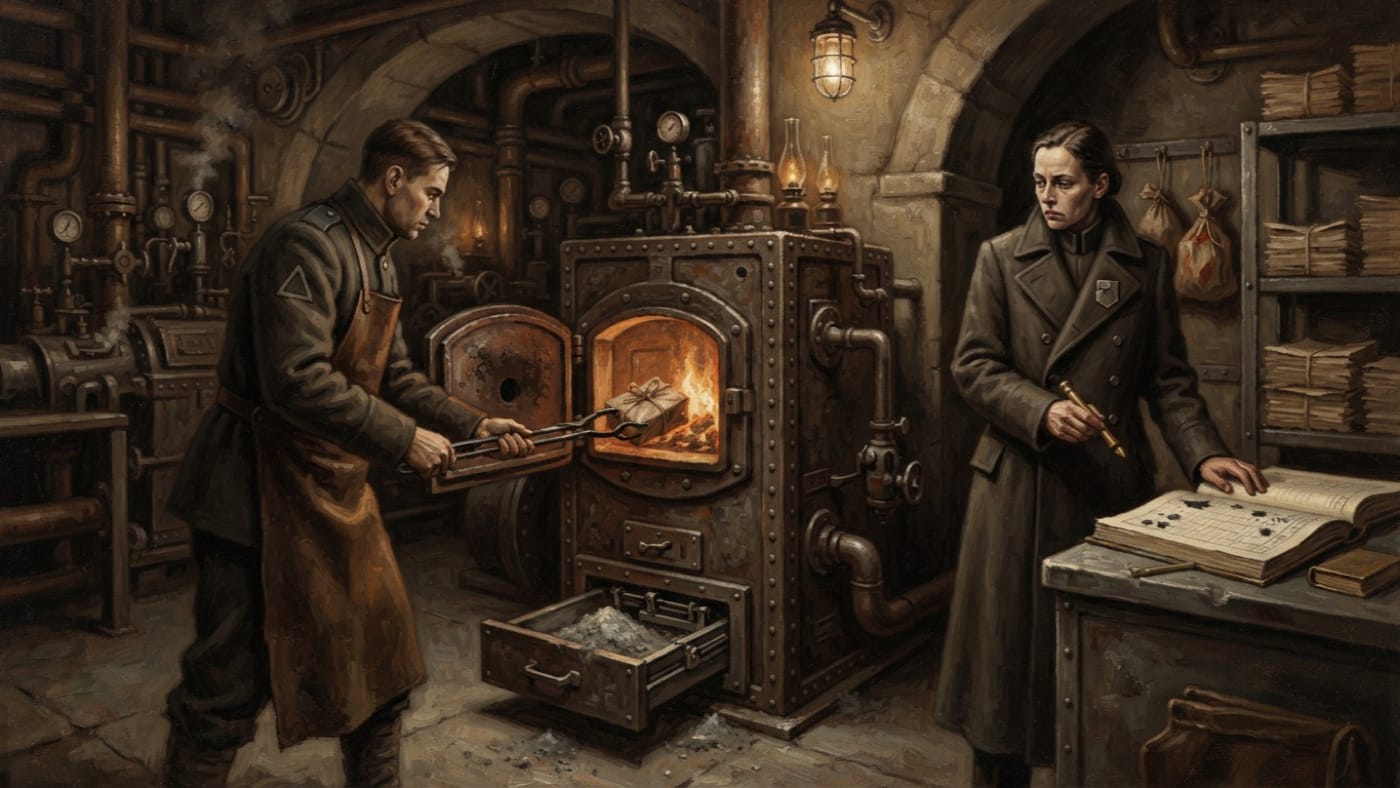
#On the Mouth, the Hinge, and the Drawer
The field furnace is a box that eats paper on instruction. Anyone hoping for a cathedral of flame has come to the wrong office. The record gives it a mouth that opens, a hinge, a drawer for what is left, an attendant who waits, and a column where a man puts his initials. That is the whole of its documented anatomy, and it is enough to dispose of a regiment's conscience before the soup goes cold.
This entry is a documentary survey taken in A.S. 201, the present year, which is 1911 by the reckoning of the Bureau of Records. A.S. 201 is the date of the survey. It is not the furnace's founding, manufacture or first lighting, none of which the Ledger preserves for the class as a whole. Furnaces have makers, and the makers presumably had names. The Bureau kept the ash and lost the craftsmen, a choice that tells you a good deal about what the Bureau values.
Field furnace (place). Referral index entry, backlog row, unresolved.
Corrected. The field furnace is an instrument kept at licensed Trench Court stations, and the referral named no particular installation. Any reader who wants a single furnace with an address and a founding plaque must find one himself. The Codex will not invent one to tidy his index.
What the survey can establish is practice. Under Burn Directive 7-C the furnace is where authorised destruction of dangerous final testimony becomes a fact with a weight. It is the last station in a chain of custody. The furnace finishes that chain and has no authority to begin it.
#On the Order That Lit It
The furnace's authority dates from A.S. 91, when the joint mandate of Records and the Bureau of War constituted the Trench Courts. The settlement followed the Uncounted Winter, whose span the archive disputes somewhere within A.S. 87 to 91. Its total the archive does not dispute: fifty thousand dead without attestation. The Trench Courts were the remedy, a clerk at every wound to catch name, unit, vow and bequest before the breath went.
The remedy had a side effect. Clerks who write down exactly what dying men say end up holding exactly what dying men say. Burn Directive 7-C, Cauterize on Receipt, was issued in that same settlement to decide which of those sentences the Synod could afford to keep. The furnace was the means. The Contradiction Doctrine supplied the categories, and the furnace supplied the heat.
#On the Passage of a Bundle
Most testimony never reaches the furnace. Grief is filed as grief, pain as injury, and late repentance as contrition. Only what the Directive names goes to the fire: contradiction bundles, contagious-doubt packets, officer-sensitive accusations, certain sealed pouches. Any sentence that strikes official structure at a joint takes the long road to the short end.
The road is numbered. A Trench-Court Clerk marks the sheet with sector code and doctrinal severity and seals it in a contradiction pouch. The pouch receives a bundle number, and the number enters the log without any summary of contents. The Directive takes this omission very seriously. A pouch in hand is not yet a burn. Sealing preserves the testimony long enough for someone with a higher signature to decide its fate.
A courier carries the sealed pouch. The standard authorisation is countersigned by a Front Prelate or a War Registrar, and the Directive allows exceptions for shelling, contamination, emergency, and the irregularities that rank finds convenient. The published sequence lists transfer before countersignature. It does not say that every courier stands about waiting for ink, and neither will I. The receiving Contradiction Custodian checks wax, cord, weight and code against the court ledger. Only then does the mouth open.
Clerks' field descriptions: "Burn orders may come by courier: you feed pages to a small furnace until the dugout smells like paper and meat."
Corrected for instruction. The smell is accurately reported. The procedure is not. A burn under Directive 7-C requires authorisation, a receiving Custodian, and a custody record. A clerk who feeds pages to iron on his own initiative is committing an offence with a lantern nearby.
The bundle goes in, and the attendant waits until the flame has done what policy commanded. Nobody hurries. A half-burnt contradiction is worse than an unburnt one, because it has been seen to survive.
#On the Ash Chain
When the fire is finished the record starts again. The ash is cooled, weighed, swept, sealed, entered in the drawer count, and classified as administrative waste. From here the ash drawer takes over as its own small jurisprudence. Expected residue is reckoned against the pouch. Excess mass means a hold, deficient mass means Records is told, and no ash at all means the disposition is pending.
A Custodian signs three columns: pouch index, furnace log, and ash drawer sheet. They must agree. They must not agree too readily, since a perfect match is how the careful forger gives himself away. Inspectors count pouch numbers first and ash second. They ask about damp pouches, late countersignatures, and pages logged as destroyed before the courier arrived.
The ledger proves a great deal. It proves Bundle such-and-such was received, authorised, burned, cooled, weighed and filed. It proves the hand and the hour. It cannot prove one word of what the bundle said. The count survives and the sentence does not, which was the whole purpose. Records has turned a death into a mass in grams and calls the result reconciled.
#On the Quarrel at the Mouth
All three factions of the Trench Courts stand round the furnace, and none of them likes it in quite the same way.
The Rubric Clerks value the furnace because it gives their compression somewhere to go. Receive, reduce, seal, route. A widow receives a clean notice and the regiment gets an untroubled morning. Some of this is cowardice. Some of it is bread put on a table that truth would have emptied.
The Record-True Clerks want every word in the Ledger before the flame touches it. Some keep duplicate slips. Records calls this preservation misconduct. Since a duplicate is the only form in which a burned sentence can outlast its own ash, I record the charge and do not join in it.
The Custodians hold keys to the pouch room and the furnace room alike, and that makes them neither friends nor enemies of either camp. They decide whether a sentence goes to archive, to rear review, or to ash. A Custodian can delay a burn until an officer has lost his protection. He can also take money to hurry one. The parent Directive lists the standing risks plainly: premature burn, bribed disposition, false or delayed disposition, ash variance. A family can pay to keep a son's doubt out of the pouch. An officer can pay to put an accusation in it. The furnace burns whatever reaches it, and the market decides what reaches it.
#On the Fire That Waits
One class of page is not to be put through the mouth on routine authority. Testimony marked Cadence Anomaly requires review by a Cadence Examiner before any routine burn. The exceptions are spreading contamination, witnesses beginning to repeat the phrase, or a page addressing a living person by name. The emergency route bypasses rear review and requires a Custodian witness. The drawer is then sealed inside a secondary tin.
Clerks report pages that would not catch until a name was spoken, pages that curled round a first letter, black flakes shaped like music, and sheets that vanished somewhere between the flame and the drawer. The Bureau of Engineering finds no meaningful difference. I file the clerks' reports as clerks' reports. I note that the clerks are the ones who stand beside the iron, and I offer no ruling on the physics. The Directive offers none either. It simply tells no one to burn such a page alone.
#On Present Use
As of the A.S. 201 survey, every licensed Trench Court station keeps its Directive 7-C materials apart from ordinary ledgers: pouches, marks, authorisations, furnace log, drawer, variance sheets. The furnace is in use. It is counted, abused and reconciled, and it remains mandatory. Its maker is unrecorded, its fuel is outside this survey's competence, and its individual sites are recorded only in station inventories that the Codex has no wish to publish.
The mouth opens. The bundle enters. The attendant initials the column, and the drawer reports a weight.