
#On the Men Between Page and Flame
The bundle has already spoken. The Custodian decides whether anyone else will hear it. — Field Records proverb, formally denied
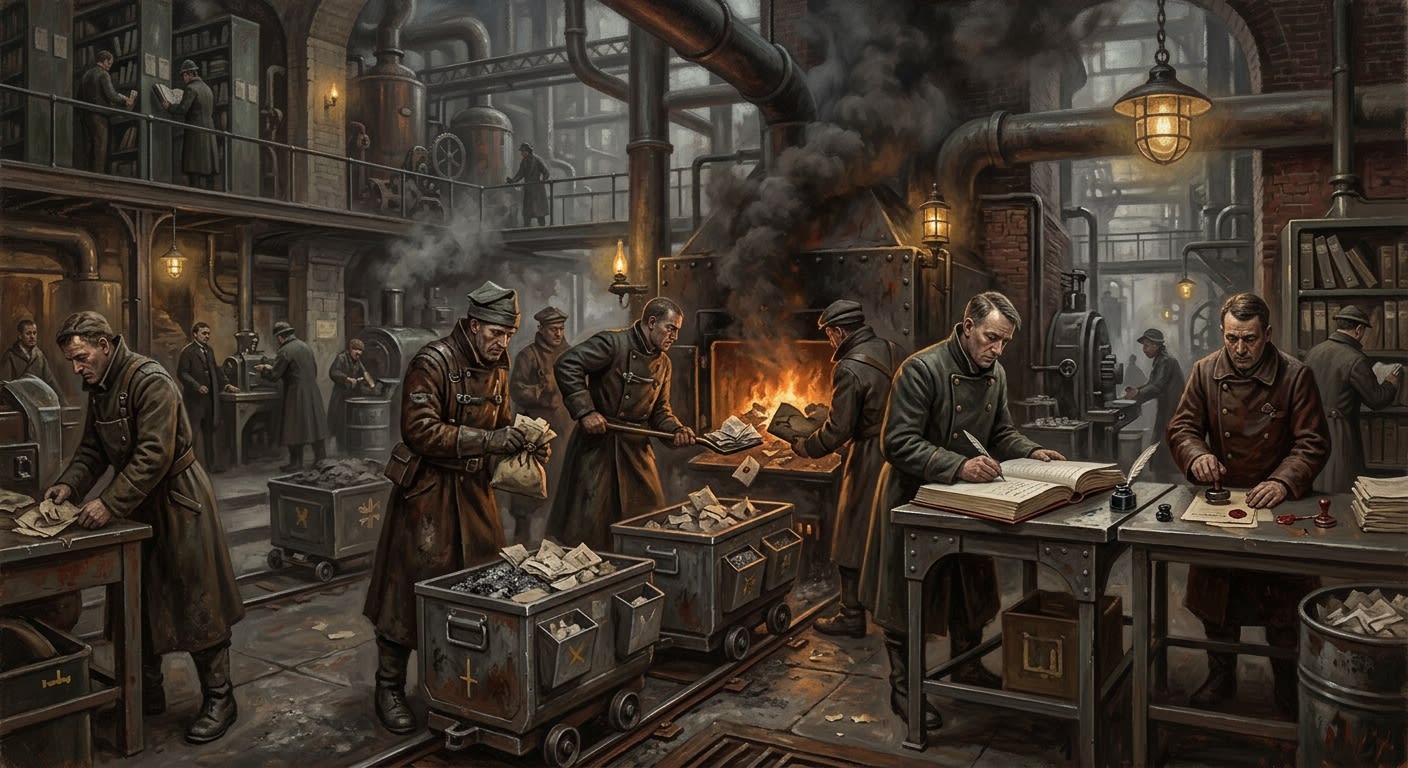
Contradiction Custodians are senior Trench-Court Clerks entrusted with the burn cycle: pouch counts, bundle routing, furnace logs, ash certification, rear review packets, and the small sovereign decision by which a dead man’s final accusation becomes evidence, waste, or smoke. They stand above supervisors, below Desertion Hearing Specialists, and precisely where the Synod likes to place dangerous competence: close enough to the sin to manage it, too watched to enjoy it, too useful to be clean.
They sign nothing twice.
That detail is no superstition. A Custodian signs the pouch ledger once, the furnace log once, the ash drawer once, the rear transfer docket once. Duplicate signatures imply duplicate custody. Duplicate custody implies the possibility that truth existed in two places at the same time. The Bureau of Records dislikes metaphysics unless it has numbered the shelves.
#On the Origin of Custody
The office emerged after the Uncounted Winter, when the Trench Courts constituted in A.S. 91 solved one disaster by producing another. The first disaster was unrecorded death: fifty thousand men without attestation, widows without status, orphans without benefits, creditors billing corpses with admirable punctuality. The second disaster was recorded speech. Once clerks began writing final confessions beside the wound, the Ledger acquired more truth than the war could safely digest.
A dying man is a reckless witness. He names cowards, liars, demons, lovers, thieves, saints, officers, angels, and quartermasters. He says what he saw. He says what morphine lent him. He says what fear forged in the last hot chamber of the skull. Some of it is garbage. Some of it is evidence. Some of it is contagious enough to turn a dugout into a tribunal and a tribunal into mutiny.
Burn Directive 7-C gave the Synod a remedy: Cauterize on Receipt. The contradiction pouch became the wound dressing. The Custodian became the hand deciding whether the dressing went to the surgeon, the archive, or the furnace.
Early Records memoranda describe Custodians as “neutral routing officers.”
Corrected. A man who chooses between archive and ash is neutral in the same sense that a guillotine is symmetrical.
#On the Work of the Burn Cycle
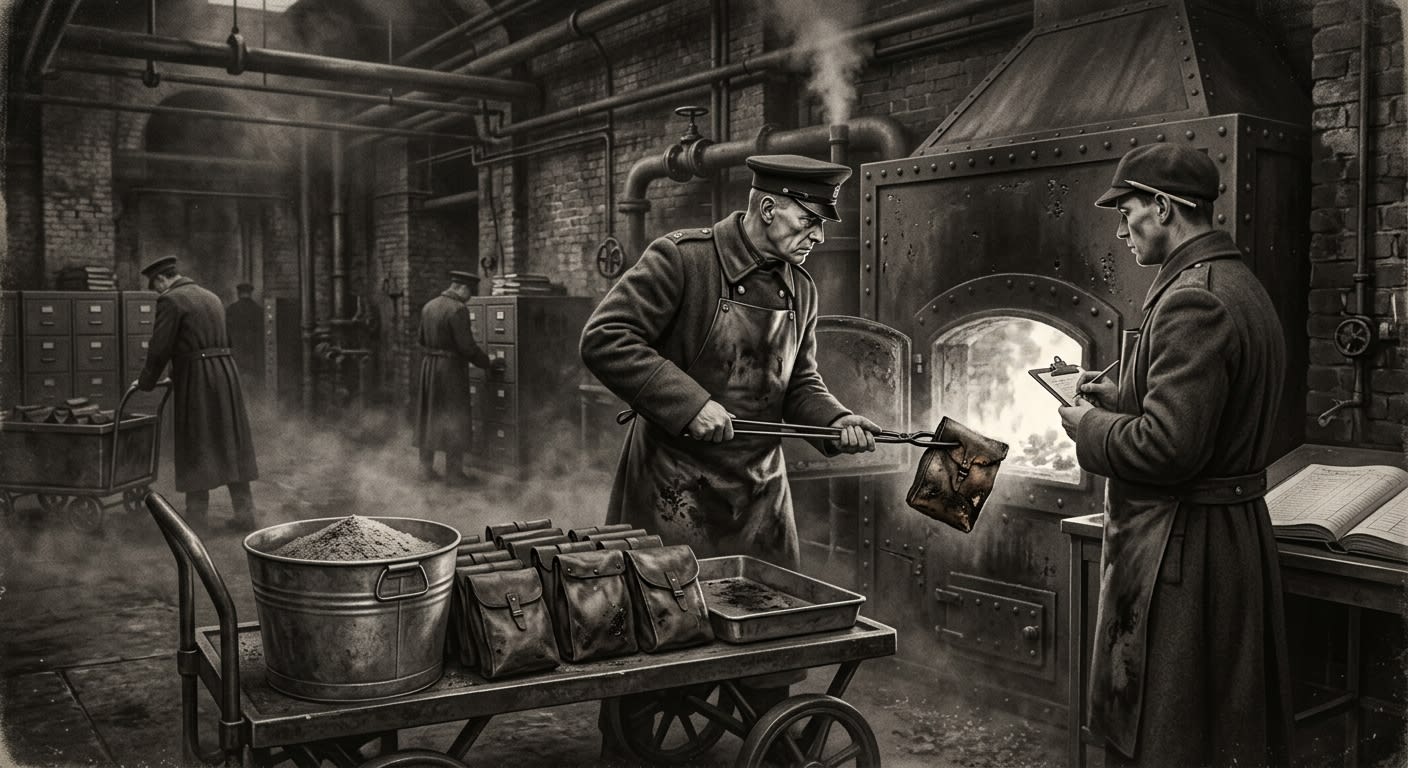
The burn cycle begins with count. Counts are holy. A pouch arrives sealed from a court table: bundle number, clerk mark, category code, witness notation, routing strip. The Custodian checks the wax, weighs the pouch in the hand, smells for damp, notes soot, blood, brine, and the particular sourness of pages stored too near fear. He compares the pouch against the court ledger, the casualty return, and the ash schedule. Then he decides which danger has entered his custody.
Ordinary dangerous truth goes to the furnace. Officer-sensitive truth may go to rear review if the officer has enemies of equal rank. Demon-sensitive truth goes to a Cadence Examiner if it speaks in borrowed rhythm. Pension-sensitive truth waits until the family notification leaves, because bread should not be interrupted by truth still under administrative review. Politically useless truth burns at once. Politically useful truth develops procedure around itself.
The Custodian records disposition in three places: pouch index, furnace log, and ash drawer sheet. The three must agree without appearing to have copied one another too eagerly. A perfect match draws suspicion. A sloppy match draws auditors. The experienced Custodian introduces one harmless variance — a time rounded to the nearest bell, a smudge in the assistant’s column, an ash weight recorded as approximate — so that the file looks human enough to survive inspection.
This is why they are chosen from clerks who have already survived the lantern table. Innocence cannot perform this work. A fool burns too much. An idealist preserves too much. A coward forwards everything rearward and is eaten by backlog. A Custodian learns which truths have teeth and which only smell bad.
#On Ash as Evidence
Civilians believe burning destroys a record. This is adorable. Burning moves the record into a more obedient form. Ash has weight, time, drawer number, witness mark, furnace attendant, temperature notation, and the Custodian’s signature. Ash can be audited. Ash can be reconciled against pouches. Ash can prove that the Bureau disposed of something without requiring the Bureau to admit what the something said.
The ash drawer is the Custodian’s little reliquary. It is pulled, cooled, weighed, swept, sealed, and entered. Some Custodians tap the drawer three times before opening it. Others refuse to touch it with bare fingers. At Bastion-Brest, one Custodian kept separate brushes for final bequests and contagious doubt, claiming the former left blue soot on the hinge. The Bureau of Engineering found no blue soot. The Custodian died convinced the engineers had looked with the wrong eyes.
ASH CERTIFICATION IRREGULARITY — BASTION-BREST Drawer 4 showed excess weight after authorised burn of Bundle ████. Custodian note: “Names remain.” Engineering note: no mechanical fault. Records note: reconcile by variance allowance. Doctrine note: ███████████████████████████████████████████. Final action: drawer sealed inside drawer; Custodian reassigned west without tongue-bell privileges.
A good Custodian treats ash with respect and contempt. Respect, because ash is the final form of managed contradiction. Contempt, because sentiment near an ash drawer makes a man slow, and slowness attracts questions. They do not weep. They check mass.
#On Their Relations with the Factions
Rubric Clerks feed the Custodian’s world by reducing confessions into categories fit for routing. They make the burn cycle legible. Custodians recruit from them often, because a Rubric Clerk already understands that truth must fit the container before it can be moved. The danger is over-neatness. A Custodian who trusts clean categories too much becomes a furnace clerk with a better title.
Record-True Clerks are the Custodian’s headache, conscience, and future indictment. They hide duplicate slips, delay burn orders, copy pouch numbers into hymn initials, and preserve exact phrases under false covers. Custodians hate them because they introduce memory where disposal was scheduled. They also need them, on rare and humiliating occasions, when a burned bundle becomes politically useful after the smoke has done its work. Then the hidden copy is discovered with solemn gratitude, retroactively authorised, and cited as proof of Records diligence. Contradiction is policy. Gratitude is theft wearing gloves.
With Cadence Anomaly, Custodians become visibly unhappy. Pages that will not burn until the name is spoken offend their entire theology of disposal. A Custodian prefers categories that enter the furnace as paper and leave as ash. Borrowed voices linger. They require holds, examiners, second witnesses, and silence around the fire. The Custodian who whispers an anomalous name to hurry ignition has already lost, whatever the ash drawer says.
#On Abuse and Advancement
The office attracts bribes of a finer grade than ordinary trench corruption. A family pays a clerk for faithful classification. An officer pays a Custodian for disappearance. A rival officer pays for rear review. A chaplain pays to have contrition preserved until a sermon can profit from it. A quartermaster pays to burn a bequest mentioning boots. At Bastion-Przemyśl, lamp oil buys clean death. At Bastion-Constantinople, morphine buys silence with better manners. At Custodian rank the coin becomes promotion, protection, transfer, and the great currency of all bureaucracies: future noninterference.
The Bureau of Purity knows. Purity always knows, except where knowing would require action against someone administratively convenient. It audits pouch counts, watches ash weights, interrogates assistants, and leaves most Custodians alive because the burn cycle must continue. A corrupt Custodian is a risk. A terrified empty chair is a larger one.
A Purity inspection manual states that “all contradiction disposition is subject to direct corrective oversight.”
Clarified. Oversight applies where correction improves control. Where correction damages throughput, oversight observes itself observing and goes to lunch.
Advancement out of Custody is possible and spiritually ruinous. Some become Desertion Hearing Specialists, having learned to hear absence as guilt. Some become Cadence Examiners after surviving a page that answered back. Some are promoted to rear Records offices where they train younger clerks with beautiful calm and never stand downwind of a furnace. The best are kept where they are until their handwriting loses pressure and their assistants begin checking whether they have signed a page twice.
#On the Custodian’s Private Rites
Every Custodian develops private rites, though Records denies this because private rites imply private fear. The left glove for unopened pouches. The right glove for ash. Salt under the furnace lip. A spoken inventory of tools before dawn. No eating during burn. No family names in the room. No blue ink. No hymn during drawer cooling. No jokes after cadence holds. At Bastion-Irongate, Custodians tap the furnace hinge with the seal handle before feeding any bundle containing officer accusation. They say it prevents the hinge from sticking. The hinge has never stuck. Theology begins with statistics of this sort.
Their taboo is simple: never read aloud from a pouch alone. Reading summons witness. Witness summons duty. Duty summons paperwork. If a line must be checked, the assistant stands present, lantern trimmed, hand away from the seal tin, mouth closed. The Custodian reads silently unless cadence review requires sound. Several have gone deaf in one ear. Several pretend this came from shelling. Shelling is a generous alibi on the Line.
#On the Present Disposition
As of A.S. 201, Contradiction Custodians operate in every major Trench Court sector along the Sagittal Line, with heavier concentration at Bastion-Brest, Bastion-Przemyśl, Bastion-Irongate, and Bastion-Constantinople. Their work is officially procedural, unofficially judicial, and actually priestly in the old bloody sense: they decide what the fire receives.
They are watched by Records, used by War, tolerated by Purity, resented by Rubric Clerks, feared by Record-True Clerks, and courted by officers who understand that an accusation burns differently depending on who feeds it. They possess no public doctrine, no guild banner, no patron beyond borrowed Saint Vell, and no anthem. An anthem would require voices. They have had enough of those.
The Custodian’s virtue is custody: that cold administrative holiness by which a dangerous thing is held long enough for authority to decide what it was always meant to become. Archive, ash, or weapon.