

#On the Men Who Make Grief Legible
Compress the confession. Preserve the family. Burn the remainder. — Rubric Clerk table-prayer, unofficial
The Rubric Clerks are the majority faction among Trench-Court Clerks, the growing school, the promotion-board favourite, the men and women who hold that the front runs on belief and paperwork, and that both substances spoil when exposed too long to unsorted truth. They are accused of cowardice by Record-True Clerks, of brutality by widows who learn too late what was removed from a death notice, and of sentimentality by Contradiction Custodians who think any hesitation before flame smells like amateur theatre.
They are, the Creator help the Ledger, often correct.
A Rubric Clerk does not ask what a dying man meant in the great interior theatre of his soul. He asks what category can carry the words without breaking the unit, the widow, the pension office, the morning assault, or the officer whose signature keeps ammunition moving. This is the entire moral horror of the faction. They do not hate truth. They triage it.
#On the Birth of the Card
The Rubric Clerk was born from the same catastrophe that birthed his enemies. During the Uncounted Winter, fifty thousand soldiers died without attestation in the northern sector, and the Synod discovered that grief without forms becomes riot. A.S. 91 gave the front its Trench Courts: lantern table, seal tin, waterproof sheets, brine cloth, confession categories, contradiction pouch, and authority to turn a man’s last breath into administrative fact before it cooled.
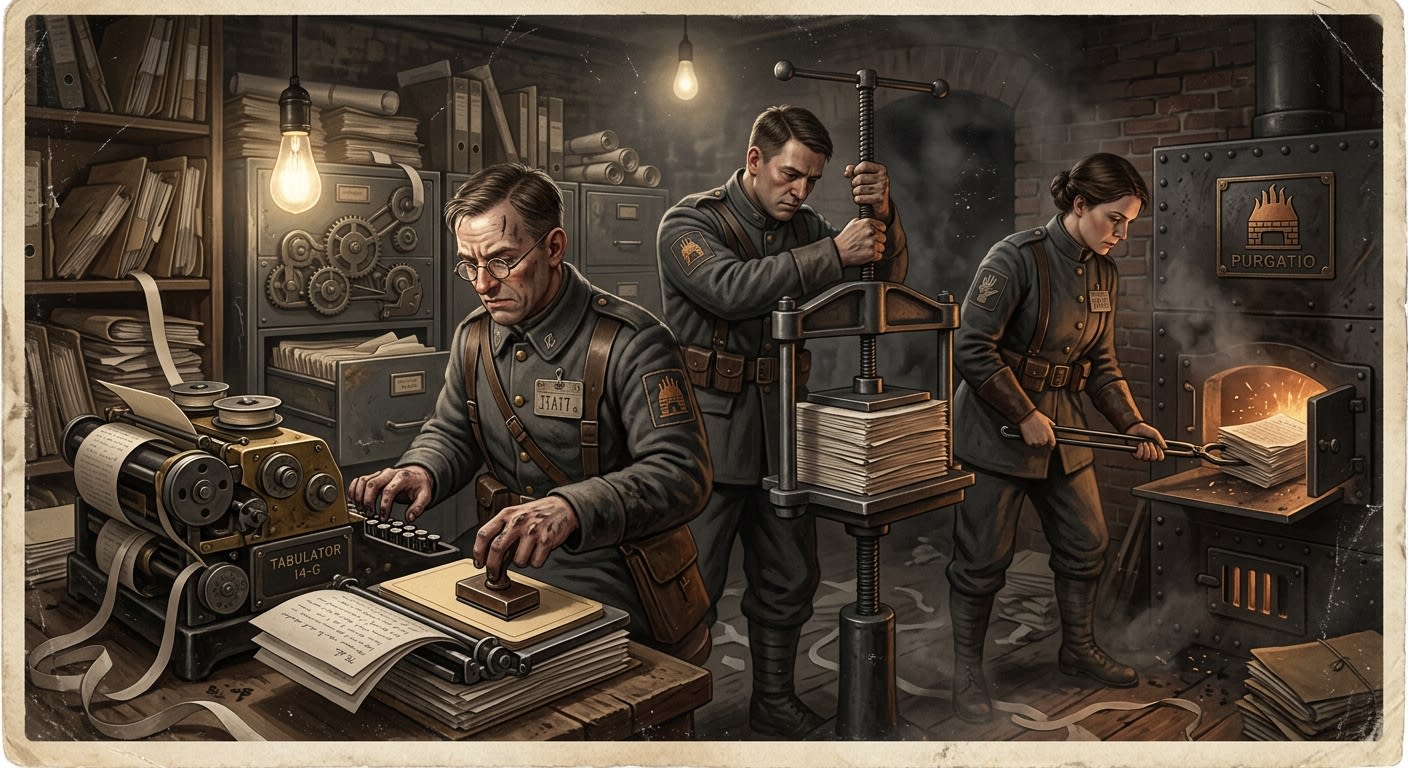
The first rubric cards were ugly little things, stiffened against damp, printed in cramped type by rear offices that had never watched a man dictate a bequest while holding his intestines in place. They listed the categories: faithful, drift, contrition, contagious doubt. Later, after Wound-Site 14 produced confessions in voices that did not match the mouths speaking them, cadence anomaly was added with a margin too narrow for comfort. The card was meant as a servant. The Rubric Clerk made it a discipline.
The Deserter Purges sharpened the habit. Quick-hearing protocols and loyalty phrasing rubrics taught clerks that phrases could be weighed faster than souls. “I was separated” carried one weight. “They left me” carried another. “The officers lied” demanded a pouch, a burn order, or a supervisor with political courage, which is to say a supervisor soon transferred.
An A.S. 94 training note describes the rubric card as “a neutral aid to field comprehension.”
Corrected. No card that decides pensions, burials, burn orders, and accusations is neutral. It is a blade with small print.
#On Compression
Compression is the Rubric Clerk’s sacrament. A man says: tell my wife I saw Captain Harl feed the left company into the fog after the bells failed and I am sorry I ran and my brother’s real name is not in the rolls and the dead walked behind us singing Mother’s harvest song. The Rubric Clerk hears seven matters, four offices, three dangers, and one line of text the family can safely receive. He writes: Contrition with drift. Final affection expressed. Bequest pending verification.
There. A pension may proceed. A widow may mourn without Purity at her door. A regiment need not hear that the dead sang. Captain Harl may continue being useful until someone with a cleaner ledger chooses to dislike him. The brother remains outside the rolls, which may be mercy or abandonment depending on who is hungry next winter.
Record-True Clerks call this murder by abbreviation. Rubric Clerks call it keeping the living alive long enough to regret the method.
A good Rubric Clerk compresses without obvious falsification. He knows which words can survive. He knows which accusations will trigger inquiry, reprisal, scandal, or silence so total the family will receive less than a lie. He can turn “we were abandoned” into “unit separation under hostile conditions” without changing grammar too visibly. He can turn “the bell did not ring” into “cadence confusion reported” and keep the report alive in a file quiet enough to outlast the officer who would otherwise kill it.
That is their private defence: compression can smuggle truth through a system that would burn it if named plainly. This defence is sometimes sincere. It is also convenient enough to be dangerous.
#On the Clean Narrative
The clean narrative is the Rubric Clerk’s gift to the dead, and I use gift in the old fiscal sense: something presented with ceremony and paid for by someone else. Families need death to arrive in a form they can spend. A death marked faithful unlocks rations, burial rites, inheritance triggers, school stipends, widow classifications, and the small civic courtesy of being allowed to grieve aloud. A death marked contagious doubt brings inspection, reduced benefit, parish whispers, and the slow administrative starvation of children who have already lost enough to satisfy any decent appetite.
Rubric Clerks know this. They sit where truth meets ration. When a dying man curses the Synod, his wife’s bread hears it. When he names an officer, his son’s apprenticeship hears it. When he reports demon voices, his parish may hear Purity’s knock. The Rubric Clerk chooses which ears must remain mercifully deaf.
The clean narrative can be kindness. It can also be fraud with a mourning ribbon. Rubric Clerks live inside that ambiguity until it hollows them into instruments.
#On Their Enemies at the Table
Their quarrel with Record-True Clerks is intimate because both sides have held the same dying hands. Record-True Clerks preserve exact words and accuse Rubric Clerks of cowardice before the furnace. Rubric Clerks answer that preservation without consequence is vanity, and preservation with consequence is sometimes murder committed in the name of honesty. The argument would be easier if one side were stupid. The Creator, who enjoys paperwork more than He admits, denied us that mercy.
The quarrel shows itself in small violences. A Record-True Clerk copies too much; a Rubric supervisor cuts the passage with red pencil. A Rubric Clerk marks grief as drift; a Record-True assistant writes the original phrase in the margin. A burn order arrives; one side delays by claiming wet wax; the other side reports damp fraud. They drink in different corners. They invoke Saint Vell with different expressions. The saint, being safely dead, offers no arbitration.
The Bureau of Purity prefers Rubric Clerks until it does not. A tidy category reduces contagion. A tidy category also conceals corruption, officer crime, secret mercy, and demon influence under neat handwriting. Purity understands this and keeps enough suspicion in reserve to remain itself. The Bureau of War prefers Rubric Clerks openly. War has never liked a sentence it could not shorten into an order.
#On the Phrase Wheel and the Black Comfort
Rubric culture spread beyond the trench table because the Synod loves any device that makes judgement repeatable. Confessor-Booth Clerks have sin-rubric cards. Codex Doubt Auditors have phrase wheels. Deathbed harvesters have terminal confession steps. Rubric Clerks belong to this grand administrative family: the holy reduction of human ruin into boxes small enough to stamp.
Their tools are plain: short-codex cards, category seals, correction prompts, burn-routing marks, pouch slips, family notification templates, and the clerk’s own hand trained to stop writing before truth becomes expensive. Recruits learn the four gestures: receive, reduce, seal, route. Veterans learn the fifth: sleep badly without mentioning why.
TRAINING SUPPLEMENT — RUBRIC DISCIPLINE, EXCERPT If subject states: “We were ordered forward after command knew ███████████████,” record as drift unless corroborated by officer-safe witness. If subject states: “The bell answered in my dead brother’s voice,” record as cadence anomaly upon second-witness confirmation of nonhuman interval. If subject states: “Do not burn this,” ████████████████████████.
A faction that compresses grief develops humour like mould under bread. They joke about “fat confessions” and “thin deaths.” They call a clean one-line transcript a bishop’s breakfast. They praise a clerk who can save three pensions in one sentence. Then, at night, they sit beside the furnace and drink enough to make the blue edge of burning names look like ordinary flame.
#On Corruption, Mercy, and the Useful Lie
Rubric practice invites corruption because every category has a price. A family pays for faithful. An officer pays for contagious doubt. A chaplain pays for contrition because repentance makes sermons easier. A supply sergeant pays to erase a bequest involving stolen boots. At Bastion-Przemyśl, lamp oil purchases cleaner death. At Bastion-Constantinople, morphine and promises perform the same errand in better coats.
Rubric Clerks defend themselves by pointing to mercy seals: contagious doubt softened into grief; desertion condensed into confusion; accusation hidden under operational variance so the widow keeps bread while the file keeps a pulse. I have seen such mercy. I have also seen the same motion sell a murderer his virtue back at wholesale.
A Bureau of Records circular praises Rubric discipline as “the extinction of discretionary corruption through standard form.”
Corrected. Standard form does not extinguish corruption. It gives corruption a uniform and teaches it to salute.
The useful lie is the black comfort of the faction. A clean death may feed children. A dirty truth may only feed scandal. A burned accusation may keep ammunition moving. A preserved accusation may prevent the next useless assault. Rubric Clerks live by choosing quickly among such poisons and then pretending the chosen poison was medicine all along.
#On the Present Majority
As of A.S. 201, Rubric Clerks dominate the Trench Courts because the war rewards speed, promotion boards reward compliance, and families reward the men who can keep benefits intact. Their signs are easy to spot: tidy category columns, short family notices, low contradiction leakage, high throughput, obedient pouch counts, excellent burn logs, and eyes that pause half a second too long when someone says complete transcript.
They are growing. Record-True Clerks shrink. Contradiction Custodians rise from Rubric ranks more often than anyone admits, because a man already trained to compress truth is easier to trust with its disposal. The machinery selects for the hand that stops writing.
The Rubric Clerk’s defence remains ugly and strong: the dead are gone, the living still need bread, and the front will not hold while every dying sentence receives the courtesy of philosophy. He is correct often enough to be forgiven by superiors and damned by memory.