
#On the Fifth Box
If the mouth is loyal and the voice is not, record both. — marginal instruction, Cadence Examiner copy, seal damaged
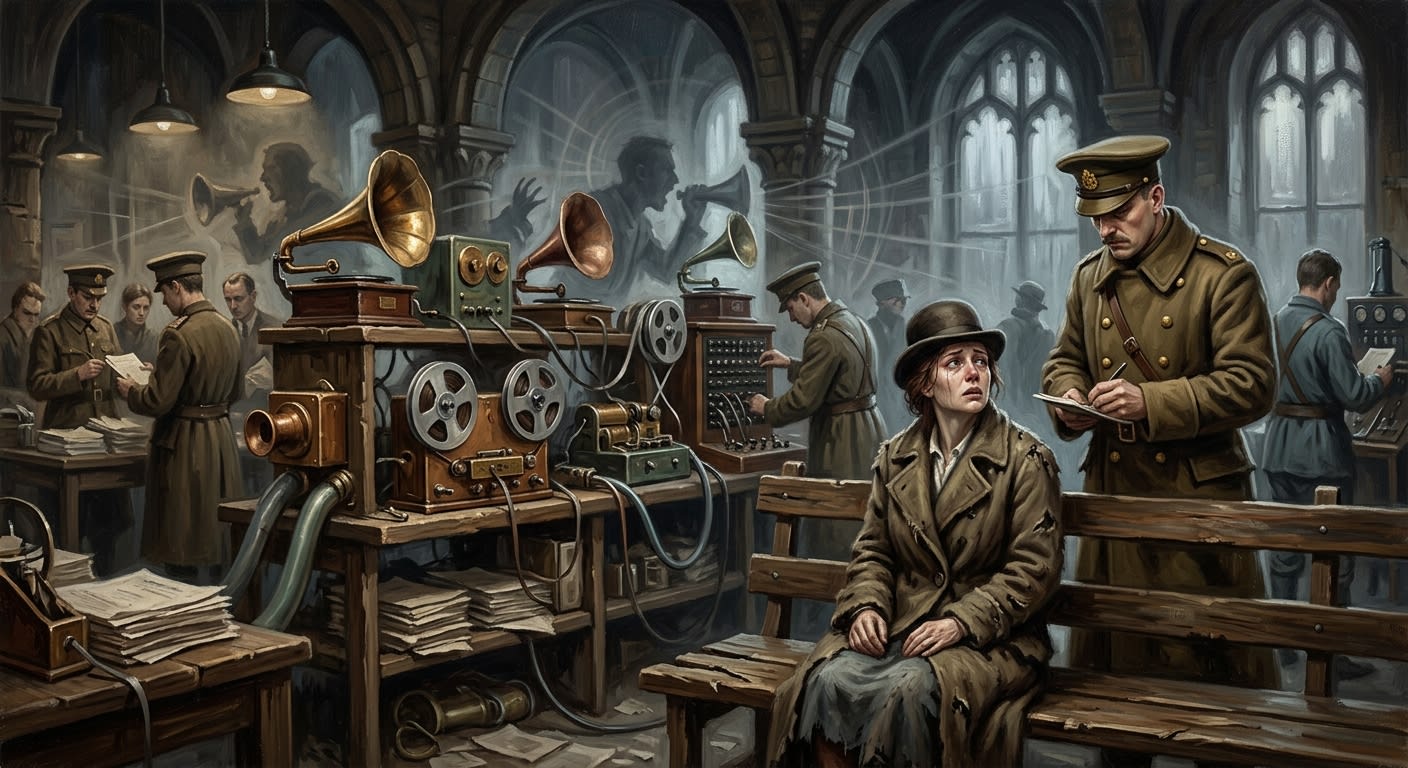
Cadence Anomaly is the fifth confession category of the Trench Courts, added in the A.S. 91 Trench Court settlement (Unregistered) after the demon breach at Wound-Site 14 (Unregistered), where dying confessions began arriving in voices that did not match the mouths producing them. The first four categories — faithful, drift, contrition, contagious doubt — concern meaning. Cadence Anomaly concerns custody. Who owns the sound when a soldier’s mouth moves and another dead man answers?
The category has been used eleven times. Eleven is a small number in civilian arithmetic and an enormous number when applied to the voice of the dying. Every clerk who used it requested transfer immediately afterward. Seven transfers were granted. Four were not.
I dislike unanswered personnel questions. They breed in the margins.
#On Wound-Site 14
Wound-Site 14 was a forward medical cutout in the northern sector, east of a trench spur that maps later renamed twice and then filed under an older name to discourage curiosity. It existed for thirty-six hours during an assault whose formal description contains the phrases limited push, weather interference, and acceptable attrition, which is how one writes massacre without staining the stationery. Medics dragged the salvageable west. The unsalvageable went to the lantern table.
At first the clerks recorded ordinary ruin. Men confessed fear, theft, lust, desertion, hatred of officers, love of mothers, and all the small private debris that falls from a soul when artillery has cracked its casing. Then Corporal Maes of the 19th Ravelin Sappers spoke in his captain’s voice. The captain was alive, three miles rearward, and eating tinned beans at the hour of record. Maes used the captain’s childhood name, which was sealed in a Records schooling file. The clerk marked contagious doubt and kept writing.
The second case was worse. A gunner with no tongue recited the Common Allegiance in perfect alto, using the voice of a choirwoman hanged in A.S. 84 for unlicensed antiphon. The third case asked after a wife belonging to a soldier already dead at Bastion-Brest. The fourth case sang a muster-bell pattern before any bell rang. The fifth case did not speak until the clerk wrote the wrong name; then it corrected him.
The first field summary described Wound-Site 14 as “echo contamination under shell stress.”
Corrected. Echoes repeat. These voices answered.
By dawn the Trench Court supervisor had three sealed pouches, one clerk unable to hear his own speech, a medic refusing to enter the dugout, and a chaplain who kept asking whether last rites applied to the speaker, the spoken-through, or the thing holding the interval between them. The supervisor did the only sane thing available to a servant of the Synod: he invented paperwork.
#On Diagnosis
A Cadence Anomaly is more than strangeness of voice. Men dying of chest wounds rasp. Men with shattered jaws whistle. Men under morphine borrow tones from childhood because pain opens old cabinets in the skull. Bell-sickness can make a clerk hear rhythm where none exists. The front is full of noises, and most of them deserve no theology.
The anomaly begins when identity detaches from sound. The dying man speaks in the voice of another registered person. The dying man uses a name he had no lawful means of knowing. The phrase follows bell-cadence absent from the local schedule. The mouth moves behind the words, half a beat late. A second witness hears a second voice under the first. Ink records a phrase the clerk does not remember hearing. The lantern flame leans toward the speaker as though listening.
The field test is crude: repeat the name, check the tag, ask for unit, ask for home parish, ask for mother’s name, ask for the current bell-hour. A normal dying man fails from blood loss, terror, shock, or the Creator’s admirable refusal to make death tidy. An anomalous confession fails by knowing too much or by answering from the wrong life. The distinction is narrow enough to hang a clerk.
Rubric Clerks hate the category because it resists compression. Record-True Clerks love it with the imprudence of scholars standing near a loaded gun. Contradiction Custodians prefer it routed, sealed, and absent from morning conversation.
#On the Eleven Uses
The official count is eleven. I have seen the count, though not the names, which were sealed behind a Records screen bearing three waxes and an expression of bureaucratic chastity so theatrical I nearly applauded. The eleven uses span multiple courts, though Wound-Site 14 remains the founding cluster. Seven clerks requested transfer and received it. Four requested transfer and vanish from the tidy portion of the file.
Seven granted transfers tell one story: trauma acknowledged, personnel rotated, field discipline maintained. Four absent transfers tell a better one.
CADENCE ANOMALY PERSONNEL APPENDIX — EXCERPT Case Clerk 08: transfer requested after subject used clerk’s own future death phrase. Disposition: █████████████████. Case Clerk 09: refused furnace participation; claimed pages “answered from ash drawer.” Disposition: reassigned to █████████. Case Clerk 10: speech irregularity noted during debrief; all vowels carried second register. Disposition: ███████████████████████. Case Clerk 11: no discrepancy; clerk did not request transfer; signature appears on request in clerk’s hand.
The Bureau of Records insists the eleven are contained. The Bureau of Bells insists cadence contamination belongs to its jurisdiction only when bells are involved, which is to say whenever it wants authority and never when it might inherit blame. The Bureau of Purity maintains a watch list of clerks who have processed anomalous speech. The Bureau of War maintains a shorter list titled Operational Utility, because War looks at a dead man speaking in an enemy officer’s voice and sees interrogation potential. War should not be allowed near miracles. War thinks miracles are ammunition with incense.
#On Fire That Refuses Instruction
Pages written under Cadence Anomaly do not behave well at the furnace. This is superstition. It is also attested by clerks who disagree on everything else, which makes dismissal as one faction’s melodrama too tidy even for Doctrine. Some pages do not catch until the clerk speaks the name aloud. Some curl inward around the first letter. Some burn cold, leaving black flakes in the shape of musical notation. One bundle, at Bastion-Brest, produced no ash at all; the paper vanished between flame and drawer, and the furnace mouth clicked shut with the primness of an offended abbess.
The doctrinal explanation is brief: contaminated speech resists improper disposal. The practical explanation is shorter: no one knows.
Burn Directive 7-C does not quite fit. Contagious doubt can be cauterized. Cadence Anomaly may require quarantine, examination, exorcism, acoustic review, or a clerk with the nerve to admit the page is still listening. Custodians dislike exceptions. Furnaces dislike being contradicted. The category sits between them like a sealed tooth under the tongue.
Record-True Clerks argue for preservation of every anomalous transcript, exact and whole, because the sound may contain evidence of demon movement, battlefield afterlife, registry error, saintly intervention, or something worse than all four: an administrative category not yet invented. Rubric Clerks argue that families cannot be told their son died while speaking in the voice of a hanged choirwoman from A.S. 84. Both arguments are strong. The page waits.
#On the Bureaucratic Horror of Borrowed Voices
The Synod’s authority rests on attachment: name to body, body to vow, vow to record, record to consequence. Cadence Anomaly loosens the stitch. If a dead captain speaks through a living corporal, which file receives the words? If a tongueless gunner sings with a condemned woman’s voice, does the heresy revive, confess, or seek appeal? If a soldier repeats a bell pattern before the bells ring, has the future entered testimony, or has the bell already rung somewhere Records has not admitted exists?
This is why the category is restricted. It threatens the grammar of rule. A demon assault that tears men apart is simple. Count bodies. Issue attestations. Replace boots. A voice that migrates across ledgers is an administrative obscenity. It makes the archive porous.
A Bureau of Doctrine footnote once suggested Cadence Anomaly may indicate “the soul’s persistence under extreme doctrinal pressure.”
Removed. The soul may persist in sermons. In field registries it must await authorised language.
Cadence Examiners have begun collecting rhythm samples: syllable length, breath interval, stress pattern, bell-match, undertone, post-mortem echo. Their charts look like music made by a tax collector. Some examiners claim anomalies cluster near failed peals, prayer-jams, and shell impacts that disrupt field bells. Others point to trench courts built over older burial lines. A few blame clerks, which is the safest theory because clerks can be reassigned and earth cannot.
#On the Present Application
As of A.S. 201, Cadence Anomaly remains field-restricted, rarely used, and heavily audited. A clerk who marks it must notify the supervisor, seal the sheet apart from ordinary contradiction pouches, obtain a witness signature if the witness has not fled, and refrain from repeating the anomalous phrase aloud unless ordered by a Cadence Examiner. The family notification uses no special language. It cannot. There is no approved way to tell a widow that her husband’s last words arrived in another man’s mouth.
The category persists because the front keeps producing speech the Ledger cannot swallow whole. The Bureau will tame it eventually. It will rename the horror, divide it into subtypes, assign tariffs, train examiners, approve forms, and print a pocket card. There is no abyss so deep that Strasbourg will not lower a filing cabinet into it.