
#On the Quarter After the Fire
"Ash pays no rent." — Ash Fines saying, chalked on a flame-sealed jamb and cited twice for sarcasm
Every town in the Heartlands has a district it would prefer the inspector not visit. Most of them grew there: a tannery downwind, a fever ward by the water, a street of taverns the bell-wardens gave up on. The Ash Fines District of the Grain-Gray Ration Parliament of Wexel did not grow. Clerks assessed it into existence one parcel at a time. None of them meant to build a quarter, and between them they have built one of the largest in town.
No survey records its founding, because nobody founded it. The Ash-Fine Marshals enter Wexel's papers after the Dust Fire of A.S. 112, and the district follows the Marshals as ash follows a torch. Each purified house left a lot. The lots lay side by side because debt lies side by side: a street that cannot pay its mirth fines rarely has one household that can. By the time the Ration Prefecture noticed that the burned parcels touched, they made a district, and the Bureau of Records named it for the sake of the filing cabinets.
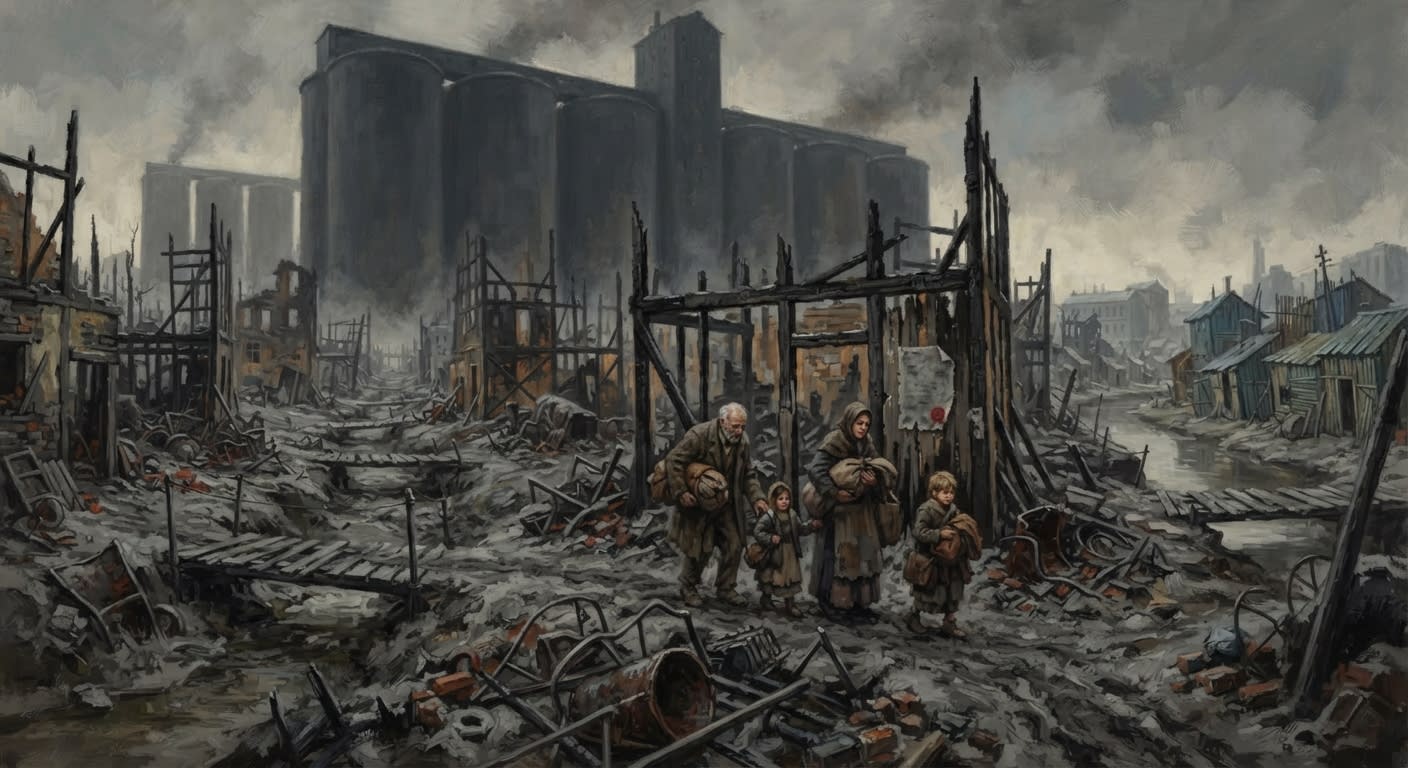
It sits low, between the back lanes of the Chit Market and the irrigation canal, on ground that drains badly. Canal runoff keeps the cinders wet. The ash never blows away and never sets. It lies as a grey paste that takes a boot to the ankle and holds the print for a week. The smell in every season is old smoke over wet ash, like a hearth someone has pissed on. All fourteen silos of the Silo Crown can be seen from the lots. The residents call this surveillance, and the Parliament calls it a view.
#On Ash Bills and Addresses
"The house is gone. The address remains." — Bureau of Tithes assessment circular
The Marshals' own entry sets out the procedure, and I will not recite it twice. The ash bill arrives on grey paper under a red flame seal. The household has three days to pay in pounds, labour-hours, chits, lamp oil or names, and on the fourth day the house is purified. The word was lent by the Bureau of Purity, which has never asked for it back. This entry is about what the procedure leaves behind: a parcel that lives twice in the Ledger.
In the Records entry the household has ceased to exist. It holds no dwelling, and a household with no dwelling cannot be allotted provision, only clemency. In the Tithes entry the parcel has improved. Now that it is cleared, it carries a higher land assessment than it did with a family on it, because debtors lower the value of land. Both entries are correct. They are kept in separate buildings so they never have to meet.
So a family in the Ash Fines District often sleeps inside the charred frame of its own former house. The parcel is empty and taxable by decree, and the doorjamb still carries the flame seal the Marshals nailed there. The seal stays because removing it would deface a Tithes instrument. The family stays because nowhere else will take a household the Ledger has closed. Nobody collects rent from people who do not exist. The land tax is billed to the parcel, and the parcel pays it by being worth more.
#On the Ash-Fined
"Stand where the ledger says nothing." — advice given to Ash Fines children
The Parliament recognises six classes of person in Wexel, and the ash-fined are the fifth. Below them are the erased-but-used. They have no class because they have no names, and they live in the district because it is close to their work.
The ash-fined are foreclosed families, widows whose husbands were paid into the name drawer, mill hands fined out of their chits, and a surprising number of former clerks. They move quietly. Visiting inspectors sometimes take this for contrition. It is arithmetic. A citizen with a house can be fined against the house. Once the house is burned, the only things left to fine are labour, ration and body, and a Mirth Office citation that lands on the body tends to stay there. The ash-fined do not laugh in the street, sing at the pump, or pause longer than eight seconds anywhere an inspector can count.
The erased-but-used work at night, once the quiet hours have emptied the lanes. The Prefecture uses them as ash crews. They rake the purified lots flat before the Tithes assessor walks them, sort the nails from the cinder, and haul the seizure carts back to the barracks. They are paid in chits drawn on no named account. I asked a Prefecture clerk how many there were. He said the figure was zero and that they started at the eleventh bell.
The children learn a map no Bureau has drawn. They know which lots are purified and which are only encumbered, and so which ruins no inspector will enter. By law a purified lot is absent. Until the ash crews rake it, an absent lot is the safest ground in Wexel: somewhere to sleep, hide a sack, or eat something that was never weighed. The children also learn early what the name drawer is, and that their family could buy three days with someone else's.
The furniture goes elsewhere. Within a month of a fire, the table the seizure clerk priced turns up in the back stalls of the Chit Market with its tag scraped off. It sells at unregulated prices, sometimes to the household next in line for an ash bill. I saw one chair that I am fairly sure had been sold from two different fires.
#On Canalback, Cellars, and Unwatched Houses
The Mirth Office rarely tells the Ash Fines District from Canalback, and the Marshals burn in both, but they are different places. Canalback is poverty with a roof: tin-and-reed shacks on the canal's southern bank, with algae, fever, cheap stew, and cellar doors behind the flood-stains. The Ash Fines District is what comes after the roof. A Canalback family is poor. An Ash Fines family has been closed.
The Cellar Circles, who call themselves the Quiet Mirth, keep their joke-sheets in Canalback cellars. They use the Ash Fines District for what it does best, which is going unwatched. No inspector audits a building the Ledger has already declared gone. The Mirth Office has no citation form for an absent structure, and Sister-Lector Neme Varr has refused to create one, because the form would admit the structure exists. A charred hearth on Ash Fines Row makes a better dead-letter drop than any cellar, as long as the sheet is wrapped against the wet. The Row is the district's worst stretch and the one burned most often. There are feasts under its half-roofs: a stolen loaf, a smear of honey, lamp oil burning behind a ration sack, and a silence even the Mirth Office could approve.
Do not call it rebellion. It is dinner. The same half-roof that hides a loaf hides whoever is listening for names, and a household on its third day will trade a feast to the Parliament for three more days in its house. The black market sells something it calls arson insurance. No one I asked had ever heard of a claim being paid.
Ration Prefecture district survey, reissued annually: "Ash Fines District — population nil. All parcels purified; no residential occupancy recorded."
Corrected to read "no residential occupancy recognised." The earlier wording could be checked by walking down Ash Fines Row, and a surveyor from the Bureau of Alchemical Standards once did. The survey was corrected. The surveyor was moved to the Scale Gate, where the people who set the weights also check them.
#On Smoke, Revenue, and the Present Shortfall
The Tithes compliance note for A.S. 199 puts arson-fine revenue at 4,200 stamped pounds, adjusted. That was three percent below projection, owing to "insufficient flammable housing stock in the Canalback sector." The missing stock is in the Ash Fines District, already burned. A frame that has burned once takes a second torch badly, and wet ash will not take one at all. The district is where the Marshals' work ends and their ground runs out. Each year it grows by exactly the number of houses Wexel can no longer bill.
Canalback's rumour is that Speaker Huld Bex means to close the shortfall in one night: a great many bills at once, and the name drawer emptied into the carts. I hold no document that confirms it. I do hold the Marshals' oil requisition for the coming quarter, drawn on stores from the Palatine Switchyard of Lorn. It is four times the last one. The Ash Fines District has too little left that will burn to use that much oil. The streets next to it have plenty.
ASH CREW RAKE-RETURN, PARCEL ██, ASH FINES ROW (Prefecture copy). Nails: 2 lb. Hinges: 3. Grain residue beneath hearthstone: ██ lb, inconsistent with household allotment. Residue reconciled to ████████ surplus ledger. Forwarded: ██████████. Crew: none recorded.
By A.S. 201 the Chaff-Winds have made the district's quiet expensive. The wind crosses the wet lots and picks up whatever paper it finds: ash bills pinned to jambs, scraps of joke-sheet, the Tithes schedule nailed up at the end of the Row. It sends the clauses back from the Silo Crown out of order. "The household is purified" has come back over Parliament Square as "the house is purified of its household." The Bureau of Rites logged it as a non-doctrinal echo. Every ash-fined resident who heard it took it as testimony. When a widow laughs at her own ruin, the wind carries the laugh to the Mirth Office Schoolhouse and drops it into recitation drill. The Office fines the district. The district has nothing left to seize, so the fine becomes labour, and the labour becomes a night crew.