
Sources are read and the draft is done. It comes to about 1,650 visible words, with the brief's structure and density.
#On the Authorized Black
Burned authority keeps its accent. — copy-hall saying, Nemea; carver unrecorded, grammar approved
Ash-ink is a family of inks, some lawful and some hanged. They share one principle. Authority that has been burned can be ground down, bound again and written back onto paper, and the page will treat the result as authority, on the rather reasonable grounds that it once was. The Bureau of Records brews the lawful kind, sells it and punishes everyone else for owning any. Heretics brew the other kind in cellars, in washhouse coppers and once, according to a Purity report I have no reason to doubt, in a baptismal font borrowed overnight from a parish that never noticed.
The Codex has to separate the two, because the Synod depends on the difference and the forgers depend on nobody finding it. The authorized black comes from Nemea, in sealed bricks. Everything else is imitation, and imitation has succeeded often enough that it now has recipes, factions and a small literature of complaint.
#On Nemea's Vats
The sanctioned product has documentary existence from A.S. 96. In that year the Hollow-Script Scriptorium of Nemea was raised on its chalk ridge in the Zone 2 heartlands, six years after the Concordat, as an archive-scriptorium for a Bureau whose ledgers could not agree on who was dead. Nobody should read the date as the invention of ash-ink. Burned paper has been stirred into cheaper black since the first clerk ran short of gall. A.S. 96 is the year the Church took charge of the vats.
The vats are in the Inkhouse Quarter, below the copying halls and above the vaults, where the architecture itself describes the job. They are copper, each about the size of a confessional. The base is lawful and dull: burnwood charcoal from the ash orchards, iron-gall, and a vinegar binder that gives the whole district the smell of a pickling-house repenting of its sins. Manifests also list a mineral supplement. Under that phrase go bone-dust from decommissioned reliquaries, ash from saint-cloth burned when it failed certification, and calcite scraped from the walls of consecrated vaults. The Chapterhouse denies this with the full vigour of an institution that files the denial beside the invoice.
The finished ink is compressed, stamped and wrapped, and it leaves Nemea as bricks by the Courier Spur and the Inkhouse Bridge. Every Records office on the continent uses it for its most sensitive work. Abbot-Registrar Solene built the house and died at its desks. Production widened under her successors. Today Abbot-Registrar Maelen Voss never handles the stuff without gloves, which in Nemea means he is never without gloves at all.
Particulars of proportion, temperature and the order in which the dead are added have been withheld at Phase Two by the Bureau of Masks and Seals. I had no objection. A theologian who publishes recipes is a grocer.
#On What the Ink Does
Nemea ash-ink binds text to paper with unusual permanence and unusual evidentiary force. The first quality is what Records pays for. The second is what keeps Records awake.
Common iron-gall rests on the page and slowly browns, like a guest outstaying the welcome. Nemea ink goes into the fibre and stays as if it had been baptized there. It resists washing and outlasts damp. It survives the pumice-stone, and there it becomes a theological problem. A clerk who scrapes it does not uncover blank paper. He uncovers more writing: words that rise from under the scraped line as though the leaf had been holding back a confession out of politeness. The Scriptorium's own records hold cases of this. One novice in A.S. 194 scraped a single word from a correction order and turned up a name that had been erased nine years earlier. The Silence-Master confiscated the document, the knife and the novice's voice, in that order.
This is why Records uses the ink for high-authority copies, identity corrections, confession abstracts, corrected decrees and certificates of absence. It is a strange business to certify that someone does not exist in a medium that refuses to be removed. Records calls the result evidentiary force. The copy-halls call it the ink remembering. Both are correct, and the second is the one on the payroll.
Pale Kin Runner field notes, repeated in earlier Codex material, described street ash-ink as "chemically identical to the output of Strasbourg's own stationers."
Corrected. Street preparations imitate Bureau issue at the level of the eye, the nib and the tired clerk. They contain no relic residue. They do not rise under the scraper. They are good enough to pass inspection and poor enough to be recognised afterwards, which describes most careers as well.
The Bureau is fond of permanence and resents independence, and in Nemea's black it has bought both from the same vat.
#On Heretical Hands
Ash-ink outside the Bureau is less stable and less uniform, and it is more dangerous for exactly those reasons. The two principal heretical traditions come from different wounds and write for different ends.
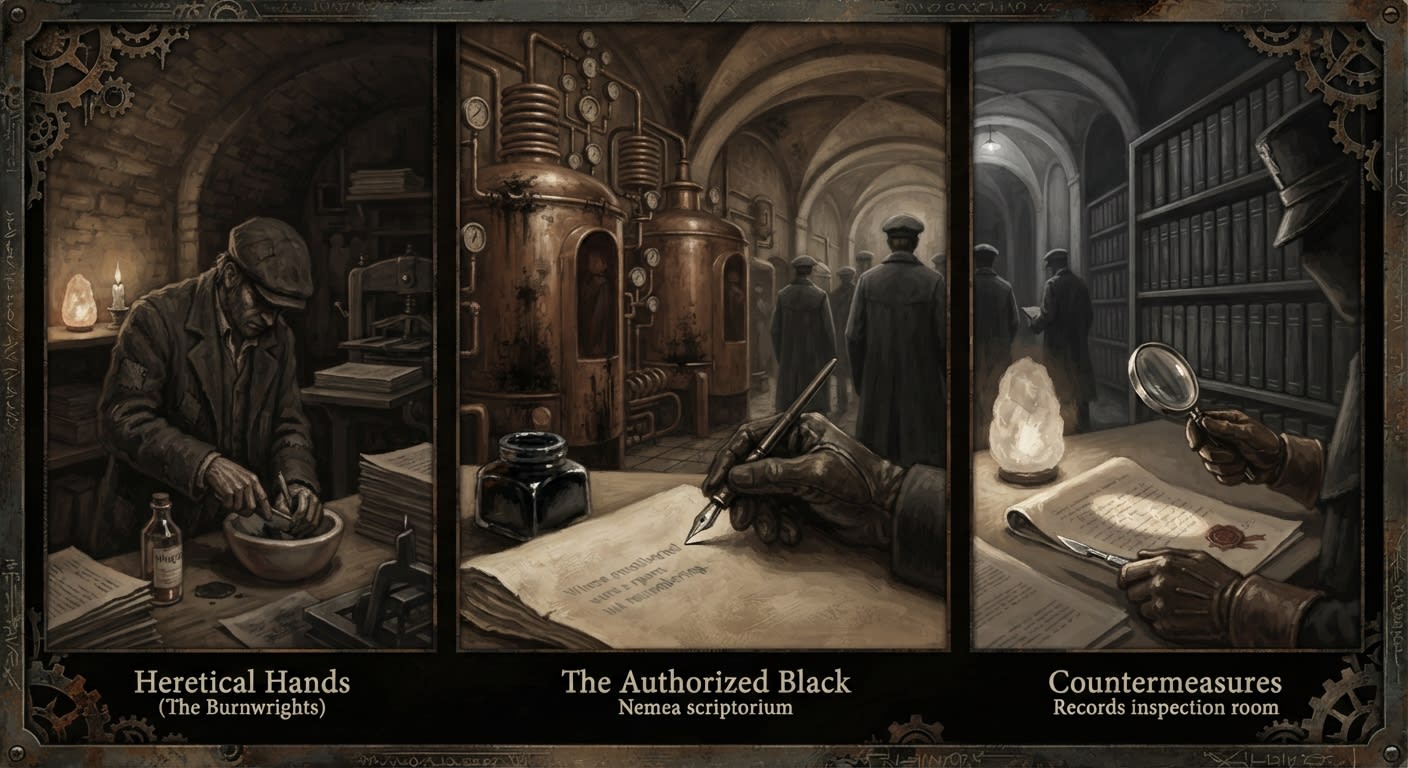
The Burnwrights of the Silent Godless make their ink from approved documents wherever they can get them. The ash of a Bureau leaf carries its sizing, its glue and the faint mineral dust of official storage. They cut it with lampblack, gum and vinegar, plus a few bodily and household contaminants I will not list, and the result is a dull grey line that passes for old marginalia under poor light. This ink kills people on paper. With it the Burnwright spoils a ration identity, weakens a tithe name, turns a baptism into a dispute, and hands the condemned body a new name with believable debt attached. With it he writes burner catechisms: approved prayer books whose prayers are untouched and whose margins hold dead-drop routes, countersigns, replacement names and lists of safe Pale Kin Runners. Tradecraft sharpened after the Great Inquest of Names in A.S. 173 taught the survivors which registries spoke to each other. By A.S. 175 the Bureau of Purity had admitted in writing that the network was adapting faster than its response cycle. Burnwrights copied that sentence into their training margins, in ash-ink.
The Ash Registrars come out of Mother Sava's burnt registry of A.S. 154 and the ash-handed midwives who went back to search through the char. Their mixture is lampblack, gum, stolen parish binder and the powdered residue of burnt records, and it is intended to look like cheap Bureau issue. Nobody forges the cathedral hand for a parish birth-roll. Their products are false stillbirths, duplicate baptisms, adulterated rolls, packets of supporting paper nine documents thick, and transfers into parishes that burned three winters before. Everything is aimed at one result: a file dull enough that no auditor will open it twice. A living child grows up behind a death that nobody bothers to check.
Registrars quarrel over their recipes as bitterly as theologians quarrel over grace. One school holds that bone-ash must come only from the unregistered dead. The other says bone must never be used, because bone remembers. Having stood beside the Nemea vats, I will say only that the second school has been reading something it should not have.
#On Countermeasures
Three Bureaus hunt counterfeit ash-ink, each by its own temperament.
Masks and Seals examines the physical page. Its officers test for ash-ink bloom, the faint grey halo that forms where imitation binder draws damp. They look for fibre lift where old ink was scraped and new laid over it, for heat-softened seal margins, and for wax that was reheated without parish dust. Their instruction card still reads that any document smelling faintly of vinegar and chapel smoke should be isolated together with its clerk.
Records examines origins. It traces paper back to the supplier, the supplier to the mill and the mill to its tithe account, and it compares local abbreviation habits with the dreary diligence of a man counting his own teeth. The reforms that followed the Forgery Panic of A.S. 178 gave it seal-chain records and dual-scribe authentication, and it is still annoyingly proud of both.
Purity arrests people and then examines them. Its record is uneven, because street ink will not confess and it keeps the one who mixed it too frightened to be coherent.
Nemea's own procedures differ in kind, because the ink there is more than suspect: it is active. Salt-lamp circles burn all night over sensitive documents. Mirror-checks compare each page against its certified reading. The standing order to burn the second draft is obeyed. The documents go on changing regardless.
RECORDS INTERNAL — COMPARISON TRIAL, ███████ OFFICE, A.S. 199 Sample A: Burnwright grey, recovered from burner catechism. Scraped: blank. Sample B: Ash Registrar parish mixture. Scraped: blank; minor flake. Sample C: Nemea brick, lot ██-██. Scraped: ███████████████████████. Examiner requests reassignment. Request approved. Sample C returned to vault under glove.
#On the Present Risk
The trouble at Nemea became official in A.S. 198, when the Night-Rewriting Contracts were classified. The contracts in the vaults began changing overnight: terms lengthened, debts grew, and guarantors migrated from the witness line into the body of the obligation. The Chapterhouse blamed saboteurs. The saboteurs blamed the ink. The Bureau of Alchemical Standards found vat number seven identical to every other vat, which cleared vat seven and implicated all of them.
By Doctrinal ruling of A.S. 201, the contracts rewrite themselves because the ink is doing its job, which is binding truth to paper. The truth it perceives does not always match the truth that has been stamped, and that discrepancy has been sent to a sub-committee as a theological matter. I signed that ruling, and I stand by it with the confidence of a man whose own name once grew overnight on a Nemea folio and who has the folio burned.
As of A.S. 201, Voss is requisitioning gloves by the crate. Inquisitor-Corrector Sel Durn has come from Strasbourg to find out whether office definition can bind sanctified ink. The Courier Spur still ships bricks, because the Great Ledger cannot correct itself in any other black. Meanwhile, somewhere in Zone 2, a Burnwright is grinding a ration card into a spoon of vinegar to make a grey that will pass, and an Ash Registrar is teaching a widow how to blot a line so that it looks bored.
In short, the Synod's own ink may be trying to become true, while heretics use counterfeit ink to make true records too expensive to check. Records has one policy for both, and it is to order more ink.