
#On the Sentence That Ate the Queue
The Ashbread Clause is not its formal title. The Concordat of Civic Cadence calls it Section II, Paragraph 4, and prints it in the same modest type as the paragraphs on chalk colour and the numbering of citation pads. The Marshals named it for the bread. The clerks never named it at all, which is how a clerk shows affection.
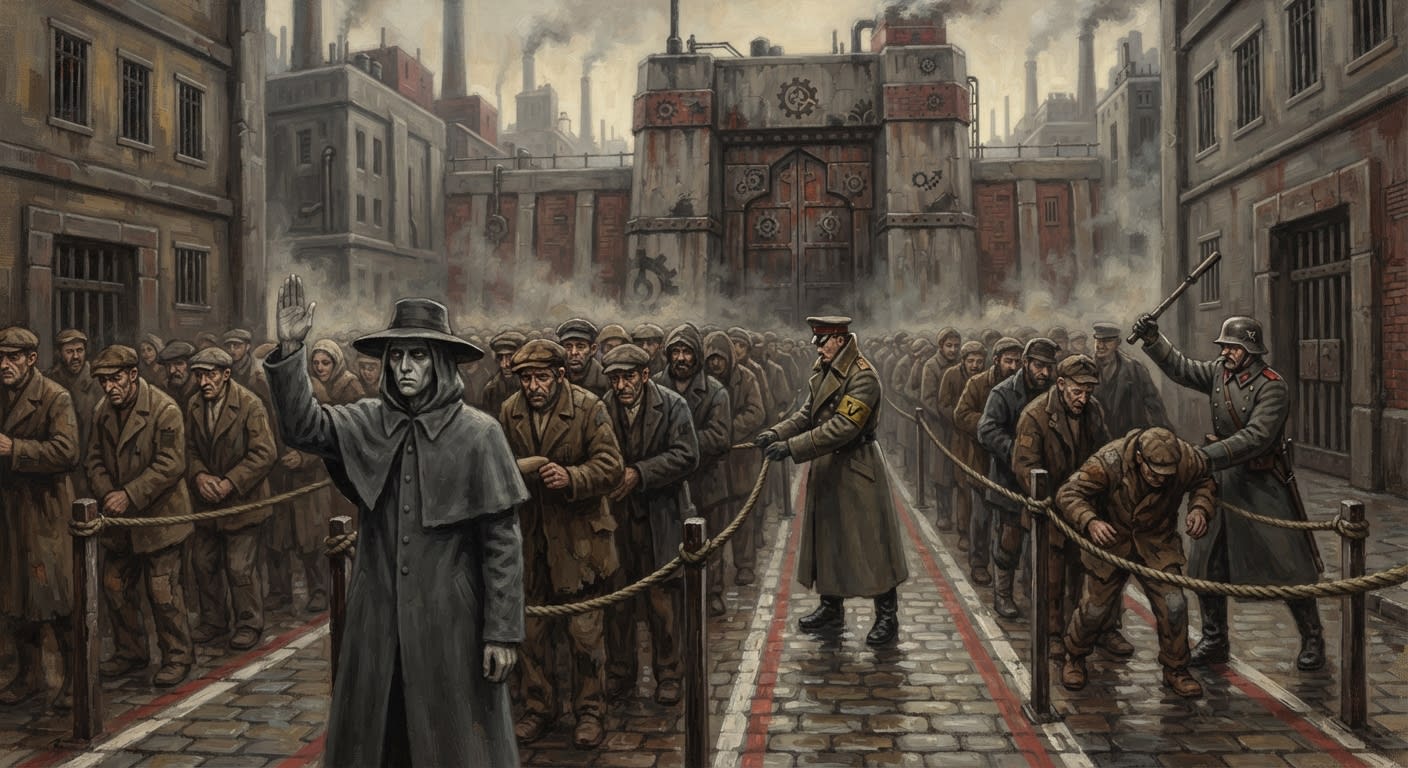
It is one sentence with a subject, a verb of subjection and three nouns. Before A.S. 113, a woman standing in a bread line at Bastion-Brest was a petitioner. In law she was a recipient of charity and in practice a nuisance with a ration token. Once the Concordat was sealed she became a person assembled for civic distribution, and so fell within all three nouns before she had moved a step. The paragraph asks nothing of her. It says what may be done to her.
Look at the drafters' choice of words. They did not write ration, and they did not write bread. Nor did they write famine, although the famine was the only reason anyone had assembled. Civic distribution is a phrase for posting letters. Hunger does not appear in the clause, because a legal instrument that names hunger has admitted a debt, and the Synod prefers to admit jurisdiction.
#On What the Clause Refused to Name
The facts from which the paragraph was made are these. In A.S. 112, at the northern grain depot of Bastion-Brest, a yard built for three thousand petitioners admitted twelve thousand. The gates opened on schedule. The lane ropes were hemp, and wet, and they snapped one after another. The crowd folded inward on itself. The Bureau of Records counted three hundred and seventeen dead. The intake tables of the Bureau of Mercy, where the bodies were actually handled, put the number nearer five hundred. The same winter's shortages set off the Broth Riots across Brest, Königsberg and Przemyśl. That was the season of stalled convoys and thinned broth, and in it a queue was the most dangerous place a citizen could lawfully stand.
The Concordat's own words for all this were "lane failure" and "unanticipated devotional density." The phrase devotional density deserves a feast day. It turns twelve thousand starving people into an excess of piety, as though the yard had been overwhelmed by pilgrims and not by the plain arithmetic of a failed grain season.
Now read the clause against the facts. It does not enlarge the yard. It does not order more bread, dry rope, or a clerk able to count to twelve thousand before opening a gate. Every material cause of the Ashbread dead remains outside Section II, Paragraph 4, where no one can prosecute it. What the paragraph covers is the only element of the disaster that could be disciplined, which was the people.
JOINT DRAFTING MINUTE: RITES / WAR, SECTION II (EXTRACT) Proposed Paragraph 5: "No distribution yard shall admit petitioners beyond ███████ of its surveyed capacity." Moved by: ████████, Bureau of Mercy observer (non-voting). Struck by: ██████████. Reason entered: "A capacity figure constitutes a promise. The Concordat regulates conduct, not supply."
#On Auditory Regulation
The first noun makes hunger answer to sound. Under the catechism of the Cadence Corps, One beat. One body. One road., a person assembled for distribution may now be commanded by whistle-flute, bell or the Beat Caller's voice. STEP. HOLD. BREATHE. The whistle is tuned every morning to the city's governing bell, so the queue's lawful rhythm belongs to whichever office owns the bronze.
Look at what this allows. A petitioner who does not hear the HOLD, because she is deaf or old, or because four thousand people behind her are shouting about the bread, has broken regulation. Her failure to hear is a breach, and a breach may be corrected. Before the clause, falling out of step in a bread line was bad manners. After it, the same stumble was an offence.
The Doctrine Marchers love this paragraph and read it aloud at ration yards as if it were an antiphon. In their reading, a hungry crowd moving to one beat has been gathered into a nave with no roof. I once watched a Marcher lead four hundred petitioners through a psalm cadence at a Brest gate while the grain carts were still two hours up the road. The singing was excellent. The loaves had not arrived.
#On Lane Compulsion
The second noun turns the petitioner's body into material for the route. The rope-lane rigs, iron stakes and chalk marks issued under Section III of the Concordat get their civilian target from this paragraph. Chalk is white for passage, red for danger and black for a sealed lane. The petitioner does not choose a lane. She is placed in one, and once placed she may not leave.
The drafters chose compulsion with care. They passed over guidance and arrangement, and they rejected even direction. Compulsion means that stepping out of the lane is itself resistance, and resistance lies under the third noun, where the batons are.
The Flow Marshals made lane compulsion into a working craft. They use micro-stops, staggered releases and false releases, which open the front of a lane for three breaths to relieve pressure at the rear and then close it again before anyone reaches the table. A false release is a small legal lie told to a crowd so that the crowd does not kill itself. It works. The Flow Marshals have kept more petitioners alive at more gates than any hymn, and they do it by treating each petitioner as a unit of pressure to be vented.
The yard at Brest was resurfaced in A.S. 114. The new stakes were iron, the new ropes were double-braided, and the chalk lines were cut into the stone so that rain could not wash them out. The lanes are now permanent, in the stone as well as in the Concordat.
#On Corrective Dispersal
The third noun licenses violence, and the rest of the clause depends on it.
Corrective dispersal gives a Marshal the power to break up a distribution assembly by command, by cutting the lanes, or by baton-staff. The commands are CUT, OUT and SCATTER. The paragraph sets no threshold for when dispersal becomes lawful. It does not say in danger of crush or upon collapse of lane. The only condition is that the persons are assembled for civic distribution. Standing in a queue for bread is therefore enough to make a person someone the Corps may drive off.
The Iron Wedges understood this before the ink was dry. In their reading a hungry crowd is a riot that has not yet happened, and a weighted baton delivered early is cheaper than a crush later. Their records of crushes prevented are very good. Their records of loaves undelivered are not kept, because no one ever required them.
It has always been the Bureau's position that corrective dispersal is an instrument of mercy, used to save the crowd from itself. Whether a crowd is being saved from itself or from its supper is left to the officer holding the stick.
The Cadence Corps field primer states that "corrective dispersal shall never be applied to a compliant distribution line."
Corrected: whether a line was compliant is entered on the citation pad after it has been dispersed. So far, every dispersed line has been recorded as non-compliant.
#On the Clause After Ashbread
A paragraph written for one ration yard in Brest would have died with the famine. The Ashbread Clause lived on because the sections after it carried it. Section IV requires trained Marshals in every Synod city of more than five thousand souls, posted at gates, bridges, cathedral approaches and ration yards during the high-traffic bells. Wherever Section IV sends a Marshal, Section II, Paragraph 4 goes with him. Section V gives the Bureau of War the right to second Marshals during levy movements. Section VI gives the Bureau of Rites authority over chant and the purity of processions. Both of those sections rest on the first one. The clause established that a crowd assembled for public need is a crowd assembled for public control, and every later section treats that as settled.
In A.S. 129 the Night of Two Bells showed that one beat cannot govern a street where two lawful bells ring at once, and nineteen mourners died in a Strasbourg canal. The Route-Timing Concordat repaired the fault with two-bell clearance and the Cadence Architects. It changed the bell tables, the route sheets and the training of senior Marshals. It did not change Section II, Paragraph 4, because nobody had asked it to. The bells had failed. In the Bureau's view the clause had worked.
As of A.S. 201 the clause applies in every major Synod city and at every bastion gate complex. Brest's ration yards still chalk their lanes to the old diagrams. Recruits to the Corps learn the paragraph by heart in their first week, before they learn to tie a lane knot, and they recite it at the same speed as the catechism. What began as an emergency measure is now the ordinary law of the bread line. The same paragraph governs every queue for grain, broth, salt, coal or the blessed issue of lamp oil. A person who stands in any of those lines has consented, by standing there, to be regulated, compelled and dispersed.