
#On the Place Where Price Becomes Verdict
Below the Binding Markets, where the fumes thin and the heat thickens, the canyon wall of the Gilded Chasm has been cut into ledges. The Assessment Halls stand on those ledges. A market asks what a man will accept. The Halls decide what he is worth, write the figure down and file it where he cannot reach it. Price is a quarrel between two parties. Value, in the country of Velmora, is a verdict, and no court hears the appeal.
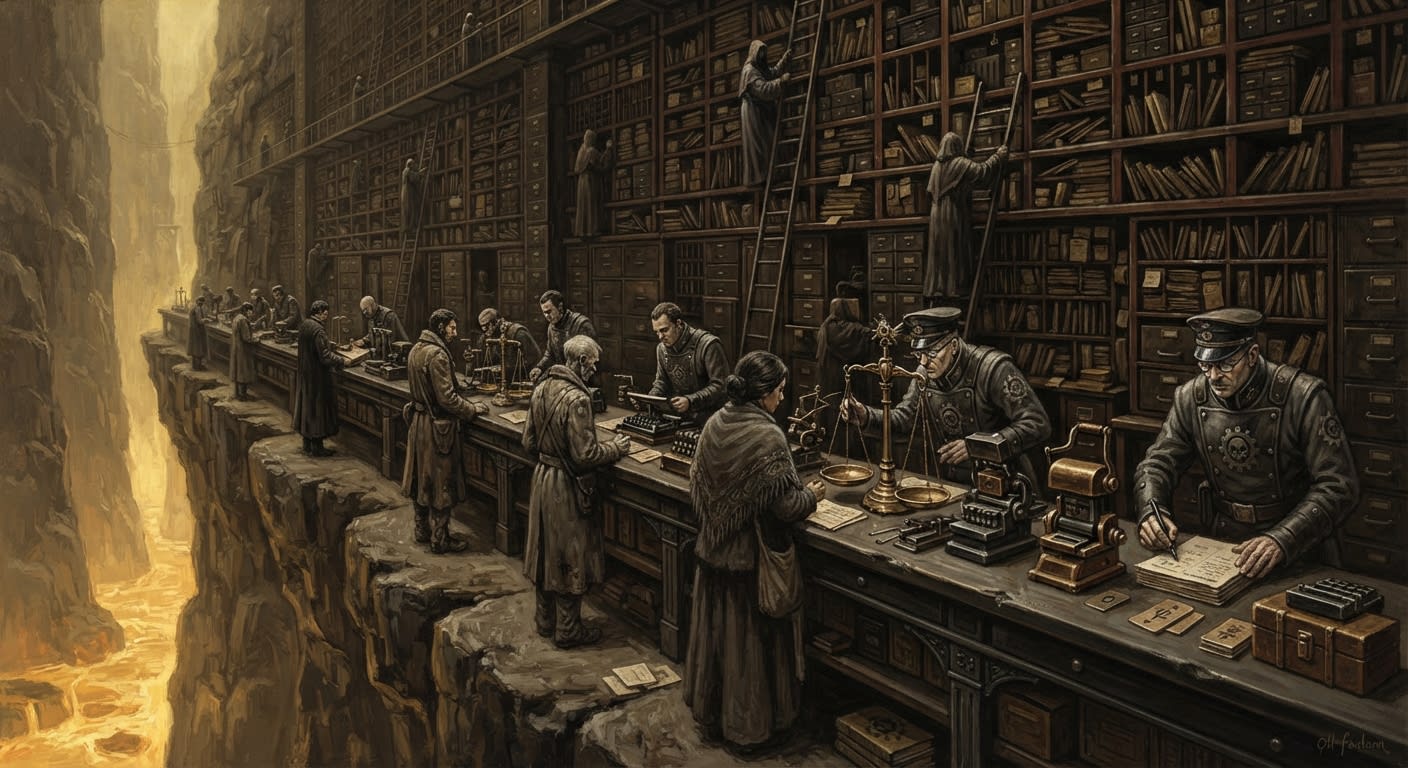
The Halls are terraces more than buildings. Each ledge is roofed by the overhang of the cliff above it and open at the front to the drop, so the assessed stand with their backs to the stone and their faces toward a fall of several hundred fathoms. Long black tables run the length of every terrace. On the tables sit brass scales, stamp-presses, tag-boxes and ledgers bound in a leather the Bureau of Purity declines to classify. Behind the tables the rock has been cut into shelving: pigeonholes, drawers and niches that climb from the floor into dark the lamps cannot reach. The light comes up from below, off the molten rivers, and it is gold and cold at once. Men who have stood in it say it feels like being read.
They lie east and southeast of Bastion-Sibiu, deeper than any Synodal party has gone and come back up with its papers. Behind them the Hollow Vaults swallow tunnel after tunnel, and beyond the Vaults waits the Vault of Ten Thousand Keys. The order of descent is instructive. First a man is bargained with, then valued, then stored.
The Halls have been in operation for about a century. Nobody has found a foundation stone, a dedication or a date of first sitting. A house that expects to be paid forever has no use for birthdays.
#On the Measures Taken There
Objects are assessed, of course: ore, bullion, heirlooms, deeds, relics. Those are the easy lots. The Halls' reputation rests on the other inventory.
A soldier brought to the table is weighed for his remaining courage, counted in engagements. A widow is weighed for her grief, which is a lever, and a lever has a market. A magistrate is weighed for his shame, a clerk for his secrets, an officer for his debts of honour, a mother for her children's likely obedience and for the children she has not yet had. A friendship is weighed for the useful betrayals it contains. Each man is weighed for his years remaining. Last of all comes the figure the Halls prize above the rest: the price at which this man would sell another man, and the price at which he would spare him.
Nothing is placed in the scales. The assessed stands before the table, an Assessor looks at him, and one brass pan sinks. A Ledger-Keeper calls the figure. A clerk stamps a tag. The tag is entered and the tag is shelved, and whatever happens to the man afterward is whatever happens to the tag.
The Doctrine position must be put precisely, and the Lictors of Purity insist on it. The Halls do not tear courage out of a man like a tooth. They price it. A priced thing begins, slowly, to behave like stock. The widow who has heard her grief valued starts spending it. The captain who knows his courage has a figure starts rationing it. No law compels either of them. They have learned the figure, and the figure is patient.
Bureau of War intelligence summaries list the Assessment Halls as "the Chasm's slave auction."
Corrected. The auctions are held above, in the Binding Markets. The Halls hold none. An auction admits that the price is in dispute.
#On Assessors and Inventory
The word "Assessor" names three different creatures in the files, and a clerk who confuses them is a clerk who will one day be assessed.
The first are the demonic Assessors, Velmora's mobile intelligence organs. Their gaze calculates. They walk the Sibiu approaches, the Danube crossings and the notary offices of half the Transylvanian foothills, and what they see goes somewhere. The Assessor captured near the Danube in A.S. 172 held four thousand pages on the souls and accounts of Bastion-Sibiu's Third Company, and the Bureau learned too late that the information had already been filed. The Bureau of Doctrine holds that it was filed here. I concur. No other shelving in the Chasm is built for the purpose.
The second are the human Assessors of the Ten Thousand Keys, the third tier of the Hierarchy of Debt, who judge recruits and collateral for the cult. Defectors report that promising cult Assessors are taken down to the Halls to have their eye corrected against the demonic standard. They come back quiet. The defectors add that they come back more accurate.
The third are the Tithe Assessors of the Bureau of Tithes, who also carry scales, ledgers and seal-presses, and who are servants of the Synod.
The Halls' inventory is considerable. The shelves climb out of sight, and caretakers on ladders move among them, filing and reconciling. Those valued highly enough are purchased. Their tags go down the ledge to the Hollow Vaults or into the Binding Markets as collateral against terms not yet drafted. A black key is cut in the Vault for the ones that matter.
Those judged worthless are discounted. The Bureau's best descriptions of the Halls come from the discounted, who are sometimes turned loose. They walk west carrying their figures. That is the cruelest outcome the Halls offer, and it is a deliberate one. A man told he is worth almost nothing returns to Sibiu with a wound no surgeon can find. Some months later a moneylender of the Ten Thousand Keys offers, very gently, to have him reassessed.
The Bureau of Doctrine further holds, over the objection of the Bureau of Engineering, that the Assessment Engines captured in Synod territory are the Halls made portable. Engineering calls this theology. Doctrine calls it inventory control.
VALUATION SLIP — RECOVERED FROM THE COAT-LINING OF A DISCOUNTED SAPPER, SIBIU QUARANTINE LEDGER Courage: ██ engagements, declining. Years remaining: ██. Loyalty to sergeant: sale price █ Crowns; spare price █████. Wife's grief, prospective: good. Disposition: DISCOUNTED. Release west. Reassess on demand. Note on reverse, in the sapper's hand: "I asked them to write it smaller."
#On the Use of the Figures
A figure that sits on a shelf earns no interest. The Halls feed Velmora's war.
Their valuations reach the Binding Markets, where contracts are drawn to fit each signatory as closely as a tailor's pattern. They set the terms of the Contract Theurgy that crawls into a signatory's flesh. They supply the Hollow Vaults with custodians and the Ten Thousand Keys with recruitment lists, including a record of who is lonely, who is ashamed, who is owed back pay and who has a sister in debt. They give the extortioner his lever and the briber his exact sum.
The effect on the Sibiu supply war is plain arithmetic. Velmora's agents do not haggle, because haggling is for those who have not consulted the Halls. The quartermaster who dilutes the grain was offered precisely enough, neither a Crown over, which would have frightened him, nor a Crown under, which would have offended him. The toll clerk who waved the wagon through was offered a forgiven debt instead of coin, because his tag said that coin would shame him and forgiveness would not. The convoy was corrupted before it formed, on a ledge a hundred miles east, by a clerk who has never seen the road.
Collection is scheduled from the same shelves. Each tag carries a date. Men near the Line insist the date is the worst of it.
#On Synodal Countermeasures
The Synod cannot reach the Halls, so it contests them where their figures are spent. Standing instruction for the Sibiu sector and every office that handles its traffic:
Do not accept a free assessment of anything, including a horse, a ring, a son's prospects or your own constitution. A stranger who values something without a fee has already been paid by someone else.
Do not ask your worth. That applies to officers, confessors and wives, and above all to anyone who seems to know it.
Do not read a figure aloud. Once spoken, a figure gathers witnesses, and witnesses make it binding. Ledger-Keepers need nothing more.
Burn valuation slips unread. Slips appear in coat-linings, prayer-books, ration tins and the soles of boots, and they may bear handwriting you recognise.
Refuse to witness any document whose terms you cannot read in full. Deny the ledger its witness and it cannot close.
Rotate auditors and contract readers before their fascination becomes a hobby.
Discounted returnees go to Purity quarantine and to confession, in that order. Keep them away from moneylenders for three years. Keep them away from kindness offered on terms for the rest of their lives.
The Bureau of Tithes will not treat the Assessment Halls, their valuations or their discounted persons as a source of revenue, intelligence for levy or a model of efficiency. The sealed ruling of A.S. 181 already forbids levying the Chasm. This instruction extends it to admiration.
The Halls are sitting tonight. The pans are moving, and someone on a high ladder is shelving a tag.