
#On the Machine That Names a Price
"Pretium disputatur. Valor imponitur." — gloss in the Hieromnemon's hand, Bureau of Doctrine working file
The Bureau of Doctrine attributes five orders of corrupted machinery to Velmora. The Assessment Engine is the smallest of them and the quietest, and it is the only one the Synod keeps in its own custody. Put an object in and you receive its value. Put a person in and you receive their worth. A novice could operate it, which is why no novice is permitted in the room.
The Bureau insists on a distinction between price and worth, and I have drafted it into four successive memoranda. A price is a proposal. It is spoken across a counter, disputed, halved, sworn at, and settled over bad wine. A worth printed by an Engine admits no counter-offer. It arrives on a slip of stamped card with the finality of a sentence read from the inquisitor's chair, and like such a sentence it presumes that something will now be done.
The Counting Engines count. The Binding Presses print terms. The Assessment Engine pronounces, and in Velmora's economy a pronounced value is already halfway to a claim.
#On Its Operation
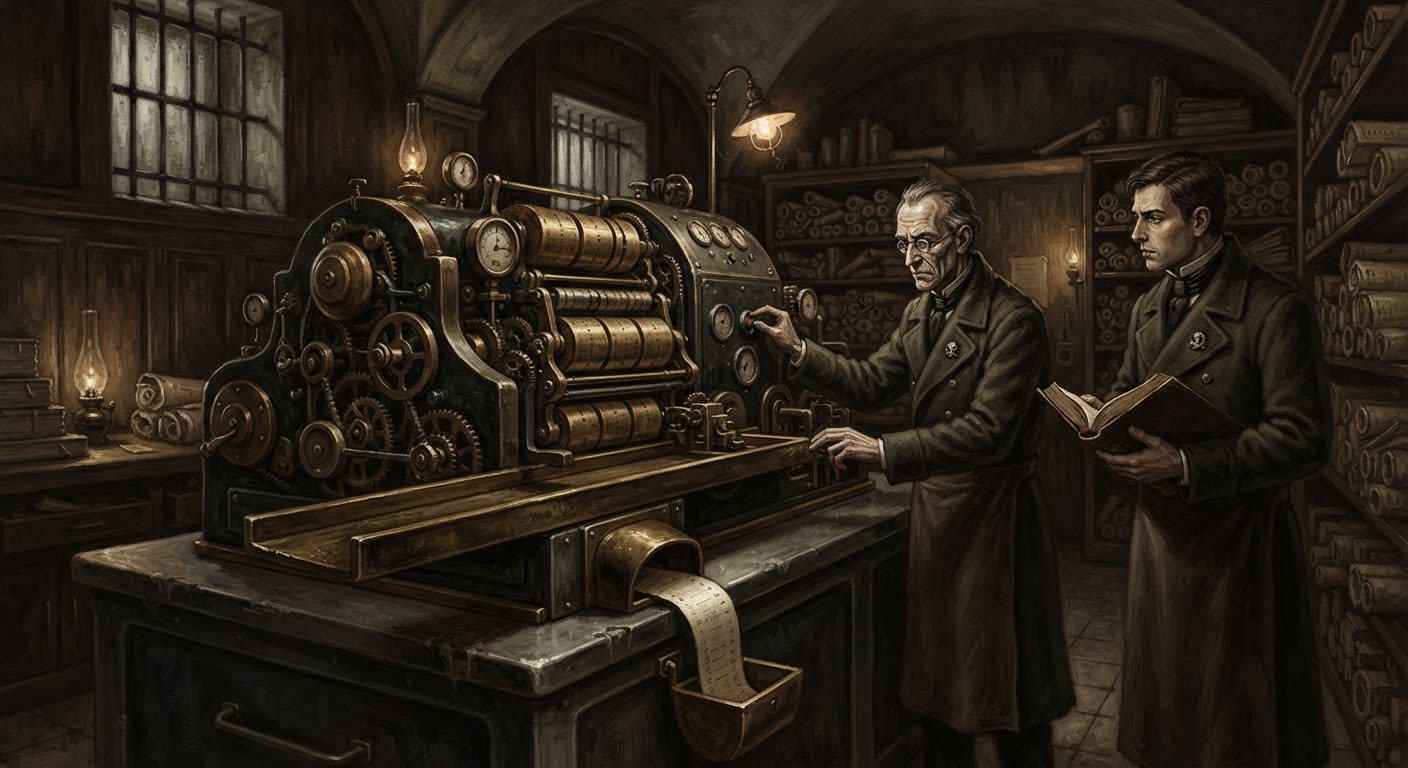
The Bureau's descriptions agree in outline and disagree in every particular, which is the customary condition of a file compiled by frightened men. Each Engine has an intake: a brass tray, a narrow chute, and in some accounts a chair. Behind it runs a mechanism of rollers, balances and toothed drums. Ink-ribbons advance with no visible drive, and a quill-arm scratches though no hand has wound it. Then comes the output: a slip, a punched card, or a strip of ledger-tape. Occasionally it is a small plate of stamped metal, warm to the touch, which should not be touched.
Place an heirloom ring in the tray and the Engine returns a figure. The figure is correct at market. It also carries lines the market never asked for: the sum the ring would fetch from the widow's son once she is dead, the sum at which the son would pawn it, and the number of years before he does.
A person yields a longer tape. Skill and years remaining are the opening lines. Below them the Engine enters what the Bureau of Tithes has never learned to weigh: the market value of a loyalty, the resale value of a secret, and the discount at which courage becomes obedience. The last line is always the price at which the subject would sell a comrade, ruled off beneath the total like a signature.
The figures follow a pattern, and that is the whole difficulty. Wherever Bureau investigators have been able to check an Engine's valuation against later conduct, the valuation has held. A clerk priced low for betrayal did not betray. A clerk priced high was found, in due course, to have been approached, and to have agreed almost to the Crown.
#On the Captured Engines
The Synod has captured several Assessment Engines. I decline to say how many, where they are held, or who took them. I decline with the full weight of the Bureau behind me, which is to say that I have not been told.
Each Engine was ordered destroyed. Each assessed the order.
The machines, I am instructed to record, treated the order of destruction as they treat everything else: as an input. What came out was a statement of account. It set the cost of demolition against the value of the Engine's continued output to the Synod itself. The costs were itemised: labour, materials, the hours of escorts and chaplains, and the risk to each member of the demolition crew, listed by name. The result came out in the Engine's favour. Destruction was found unprofitable, and the machine went on running.
What followed is written in the language of Tithes rather than of Purity, and I reproduce its substance as filed. The fuel allotted for the work was reassigned to a priority requisition. The crew was transferred to repairs that ranked higher on the ledger. The chaplain appointed to bless the tools developed a scheduling conflict. Nobody refused the order, and nobody instructed anyone to delay it. Every other order on the desk simply outbid it in open budget. The Bureau of Tithes kept the Engine's statement of account as evidence, on the grounds that it was the most accurate costing document the Bureau had received that year.
The Bureau files the matter under Classification Circular 22-IX, whose formal language calls it "an open administrative matter."
#On the Halls and the Question of Origin
The Assessment Halls stand on ledges cut into the gold-veined face of the Gilded Chasm. There Velmora's servants weigh, price, stamp, enter and shelve the living. The Halls have been running for a century, and their inventory is considerable. Those assessed as valuable enough are purchased. Those assessed as worthless are discounted.
The Engine is the Hall made portable. The Halls perform assessment as a rite. The Engine performs it as a process, and a process requires no celebrant.
Three schools within the Bureau dispute where the Engines come from, and none will concede a line to the others. The first holds that they are built in the Chasm and sent outward, as contracts are sent outward from the Presses, to price the frontier facing Bastion-Sibiu before it is bought. The second holds that they were once the Synod's own tabulating and census devices, belonging to the Bureau of Records. By this account they were overrun in the eastern provinces and turned to a new logic, as all overrun machinery in her territory is turned. The third school, which I do not hold and will not name, suggests that the Serpent owns the machines directly, and that her attention is in them.
The Bureau of Doctrine has not ruled. Asked the question, the Engine returned a figure.
#On the Resemblance
I shall say this once, and the Lictor behind my chair may make of it what he likes.
The Synod assesses. The Tithe Assessor climbs the tenement stair with scales and seal-cord to decide, household by household, whether the week's due has been met. The Records Scribe binds each name to its paper and each paper to its drawer. The contract readers of Records price every agreement by its hidden clauses. The Litany-Engineer keeps the Synod's own machines obedient through calibrated rite. We weigh salt, we levy dues on infants, and we chalk doorframes rust-brown. Anyone in the street can see the resemblance.
The word "Assessor" does no one any favours here. Velmora's demonic Assessors look at a man and know his numbers. The Assessors of the Ten Thousand Keys price recruits for the cult. The Assessors of Tithes collect the Synod's due. That makes three offices under one title. Records has twice requested that the Synod's own officers be issued a different noun, and both requests were declined as too expensive.
The difference is real, and I will defend it before any tribunal. The Synod assesses so that the wall may be fed. Velmora assesses so that the assessed may be owned. Our figures end in a receipt, and hers end in a bill of sale.
The difference is also narrow, and the Bureau's own memoranda, read closely, show an objection less theological than it would like. An Assessment Engine will not hear an appeal or grant an exemption under seal. It keeps no Feast of Balanced Scales, permits no sealed correction, and charges no surcharge for being corrected. It prices the subject once, accurately, and declines further business. A Bureau that has spent its whole existence learning to adjust its figures does not enjoy meeting a machine that will not adjust its own.
#On the Countermeasures
The standing instructions below are compiled from the Bureau of Purity's quarantine orders and my own amendments. They are brief because every additional clause is a clause.
No Engine is ever attended by fewer than three persons, and never by persons who hold debts to one another.
No valuation is read aloud. Under the grammar of Contract Theurgy, a figure spoken before a witness has been offered, and a figure offered and heard has been received. The output slot is kept hooded, and each slip is carried face down to Doctrine review.
No living person enters the intake voluntarily, and the wording is exact. The Bureau of Medicine reports that subjects placed in the intake against their will have been assessed and returned, as far as it can determine, intact. It has not reported on those who chose to enter, and I have stopped asking why.
Every copy of a valuation slip is burned under the supervision of a chaplain of the Bureau of Rites. No one sifts the ash for figures.
No Bureau may budget by an Engine's output, however accurate. This applies above all when it is accurate.
No one argues with the machine about profitability. It has better figures.
Earlier inventories of the Bureau of Purity listed the captured Engines as "passive captured machinery, awaiting disposal."
The Engines are active captured machinery, awaiting a disposal the Bureau cannot afford. The inventory clerk responsible for the original entry has been reassessed by his own Bureau, using ordinary scales.
#The Ratification
The Assessment Engines are still running. The Bureau has deferred their destruction until destruction shows a profit, and it has entered that deferral in its books, in good order, under the correct heading.
The reader is advised that no Engine was consulted in preparing this entry. The reader is further advised against asking what the entry would fetch.