
#On the Province That Appears in a List
Auvergne enters the War register the way most provinces enter heaven: as one name in a sentence about somebody else. The Citadel of Lyon receives levy boys from the Rhône corridor, Burgundy, Savoy, Auvergne, and the southern road. The Rhône entry repeats the list in almost the same words. Two files, one sentence, a province. Records has raised cathedrals on thinner footings and charged for the pews.
This survey was commissioned in A.S. 201 to set down what the Codex presently knows of Auvergne. The commission dates the survey. It does not date the Levy, the province, or the first boy who left it with ink on his wrist. No folio placed before me holds those beginnings, and I will not forge one to give the index a tidier spine.
What the files hold is enough to work with. Auvergne lies in the Western Heartlands, well behind the Sagittal Line, at that comfortable distance from the front where sons are produced rather than spent. It sends boys to Lyon. Lyon sends them east. The rest of this entry describes the machine that turns the first sentence into the second.
#On the Household and the Fraction
The Continental Levy reaches Auvergne by the same door it uses everywhere between the Baltic and the Tagus: the household. The First Continental Levy of A.S. 110 fixed the public rate at one son in ten under the joint seal of War and Doctrine, and it classified refusal as apostasy. Treason would have required a prince to betray. Apostasy needs only a mother at a doorway.
The general sequence is public and well rehearsed. The Bureau of Records keeps the census, and the parish roll is checked against birth-roll and confession ledger for any son who has gone missing between font and pew. A Discrepancy Writ summons the Bureau of Purity, which supplies consequences. The Bureau of War receives the result. Since A.S. 112 the Bureau of Conscription has stood in the gap between list and officer, processing what the other offices find and claim. Its order of business runs: census confirmation, household quota declaration, confession receipt, the Triune Knot stamped on the wrist, provisional assignment, transfer to War custody.
That is the machine as it stands in every province. The survey cannot say which parishes in Auvergne hold the rolls, which field or yard serves as its muster ground, or which clerk signs its returns. One in ten is the figure the pulpit announces. Some provinces carry harsher fractions under seal, and I have no warrant either to name Auvergne among them or to strike it from their number. The ledger I was given has a blank where that line should be. I leave it blank. Blank ink tells no lies, which puts it ahead of most provincial returns.
Earlier editions of the Conscription entry stated that the Bureau of Conscription was founded in A.S. 110, simultaneously with the First Continental Levy.
Corrected. The Bureau was constituted in A.S. 112. The two years between decree and charter are filed as "preliminary operations." Every province that sent sons in those years, Auvergne included if it did, delivered them to an administration that had not yet been invented. The boys marched anyway.
#On Reception at the High Yard
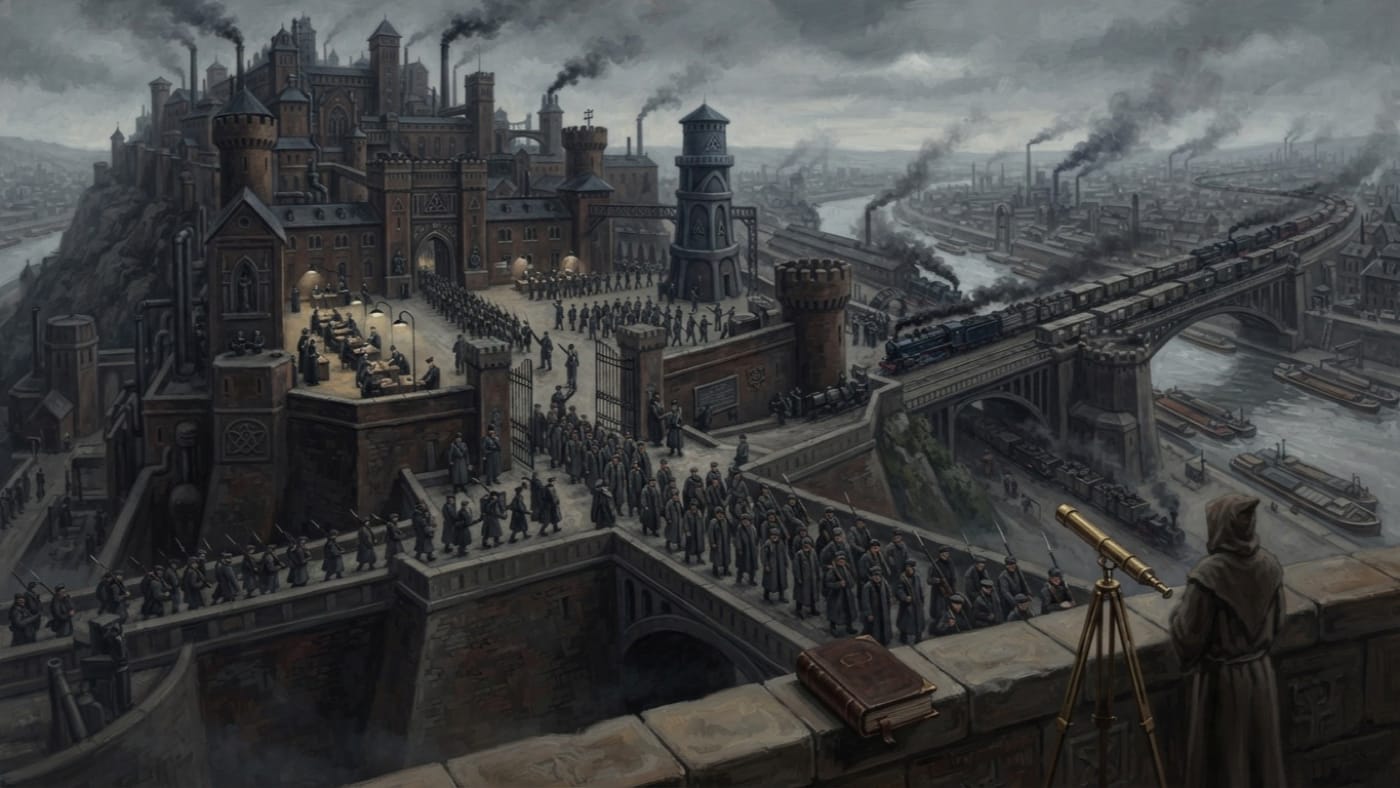
Lyon is where Auvergne's sons become legible. The Citadel's own entry describes three principal yards, and the architecture catechises before any chaplain has to: the First Yard receives families, the Second receives boys, the Third receives soldiers.
In the First Yard, papers are presented under arcade lamps. The wrist stamp is checked against parish roll, baptismal mark, household ratio and dental condition, since a rifleman who cannot tear cartridge paper with his teeth is of little use to the east. The Bureau of Mercy grades the body for marching, digging, carrying and dying, in that order. Appeals are received, considered and denied, which the public form calls one step. Lyon's clerks are hardened by long exposure to the inventions of Lyon's own mothers, whose duplicate certificates and sudden monastic vocations the Citadel records with professional resentment. Whether the families of Auvergne attempt the same arithmetic, the survey does not say. The clerks check them by the same table.
The Second Yard removes the province. The Citadel's register says plainly that levy boys are stripped of provincial rhythm and stamped into Synodal tempo. Whatever gait a boy brought down from Auvergne, whatever cadence his parish sang to, whatever swing his arms learned behind a plough or a cart, the drum corrects it. He learns heel strike under that drum, chant without ornament, rifle instruction by catechism, and the first great truth of the Line: a bell is obeyed before it is understood. The drillmasters' slate paddles carry four words: TEMPO, SILENCE, BREATH, ERROR. The last is applied to knuckles and to pride with equal care.
The Third Yard finishes the conversion. The recruit receives line kit, rifle assignment, boot ledger, train docket and the first corrected letter home. The correction is a craft. A boy writes that he is cold, frightened and hungry, and the letter reaches his mother saying he is warm in the Faith, fed by Providence and eager for the east. His handwriting gets better as the content gets worse. The family receives a son in transit and a document in perfect order.
#On the River Road and the Rail East
The Citadel stands on the western height above the Rhône, and its east gate looks down on the quays. That siting matters to every province on the intake list, because the Rhône road is a military artery long before it is a pilgrim route. It feeds depots, catechism-barracks, southern pilgrim columns and coastal supply, and it carries boys toward the Line under the patient supervision of Passage, Tithes and War.
Here the survey has to be careful with what it knows. The files place Auvergne's boys at Lyon. They do not say how the boys get there: by which road, in which season, under which escort, over how many days. I will not supply a route for the sake of a pretty paragraph. The Rhône entry says nothing about Auvergne sitting on the river, and the Citadel's entry says nothing about Auvergne boys arriving by barge. The corridor is the destination's geography. Auvergne's own roads stay unmapped in this survey, and that is how they will stay until somebody commissions a clerk with boots.
After Lyon the record turns definite again. Recruits leave the Third Yard eastward by rail. The Citadel names Brest, Przemyśl, Shipka and Constantinople among the bastions its recruits reach, as a description of where the Citadel sends boys in general. No Codex file assigns an Auvergne contingent to any one of them, and the Conscription files themselves record where men went with far more care than where they came from. A province of origin is a column the Bureau fills once and never reads again.
#On the Present Condition
As of A.S. 201, Auvergne remains a named source of levy boys for the Citadel of Lyon and for the Rhône corridor's supply of the east. That is the whole of its standing in the War register, and it is a standing many provinces would envy. A province that appears in lists is a province that pays. A province that pays is left alone between collections, which in the present age is the nearest thing to a blessing the Bureau of Doctrine can sign.
The households carry the rest without benefit of survey. A son is assessed, marked, received, corrected and dispatched. A table seats one fewer. A letter comes back in a better hand than the boy ever wrote. The parish roll is amended, the census confirmed, the quota met, and in due course another assessor comes up another road with the same ledger under his arm.
The commissioning office asked for a regional supply survey. It has one. The province supplies. Lyon receives. The east consumes. Any further detail would have to be invented, and I leave invention to the mothers of Lyon, who are better at it and whom we hang for it.