
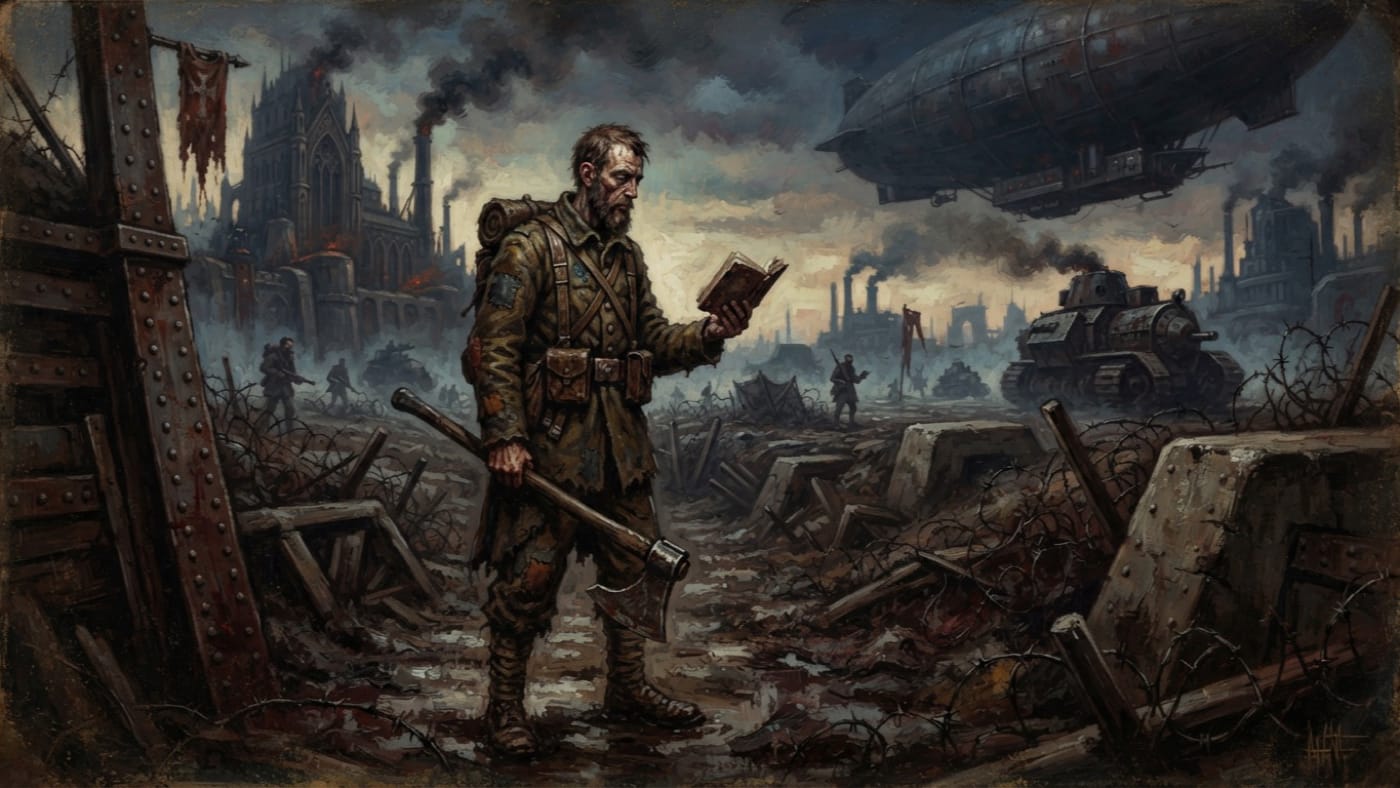
#On the Axe-Psalter's Station
An axe-psalter is a Scandinavian soldier who can fight and pray at the same time. I set the definition down plainly because the Synod has spent a long while making it more complicated. The axe-psalter holds no rank the Bureau of War invented. No charter was drawn up for the type and no founding order was sealed in Strasbourg. The type arrives at the depots already made. It is made in the Fractured North, by families, by winter, and by a liturgy the Bureau of Doctrine has filed for most of living memory as compliant in substance and deviant in form.
That is the whole difficulty. Strasbourg wants the soldier and distrusts the parish that produced them. It pays for the competence and files the upbringing under Pending. Officers along the Line commend the northerners for a quiet steadiness under fire. At the same posts, the Purity supervisors find the same men and women unsettling and say so in the margins of the same files. Both findings are true and both are stamped. Nobody in the Bureaus has been asked to reconcile them, and nobody will volunteer.
#On the Northern Upbringing
It is said, and the saying is older than my service, that children in the North learn to wield both axe and psalter before their twelfth year. I once watched a girl of nine recite the Creed in clean liturgical Latin while splitting firewood one-handed in a snowstorm. She did not look up at the southerner. The Latin never faltered at the stroke, and the stroke never waited on the Latin. I have seen seminarians of twenty lose their place in the same Creed because a door slammed.
No academy teaches this. Wardens are few in the North, so households enforce the Covenant. The mother hears the evening office before she serves the fish. The elder sets the fast days. The uncle puts a hatchet in a child's hand at six and corrects the grip and the responses in the same breath. Work and prayer are taught together because a northern day has no second hour in which to teach them apart. Wood must be split and the office must be said. The dark comes at three in the afternoon.
At Hrafnvik I saw what the rest of that education costs. Every household there owes oil-tithes, watch-hours and fast days. The longhouses smell of smoke and wet wool, and the render yards of hot fat and brine. Whole villages rise before dawn to chant the Creed on the cliffs, and the wind takes most of it. The clans order the fasts as discipline. In a thin seal season a fast runs on into something the clans do not name and the Synod calls voluntary penance. Then a child learns the psalms on an empty stomach, and learns that the psalms do not fill it.
The northern soldier's steadiness is a habit taught early and paid for in grain the North does not have. Strasbourg should not mistake it for a gift.
#On Service at the Line
The Church's armies already fight to liturgy. Every soldier on the Sagittal Line marches to cadence, answers the bell and is expected to know the responses. A Litany-Engineer could tell you how a company sounds once it has forgotten them. The axe-psalter's distinction is not that they pray in battle, because everyone prays in battle. It is that the northerner was never taught the two as separate acts and needs no drill-sergeant's count to hold them together. A southern conscript recites because the cadence requires it. An axe-psalter recites the way a fisherman bails.
I have written that an axe-psalter is worth three southern conscripts, and I stand by the sentence. No muster roll produced that figure. It is the judgement of a man who has watched both kinds hold a wet trench after dark. The Bureau of War is welcome to prefer its own arithmetic whenever it produces some.
The North does not dress up its reasons for going south. Bastion-Königsberg pays its garrison in coin and feeds it warm food, which after a northern February is argument enough. The shipyards of Hamburg hire without papers. The Line takes whoever arrives. Some who leave have already stood the Winter Watch on the cliffs with axe, harpoon and lantern before they ever see a Synod depot. Others have only split wood and said their office. The Line does not ask which.
They carry what is practical: an axe that was a tool before it was a weapon, a psalter worn soft at the corners, and wool that never dries. The axe-psalter has no uniform and no insignia. The quartermasters issue them what they issue everyone, and the northerners keep the axe anyway.
#On Doctrine and Usefulness
The Bureau of Purity does not suspect the axe-psalter of heresy, and its task would be simpler if it did, because heresy has procedures. What Purity suspects is provenance. The soldier learned the Creed correctly, but in a parish where the hymns are adjusted, the saints are supplemented and the bells ring tunings the Bell Codex does not recognise. The investigation into northern bell practice is still open and no finding is expected. So every northerner at the Line arrives with a question attached that they did not ask and cannot answer.
The Bureaus confuse the matter, so I set it straight here. The axe-psalter is no Bellwarden. They hold no key, keep no licensed tower and answer to no Office of Bells. They belong to no specialist order and perform no rite a southern regimental chaplain could not perform. The Watchers credit the fjord-bells with holding back det grå vattnet, and they credit them with more than the Bureau of Bells will. Whatever the bells do, the soldier who leaves the fjord leaves them behind. A northern private at Königsberg rings nothing. They pray, and swing, and hold.
The Bureau of Doctrine has therefore settled into its customary posture. It prizes the product and withholds its approval from the workshop.
#On the Fjords They Leave
Every axe-psalter at the Line is one pair of hands gone from a longhouse. The North counts this more carefully than the Synod does. The young leave and do not come back, and each winter the fjords are quieter. Fewer people split the wood and fewer stand the cliff-watch. Fewer children have an uncle to correct their grip and their responses in the same breath. The next generation of axe-psalters is being taught by a thinner household than the last, and the one after that will be taught by a thinner household still.
The bell-towers want fewer ringers because fewer settlements remain to ring for. The Watch grows thin at the narrows, and the Bureau of War's recruitment ledgers grow thick in Königsberg. These are one set of figures entered in two different books.
The Bureau of Records now puts the whole region at about 1.9 million souls and does not expect ever to verify the number. The elders keep their own count and will not share it. A people whose only defences are distance and competence does not publish its numbers to an empire that recruits.
In A.S. 197 I was sent north to assess compliance, and I assessed it. I did not assess this. The Bureau of War values the northerners, and I have given it a sentence to value them with. Neither of us has proposed sending anything back up the fjords except paper. The North has no mills to make paper and no use for more of ours.
ERRATUM — BUREAU OF RECORDS, NORTHERN CENSUS OFFICE. The Northern population estimate in force before A.S. 200 is withdrawn and is not to be cited. Revised figure: approximately 1,900,000, verification pending. The decline is attributed to emigration.
Stamped: Bureau of Records — A.S. 200