
#On the Ground and the Name
Battery Veyl was one of the named Synodal artillery emplacements on the eastern flats at Belgrade in A.S. 120, during the action the Church now keeps as the Miracle of the Danube's Turning. Its service there is documented. Almost everything else about it was either filed where I have not been permitted to look or never filed at all. The Bureau of Records treats those two conditions as one.
The registry gives a name and an hour, the sixth hour of the battle. It does not give a founder, a commander, a number of pieces, a calibre, a relic in any breech, the year the battery was raised or the year it ceased to be carried on a roll. I list these gaps so that no sermon-writer with a free afternoon decides to fill them in.
The ground was river-flat below the ruined city, low and grey, with the Danube at the batteries' backs. By A.S. 120 Belgrade had been lost, burned, perfumed and quarrelled over for three generations. Velkara's Shattered Courts had soured the upper districts, and Wrath worked the eastern approaches with fire. A gun line set there faced the Enemy to the east and had a river behind it, which was meant to be a comfort. Rivers make poor rearguards. They do not hold ground; they take it.
Seventy-five years had passed since the Sundering of A.S. 45. The faithful had learned to fall back with honour at Kalnik Ridge and at a hundred lesser places. Belgrade was where War meant to stop falling back, and it put its guns in the mud to prove it.
#On the Mud and the Guns
War's planners judged the eastern flats firm after nine days without rain. The Danube had fallen and the low ground had crusted over, so men with dry boots drew lines on it. By the second hour, gun-teams along the line were axle-deep. By the third, the forward caissons were being unloaded by hand. Deacons passed sanctified powder down a chain of arms the way villagers pass buckets at a chapel fire. In the fourth hour, three artillery captains asked leave to withdraw. They were ordered to maintain devotional position.
The record does not say which three. No document I have been shown names Veyl's officers, and I will not enter them for a refusal they may never have received.
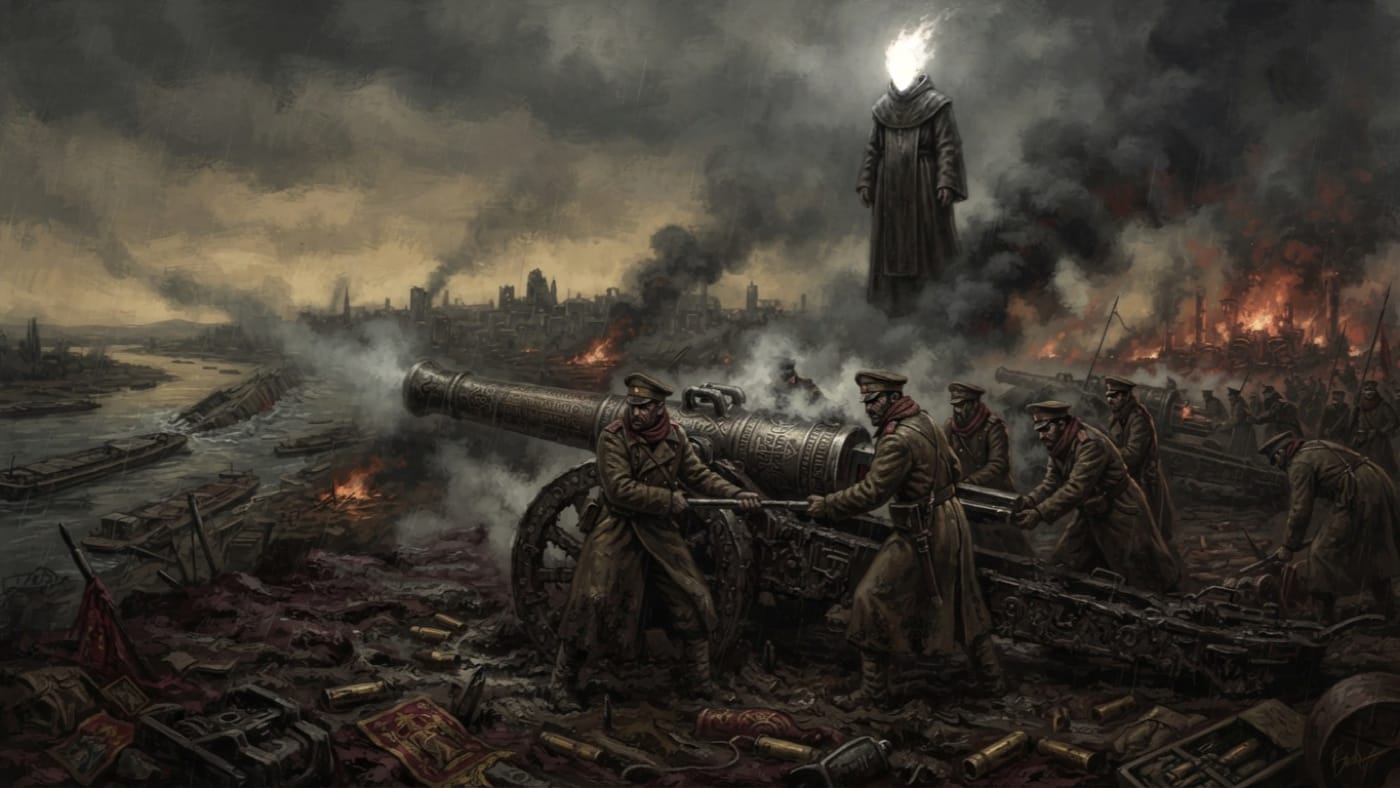
Relic artillery is served the way liturgy is served. The crews are deacons first and gunners second. Axles are oiled under the proper psalm, charges are packed with bone-ash, and a jammed breech is confessed before it is cleared. That is slow work on a dry field. In Belgrade mud it was a Mass said on one's knees while the altar slid away. The registry does not say whether Veyl's pieces were relic guns, river guns or common iron christened for the day. It places them in the line, and that will have to do.
Maldrake's host came across the flats: Wrath-forged infantry, furnace troops, pyre-smiths branding their own ranks until the men went up in fire, and engine columns glowing red through the haze. Their iron gave off heat that crews could feel across open ground. Hellbow companies raked the line from the southern bank with slag-bolts. Every gun in the Synodal line faced that furnace with a river nobody trusted at its back. The ground between gave a little more with every recoil.
#On the Sixth Hour
At the fifth hour, a woman holding a psalter was seen above Battery Saint-Margaux.
At the sixth hour, a second figure was seen above Battery Veyl.
No one could report its face. Where the face should have been there was a visor, and the visor was white fire. The accounts give it no name, no sex, no patronage, no gesture of blessing, no word and no relic. It hung over the guns while the crews worked beneath it and the engines came on. That is the entire approved description. I have read it more often than any honest man reads a single sentence.
At the seventh hour, a robed bearer holding three burning phalanges rose above the river itself. No official document names that figure. Porters call it Saint Ignatius the Carrier, and that name is a porters' devotion. It belongs to the seventh hour and to the river, and it does not drift an hour upstream to Veyl. There were three hours, three figures and three positions. Records keeps them in separate columns, and so shall I.
Then the relic guns fired in sequence. The river rose in a long diagonal ridge and ran backward. Barges tore loose and were driven east with their chains still attached. Hostile infantry in the ford took the Danube full in the face. A pyre-engine trapped in the Flesh-Mud burned hotter, and the mud baked, cracked and swallowed it whole. At the eighth hour Maldrake's centre broke. No document credits Veyl with the reversal of the river or the loss of the engine, and none rules it out. War ratified the combined action, and the combined action is what the Church received.
Earlier campaign sermons stated that the Danube "parted."
Corrected. The Danube turned. A parted river opens a road for the faithful. A turned river strikes the Enemy in the teeth. Doctrine prefers the second, and so do I, having stood on neither bank.
#On the Survivor and the Sealed Phrase
Battery Veyl has a second entry in the archive, and it concerns another hour's saint.
Among the confessors' papers from the field is a statement taken from a survivor of Veyl. It says nothing about the white visor. It concerns the bearer above the river, the third saint, whom the witness saw from Veyl's ground an hour after Veyl's own apparition.
CONFESSOR ANNEX — BELGRADE FIELD, A.S. 120 Battery Veyl survivor testimony: "The third saint looked at us and ███████████████████████." Records action: testimony copied twice; original sealed. Doctrine action: phrase omitted from public miracle account. War action: witness returned to front after three days; no further statement recorded.
Mark the order of custody. Records took the words, the Bureau of Doctrine took the meaning, and War took the man. Each office kept the part it knows how to keep. The witness went back to the guns with whatever was left, and nothing more is entered under that name. I have heard the phrase finished at dinner tables by men who were never at Belgrade and have never seen the original. They finish it differently every time. The seal holds against all of them, and against me.
The casualty annexes enter forty thousand Synod dead for the whole field. Veyl's share is not broken out. The crews who served under the sixth-hour fire are somewhere in the columns for killed, missing, translated, drowned, sanctified, unconfirmed and river-accounted. They are filed by condition, not by gun.
#On the Pilgrims and the Present Ground
The victory gave the faithful somewhere to walk to, and they walked, without permits and by the tens of thousands. The Bureau of Pilgrimage was constituted in A.S. 123 in the wake of that traffic, and the Harmonized Routes decree followed. In the public account, Veyl survives as the middle of three: Saint-Margaux, Veyl, the river. It is the name people forget first. The saint over it left nothing to paint, and its guns are not the ones said to have fired themselves.
In A.S. 201, Belgrade is still ruined and still contested. Pilgrims come in under armed escort. They are shown the approved rise above the river, the artillery plinths, the chained marker where Battery Saint-Margaux stood, and three basalt sighting posts that fix the three apparitions. They are kept off the lower flats, which still breathe after rain. No marker for Veyl is recorded. The registry does not say whether any plinth on the viewing ground held Veyl's guns, whether any of those guns came out of the mud, or whether any battery carries the name today. Those questions sit where the founder and the commander sit.