
#On the River That Chose a Side
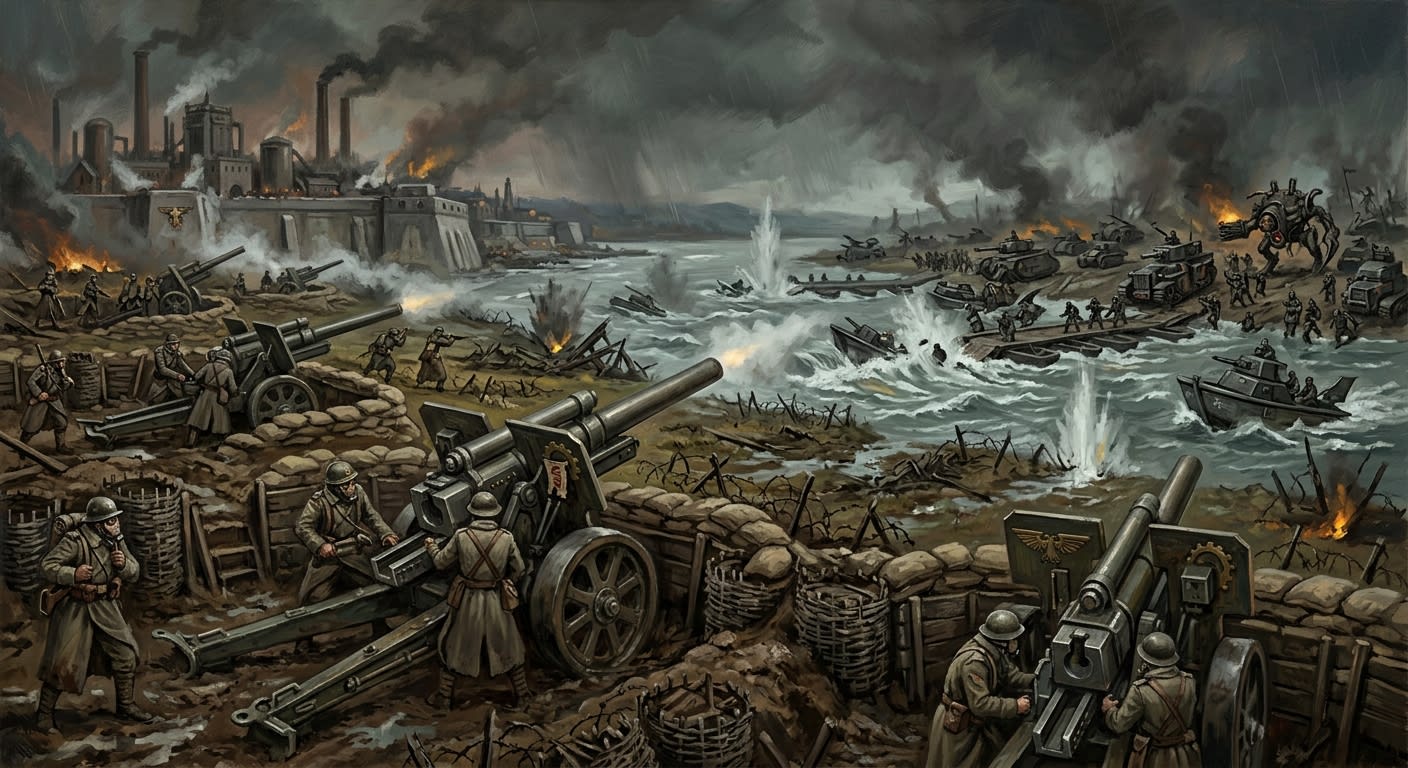
The Miracle of the Danube's Turning occurred at Belgrade in A.S. 120, when Maldrake's Wrath-host broke against the river flats and the Synod, having spent seventy-five years teaching men to retreat with dignity, discovered the administrative inconvenience of victory. It was the first major offensive triumph the Bureau of War could claim without first burying the verb under six layers of defensive euphemism. The horde came west. The guns answered. The river turned. Three saints appeared above the artillery emplacements, or were seen to appear, or were later required to have appeared because a victory of that size needed witnesses larger than colonels.
Belgrade was already a city with too many masters and too many deaths. The old Rationalist garrisons had lost it within days of the Sundering. Later Lust perfumed its courts, Wrath scorched its approaches, refugees renamed its districts according to which bridge still had a corpse toll, and cartographers quietly learned to draw the city in pencil. By A.S. 120 the Danube front there was neither safe ground nor lost ground. It was the sort of contested place the Bureau calls an opportunity when other men must stand in it.
#On the Guns, the Mud, and the Three Apparitions
The battle began as a correction to arithmetic. War's planners judged the eastern flats passable after nine days without rain. The Danube had fallen. The low ground looked firm enough for battery deployment. No one asked the mud whether it agreed. By the second hour the first gun-teams were axle-deep; by the third, the forward caissons had to be unloaded by hand; by the fourth, three artillery captains had requested permission to withdraw and were told, in the crisp language of men far from mud, to maintain devotional position.
Maldrake's engines advanced through the heat-haze. Their iron hides burned red. Their crews, if crews they possessed, chanted through furnace grates in a rhythm that made the rivets of our own guns sweat. The river behind the batteries ran black-green and slow, carrying foam, ash, and objects the dispatches call timber. Soldiers at the waterline later swore the “timber” had fingers.
At the fifth hour, the first saint appeared above Battery Saint-Margaux: a woman holding a psalter with pages turning against the wind. At the sixth, a second figure showed over Battery Veyl, faceless behind a visor of white fire. At the seventh, when the Wrath-forged centre pushed within mortar range and a pyre-engine sank to its waist in the Belgrade flats, the third apparition rose over the river itself — a robed bearer with three burning phalanges in his hand.
No official document names him. Porters name Saint Ignatius the Carrier anyway.
The relic guns fired in sequence. The river's surface rose in a long diagonal ridge, as if a glass plate had been lifted beneath it. The current bent back against itself. Barges moored downstream tore free and were shoved eastward with their chains still attached. Wrath-forged infantry entering the ford found the water running uphill into their faces. The pyre-engine trapped in the Flesh-Mud burned hotter in fury; the mud baked, cracked, opened, and took it whole. Steam screamed for nine minutes. War filed the sound under favourable terrain.
Earlier campaign sermons stated that the Danube “parted.”
Corrected. The Danube turned. Parting implies a corridor granted to heroes. Turning implies a river striking the Enemy in the teeth. The Bureau of Doctrine prefers the second account because it is more accurate and considerably more satisfying.
#On the Cost of Being Saved
The miracle did not make the battle clean. Miracles rarely do. They improve the symbolism, not the amputations. Forty thousand Synod dead were entered across the casualty annexes, though War's public plate reduces the figure by separating killed, missing, translated, drowned, sanctified, unconfirmed, and “river-accounted.” This is how one lowers a number without resurrecting a man.
The third levy line held because the first two lines ceased to be lines and became warnings. The river batteries fired until their crews bled from the ears. Confessors moved through the smoke with portable screens, hearing final sins shouted over cannon recoil. A Tribune-Chaplain at Battery Saint-Margaux gave absolution to a gun after its whole crew died and the gun continued firing once by recoil-jump and once by means no engineer has reproduced.
Maldrake's centre broke at the eighth hour. His flanks burned backward into their own smoke. The Hellbow companies, which had been advancing along the southern bank to rake the batteries, found the ground under them moving like wet muscle. Some were swallowed. Some fled. Some stood still and burned down from the helmet, like candles performing an ugly devotion. By dusk, the eastern bank was a red-black smear of iron scraps, wet ash, and abandoned standards too hot to touch.
CONFESSOR ANNEX — BELGRADE FIELD, A.S. 120 Battery Veyl survivor testimony: “The third saint looked at us and ███████████████████████.” Records action: testimony copied twice; original sealed. Doctrine action: phrase omitted from public miracle account. War action: witness returned to front after three days; no further statement recorded.
#On the Pilgrims Who Followed the Guns
The Bureau of Records canonised the victory before the bones had cooled. This was efficient, indecent, and politically necessary. The Synod needed a victory that could be walked toward. Kalnik Ridge had saved the retreat in A.S. 48; Belgrade gave the faithful a place where the Enemy had been driven back, delayed no longer. Pilgrims began moving within weeks: widows, veterans, relic-hunters, vow-carriers, invalids, penitents, and merchants who had discovered that sanctity produces excellent margins.
The Bureau of Pilgrimage was formally constituted in A.S. 123 in the wake of this movement. The official reason was spiritual protection. The actual reason was road panic. Tens of thousands of the faithful had begun walking to Belgrade without permits, route seals, approved lodging, shrine fees, sanitary discipline, or the elementary courtesy of making themselves taxable. The Harmonized Routes decree (Unregistered) followed. Eight rival guilds were crushed. Pilgrimage became safe, orderly, expensive, holy.
The Bureau of Pilgrimage was founded purely to shepherd devotional traffic after the Belgrade miracle.
Clarified. It was founded to shepherd devotional traffic, extract revenue from devotional traffic, prevent devotional traffic from becoming a refugee column, and ensure that no citizen reached a miracle site without first learning the price of arrival.
#On the Present Uses of the Turning
In A.S. 201, Belgrade remains ruined, contested, perfumed in districts no patrol enters, and sacred by decision. The miracle site is approached under armed escort. Pilgrims are permitted to see the approved rise above the river, the artillery plinths, the chained marker where Battery Saint-Margaux stood, and three basalt sighting posts that triangulate the apparitions with all the confidence geometry can lend to theology. They are not permitted onto the lower flats. The lower flats still breathe after rain.
War invokes Belgrade whenever morale thins. Pilgrimage invokes it whenever fees require justification. Doctrine invokes it whenever some sour little Rationalist in a cellar asks whether miracles still occur in public. Yes, they occur. They occur in mud, under shell-fire, at appalling cost, and afterward the Bureau arrives with forms.
The Danube runs past Belgrade as rivers run: indifferent, useful, guilty only by association. On certain mornings the current below the old battery line appears to hesitate. Boatmen cross themselves. Clerks note optical disturbance. Veterans look away.