
#On the City That the River Refused to Bury
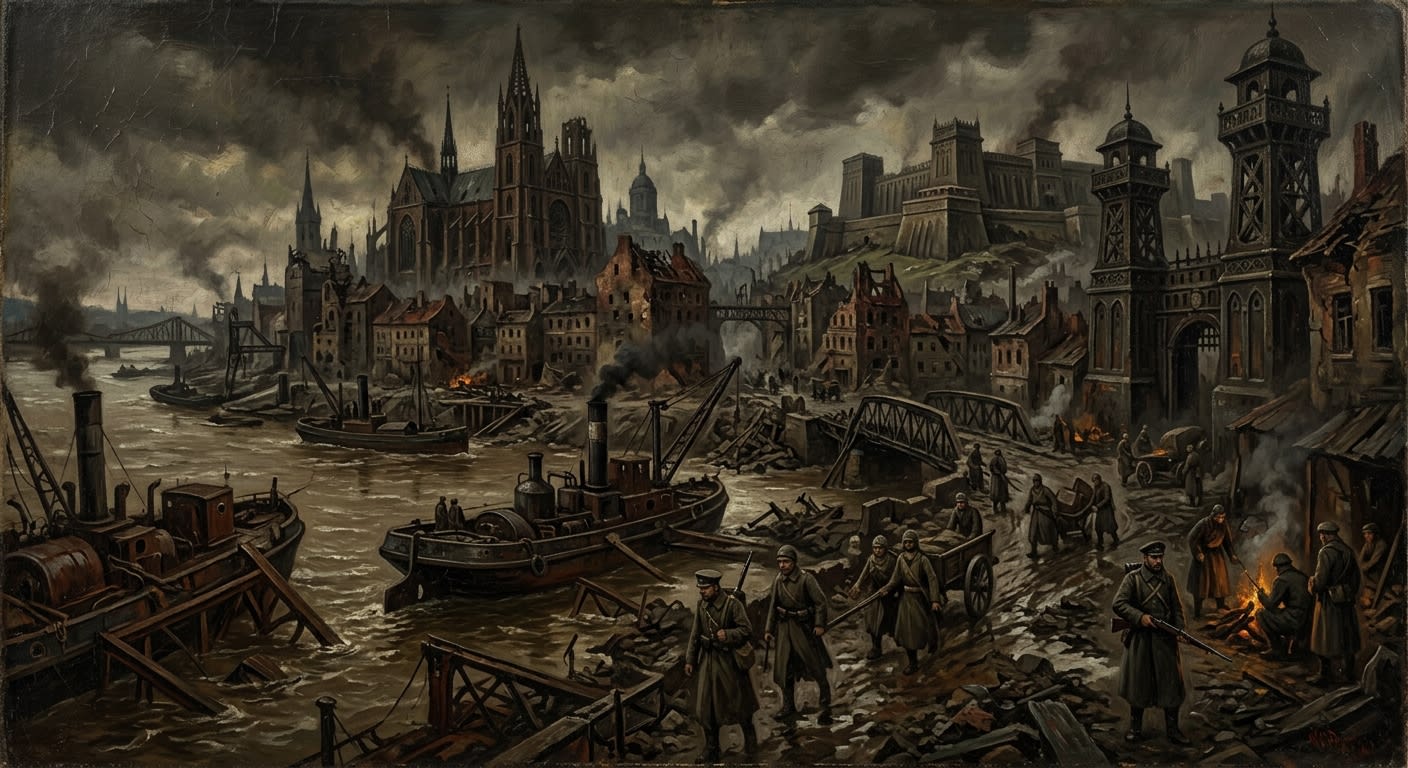
Belgrade is a ruin with a pulse, which makes it more troublesome than an intact city and less honest than a grave. It sits where the Sava submits itself to the Danube, or where the Danube receives the Sava, depending upon which river one is trying to flatter. The old city rose on the high ground above the confluence, white stone over brown water, fortress over market, chapel over tavern, argument over mud. It was always a hinge. Rome used it. Byzantium used it. Hungarians, Serbs, Ottomans, Austrians, Rationalists, and finally the Synod all discovered that whoever holds Belgrade may inconvenience the rest of the continent.
The continent has been inconvenienced.
In the present year, A.S. 201, Belgrade is classified Zone 5/6: ruined, contested, partially reclaimed for pilgrimage, denied for settlement, sacred by ratification, hostile by weather, and useful by every Bureau that requires an example. It is south and east of Budapest, downstream along the Danube's muscular road, north of the deeper Balkan wound, west of the Shadow Court's wandering jurisdiction, and too near the old Shattered Courts for any sensible clerk to speak its name while wearing perfume.
The faithful know Belgrade for the Miracle of the Danube's Turning in A.S. 120, when the river rose against Maldrake's advance and struck Wrath in the teeth. Pilgrims are sold the miracle. Soldiers are sold the victory. Clerks are sold the route fees. The city itself sells nothing. It keeps its burned stones, its lower flats, its perfume scars, its saint-sighting posts, and the patient silence of a place that has survived too many owners to respect any of them.
Registry plate, Belgrade / Danube Confluence / Zone 5–6: ruined-contested; controlled pilgrimage access; no civilian resettlement authorised; primary incidents include Eastern Silence prefigurations, the Shattered Courts surge, and the Miracle of the Danube's Turning in A.S. 120; current hazards include Wrath residue, Lust-sorcerous fragments, river anomaly, unauthorized relic scavenging, and lower-flat respiration after rain.
#On the Old White City
Belgrade's old name, the White City, survives in a hundred parish sermons because preachers adore irony when the dead cannot object. The stone was white once. Limestone walls, chalked bastions, pale towers catching river light at morning, the whole citadel glowing above the confluence like a tooth in a saint's jaw. Traders crossed there because rivers made the command. Armies crossed there because traders had already found the roads. Priests crossed because armies make cemeteries and cemeteries make excellent parish prospects.
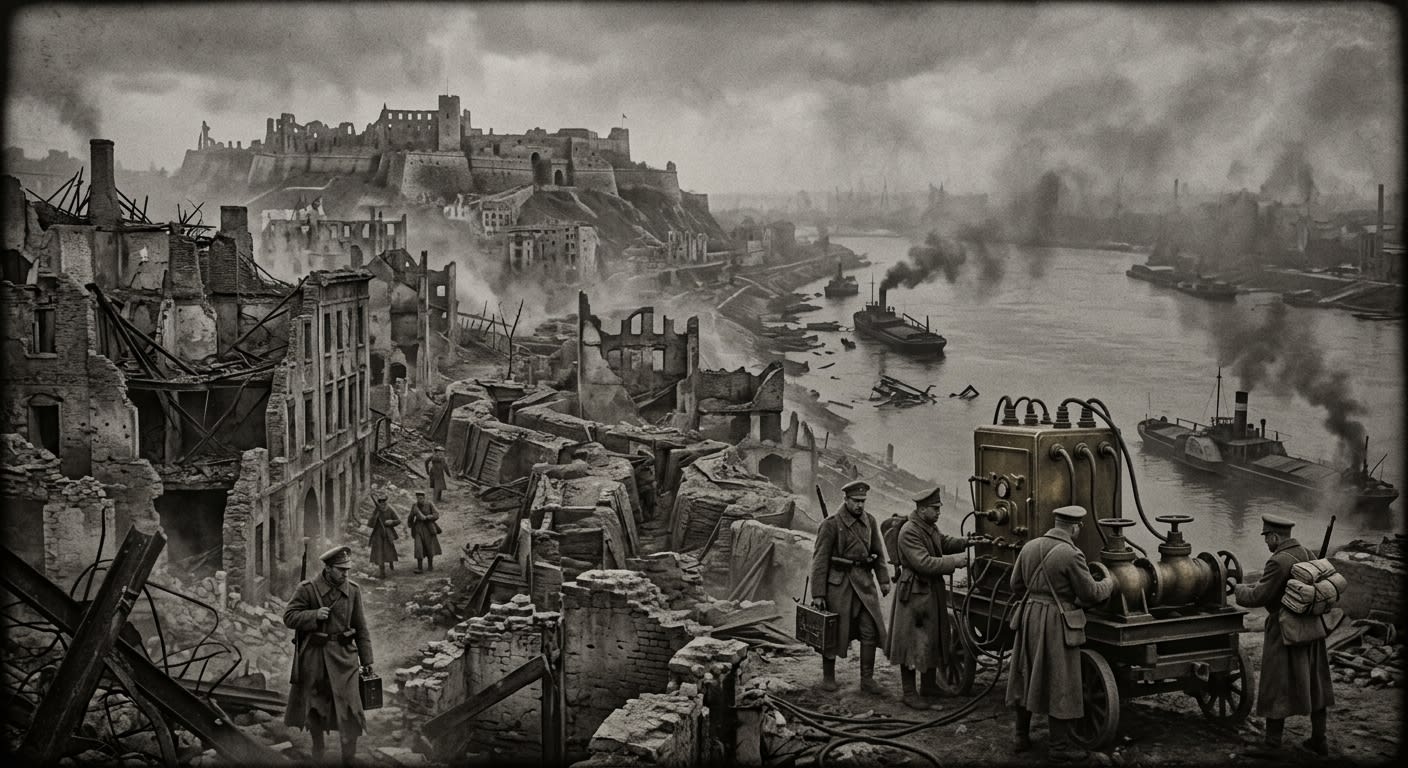
The Rationalist Republic treated Belgrade as a Danubian administrative node, a vulgar phrase with clean boots. The city linked Budapest to the Balkan interior, Vienna's tax hunger to southern grain, garrison roads to the Morava valley, and the old imperial habit of believing a map could hold what a patrol could not. In A.S. 38, during the Eastern Silence, the cords went slack. First came lost packets, then blank ledgers, then refugees with stories of moving forests, kneeling bells, and fog that counted fathers out of families. Belgrade received those stories before it became one.
The Sundering in A.S. 45 made the old categories childish. Routes that had carried grain began carrying teeth. Forts that had counted customs began counting survivors. Belgrade became a forward wound before the Synod possessed the vocabulary for forward wounds. The first detachments that tried to hold it after the eastern rupture found streets built for commerce and useless against Hell. Shopfronts do not resist forge-beasts. Market halls do not repel perfumes. Municipal pride dies badly under sorcery, usually while quoting regulations.
The first Synodic surveyors after the collapse did what surveyors always do when confronted by apocalypse: they measured. They measured the western gate, the river drop, the citadel wall thickness, the burnt quay, the distance from the chapel of Saint Petar to the market well, the number of intact ovens, the depth of ash in the counting house, the length of a claw mark across the customs lintel. They measured until one of them noticed that the well depth changed when prayers were spoken near it. The lead surveyor ordered silence, took three more measurements, and filed all four figures. Records kept the fourth. War kept the first. Doctrine requested the second and third under seal. This, reader, is how a city becomes multiple facts before breakfast.
Refugees from the Morava roads brought household gods hidden inside saints' boxes, marriage coins sewn into hems, Balkan icons blackened by hands rather than smoke, and enough private grief to drown a small republic. They camped under Belgrade's outer slopes until the camps were shelled, blessed, abandoned, reoccupied, and blessed again. By A.S. 70 the city had already acquired its permanent smell: river mud, spent powder, old incense, hot iron, cabbage boiled in fear, and the faint sweetness of flowers nobody admitted planting.
By the time the Great Retreat hardened into the early Line, Belgrade had slipped beyond ordinary possession. It remained useful in memory, costly in flesh, and too visible along the Danube for the mercy of irrelevance. The Bureau of War marked it as a possible southern hinge. Doctrine marked it as a warning. Records, displaying unusual wisdom, stopped trying to reconcile the two ledgers and opened a third marked Pending.
#On the Shattered Courts and the Scent Before the Fire
Belgrade's corruption is not solely Wrath's, despite what simplified campaign plates imply. Wrath broke itself against the Danube there, yes, and left iron in the mud, screams in the guns, and heat under stones that should long since have cooled. But before the river turned, before the saintly apparitions, before the first levy-armies learned that heroism is a polite word for dying in sequence, Belgrade had already become a mouth for Lust.
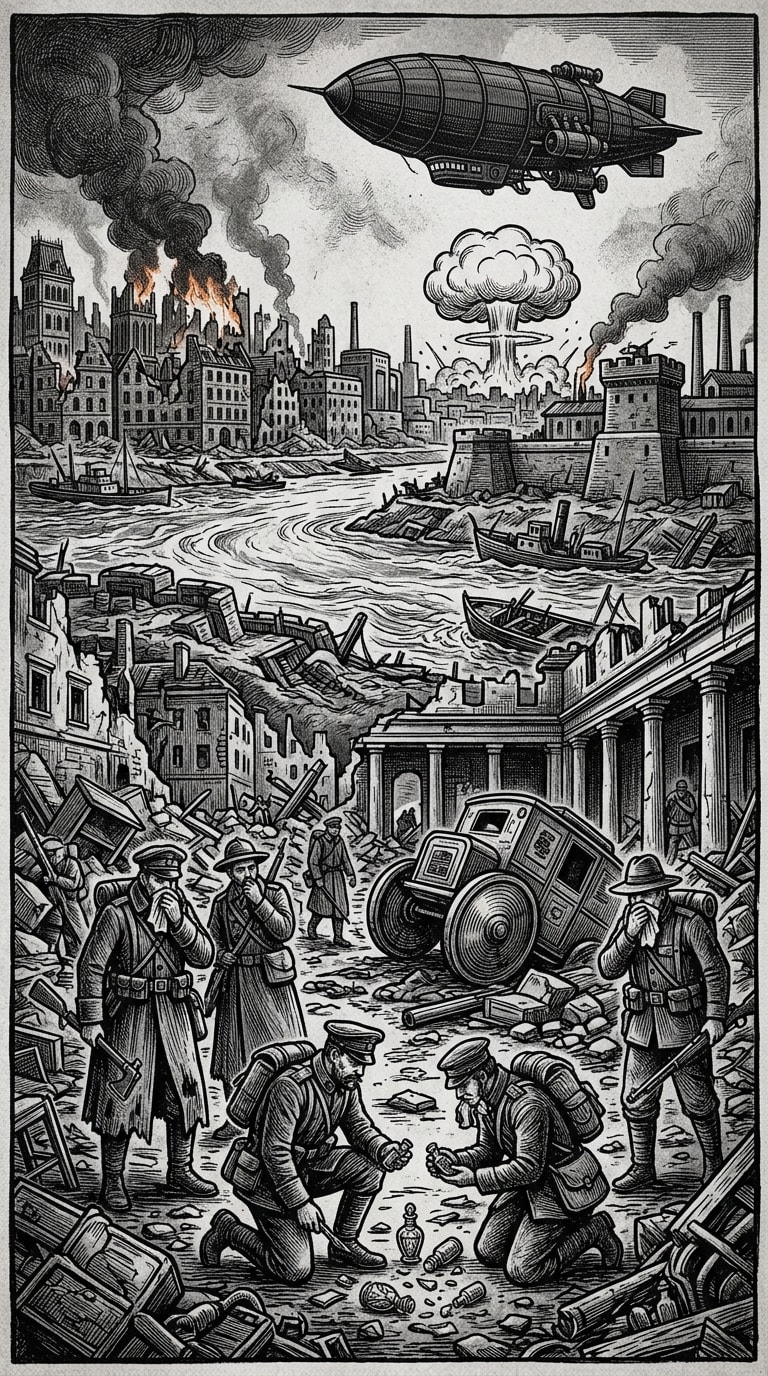
In A.S. 117, the Shattered Courts surged from Belgrade. The perfume fogs reached Budapest and crossed both banks. That distance matters. Belgrade did not merely suffer the phenomenon; it transmitted it, or hosted it, or opened the chamber through which Velkara's art walked west with scented cuffs. The Bureau's public phrase was localised atmospheric event. Public phrases are the curtains behind which officials change bloodied robes.
At Belgrade itself the reports were uglier and less publishable. Soldiers quartered in noble houses found mirrors still hanging in rooms whose ceilings had burned away. Two companies due for rotation at dawn instead spent the morning duelling shadows they swore were beloved faces. An artillery sergeant confessed to murdering his daughter, though the daughter lived in Lyon and later testified, with commendable irritation, that she had never met the man he killed. Lavender appeared in a powder magazine. Rosewater soaked a field chapel's altar cloth. Ambergris drifted through casualty tents where no civilian had passed and no whale, to my knowledge, had been enlisted.
BELGRADE SHATTERED COURTS — RITES ANNEX, EXTRACT Recovered mirror fragment showed █████ persons standing behind observer. Observer was alone. Fragment sealed, boxed, blessed, weighted, and dropped into the Danube under bell escort. Three days later it appeared in Captain ███████ shaving kit. Captain's wife reported receiving letters in his hand after his death, “more loving than before.”
The Mirror and Perfume Arts leave a residue more durable than ash. Ash dirties. Scent persuades memory to wash itself. A room smells like safety; a stranger receives the file marked beloved; a warning arrives perfumed and gains admission past the guard. Belgrade acquired this residue and never fully lost it. Even now the approved pilgrim routes avoid certain courtyards where flowering weeds grow in winter and where men recall childhoods they did not possess.
Older War plates describe Belgrade as a purely Wrath-afflicted theatre after A.S. 117.
Corrected. Wrath supplied the visible catastrophe. Lust supplied the earlier permission. The city was courted before it was burned, and only a clerk with no nose could miss the sequence.
#On Maldrake's Advance
Maldrake came because Wrath must strike the place where roads, rivers, and frightened men converge. The Danube valley offered him a corridor toward Budapest, Vienna, and the Central Corridor's throat. The old Belgrade flats offered fords, battery positions, ruined suburbs, and enough human rage to season the ground. In A.S. 120, his Wrath-forged centre advanced through the heat-haze, iron hides burning red, furnace grates chanting in a rhythm that made our guns sweat at the rivets.
By then the First Continental Levy had been feeding boys into the southern war for a decade. The levy-armies were no longer raw in the innocent sense. They had been drilled by War, blessed by Doctrine, sorted by Records, terrified by Purity, and educated by the simple field curriculum of seeing what Maldrake did to men who ran. They arrived at Belgrade as numbered flesh and became, in the Bureau's later phrasing, a ratified miracle of martial obedience. The phrase is indecent. It is also accurate in the way a butcher's invoice is accurate.
The battle line formed along the river batteries. Battery Saint-Margaux held the northern rise. Battery Veyl commanded the lower sweep. Pontoon crews worked under heat that cracked their prayer beads. Confessors walked behind the guns with portable screens, hearing sins shouted between recoil and counterfire. The Danube ran black-green, carrying foam, ash, and objects field dispatches called timber. The timber had fingers. I record the fact because the dispatches did not.
At the fifth hour, the first apparition appeared above Battery Saint-Margaux: a woman holding a psalter whose pages turned against the wind. At the sixth, a second figure shone over Battery Veyl, faceless behind a visor of white fire. At the seventh, when Maldrake's centre pushed within mortar range and a pyre-engine sank waist-deep in the flats, the third apparition rose over the river itself, a robed bearer with three burning phalanges in his hand. No official document names him. Porters name Saint Ignatius the Carrier anyway, because porters often possess better theology than committees.
Then the relic guns fired in sequence.
#On the Turning
The Danube did not part. That is the children's version, painted on chapel boards by men who believe miracles should behave like theatre curtains. The Danube turned. The river's surface rose in a long diagonal ridge, as if a pane of invisible glass had been lifted beneath it. Current bent back against itself. Barges moored downstream tore free and were shoved eastward with their chains still attached. Wrath-forged infantry entering the ford found water running uphill into their faces. The pyre-engine trapped in the flats burned hotter in fury; the mud baked, cracked, opened, and took it whole. Steam screamed for nine minutes.
War filed the sound under favourable terrain.
Campaign sermons once claimed that the Danube opened a dry path for Synod troops.
Withdrawn. The river granted no path. It struck. This is why the miracle matters. A helpful river assists heroes; a wrathful river makes heroes unnecessary for nine glorious minutes.
The miracle did not clean the battle. Miracles improve symbols, not amputations. Forty thousand Synod dead were entered across casualty annexes, though the public plate lowers the number by separating killed, missing, translated, drowned, sanctified, unconfirmed, and river-accounted. One may reduce a figure by giving each corpse its own drawer. The corpse remains stubbornly singular to its mother.
The third levy line held because the first two lines had become instruction. The guns fired until crews bled from ears, mouths, and the soft membranes of certainty. A Tribune-Chaplain at Battery Saint-Margaux gave absolution to a gun after its whole crew died and the gun continued firing once by recoil-jump and once by means no engineer reproduced. Engineering tried in A.S. 124, killed two apprentices, cracked a chapel wall, and concluded that faith resists standardisation. Observe how the obvious becomes official only after sufficient casualties.
Maldrake's centre broke at the eighth hour. His flanks burned backward into their own smoke. Hellbow companies advancing along the southern bank found the ground under them moving like wet muscle. Some were swallowed; some fled; some stood still and burned down from helmet to heel like candles trained by a cruel choirmaster. By dusk, the eastern bank was a smear of iron scraps, wet ash, abandoned standards, and mud that bubbled when priests recited victory psalms.
#On the Cost of Being Sacred
A victorious battlefield becomes a shrine before the flies have finished. Records canonised Belgrade with indecent speed because the Synod needed a victory that could be walked toward. Kalnik Ridge had saved retreat; Belgrade made the Enemy visibly recoil. That distinction filled roads. Within weeks came widows, veterans, relic hunters, vow-carriers, invalids, penitents, opportunists, counterfeit guides, bone merchants, and pious fools whose faith had outrun their shoes.
The Bureau of Pilgrimage was constituted in A.S. 123 partly because of this flood. The official reason was spiritual protection. The less embroidered reason was road panic. Tens of thousands began moving toward Belgrade without permits, lodging seals, route tokens, sanitary discipline, escort contracts, or the elementary courtesy of being taxable. The Harmonized Routes Edict followed, crushed the private pilgrimage guilds, and made holiness safer by making it expensive.
Belgrade's approved route begins west of the old citadel and approaches under armed escort. Pilgrims see the upper rise, the artillery plinths, the chained marker where Battery Saint-Margaux stood, and three basalt sighting posts that triangulate the apparitions with all the confidence geometry can lend to theology. They kneel where told. They sing when cued. They are sold little river-stones certified as adjacent to the miracle, a phrase wide enough to include half the Balkans and narrow enough to satisfy a pilgrim with coin.
They are not permitted onto the lower flats. The lower flats still breathe after rain.
Pilgrims ask about the breathing. Wardens call it gas release from saturated battlefield soil. Engineers call it residual thermal cavitation. Doctrine calls it a matter outside devotional necessity. Veterans call it breathing and move their boots farther uphill.
#On the Ruined Districts
Belgrade is less a city now than a set of refusals. The Upper Fortress refuses collapse. The river batteries refuse silence. The lower flats refuse burial. The old market quarter refuses inventory. The noble houses near the Shattered Court breach refuse to keep mirrors broken. Each district has developed its own method of being unsafe, as if municipal government survived death and devolved authority to hazards.
The Upper Fortress remains the most stable zone, which is to say one may stand there for an hour without being loved by a smell, cooked by a paving stone, or addressed by a window. Bureau of War maintains an observation post in the old citadel, rotated every thirty days. The men stationed there clean sighting posts, watch for Wrath residue in the flats, monitor illegal crossings, and submit weekly reports whose margins grow wider during rain season. Wide margins are a symptom. The content thins because what they see does not fit ordinary lines.
The Battery Fields lie east and south of the approved pilgrim walk. Saint-Margaux's plinth is chained and polished by permitted hands. Veyl's old emplacement is half-swallowed by black grass. The third river sighting point, the one associated with the robed bearer, is guarded by a hooded lamp and two men with orders not to speak after midnight. The orders are practical. The river repeats names there. Names of the dead, names of the unlisted, names of men still serving at Bastion-Irongate, names of children born years after the battle. Records has requested copies. The garrison has declined on grounds of ink conservation, which may be the bravest lie in the file.
The Perfumed Quarter is closed. Its official boundary runs through three streets, two burned courtyards, and a chapel whose door has been nailed shut from both sides. Flowers grow there in masonry cracks through winter. Their scent changes with the listener: orange peel, a lover's wrist, clean sheets, funeral lilies, a mother's kitchen, a promotion one deserved and never received. Warden patrols wear ash-vinegar cloths and iron mirror plates strapped face-in against their chests. They enter only to retrieve fools, deserters, or evidence. The evidence often returns willingly. The fools less so.
The Market of White Stalls is forbidden to civilians and beloved by scavengers. Cloth awnings still hang in some lanes, though no cloth should have survived eighty years of rain, fire, frost, and armed neglect. At noon the stalls cast shadows toward the sun. A spice counter near the old north gate displays small heaps of dust arranged by colour. When disturbed, the heaps re-form by morning. Once, a Purity assessor found saffron there and wept for six hours. He had never tasted saffron. His mother had. She had died in Seville.
A sealed Belgrade Market Retrieval File from A.S. 198 records a ledger fragment bearing prices for goods absent from Europe since before the file's permitted date. The seller's name is blacked out. The seller's Great Ledger status, less carefully hidden in a copied margin, reads: unborn beyond the current Ledger. The patrol cook who attempted purchase with ration chits was disciplined, which proves that even terror cannot abolish appetite.
#On Roads, Pilgrims, and Thieves of Sanctity
Belgrade's sanctity attracts industry, as sanctity does whenever officials neglect to post sufficient guards. There are authorised pilgrim handlers, licensed route-stampers, approved relic counters, sanctioned stone sellers, river-water bottlers operating under strict dilution tables, confession tents, boot surgeons, vow interpreters, and the small army of clerks required to ensure the faithful do not approach the Creator without a docket.
There are also thieves. Purse-cutters infest the road in quantities that suggest a breeding programme. Sanctity-thieves take fragments: scorched iron from the batteries, black mud from the lower flats, mirror splinters from sealed houses, ash from Wrath-burns, scented weeds from the Perfumed Quarter, river stones taken below the approved line. Some sell them. Some worship them. Some mail them to enemies. Some keep them under pillows, which is the sort of devotional stupidity that keeps Purity employed.
The Bureau of Settlement has forbidden resettlement five times. Each prohibition is followed by discovery of another illegal hut, another cellar camp, another ash-seller's den, another refugee family persuaded that ruined cities are cheap because the dead have poor tenancy law. The inhabitants are removed. The dwellings are burned. Three months later smoke appears from another chimney that no survey marked.
The Bureau of War wants Belgrade kept empty except for garrison, pilgrims, and controlled salvage. Pilgrimage wants more access and fewer unexplained disappearances, in that order. Settlement wants the right to count illegal residents before War burns their huts. Records wants the A.S. 120 casualty ledgers reconciled with the shrine donation rolls, which is adorable. Purity wants mirrors removed from every standing room and scents prohibited within five miles. The river wants none of them and receives them all.
#On the Danube After Its Miracle
A river that has performed one miracle becomes permanently suspect. The Danube below Belgrade runs as rivers run: useful, brown, cold in the deeper channels, treacherous at bends, bearing silt, corpses, ferry ropes, prayers, and the occasional administrative theory. But at the battery line, on certain mornings, the current hesitates. Not reverses. Hesitates. A river about to remember itself.
Boatmen cross themselves. Clerks note optical disturbance. Veterans look away. Pilgrims, being pilgrims, stare until a Warden strikes them with the flat of a staff and calls it pastoral correction. The hesitation lasts no more than a breath. During that breath, floating objects align diagonally across the surface in the same angle recorded in the A.S. 120 sighting diagrams. Leaves, driftwood, dead fish, once a row of severed buttons. The Bureau of Engineering says eddy. The Bureau of Doctrine says sign. The Bureau of War says useful for morale. The river says nothing, which makes it the wisest participant.
There is an old argument over whether the miracle saved Belgrade or merely saved the Line from what Belgrade had become. I prefer the uglier answer. The river did not rescue the city. It denied Maldrake passage. Denial is not mercy. A locked cell may save the village while leaving the prisoner inside to rot. Belgrade remained on the wrong side of too much history, too scented to trust, too sacred to abandon, too useful to mourn plainly.
The annual river audit now uses three boats. The first carries War personnel and hooks. The second carries Rites personnel and sealed lamps. The third carries Records personnel, whose task is to write down what the first two boats deny having seen. The boats leave in line and return out of order. This has occurred seven times in nine years. Engineering blames current shear. The boatmen blame the battery line. Records blames the boatmen for failing to maintain sequence, which is charming in the way a rooster blaming dawn is charming.
Once, in A.S. 196, the third boat returned first with dry oars after a rainstorm. Its clerk had filled six pages with the same sentence: the river has corrected the witness. The sentence was copied, sealed, and omitted from the public hydrological appendix. The clerk retired to a Mercy ward in Bratislava and now refuses to drink water unless it is poured from a vessel facing west. Mercy calls this fixation. I call it a footnote with a pulse.
The lower flats after rain are the key. Water gathers in shell-holes, hoof-pits, collapsed trenches, and the old ford scars. The mud swells. Little bubbles rise, burst, and release warm air smelling of iron, candle wax, rosewater, and river weed. Sometimes the bubbles form in sequence, like words spoken by a drowning man with excellent diction. Rites has collected samples. Purity has burned samples. Records has requested samples. War has forbidden samples after an A.S. 194 vial cracked in transit and caused three clerks to confess to battles at which they had not been present.
#On the Present Condition
Belgrade, as of A.S. 201, remains a sacred wound under armed supervision. The Upper Fortress holds a rotating garrison. The pilgrim path is open during approved seasons. The lower flats are closed. The Perfumed Quarter is sealed. The Market of White Stalls is raided, denied, and raided again. The Danube continues, insolently riverine, with occasional lapses into theology.
Budapest watches from upriver with the anxiety of a city that has smelled Belgrade's breath before. The abandoned bank of Pest owes part of its silence to what came from Belgrade in A.S. 117. The Central Corridor owes part of its survival to what happened there in A.S. 120. Pilgrimage owes one of its founding panics to the roads that filled afterward. War owes a morale plate. Doctrine owes a miracle. Records owes an apology to forty thousand dead and will, naturally, issue a revised table instead.
Belgrade's true danger is not that it is dead. Dead cities are manageable; they accept plaques. Belgrade keeps producing obligations. A pilgrim kneels and owes gratitude. A soldier stands watch and owes silence. A clerk reads a casualty annex and owes correction. A thief pockets a mirror shard and owes his reflection. The river hesitates and owes nobody anything.
At dusk the confluence darkens first where the Sava enters, then where the Danube bends east, then along the lower flats where water collects in old bootprints too large for any man. The sighting posts cool. The chains at Saint-Margaux tick as metal releases heat. Somewhere in the Perfumed Quarter, flowers open with no sun on them. A Warden orders pilgrims back toward the approved road. One turns for a last look and smiles at a window nobody else can see.