
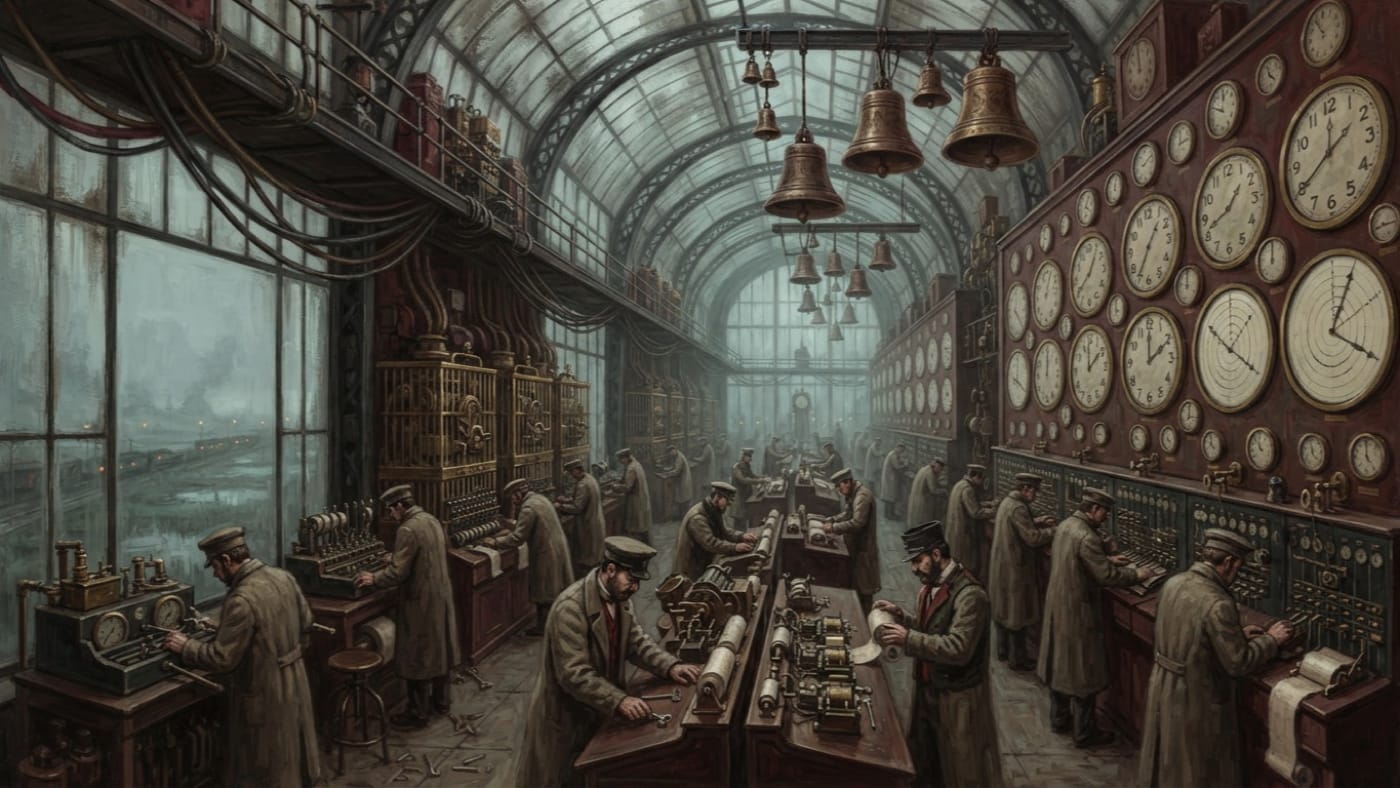
The Upper Works are swept twice daily, and in them stands a hall where Bastion-Shipka keeps its time. The Commandant's Tower, the Warden's Scriptorium and the Chapel of Saint Phocianus the Vigilant share that quarter. So does the Bell Gallery, which the garrison treats with more respect than the chapel and more suspicion than the Tower.
#On the Upper Works, and the Hall Above the Mud
The Upper Works stand on the highest stable ground the marsh concedes. At Shipka, that means the only ground that does not argue back. The corridors echo. Incense contends with lamp oil and vellum and wins against neither. Officers wear polished boots, because mud belongs to the lower districts.
A richer bastion would keep relic-caskets where the Gallery keeps its instruments. Banks of telegraph relays line the room. Clock faces stand in ranks. The whirring apparatus of the Bureau of the Hourglass runs along the walls, and telegraph sounders chatter in brass cages. The windows look across the Reed Road to the mist-veil and down into the rail quarter, where the consequences live. At prescribed intervals the great timing bells toll. The vibration rises through the stone into the soles of the feet, so a clerk in mid-sentence feels the hour before he hears it.
I will not tell the reader who founded the Gallery, who paid for it, or how many bells hang above it and under what names. No honest ledger records these things. A dishonest ledger would supply them at once, with a seal.
Shipka has no cathedral, no pilgrimage road and no famous shrine. It has reliability. The Gallery is where that reliability is made, checked and sent down the wire.
#On the Keeping of the Sector's Hours
In the strategic ledgers, Shipka is PHOCIS-MARSH NODE / TIMING RELAY 7A. The designation belongs to the bastion and its sector. It is not a builder's plaque on the Gallery door. Still, the Gallery is where the designation does its work. The node's bells and telegraph set the pulse of the nearby trenches, the outlying depots and the shrines. Its telegraph board is the metronome for patrols on foot and trains along this southern reach of the Sagittal Line. Shifts change when the bell says so. Pump crews are relieved when the bell says so. Curfew falls on the bell. A patrol that leaves on the wrong stroke meets its own sentries without warning, and a sentry who has been warned by no one is quick with the bayonet.
The same bell means different things at different heights. In the Upper Works it is a liturgical fact. It marks the canonical order of the day and is recorded in the correct hand. In the rail quarter it is a shift call, a curfew warning or the call for a train, and it tells a brakeman whether the line ahead is clear. It is one stroke of bronze with two meanings, and only one of them has ever killed anybody.
Four authorities share this hall. The Bureau of Bells codes the peals and approves every mast that rings across the marsh. The Hourglass measures. The Bureau of War moves the men and the freight. The Bureau of Doctrine decides what a peal means once it has sounded. I have looked for a custody agreement that says which of them owns the hour. If one exists, I have not been allowed to see it. In practice, everyone owns the hour until the hour goes wrong.
The line between the Gallery and the yard has a name: Mina Voss, called "Sparrow" in the rail quarter. She is a telegraph operator and signals runner in her late twenties. She works one of the quarter's busiest stations, relaying traffic between the Bell Gallery, the yard-master and the outlying signal posts. She got her nickname by scrambling across gantries faster than a sensible person would. She reads coded dispatches well, including what their senders chose to leave out, and she is openly sceptical of authority. The Gallery issues the hour. Sparrow delivers it into the hands of men who will be crushed if it arrives late.
Earlier summaries stated that the Bureau of Bells was founded in A.S. 115 and that the Bell Codex followed it.
The Office of Bells was constituted in A.S. 52 (1762 CE). A.S. 115 (1825 CE) is the year the current Bell Codex was ratified. Bell practices and local records are older than both. Neither date says anything about the age of this hall. The earlier clerk was not lying. He wrote down the year the rule was ratified and called it the year the Office was born.
#On Instruments That Require Witnesses
A bell sets an order. An instrument takes a measurement. The Gallery must do both, and the two do not always agree.
The bells are a law: strike the stroke, and the sector moves. The instruments are only witnesses, and witnesses on the Sloth front are unreliable. Syrion's fogs muffle sound more than wet air should. They make minutes seem to stretch, and in the stilt-hamlets they have left whole villages asleep at their nets. Shipka compares its clocks with those of neighbouring posts to see whether the stillness has come a little closer. When a train arrives on time by its own chronometer and late by the bastion's, a scribe draws a small sigil in the margin and sends a copy to Strasbourg. The train is on time and late at once, and both entries are properly filed.
The Synod sends Shipka its trials. The Bureau of Bells tries out new peal cadences meant to break Sloth's stillness fields here, because a mistimed peal in the marsh starts no riot in Paris. Experimental Hourglass instruments come here "for field evaluation," a phrase that covers everything from a new chronometer to a gauge the maker would rather not stand next to. The papers send these trials to the sector. They do not say which room.
Station Two is not the Gallery, and anyone who treats them as one should be corrected. It is a squat blockhouse on a reinforced causeway two kilometres east of the walls. It has its own instrument vault, its own monitoring bells and its own staff, who serve three-month tours and come back counting their heartbeats. The Gallery gets its numbers by wire.
The emergency codes on the spur cover derailment, bog or embankment failure, and marsh fire. They also include a pattern for "instrument discrepancy," which is used whenever gauges, clocks or sounders misbehave in a way the manuals do not describe. Over the years that pattern has filled with Hourglass annotations. A separate annex on temporal deviation is being discussed in committee. A discussion in committee is not an annex.
On the Sloth front generally, doctrine says wake-bells should ring irregularly: a man who can predict the next stroke may already be drifting. So the institution that makes punctuality a religious duty must also, in the right places, ring unpredictably on purpose. I find this beautiful. The accountants find it expensive.
#On Adept Vesk and the Commandant's Suspicion
Commandant Gaius Tarvor rose as a rail officer through merit and careful ledger-work rather than birth. He believes in schedules, manifests and documented procedure. He holds, almost as a point of faith, that a properly run bastion needs no heroics. His subordinates call him fair as a weighing-scale and about as charming. He has refused supply requests on grammatical grounds. For such a man, the Bell Gallery is the one room where the bastion can be run properly.
He suspects that Adept Meryth Vesk has been carrying out unauthorized temporal experiments in the Bell Gallery. He cannot prove it. Her work is documented, and every item of it falls inside her mandate. He keeps a private journal of anomalies. I have not been shown what is in it and will not guess.
Her measurements matter because of two dates. In A.S. 194 (1904 CE), during the approach of a Slumber-Hulk, her drag-gauge at Station Two showed no movement for eleven minutes. In A.S. 199 (1909 CE) she filed a formal report that Station Two loses ninety seconds every day, at the same hour. This entry withholds that hour, as her own entry does. She reports that this absence does not match any catalogued local Syrionic signature. That is what her reading shows. It does not show that the Sin-General has no part in it, since missing time is among the symptoms the Hourglass lists under his influence. It does not show a cause. It certainly does not show that anything in this hall caused, strengthened or collected the missing seconds. As of A.S. 201 the report has not been answered.
The two incidents belong to different years and must not be joined into one story for the sake of neatness. Keep them apart.
Tarvor's grievance is simple and he has some right to it. A timing node whose most learned observer reports that time is missing on a schedule has a problem he cannot fix with a manifest. He wants the fault in a person, because a person can be disciplined. Vesk puts it in the measurements, where it can only be filed. Both of them are doing their jobs.
#On Present Application
The Gallery depends on people, and the people are tired. Someone winds the clocks. Someone scrapes the corrosion off the sounders and tightens the insulators along the spur. The bells need calibration, like any bell on the Line: tension, pitch, strike interval, logged and signed. Deafness is the ordinary reward of long service in that trade. Sparrow Voss climbs the gantries at every hour of the day. None of these people is mentioned in the sermons on vigilance, and all of them are what the sermons are describing.
The hall is still used for exactly what it was built for. Trains move when it says they may. Patrols step off on its stroke. Every outlying post checks its clock against the sound from the Upper Works, which reaches it faithfully if not always on time. The trouble is classification. An observation the manuals do not cover goes into the catch-all "discrepancy" pattern, then into the annotations, then into the committee, and after that to Strasbourg, where it waits.
The Bell Gallery keeps the hour. Nobody has yet been given the authority to rule on what the hour has been doing when no one was measuring it. Until someone is, the bastion goes on ringing on schedule.