
#On the Post That Listens
Station Two is a squat stone refusal two kilometres east of Bastion-Shipka, set upon a reinforced causeway where the reed road thrusts into the Shipka Marsh and begins to regret its ambition. Official schedules call it Forward Observation and Temporal Monitoring Relay 2-Shipka. The garrison calls it the Listening Post. The Hourglass calls it Timing Relay 7A's forward ear. The marsh calls it nothing audible, which is precisely why the place exists.
It is small. Grandness belongs to parade walls, command towers, and men who have never had to coax a pump intake through black water at fourth bell. Station Two consists of a low blockhouse, instrument sheds, a red-doored cache house, telegraph masts, narrow timber walks, a pump-head, and platforms where sentries stare east until the fog starts staring back. Its windows face the Vales of Stagnance. Its clocks face each other with mutual accusation.
#On the Causeway and Its Small Architecture
The causeway is the station's first wall and its first confession. Men who trust stone more than mud become humble before the first hundred paces. Fascines bulge beneath the surface. Piles vanish into peat. Iron braces hold the walkway straight by the same principle that holds the Synod straight: sufficient pressure, constant repair, and punishment for sagging.
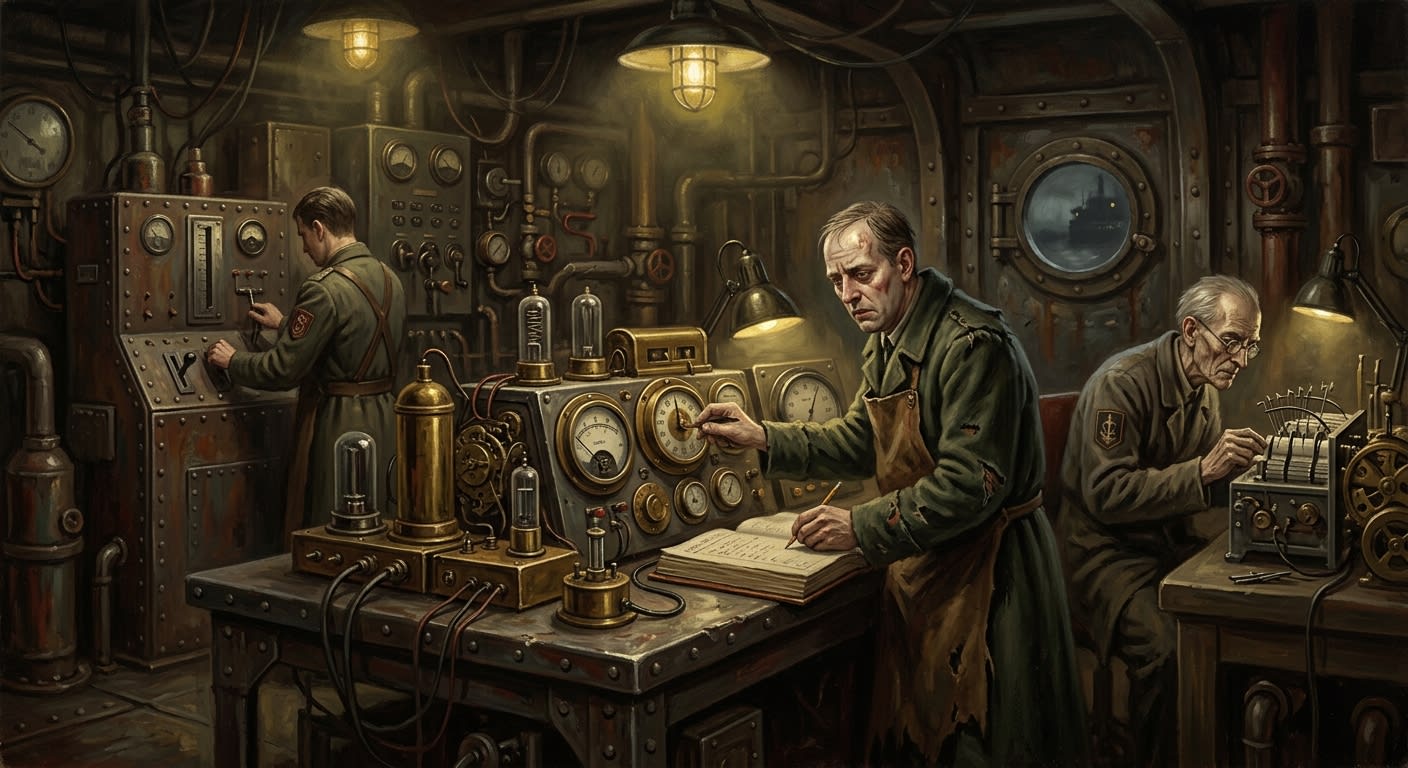
The blockhouse keeps a single main chamber for watch, signal, and emergency sleep, though sleep at Station Two has the moral status of contraband. The attached Instrument Vault is lower, warmer, and more crowded, with drag-gauges, resonance-bells, telegraph tickers, candle-burn registers, seismographs, breath counters, water clocks, spring clocks, and the little brass instruments that Hourglass adepts polish with the tenderness other professions reserve for children or pistols.
The Red Shed stands apart. Its door is painted in the colour of authorised ruin. Inside are Scour caches, emergency rations, spare telegraph coil, sealed orders, and enough sanctified accelerant to convert a failed post into a doctrinally tidy absence. No one discusses the orders. Discussion is how men discover whether they possess courage in advance, and advance courage is an unreliable commodity.
#On the Instruments and the Frogs
Station Two listens by refusing to trust any single witness. The master clock is compared to the bastion clock, the bastion clock to the telegraph beat, the telegraph beat to the candle array, the candle array to the drag-gauge, the drag-gauge to the resonance-bells, the bells to the water-clock, the water-clock to the spring chronometer, and all of them, unofficially, to the frogs.
The frogs are not in the public schedule. This is wise. Strasbourg will tolerate a great many indignities in war, but a formal memorandum citing amphibians would give the Bureau of Doctrine hives in places a gentleman does not name. Adept Meryth Vesk of Lyon has recorded their calls for years. Seven calls, pause, eleven calls, pause, seven again: this pattern precedes strong readings often enough to offend chance.
A drag-gauge measures the thickness of passing time through calibrated resistance. A filament descends. The rate tells the adept whether duration is behaving. This sentence has the comforting sound of science until one remembers that duration, at Shipka, behaves with all the discipline of a drunk novice before a reliquary cupboard.
#On the People Assigned to Unease
The soldiers rotate every three months. Longer service produces station-sickness: insomnia, auditory hallucinations, heartbeat counting, refusal to stand with one's back to the eastern window, and the habit of answering noises no one else hears. The Bureau of Medicine names this occupational exposure. The soldiers call it being tuned.
Sergeant Hallin Creed (Unregistered) has served three tours by request, which places him somewhere between devotion and damage. He is scarred, soft-spoken, and too accustomed to unease to mistake familiarity for safety. He trusts Vesk's instruments more than his eyes, which proves either corruption by science or a veteran's excellent instinct. At night he sometimes speaks to the fog. The fog has not answered in any language he admits.
Tick (Unregistered), the junior instrument-keeper, clicks his tongue in time with the chronometers until men want to throttle him or consult him. He no longer answers reliably to his birth name. His mimicry catches irregularities before dials do, which makes him useful in precisely the way a cracked bell may be useful if the crack deepens according to schedule.
#On the A.S. 194 Flatline
Station Two became more than a lonely relay in A.S. 194, when a Slumber-Hulk approached through the marsh fog: chain-bound, tower-sized, pale between links, moving at the pace of a century too tired to finish itself. The lookout raised the alarm at three miles. Shipka sounded the Wrath-Sloth Convergence code. Choirs mounted the wall. Saint Aegidius took consecrated shot. Captain Varik's Scour crews opened their sealed pitch.
For six hours the bastion prepared to murder itself clean.
At Station Two, Vesk's drag-gauge flatlined for eleven minutes. It did not slow. It did not tremble. It did not fail with the mercy of snapped brass. It refused its office. The conclusion entered her field journal with offensive clarity: time was not passing at the Hulk's centre.
A.S. 195 instructional plates taught that Shipka's guns and choirs drove the Slumber-Hulk back into the fog.
Corrected for tactical copies. Saturation fire and hymnal counter-rhythm altered the apparent trajectory of a stillness envelope. The Hulk turned parallel to the reed road. “Drove back” remains approved for schoolrooms, sermons, and officers who were standing too far west to deserve better verbs.
Hourglass readings showed four seconds of drag per minute at the wall face and near total temporal excision at the Hulk's centre. The bastion clocks and sun disagreed by four hours when the engagement ended. The Scour did not fall. The Hulk receded. Station Two survived and became, by that survival, intolerably important.
#On the Ninety Seconds
In A.S. 199 Vesk submitted the report that now sits in Strasbourg's queue with the serenity of a corpse awaiting burial. Every day, at the same hour, Station Two loses ninety seconds. The master clock does not pause. The telegraph record does not stutter. The candle registers show no flare, gutter, or wax anomaly. The sequence of measured duration contains a clean absence.
Vesk calls it the Skip. Hourglass calls it Temporal Disturbance, Localised, Non-Taxonomic, Pending Review. Soldiers call it Vesk's missing minute and a half, because soldiers, when not bullied by chaplains, are often the best theologians in the room.
The Skip does not match catalogued Syrionic deceleration. Syrion thickens time, softens motion, invites the will to sit. The Skip cuts. No lullaby phenomena accompany it. No standard drift curve fits. Resonance-bells sometimes sound fractionally brighter afterward, as though polished by a hand no one saw. Tick reports a counter-rhythm under the instruments before the absence, faint and irregular, like a second heartbeat. Vesk calls this auditory pareidolia in public and logs his pulse in private.
The hour of the Skip is removed from public copies. This removal protects the faithful from watches, dogs, private candles, speculative pamphlets, amateur measurements, and the pious idiocy by which civilians convert danger into an outing.
Sergeant Creed has found boot-prints after heavy fog: always leading off the outer causeway, never returning, never filling with water at the proper rate. Vesk has measured the stride length. It matches no posted personnel. This fact appears in no formal report. Prudence, like mold, grows well in marsh air.
#On What the Post Guards
Station Two guards warning, and warning is an ugly kind of mercy. The post cleans telegraph signals before damp and Sin-tainted air blur them beyond command. It records Sloth-surge, drift-fog, bell-lag, frog-silence, staff tremor, boot-print persistence, animal rhythm variance, causeway flex, and the little pauses in ordinary procedure by which a catastrophe begins applying for office.
The Bureau of the Hourglass classifies Shipka's marsh corridor as a persistent low-grade stillness field. Sub-threshold, they say. Sub-threshold means the anomaly has not yet earned capital letters. It also means men have lived beside it long enough to mistake procedure for safety. Reports move west to Strasbourg through Records channels, then stall beneath Doctrine review, where urgency is made decent by delay.
A lesser empire would call Station Two a lonely shed and leave it to rot. The Synod, being crueler and more intelligent, stuffs it with clocks, sends a brilliant woman to listen until she stops sleeping, rotates soldiers before they become instruments, stores fire in a red shed, and files the warnings in a queue. This is governance. This is comedy with casualties.
The causeway holds. The clocks accuse. The fog waits at the windows like a petitioner with excellent patience.