
#On the Classification, and Why "Giant" Is the Wrong Word
"The Bureau of War classifies them as 'tank.' The Bureau of Doctrine classifies them as 'abomination.' The soldiers who have seen one classify them as 'the reason I cannot sleep, and the reason I dare not.' All three designations are correct. The Bureau's is the least useful." — Margin annotation, Bastion-Shipka tactical codex, Revision 14
The Synod has never recovered a Slumber-Hulk. This should be stated early, because it shapes every sentence that follows. What we know of them is drawn from observation at distance, from after-action depositions taken at Bastion-Shipka and the forward stations of the Vales of Stagnance, from Hourglass temporal readings that disagree with each other in productive ways, and from the testimony of men who watched one approach and lived — men whose subsequent careers in the Bureau of Mercy's quiet wards speak their own verdict on the experience.
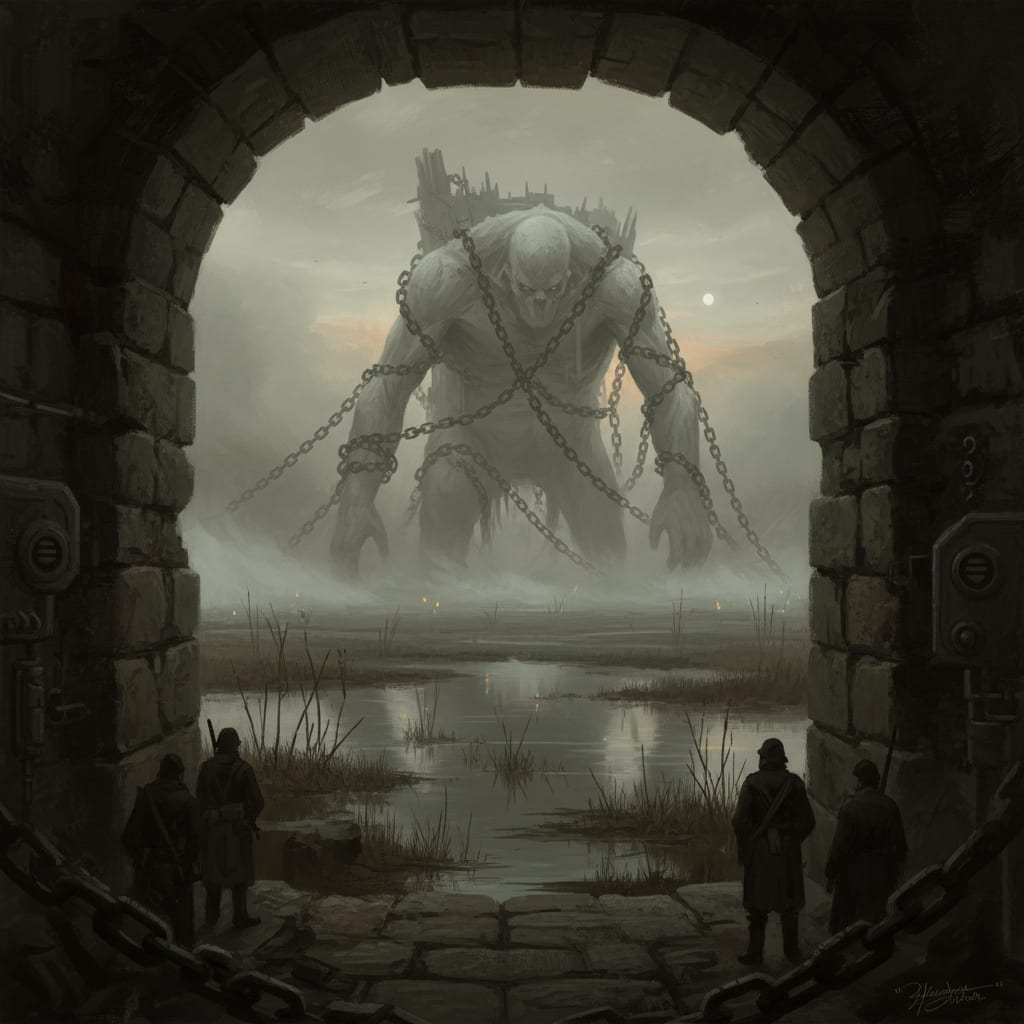
They are called giants. The word is insufficient. A giant implies proportion — a man scaled upward, limbs and trunk in familiar ratio, face recognisable as a face. The Slumber-Hulk bears proportion the way a landslide bears architecture: something that was once structured has been compressed, heaped, fused into a mass that moves with terrible slowness and answers to no geometry a draughtsman would accept.
The Bureau of War designates them as tank-class assets within Syrion's order of battle — a classification borrowed from siege terminology, meaning: slow, armoured, devastating against fixed positions, vulnerable to concentrated fire. The classification is accurate in the way that calling the sea "water" is accurate. It tells you nothing about drowning.
#On Their Appearance, and What the Fog Permits the Eye
They are seen always through fog. This is important. Syrion does not deploy his Hulks in clear weather, and the reason — whether tactical preference or ontological necessity — remains classified at the seventh seal. What the forward observers at Shipka reported during the A.S. 194 approach is this: a distant fog-bank on the marsh horizon resolved, under magnification, into a moving mass.
Chains. Iron or something older, looped and draped across a shape the size of a collapsed tower. Flashes of pale flesh between the links — not skin as such, but something that had once been skin and had since been worked upon by stillness until it became a surface without features, without blemish, without the small imperfections that mark a thing as alive. The chains moved. The flesh beneath them moved. The whole assemblage moved with a slowness that defied the word "speed" — glacial is the term the official records use, and for once the records do not exaggerate.
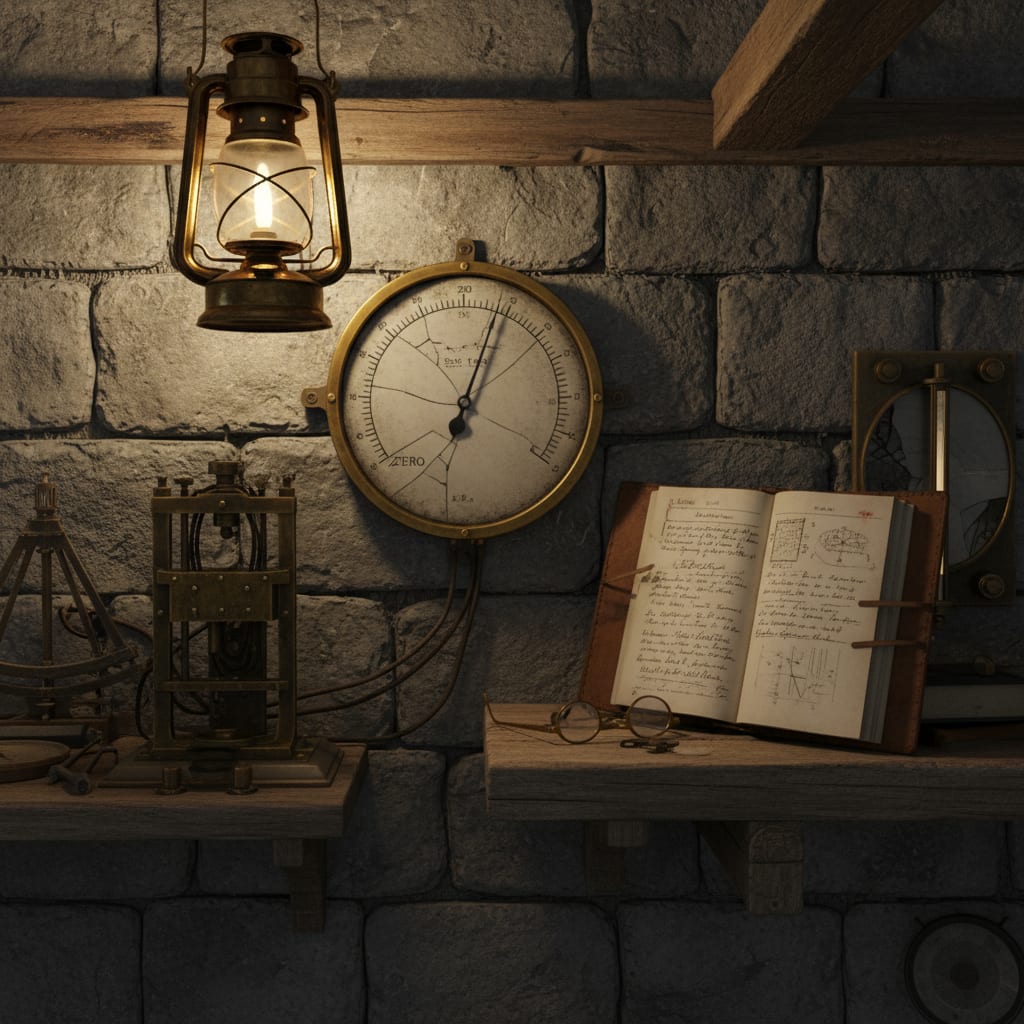
Each step took — the observers disagreed, which is itself informative — between thirty seconds and three minutes. The Hourglass instruments at Station Two recorded that time within a four-hundred-yard radius of the Hulk's position ran at approximately one-seventh normal speed, while time at the Hulk's centre registered no reading at all. The instrument simply stopped measuring, as if duration itself had been excised from the space the creature occupied.
#On Their Chains, and Who Bound Them
The chains are not incidental. Every observer confirms them: massive links of dark metal wound around the torso, the limbs, the — one hesitates to say head, but the uppermost protrusion — in configurations that suggest binding rather than decoration. The Bureau of Doctrine's official position is that the chains represent Syrion's mastery over his own creations: he binds his giants in sleep, releasing them partially for deployment, their glacial pace a consequence of chains that permit movement but deny urgency.
The Bureau of Inter-Infernal Analysis offers a less comfortable reading in its classified assessments. The chains, they note, pre-date the Slumber-Hulks' deployment in the field. They appear in no other element of Syrion's army. They bear no resemblance to demonic manufacture as documented by the Bureau of Relics. The possibility — entered into the sealed register and shared with no bureau that has not specifically requested it — is that the Hulks are older than Syrion. That they were already bound when he found them. That the chains are someone else's instrument of containment, and Syrion has woken prisoners.
An earlier Bureau of Doctrine advisory classified Slumber-Hulk chains as "ritual ornamentation consistent with demonic heraldry, comparable to Atheron's banner-wraps or Kargath's gut-chains."
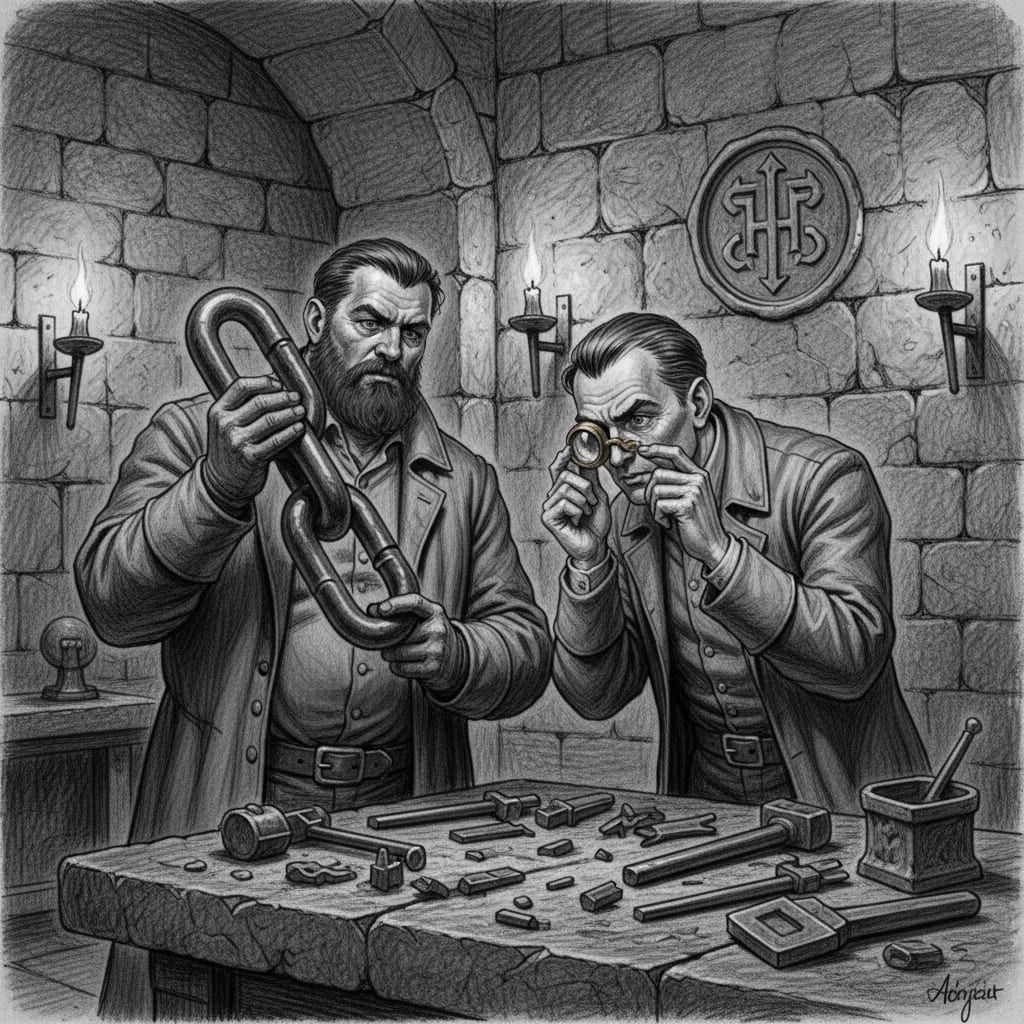
The Bureau has withdrawn this classification after metallurgical analysis of chain-fragments recovered from the A.S. 194 engagement zone. The fragments do not match any known demonic alloy. They do not match any known human alloy. The Bureau of Engineering's assessment: "consistent with no recorded manufacture." The Bureau of Doctrine's revised classification: "Origin: pending. Priority: maximum. Discussion: restricted."
#On Their Weapon, Beyond Their Fists
The catechism teaches that Slumber-Hulks destroy with their blows — that each swing falls with the weight of centuries, shattering fortifications and crushing battalions. This is true in the sense that a drowning man is killed by water. The water is the medium. The killing is done by the absence of breath.
A Slumber-Hulk does not need to strike. It needs only to approach.
Soldiers within its radius of influence — the Bureau of Medicine calls this the stillness envelope, the troops call it "the heavy" — report a progressive failure of will. Arms grow leaden. Legs refuse to lift. The rifle in a man's hands becomes impossibly heavy, as if it has gained the weight of every hour he has ever spent holding it. Orders arrive at the ear and die before reaching the muscles. The mind understands the command — fire, retreat, move — and the body responds with a languor indistinguishable from refusal. Men sink to their knees with weapons across their laps. They do not sleep. Their eyes remain open. They simply stop.
The blows, when they fall, are aftermath. A Hulk that reaches a fortification does not assault it. It leans against it, and the wall — its defenders already slumped at their posts — crumbles under a pressure that is less physical force than accumulated duration. The stone does not shatter. It ages. Mortar dries and powders. Iron rusts in moments. The wall does not fall so much as it gives up, surrendering to entropy that should have taken centuries and has been compressed into the span of a breath.
#On the Engagement at Bastion-Shipka, A.S. 194
One has come close enough to matter. The record is preserved in the Shipka tactical codex, in the Hourglass field journals, and in the disciplinary annexes where the garrison's less formal commentary has been filed for posterity.
The date is disputed — the Hourglass instruments give three different readings for the duration of the approach, and the sun's position at the engagement's end disagreed with the clocks by four hours — but the consensus places it in the wet season of A.S. 194, when Syrion's fog bank had pushed a mile and a half closer to the reed road than any prior survey recorded.
The forward lookout at Station Two raised the alarm: a distant shape in the fog, confirmed through magnification as a Slumber-Hulk at approximately three miles' distance. Moving. Approaching.
Alarm bells sounded the Wrath-Sloth Convergence code — the highest alert short of full Scour authorisation. Choirs mounted the wall. Scour crews unsealed their pitch. Captain Varik's fire company donned masks and ascended to pre-soaked ramparts. The bastion's gun Saint Aegidius was loaded with consecrated shot. Every man and woman on the wall understood the arithmetic: if the Hulk entered Scour radius, the Scour would fall on their own streets.
For six hours the bastion stood on the knife-edge.
The engagement was not a battle in any conventional sense. The Hulk did not charge. It did not accelerate. It continued its glacial approach while the bastion threw everything it possessed into the space between them. Saturation fire — every gun on the eastern wall, shells bursting in the fog, shrapnel singing off chains that should not have endured it. Hymned counter-rhythms from the Choir platforms — brisk ascending compositions designed to jar the air itself back into proper temporal flow, to push back the stillness envelope by sheer acoustic will.
And it worked. Slowly — agonisingly, over hours — the Hulk's trajectory shifted. Its steps turned fractionally, degree by degree, pushed sideways by the accumulated pressure of fire and song until it moved parallel to the reed road rather than across it. It trudged back into deeper mists without entering formal Scour radius.
The ladder-crew graffiti, preserved in a disciplinary annex because the Bureau of Records catalogues everything including insubordination: Better to sweat six hours than burn six streets.
#On Their Number, and What the Bureau Does Not Say
How many Slumber-Hulks does Syrion possess? The Bureau of War's published figure is: "confirmed sightings: four." This refers to four separate occasions on which a Hulk has been observed at sufficient magnification to be positively identified. Whether these represent four individuals or one individual sighted four times in different locations, the Bureau does not specify.
██████████████████████████████████████████████████████████████████████████████████████████████████████████████████████████████████████████████████████████████████████████████████████████████████████████████
The Hourglass readings from Station Two suggest, based on temporal displacement signatures, that at least two distinct profiles have been measured — one producing a symmetrical stillness field, the other an asymmetric one that drags harder on its left flank. Adept Vesk's notation: "either two entities or one entity that has changed shape between observations, which is a sentence I do not enjoy writing."
An earlier tactical assessment estimated Syrion's Slumber-Hulk complement at "one to three, deployable assets."
This estimate has been withdrawn. The revised assessment reads: "Unknown. Insufficient data for meaningful projection. All prior estimates assumed that observed Hulks represent total inventory. This assumption is unsupported. The fog conceals. That is its function."
#On the Theological Question, and Why Doctrine Sweats
The Bureau of Doctrine has a problem with the Slumber-Hulks, and the problem is this: they are too old.
Every other element of Syrion's army — the Mist-Walkers, the Drowse-Singers, the Stasis Archers (Unregistered), the corrupted mortals of his cult — can be fitted into the Bureau's model of demonic manufacture. Syrion, like all Sin-Generals, creates his forces from corrupted matter and stolen will. His troops are made things, assembled from the wreckage of the world the Sundering broke open.
The Slumber-Hulks do not fit. Their chains pre-date the field. Their temporal signatures exceed anything the Hourglass Monolith produces. Their flesh — what little has been observed — does not decay, does not regenerate, does not behave like demonic matter. It simply persists, unchanging, as if the concept of change does not apply to it.
The Bureau of Doctrine's uncomfortable question, filed in the sealed registry and accessible only to holders of the seventh seal: Did Syrion make these things, or did he find them?
And if he found them: Who made them? When? And why were they chained?
The Bureau has not answered these questions. The Bureau has, with its customary precision, reclassified them as "Theological Matters Pending Resolution: Priority Maximum: Discussion Restricted." This is the Bureau's way of acknowledging that it does not know, which is the Bureau's way of admitting that it is afraid, which is the Bureau's way of saying nothing at all while meaning everything.
The Slumber-Hulks walk. The chains drag through marsh and fog. The fog conceals what it pleases. And somewhere in the grey, bound in iron that no one forged and dreaming in a language older than sin, the giants wait. They have waited before. They are patient.
Syrion, for his part, does not explain. He never explains. He uses what is available, as a man uses furniture he did not build and does not understand — sitting in the chair without asking who carved it, or why it was left empty, or what sat in it before.
The citizen is advised to pray. The citizen is advised that prayer is heard. The citizen is advised that the Bureau maintains full confidence in the Line's capacity to repel all threats, temporal or otherwise. The citizen is advised to disregard this entry. The citizen is advised to report anyone who shares it.
The Bureau has spoken. The matter is sealed.