
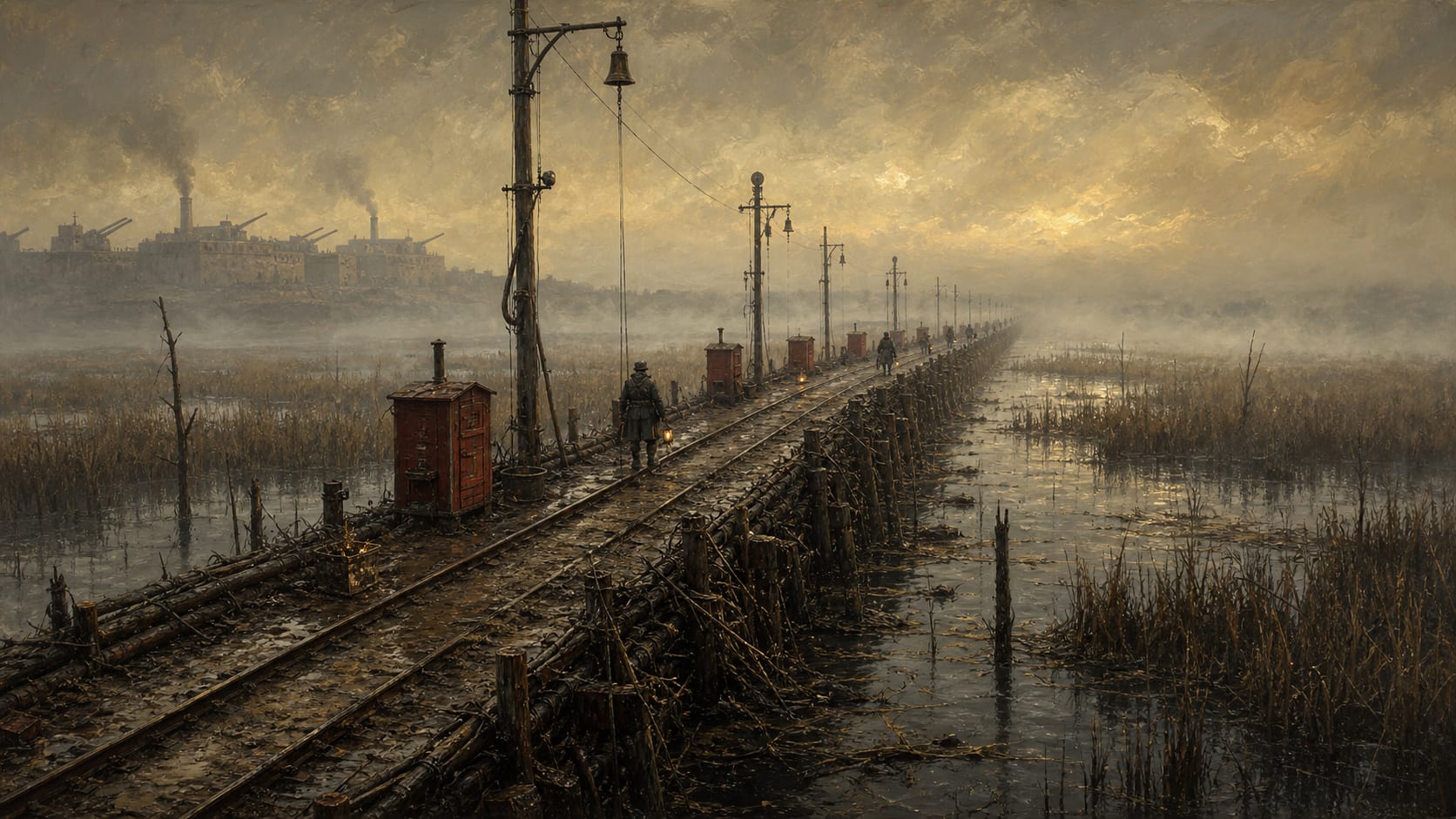
#On the Raised Line Through Sleep
The Reed Road is the thin raised oath by which Bastion-Shipka refuses to drown. It begins under the western guns, runs east across the Phocis Marsh, carries the marsh spur of the Sagittal rail, and proceeds toward fog with the confidence of a clerk delivering a writ to a swamp. Every rational map would mark it as a causeway. Every honest boot marks it as a dare.
Across it pass powder, coal, bread, timber, bandage-bolts, replacement troops, broken men returning west, and those sealed boxes whose labels have been written by War and corrected by Doctrine until their contents become a matter of faith rather than cargo. Without the road, Shipka becomes a wet fort with heroic opinions. With it, Shipka feeds the southern approach to Bastion-Constantinople and keeps the last mountain throat open against Syrion.
It is narrow, crowned, faced with fascined brush and rough cribbing, its sides sloped into black water where reeds stand like witnesses bribed to say nothing. In all that hissing country it is the only straight thing. This alone should make the reader suspicious. Straightness in a marsh is either engineering or heresy. At Shipka, mercifully, it is both with better paperwork.
#On Its Raising and the Men Who Signed Wet Paper
The Reed Road was raised during the early consolidation of the Sagittal Line, after A.S. 65, when the Synod discovered that bastions require more than stone, courage, and hymns composed by men who have never unloaded coal. Shipka needed a rail spur. The marsh answered by swallowing the first survey stakes, then the second, then a junior engineer whose name appears in three ledgers with three different spellings and one very final silence.
The Bureau of Engineering raised the embankment three times. The first lift slumped by Lent. The second took a locomotive halfway to Station One and then allowed the rear wagon to vanish down to its roofline, which the local chaplain described as a lesson in humility and the crew described as bloody predictable. The third lift held because the engineers stopped trusting the surface, drove piles into the drowned peat, packed spoil over brush and stone, and tested each section with deliberate floods until the marsh had exhausted its easier lies.
Tithes paid for the work by assessing emergency road levies on districts that had never seen a reed. Records regularised the accidents. War praised the schedule. Engineering kept private lists of sections likely to misbehave. The old crews named them with the intimacy of enemies: Sinking Saint, Nun's Elbow, the Soft Psalm, Black Spanner, Widow's Dip.
Early completion notices described the Reed Road as “stable ground secured by Synodal industry.”
Corrected in field copies. The road is maintained stability, not achieved stability. Any sentence implying finality in a marsh is either poetry or fraud. The responsible notary has been reassigned to culvert inspection, where nouns acquire consequences.
#On the Road as Instrument
The Reed Road carries trains, but that is only its vulgar duty. Its subtler office belongs to the Bureau of the Hourglass. A locomotive sent from the yard to Station Two should take a known number of minutes. A patrol between ladder markers should return before the horn code expires. A bell struck at the bastion should reach the outer platforms with a measurable delay. When these measures disagree, the road has spoken.
Hourglass adepts time the passage of standard locomotives between fixed posts and compare the result against bastion clocks, telegraph beats, candle registers, drag-gauges, and, in the less publishable margins of Adept Meryth Vesk's papers, frogs. Fog lag appears first on the road. Sound drops short. Telegraph clicks smear. Boots fall into half-cadence. A patrol comes back with eleven men and twelve shadows, or with all men present and no appetite for explaining why the trip felt shorter than a prayer and longer than a childhood.
The Reed Road is a ruler laid across treachery. The marsh cannot resist tugging at it. Syrion cannot resist breathing over it. The Synod, being the Synod, cannot resist stamping the resulting danger into a form and requiring three copies.
#On Those Who Walk It
The line gangs are the road's true clergy. They go out in oilskins and patched coats, carrying hammers, gauges, lanterns, spike keys, rope, chalk, bell slivers, stimulant tins, and the sour humour of people who know exactly how little glory weighs when placed beside a cracked fishplate. They count sleepers. They tap rails. They clear culverts, splice wire, replace warped planks, and mark soft places before a supply engine finds them by falling through.
Yessika Tren, called Yesse by those permitted to keep all their teeth, leads one of the best-known gangs. She has walked the entire spur in both directions, in rain, fog, black heat, and the particular grey morning after a sleep-plague scare when every man's eyelids looked like a hostile frontier. She knows which ladder-platforms have thin spots, which sections sing when Syrion's mists approach, and which officers should be saluted briskly so they go away sooner.
The road's unwritten law is plain: do it correctly, not bravely. A brave man may sprint across a bad culvert. A correct man closes the road, reports the fault, endures the officer's anger, saves the next train, and drinks later with the moral superiority of a saint who smells strongly of axle grease.
Lying in a maintenance ledger is treated along the road as a species of treason. The engineer who softens a stress reading to please command has joined the Great Deceiver in miniature. The marsh does not forgive optimism. The rail certainly does not.
#On Fog, Bells, and the Road's Bad Manners
The road's ordinary perils would satisfy a modest theology: bog-sinks, flood, gas pockets, sudden reed-fire, swollen ballast, sleepers twisting in wet heat, culverts plugged by roots, eels, corpses, and debris too chewed to classify. Shipka is not granted modesty. Syrion's seepage adds quiet refinements.
Watchmen on the road hear chimes that belong to no authorised bell. Half hymn, half child's toy, they arrive through mist and leave the eyelids heavy. Telegraph sounders tap phrases no operator keyed. Horn codes reach platforms in the wrong order. Treble notes return late. Bass sinks into mud. Orders seem to fall from the mouth and lie down at the speaker's boots.
The Bureau of Bells responds with staggered horns, wake-peals, ladder chimes, and signal masts. Hourglass responds with beat-counters. War responds with patrols. The marsh responds by finding the interval between them.
A patrol report from Ladder-Platform Seven records that Corporal Ivenn Rusk gave the order to fire during Drift-S 9, heard himself give it, understood the need, saw the men waiting, and “could not be bothered to finish wanting it.” The corporal was recovered alive. His next three sentences are sealed under Mercy custody.
The road teaches a doctrine the catechisms avoid: will can be delayed before it is broken. A man does not need to betray the Synod if he can be made to postpone obedience long enough for the Enemy to cross the interval.
#On Fire Laid Under the Road
Beneath the Reed Road and along its culverts lie sanctified purgation channels: sealed drums, waxed fuses, resin wadding, ignition pockets, marked joints, and red-ink maps held in three separate offices so that no single panic can burn everything by clerical accident. The arrangement is called contingency. The rail quarter calls it sleeping on kindling.
During the Reed-Road Sleepfire, marsh flame and sleep contagion flowered together in the outer stilts. Houses burned while their occupants stood swaying in their clothes, too lulled to flee. Scour crews demanded the quadrant. Engineer-captains opened pumps and sluices, flooded sections of the road, cut telegraph access, and broke the fire with water and demolition. The outer plankways died. The main quarter lived. Captain Varik's company remembered the lesson and has drilled above the caches ever since.
Purity's internal commentary described the flooding as “borderline softness toward contaminated laity.”
Filed clarification. The road survived. The infection did not establish permanent hold. The laity who remained useful were, by that usefulness, retrospectively less contaminated than first alleged.
No resident forgets the red maps. Children learn which culverts are never to be played in. Railmen know which inspection hatches smell faintly of pitch even after rain. Fire, at Shipka, punishes by serving the timetable. It is infrastructure.
#On the Hulk That Turned Beside It
In A.S. 194 a Slumber-Hulk came through the fog toward Shipka. The forward alarm rose from Station Two. The creature was confirmed at three miles: chains, pale mass, movement too slow for comfort and too certain for dismissal. Its stillness envelope pressed ahead of it, and Hourglass instruments registered time at one-seventh normal speed around the body while the centre gave no reading at all.
The Reed Road became the line of arithmetic. If the Hulk crossed it, the Scour would fall. If it entered formal radius, Shipka would burn its own rail quarter rather than permit Syrion to use it. Saint Aegidius fired consecrated shot from the walls. Choir platforms hurled counter-rhythms over the marsh. Station Two's drag-gauge flatlined for eleven minutes. The road waited under shell smoke, wet reeds, and the heavy patience of a thing that may have been older than the Sundering.
For six hours, every soul on the road and wall learned the exact weight of continuing.
The Hulk turned parallel to the Reed Road and trudged back into the deeper mist. Doctrine says righteous fire and hymn drove it away. Vesk's measurements say the saturation fire altered the apparent relation between local duration and the creature's stillness envelope. The ladder crews wrote the cleanest version on a wall later filed as disciplinary evidence: Better to sweat six hours than burn six streets.
#On the Present Use and the Exhaustion It Requires
As of A.S. 201, the Reed Road remains open. This sentence deserves the kind of reverence usually wasted on coronations. It means rails run, pumps breathe, horns sound, caches remain sealed, culverts drain, engineers curse, adepts count, soldiers chew stimulants, and the fog has not yet won the argument.
Westward seepage from the Vales has thickened in the sector. A.S. 196 brought Somnolent Communion Cells in the stilt-hamlets. A.S. 199 brought stronger fog-margin drift and the unresolved Skip at Station Two. Rest Societies have appeared among clerks, nurses, and rail hands who began by sharing shifts and ended by preaching that the Wall's demand for wakefulness is itself a sin. The road, being practical, answers such doctrine with a cracked sleeper and a simple requirement: fix it or drown.
Reports move from Shipka to Strasbourg. Strasbourg receives them. Strasbourg files them. Strasbourg occasionally replies with a revised phrase. Meanwhile the line gangs walk the road before dawn, testing each joint by hand because a phrase from the capital cannot hold ballast.
The Reed Road has no beauty except the severe beauty of things that work while being hated by earth, fog, demon, auditor, and timetable. It is a bar of mud-stained insistence laid across sleep. It is Shipka's throat, measuring rod, fuse line, supply artery, and daily insult to a marsh that would prefer all straight things softened into water.
The road holds. Count that as a miracle if one must. The engineers will count it as maintenance and be more nearly correct.