

Adept Meryth Vesk — Prose Draft
#On the Woman Who Counts the Missing Seconds
Adept Meryth Vesk of Lyon is thin, pale, ink-stained, brilliant, and possessed of the particular social grace common to those who have spent too many years listening to instruments disagree with the Creator. She serves as Senior Hourglass observer at Station Two, Bastion-Shipka, two kilometres east of the main walls, on a reinforced causeway thrust into the Phocis Marsh like a ruler inserted into a wound. Her office contains drag-gauges, resonance-bells, telegraph tickers, candle-burn registers, seismographs, breath counters, and one cracked porcelain cup whose tea rings form concentric circles she has, I regret to report, also measured.
This is not eccentricity. Eccentricity is a harmless defect in the minor clergy, usually cured by promotion or gout. Vesk's condition is worse. She observes.
The Bureau of the Hourglass sent her to Shipka under the phrase "quiet assignment," which in Bureau dialect means one of three things: the appointee is exhausted, inconvenient, or right in a manner that embarrasses a superior. In Vesk's case all three are probable, though only two are recorded and the third has been redacted by good taste, an agency rarer than the Bureau of Shadows and half as accountable.
Her present fame rests upon a defect in time. Every day, at the same hour, Station Two loses ninety seconds. The loss is measurable across independent instruments. The master clock does not pause. The telegraph record does not stutter. The candle registers do not flare or gutter. Instead, the sequence of recorded duration contains a clean absence, a cut so neat it resembles a clerk's knife passed through vellum by a hand trained to remove precisely what must vanish and leave the page otherwise legible. Vesk calls it the Skip. The Hourglass registry calls it Temporal Disturbance, Localised, Non-Taxonomic, Pending Review. The soldiers call it "Vesk's missing minute and a half," because soldiers possess a gift for theology when they are not being educated out of it.
She has submitted seven reports. The first was acknowledged. The second was appended to the first. The third was returned for revised terminology. The fourth was misfiled under bell-metal reclassification. The fifth was received by a clerk whose office subsequently underwent Administrative Reshelving and whose desk, according to Bureau of Records notation, "ceased to be assigned to any corridor." The sixth was forwarded to Doctrine. The seventh she delivered in person to a courier and watched him leave the station at the correct hour. He reached the main bastion three hours late and insisted he had stopped for no one.
Vesk did not complain. She began measuring couriers.
#On Lyon, and the Education of an Impertinent Mind
Vesk was trained at the Lyon Academy of Horological Sciences, that tolerated nest of brass, graphite, calculation, and insufficient genuflection from which the Hourglass draws its most useful nuisances. The Academy teaches bell-resonance analysis, oscillatory mathematics, telegraph synchronisation, and the finer discipline of writing observations in language bland enough that a theologian may read them without reaching immediately for flame. Few graduates master the last art. Vesk mastered it too well.

Her early papers concerned drift in paired pendulum systems exposed to distant bell-strikes. I have seen the abstracts. They are dry enough to desiccate fish, and buried within them are three conclusions that should have earned a young adept promotion, supervision, or prompt burial in a paperwork pit. First: clocks near the Sagittal Line do not fail randomly. Second: bell-synchronisation errors cluster around human fatigue patterns as much as around fog density. Third: the instruments appear to respond not merely to Syrion's field, but to the attention paid to it.
A lesser mind would have softened the conclusion. Vesk sharpened it. She proposed that temporal anomaly at the Sloth front has two components: external pressure from Syrion's domain, and local amplification through exhaustion, ritual repetition, and communal surrender. This proposal now appears in three sealed Hourglass memoranda under language so bloodless it could pass through a censor's screen asleep: field-response may demonstrate observer-adjacent modulation under fatigue-correlated conditions.
Translated into honest speech: tired people help the fog.
The Bureau of Doctrine dislikes translations. They reduce the useful distance between knowing and acting.
Vesk's transfer to Shipka followed within the year. The letter commended her "unusual aptitude for forward measurement under morally complex atmospheric conditions" and assigned her to Station Two, where the marsh reaches for the causeway, frogs call in irregular meters, and every object with a hand, pendulum, drip, flame, or pulse must be persuaded hourly to admit that sequence still exists.
Earlier personnel summaries described Vesk's posting to Station Two as a promotion awarded for exceptional analytical service.
The Bureau of the Hourglass has clarified that her posting was a lateral advancement with field-responsibility expansion, hardship supplement, restricted correspondence privilege, and no increase in rank. The distinction is too exquisite to be accidental. Promotion gives a woman authority. A lateral advancement gives her a colder room and more dangerous data.
#On Station Two, Where Time Is Kept Like a Prisoner
Station Two is a squat stone blockhouse with instrument-sheds clustered around it like penitents around a reliquary. Telegraph masts lean over the marsh. Resonance-bells hang in small roofed frames, each tuned to a slightly different interval, each struck according to a schedule Vesk revises whenever the fog learns the old one. The Instrument Vault smells of oil, ozone, damp wool, old parchment, and the particular human fear produced by a room full of clocks that do not agree.
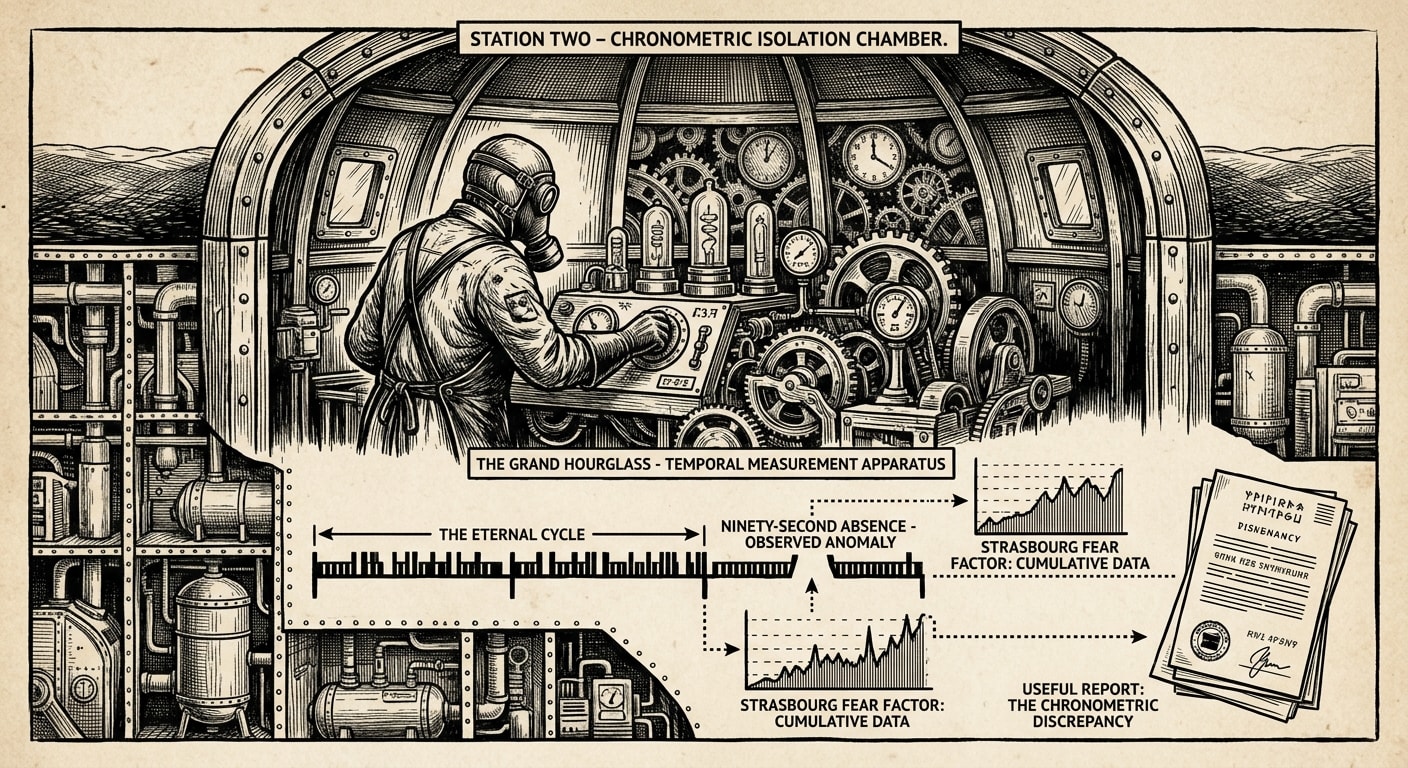
The soldiers rotate every three months. Longer tours produce station-sickness: insomnia, auditory hallucinations, compulsive heartbeat-counting, and a habit of answering noises that no one else hears. Sergeant Hallin Creed has served three tours by request, which makes him either brave, damaged, or already absorbed into the station's logic. The junior instrument-keeper called Tick no longer answers reliably to his birth name and clicks his tongue in rhythm with the chronometers. Vesk keeps both men close. They are, by her standards, calibrated.
Her daily routine begins before the first pump-bell. She compares the station master clock against the bastion clock, then against Lyon's last transmitted standard, then against the candle array, the water-clock, the spring chronometer, Creed's pulse, Tick's involuntary clicking, the east resonance-bell, the west resonance-bell, and the frogs. This last item is unofficial. It is also, according to Vesk's private tables, among the most reliable.
The frogs of the Phocis Marsh call in patterns that change when the fog thickens. Ordinary naturalists attribute this to moisture, pressure, breeding cycles, or the limitless professional cowardice of men who prefer animals to omens. Vesk has recorded frog-call intervals for four years. On days preceding the Skip's strongest readings, the frogs fall into a doubled rhythm: seven calls, pause, eleven calls, pause, seven calls again. The pattern appears nowhere in approved Hourglass taxonomy. She has not included the frogs in her formal reports. This is wise. No Bureau reads a report more quickly because frogs have been added.
The Skip occurs at the same hour. Vesk has not published the hour. This omission has angered Commandant Gaius Tarvor, who mistrusts any schedule not posted in triplicate. Tarvor suspects her of unauthorised temporal experiments in the Bell Gallery and along the reed road. He cannot prove it, because every instrument she moves is requisitioned properly, every field excursion has a stated calibration purpose, every sealed wax tag bears the correct countermark. Her documentation is immaculate.
Immaculate documentation is not innocence. It is armour.
#On the A.S. 194 Approach, and the Gauge That Refused Its Office
Before Vesk became the woman of the ninety seconds, she was the woman of the flat-line gauge.
In A.S. 194, a Slumber-Hulk approached Bastion-Shipka through the marsh fog, chains dragging through water, pale flesh glimmering between links, a moving mass the size of a collapsed tower. Station Two raised the alarm. The bastion sounded the Wrath-Sloth Convergence code. Choirs mounted the wall. Scour crews unsealed pitch. Saint Aegidius swallowed consecrated shot. The entire marsh sector prepared to burn itself rather than permit the thing to cross formal Scour radius.
At Station Two, Vesk's drag-gauge flatlined for eleven minutes.
A drag-gauge measures the passage of time through calibrated resistance: a hair-thin brass filament, weighted, released, observed. If time passes, the filament descends. If local duration slows, descent slows. If duration accelerates, descent accelerates. During the Hulk's approach, the filament did nothing. It did not descend. It did not tremble. It did not even fail with the comforting violence of a broken instrument. It simply refused to participate in sequence.
Vesk wrote: time is not passing.
Her later notation, preserved in the Shipka tactical codex, is the sentence by which many officers first learned to fear her: "The subject is not slow. The subject is still. It appears to move because we are watching from outside its stillness, and our time slides past it like water past a stone. It is not walking toward us. We are flowing toward it."
The Bureau of War disliked this conclusion because it made the engagement sound less like a battle and more like an accident in ontology. The Bureau of Doctrine disliked it because "flowing toward" an abomination grants the abomination a species of passive centrality. The Bureau of Engineering disliked it because it implied that no amount of reinforcement could prevent a wall from arriving at the Hulk rather than the reverse. Vesk filed the sentence anyway. It has since been cited in three restricted tactical revisions and omitted from every public catechism.
A.S. 195 instructional plates stated that Shipka's guns and choirs "drove the Slumber-Hulk back into the fog."
The revised tactical reading, drawn in part from Vesk's measurements, is less flattering and more useful: saturation fire and hymnal counter-rhythm altered the Hulk's relation to local duration sufficiently that its apparent trajectory shifted parallel to the reed road. The phrase "drove back" remains approved for sermons, schoolroom plates, and speeches delivered by officers who were not there.
The Scour did not fall. The Hulk turned. The station survived. Vesk, having watched time refuse to pass inside the thing, requested two additional gauges, a stronger telegraph line, and permission to establish a secondary counting post thirty paces farther east. The first two requests were denied for budgetary reasons. The third was denied because the reviewing officer read it carefully.
#On the Somnolent Circles, and the Sin of Being Tired Enough
Vesk's most offensive conclusion does not concern monsters. It concerns people.
At the stilt-hamlets around Shipka, the Somnolent Communion Cells form at the marsh edge: seven to twenty villagers, hands linked, facing a dulled lantern, murmuring ordinary kindness until their breathing shallows and their eyes fix. At dawn they are found standing waist-deep in black water, smiling. Purity calls this Sloth-Heresy, Passive Variant. The designation is adequate for arrest warrants and useless for understanding.
Vesk measured the cells. Her drag readings showed sub-Wound temporal thickening consistent with Syrionic influence, then deviated from Syrion's known signatures in a manner she described as similar but not identical. In her formal note she wrote: as though the cells are producing their own stillness rather than channelling his. Doctrine requested retraction. She did not retract.
Off the record, in the lee of Station Two while the gauges clicked and the marsh made its damp conspiratorial noises, she said something worse: exhaustion beyond a certain threshold becomes indistinguishable from prayer; prayer in the vicinity of Syrion's field becomes indistinguishable from worship; worship becomes indistinguishable from surrender. Asked which step troubled her most, she answered: the first one, because we caused it.
There are sentences an institution cannot forgive because they are false. There are sentences an institution cannot forgive because they are true in the wrong jurisdiction.
Commandant Tarvor has little patience for Vesk's moral mathematics. He needs the line held, the trains moving, the stilt-hamlets quiet, and the reports short enough to be read by men who dislike reading. Yet even Tarvor, weighing-scale soul that he is, has learned that ignoring Vesk costs more than hearing her. Her instruments identified three near-breaches that would otherwise have passed as humidity, marsh illness, or the spiritual softness of peasants. The rail quarter, after initial suspicion, respects her in the grudging manner of practical people: she comes onto the causeway when the fog is thick, and she does not lie in her logs.
That last fact counts for more at Shipka than rank.
#On the Ninety Seconds, and What May Be Waking Beneath Them
The Skip is not Syrion. That is Vesk's position, and the position has made her enemies among those who prefer every unknown thing to arrive with an existing label. Syrion decelerates. Syrion thickens. Syrion lulls, drags, softens, pauses, invites. The Skip cuts.
For ninety seconds, once per day, the local sequence at Station Two contains absence rather than delay. No fog surge accompanies it. No lullaby phenomena. No standard Class I deceleration curve. No Class III persistence signature. The resonance-bells sometimes sound fractionally brighter after the event, as though polished. Tick reports a counter-rhythm under the instruments before the Skip, faint and irregular, like a second heartbeat. Vesk calls this auditory pareidolia in public and logs Tick's pulse in private.
Sergeant Creed has begun finding boot-prints on the outer causeway after nights of heavy fog: always leading toward the marsh, never returning. Vesk has measured the stride length. The prints do not match any Station Two personnel. They also do not fill with water as quickly as they should. This detail appears in no formal report, which demonstrates that even genius can acquire prudence when surrounded by mud and superiors.
The hour of the Skip has been removed from this public entry by order of the Bureau of Doctrine. The removal is not intended to conceal danger from the faithful. It is intended to prevent the faithful from gathering at the relevant hour with watches, bells, candles, dogs, children, speculative pamphlets, or that particular species of educated idiocy which believes an anomaly becomes less lethal when observed recreationally.
Vesk's private hypothesis — inferred from her instrument placements, not from confession, because she has the courtesy never to confess in rooms where I am forced to pretend I am not listening — is that the Skip originates beneath the marsh, below the old Phocian strata, below the drowned shrine, below even the earliest ossuary-settlement levels. Something there either removes ninety seconds from Station Two or receives ninety seconds delivered from elsewhere. The distinction matters. Extraction implies appetite. Delivery implies correspondence.
Neither comforts.
She has requested field assistance for an excursion into the marsh at the relevant hour: instrument bearers, one Bellwarden, one engineer, two soldiers, and authority to place a resonance stake in a patch of ground the marsh-folk avoid by instinct and the maps identify as unremarkable. The request has not been granted. It has not been denied. It sits with her principal report in Strasbourg's blessed queue, that sacred processional of inaction by which the Synod converts urgent danger into archival dignity.
The queue does not move.
#On the Present Status of an Unread Warning
Adept Meryth Vesk remains at Station Two as of A.S. 201. She is early forties, underweight, sleep-starved, exact in dress, negligent in meals, severe with instruments, unexpectedly gentle with broken soldiers, and capable of insulting a senior chaplain by correcting his clock during absolution. She does not smile often. When she does, men become cautious, because it usually means a pattern has resolved and the pattern is unwelcome.
Her enemies call her obsessive. This is accurate and irrelevant. A sane person does not spend four years in a marsh counting seconds that vanish. A sane person does not hear frogs alter their meter and build a table. A sane person does not look at a Slumber-Hulk and conclude that the battlefield is moving toward the monster. The Synod does not require sanity at Station Two. It requires someone who can remain useful after sanity has made its excuses and gone west.
The Bureau has not responded to her report. This is often mistaken for neglect. It is worse. Neglect is passive. Bureaucratic non-response is an act with seven seals and a chair allocated for it. To leave a report unread is to preserve the universe in which the report's contents have not yet demanded action. A comfortable universe. A false one. Naturally, the Synod has furnished it beautifully.
Vesk continues to measure. She measures because measurement is the oath her Bureau permits her to take. She measures because she has seen what unmeasured minutes can do. She measures because the missing ninety seconds return each day with the patience of a creditor, and somewhere under the marsh, or inside the fog, or in the narrow administrative gap between fear and acknowledgement, something keeps perfect time.