
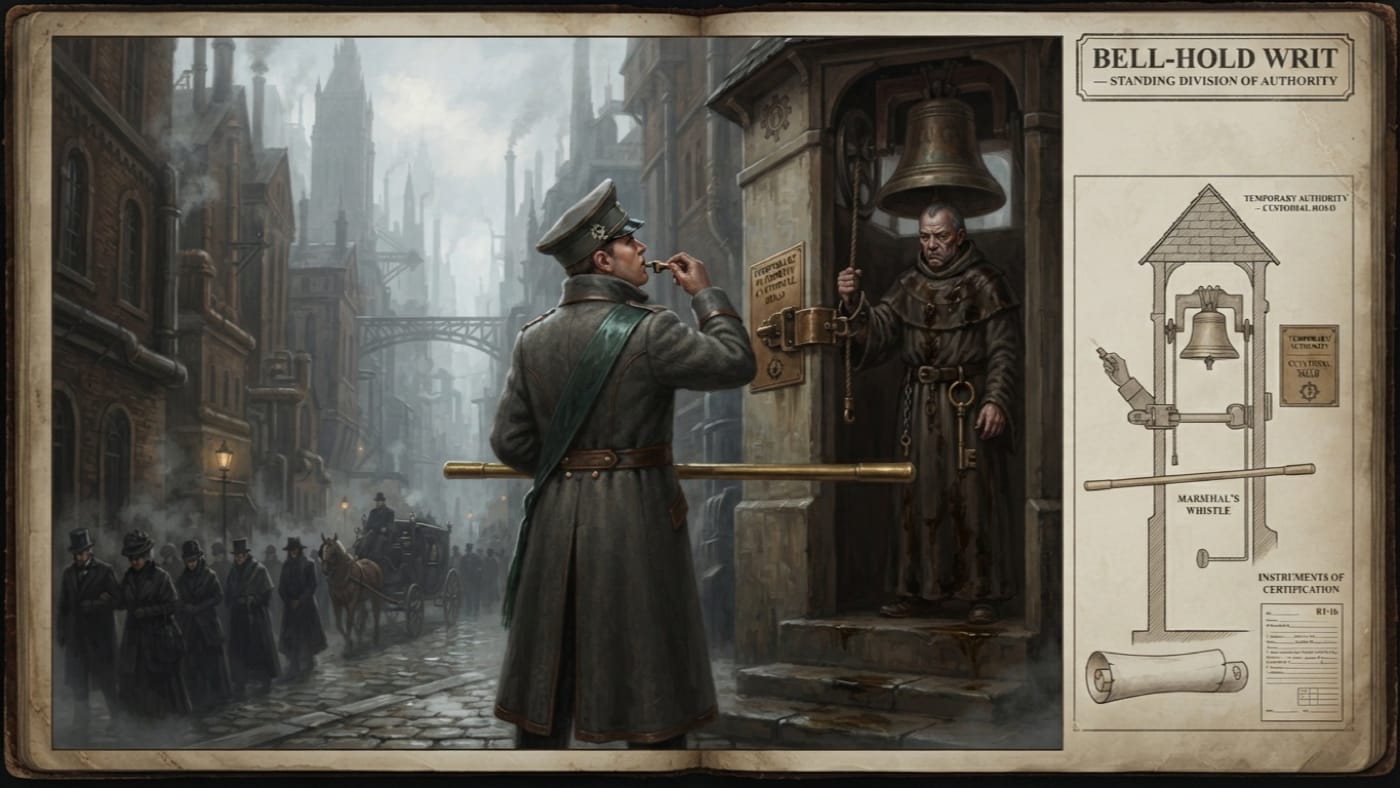
#On the Authority to Hold
The Bell-Hold Writ is the instrument by which a lawful bell may be made to wait. It divides one bronze voice between two masters. The Bureau of Bells keeps liturgical authority over tone, sequence, and sanctioned silence: what a bell says, in what order, and when the Church commands it to say nothing at all. The Procession Marshal of the Cadence Corps receives a narrower and ruder right. The Marshal may interrupt that bell while a crowd is moving through a cleared route zone. The whistle may suspend. It may not compose.
Laymen think this is a contradiction. They reason that a bell rung on a lawful schedule, under a lawful office, by a lawful hand, should not be stopped by a person in a damp sash with a flute. The mistake is to think that lawfulness belongs to sound alone. Sound lands somewhere. In a cathedral quarter at vespers it lands on eight hundred pairs of ears at once, and every pair belongs to a body that will walk toward whatever it trusts. A bell that is correct in its tower can still be wrong in the street, and a correct bell in the wrong street kills people.
#On the Strasbourg Settlement
The two jurisdictions had existed side by side for years without being introduced. The Corps had learned to march crowds under the Concordat of Civic Cadence in A.S. 113. Bells had governed the air since the Office's constitution long before that, and they received their current standard when the Bell Codex was ratified in A.S. 115. The street belonged to one office and the air to another. Nobody asked who owned the ear.
The Night of Two Bells asked, in A.S. 129. In Strasbourg's western cathedral quarter, the funeral bell of Saint Erasmus and the vespers bell of the Cathedral of the Perpetual Writ struck together. Eight hundred mourners split into three streams, and each stream obeyed perfectly. Nineteen died at a dark canal embankment. Engineering had removed its rail, a repair order had put out its lamps, and its watchman was absent. The record does not say why he was absent, and I decline to improve the record.
The Route-Timing Concordat followed in the same year. The Writ was born inside the quarrel over it. No account I am permitted to cite gives the Writ a separate day of issue, a signatory, or a seal of its own. It belongs to the settlement of A.S. 129 the way a clause belongs to a treaty, and I will not forge it a birthday so that clerks have something to toast.
#On the Cleared Route
The hold applies to the six movements the Concordat names: funeral passages, levy transfers, relic processions, ration releases, penitent marches, and emergency evacuations. During any of them, no bell within harmonic range may strike unless the lead Marshal certifies that it is compatible with the procession. Outside them, the Marshal's whistle is only a whistle, and bell-masters may ring over it at their pleasure.
The Writ gives harmonic range no distance. The practical question is whether a frightened ear could mistake one bronze for another, or hear a second bronze as a second command. The route tables answer that question street by street, in their column of exclusions. Anyone who wants a radius in paces should apply to a surveyor, and should then explain to nineteen families why the canal lay one pace outside it.
Compatibility is certified three ways: by whistle, by baton, and by written mark. The whistle speaks to the ear, which is the organ that was betrayed. The baton speaks to the eye, for the mourner at the back who cannot hear over grief and wet boots. The written mark speaks to the Ledger, which alone of the three will still exist next week. Each witness serves a different sense, and the Writ requires all three, because a certification made only in breath is gone once the breath is.
In funeral use, the silence begins three turns ahead of the coffin and lasts until the last mourner passes the final chalk mark. The source measures a turn in neither minutes nor paces. It is measured in consequences, like most of my profession.
The hold is temporary and local. It does not transfer the bell. When the last mourner steps past the chalk, the Marshal's right ends, and the bell returns to its sequence, which never stopped belonging to Bells. The whistle cannot retune the bronze, rearrange the Matins, or declare a new sanctioned silence. The best a Marshal can do is make the Bureau's own order arrive late.
#On the Table and the Responsible Name
The Writ grants a right. The Integrated Route and Bellway Table says where that right may be used. Before A.S. 129, route sheets and bell schedules lived in neighbouring offices and each made its own mistakes. The Concordat bound them into Form RT-1. Later that became RT-1b, once the first version was found to have forgotten bridges, which were still waiting patiently to become the next inquest.
The table records the route number and class, the expected crowd, the bellway authority, the harmonic exclusions, the choke points, the emergency cut lanes, and the chain of responsibility. At the bottom it carries the signature of a living officer, and the signature must be legible. Copies go to Bells, to the Bureau of Rites, and to the Corps. The Bureau of Records keeps the master and makes every request for an amendment feel like an exhumation.
This is the Writ's machinery. It is not the Writ. The table does not grant the hold. It only shows every office, on the same paper, which bronze falls silent and which name will answer for the silence. The Cadence Architects who draft the harder routes work on this document. They measure shoulders, corners, and grief delay, and then they turn the measurements into columns that bell-masters can read without having to lower themselves to visiting the street.
No table can stop a crowd from dividing. What it prevents is narrower and more useful: two offices each believing the other had read the route.
#On Dignity and Interruption
The quarrel that produced the Writ was about dignity, and it used the dead as its exhibits. Bells protested that bellway integrity could not be subordinated to street logistics. The Bureau of War observed that dead mourners obstruct traffic. Rites held that funeral rhythm was sacramental only while the mourners were still alive. The Bureau of Doctrine approved both answers and edited the preface, which is the Bureau's whole genius put into one sentence.
The parishes opposed clearance outright. Saint Erasmus opposed it, though it was his bell that had struck. Saint Odilia's Chapel opposed it. The cathedral chapter opposed it in Latin. The Corps replied with the canal casualty diagram, and the Writ was the price at which Bells agreed to stop reading that diagram aloud at council.
The Bell-Hold Commentary came three years later and is a different creature. It glosses the Writ, admires it, and grants nothing. Clerks who cite the Commentary as if it were the Writ are quoting the sermon in place of the statute.
The A.S. 132 Bell-Hold Commentary states that "no Bureau suffered diminution of dignity under the Route-Timing Concordat."
Corrected: Bells suffered it, sulked for seven years by my own tally, and filed the sulking as correspondence. Rites pretended to suffer nothing. War enjoyed itself. The Commentary records none of this, because the Commentary was written to be read aloud at dinner.
#On Standing Application
As of A.S. 201, Strasbourg publishes its daily clearance sheets before Prime. By the time the first office is sung, every Marshal with a route that day knows which towers it passes. Each bell staff knows which of its hours may be delayed and on whose name. The two then do what the settlement asks, which is to cooperate without liking each other. The Marshal calibrates the whistle to the day's bell. The Bellwarden oils the mechanism and waits at the rope, keyed and sullen. When the chalk has been passed, the bronze speaks, and it speaks exactly what the Bureau wrote for it.
Other cities apply the same route law in their own dialects. Bastion-Brest runs its ration queues under grain-yard bell locks, and hungry crowds there do not linger to discuss jurisdiction.
The Writ settles one question only: who may silence a lawful bell, where, and for how long. It says nothing about breach alarms, counter-tolls, or the orders of a garrison under assault, and I will not say it on the Writ's behalf. Any clerk who stretches the whistle past the edge of the cleared route should be handed the RT-1b and asked to point at the column that permitted it.