
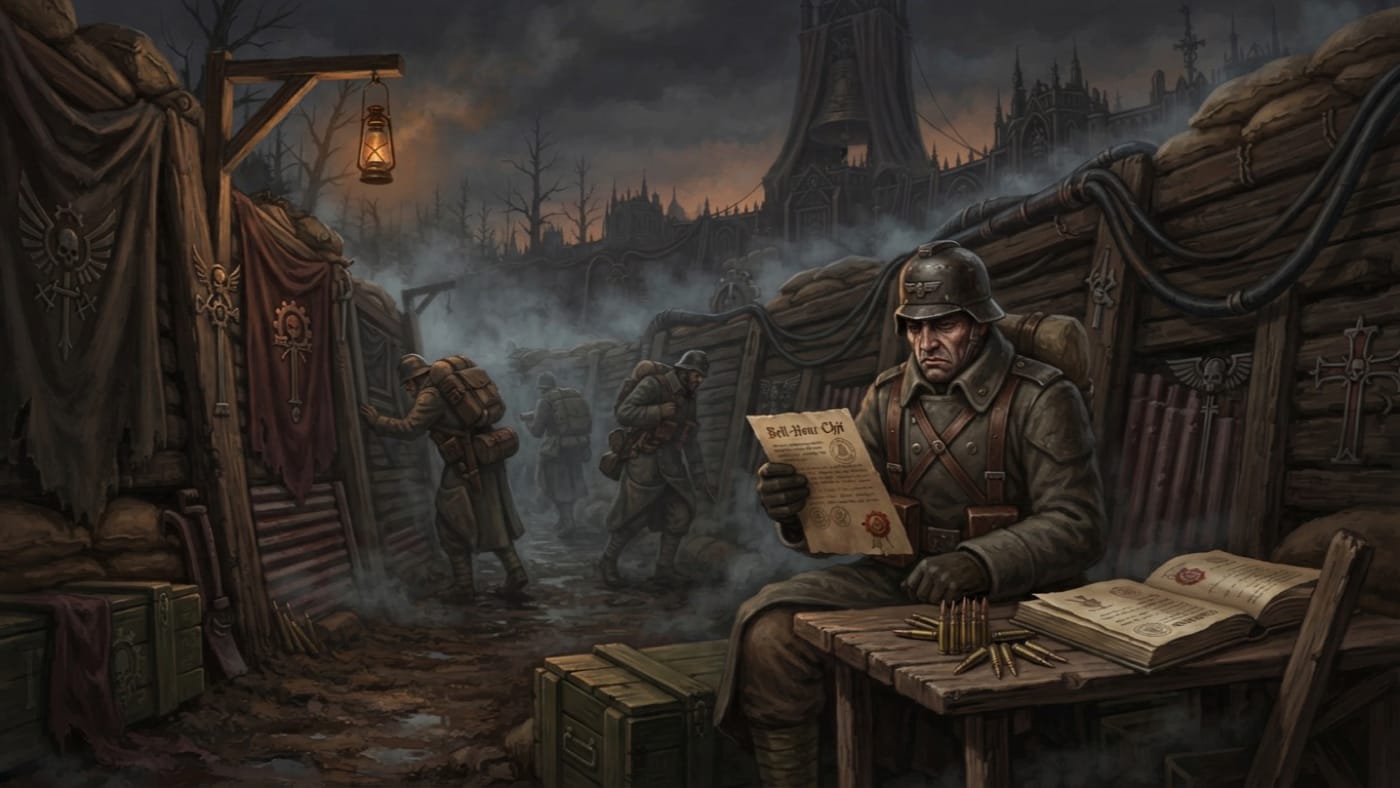
On the Bell-Hour Chit: a tract on the smallest paper by which Heaven is lent to a company. It was surveyed in the present year, A.S. 201, from the Grace Ration ledgers as they now stand, and is set down by one who has countersigned more of those ledgers than he would care to count.
#On the Allotment
A company at the Line draws its Grace Rations as it draws cartridges. They are counted, signed for and grudged. The ration has three parts: bell-hour chits, saint-shares and indulgence slips. Of the three, the chit is the plainest to look at and the most jealously watched. It represents the company's lawful claim upon sanctified ringing. It is the permission, entered in the column, for Heaven's rhythm to be spent upon these particular men in this particular mud.
The order of events matters. First the allotment is written. The chit is issued against it. Then the chit is spent, and the Bureau of Bells marks the debit. Only then does the peal reach the parapet, and only then does anyone in the trench taste anything at all. Grace reaches the front the way a pay-packet does: late, audited, and already partly spent by someone at a desk.
#On the Hour and Its Instruments
A bell-hour is time-currency, a measured slice of sanctified ringing. My own account of the ash-credit economies records bell-hours sold to factories and fieldmasters who need Heaven's rhythm to pace their work. The hour is the substance. The chit is the paper that says a portion of the substance belongs, for the present, to you.
Novices confuse the two, and the confusion is expensive. Lose a chit and you have lost a claim, while the ringing stays exactly where the Bureau keeps it. Forge a chit and you have forged a claim; the ringing stays put, and so, shortly, does the Bureau of Purity. The instrument and the quantity travel together only as far as the audit permits.
The chit keeps unwelcome company. A saint-share is a grace allotment, tied to service pledged at the altar and repaid in indulgence credit. Ash-credit is a ledger valuation of devotional collateral, a parish's pledged dust reckoned against its obligations. Indulgence slips belong to the wider trade in absolution, which has its own queues and its own forgers. The Route-Stamper's walking tokens hold bell-hour cores of their own and ring as the licensed traveller walks. They prove passage and nothing more. The chit shares their vocabulary but not their metal. The Synod runs all of these through one economy, and it has never pretended they are interchangeable. That is one of the few pretences it has declined.
#On Issue and Expenditure
The Dialectic of Power records that a soldier may be granted three bell-hours for courage. That was one award, entered once, for one soldier. Every quartermaster who has wanted to sound generous has quoted it since. It sets no standard denomination. Some awards are larger and some smaller, and the difference is itself a sermon on who is valued, delivered in arithmetic.
When a chaplain calls the peal, a chit is spent from the company's allotment and the debit is marked. The Bureau of Bells audits this spending more closely than the Bureau of War audits powder, and its penalties for irregularity are more inventive. A mis-entered bell-hour has ended more careers than a mis-aimed battery.
The jurisdictions overlap like vestments on a fat bishop. The Bureau of Bells regulates the peals and their timing under the Bell Codex, ratified in A.S. 115. The Bureau of Doctrine decides what a peal lawfully means. The Bureau of Tithes administers the tariffs. The Bureau of Records documents and countersigns. The Bureau of Rites governs the approved technique by which the chaplain actually rings. No single office owns the chit. Each owns a corner, and each will tell you that its corner is the chit.
Fail to pay your tithe and your allotment is suspended. The ash-credit account describes how this works for companies at the Line. Their Grace Rations are drawn against the ash-credit of the parishes that raised them. Where a soldier's home parish stands in arrears, the chaplain's warrant is suspended with it. I would not extend that arrangement to every factory buying Matins in Toledo. At the front it is enough. A trench needs no universal rule to go dark. One parish behind on its dust will do.
#On What the Peal Costs
Earlier editions of this Codex described miracles as "not breaking reality at all."
Under the Bureau of Records' Fourth Revision, the preferred formula is "breaking without blemish." The Bureau of Doctrine holds that the fracture opened by a bell-hour is sanctioned and heals. It holds this with great confidence and little interest in the men standing inside the fracture.
The ledger entry for a spent chit is a single line: the company, the expenditure and the debit marked. I have read hundreds of them. They are, I say without false modesty, very clean.
The trench entry is longer. The bell is tolled, and every soldier within earshot tastes iron, as if a coin had been laid on the tongue and left there. Fatigue follows. It sits in the marrow and weighs down the arms, the tiredness of a man who has marched all night rather than one who stood still for a minute. Fear recedes with the fatigue, and a steady, borrowed courage rises in its place. Men who were shaking load their rifles with quiet hands. Men who were praying for the order to fall back climb onto the fire-step and look over. They pay weariness for valour, on the spot, with the bodies present.
Here the novice makes his second expensive error. Because the chit was paid for, he believes the cost has been paid. The chit settles the company's claim upon the ringing. It settles nothing with the body of the man who hears it. The account loses an allotment, and the soldier loses the use of his legs for an hour. Two debts, two debtors, one bell.
Beyond the hour lies devotional debt, the deficit every miracle draws against the soul's credit. The Bureau of Rites records its symptoms with clinical care. There is dulled taste, when bread turns to ash on the tongue. There are insomnia hymns, phantom bells ringing at night to a melody no one can name. There is brittle joy, laughter that snaps like glass in the throat. These belong to devotional debt in general. I will not claim that each spent chit brings them in order, because no ledger I have read says so, and I do not invent ledgers. The ordinary battlefield peal does not take names or years either. Those prices belong to relics and processions higher up the ladder, and a chaplain who confuses the rungs deserves the reassignment he will get.
What I will say is that a company which spends often grows quiet in the evenings. Its cooks complain that nobody praises the stew.
#On Purchased Hours and False Grace
Behind the Line, the hour is sold outright. At the Bell-Market of Toledo, a factory may buy three extra minutes of Matins so its workers labour longer under Heaven's rhythm. A farmer may lease a single toll of Lauds to bless a harvest. Whatever paper changes hands in those stalls answers to the market's own stamps and tariffs. It resembles the soldier's chit the way a wedding certificate resembles a death warrant: same clerk, same wax, different consequences.
The Bell-Accountants carry the hour into the storehouse yard. Each convoy leaving a depot receives a portion of bell-hours, converted into ration priority. A convoy with credit moves at its appointed toll. A convoy without credit waits in the yard until the ledger remembers it. The drivers smoke, the mules reconsider their faith, and the bread quietly turns to gravel. The Bell-Accountants' catechism puts a price on the loaf, but the price is an illustration, not a rate. I once watched a junior clerk ruined for mistaking one for the other.
Where there is paper, there is forged paper. A counterfeit chit once circulated at Bastion-Constantinople promising indulgence for "five sins, any type." Hundreds queued with it. The forger's tongue was nailed to a church door, and the chits kept circulating. I include the case because it is the Codex's standing example of false grace. I qualify it because it was a fraud in absolution. Nothing in the record calls it a bell-hour chit; "chit" is simply what soldiers call any paper that promises Heaven something. The Bureau of Purity suspects Velkara's operatives. It suspects them of a great deal, and it has so far published no mechanism.
#On Present Application
This survey stands in A.S. 201. Its ledgers show the ringing scarce, the audits frequent and the suspensions routine. Chaplains carry warrants that may lapse between the evening post and the morning barrage. Quartermasters count chits beside cartridges, and the same officer makes them account for both. The Bureau of Bells marks its debits and the Bureau of Tithes marks its arrears. Between the two marks stands a company waiting to learn whether Heaven will ring for it tonight.
When it does, the men taste iron and stand up. When it does not, they stand up anyway, or they do not. The ledger records the difference as a casualty return and never as a matter of theology.
I have countersigned such returns. The penmanship was mine, and it was very good.