
#On the Bell and Its Station
Lazare tolls for relic arrivals and disputed deaths. That is the whole of its published commission in the register of the Cathedral of Saint-Victor, and in all the years Marseille has had to improve on it, the Bureau has not added a word. One bell with two errands. Marseille has spent a great deal of cunning trying to make it say more.
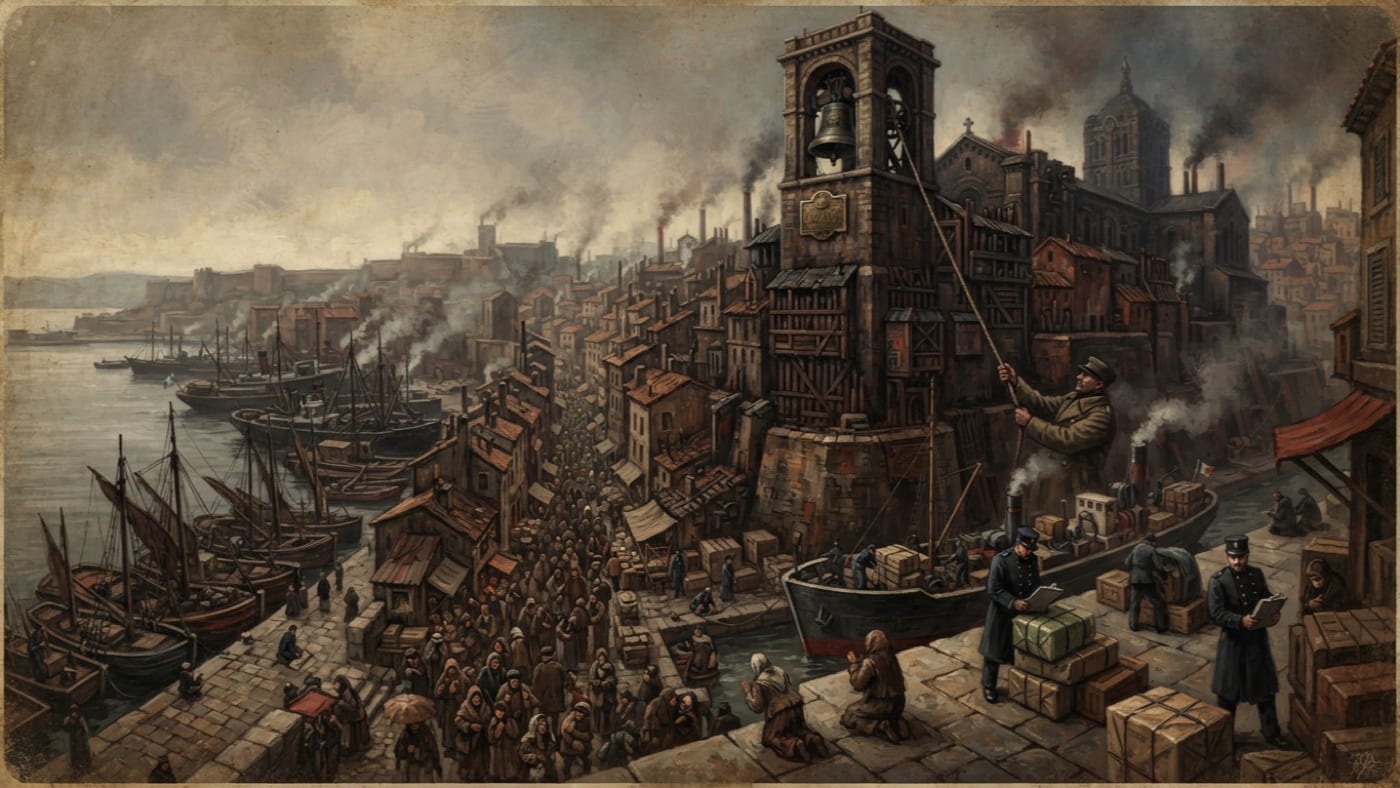
It hangs among the principal bells in the cathedral's western mass. There the Bureau of Bells keeps its southernmost major relay, a reinforced cage of timber and iron driven through limestone above the old harbour of Marseille. Lazare is not the largest of the company. Victor claims that vanity, along with a midnight habit the Bureau prefers not to discuss in print. Oraison speaks for Bureau business at the quay. Marthe calls the pilgrims to muster. Salt-John cries harbour danger. Little Beryn whines at terce through a crack that every dockside child can mimic. Three lesser bells share out parish business, ordinary funerals, debt remissions and the city's smaller humiliations. Lazare keeps to its two errands. In Marseille a bell with only two errands lives practically as a hermit.
Saint-Victor's principal bells number ten.
Corrected to nine, per the cathedral register. Saint Armand of the Foam was removed in A.S. 158, and Lazare is counted among the nine that remain. Clerks still writing "one of ten" are invited to climb the tower and count the cages for themselves.
The Bureau of Doctrine files a bell under doctrine because an authorized peal is a public pronouncement. Bronze speaks over every roof at once. Nobody chooses to hear it, and afterwards nobody may swear they did not. Whoever rings Lazare tells a whole harbour quarter that something has happened. A proclamation reaches the literate. A sermon reaches those inside the nave. Lazare reaches the fishwife gutting mullet with her back to the cathedral, and she is the congregation that matters.
#On Arrivals
Relics come to Marseille by sea, wrapped in oilcloth and sworn statements, often in that order of reliability. They come ashore within sight of Quai Saint-Lazare, the authentication quay beside the cathedral, where every bone, splinter and stained rag in the south is expected to present its credentials. Lazare marks their coming.
The effect on the quarter is immediate and undignified. Shutters go up along the dealer lanes. Pilgrims who had been bargaining over fried fish start climbing toward the west door. Reliquary polishers put out their better cloths, and the scribal booths sharpen their quills before a client has even arrived. The devout kneel at once. They are usually kneeling in the wrong direction, toward the bell instead of the harbour, and the Church does not correct them. Devotion pointed at the cathedral can be collected at the cathedral.
The city has heard that something claiming sanctity has reached the shore. It has not heard a verdict. The Bureau of Relics holds that an object is cargo with ambitions until its provenance has been traced, its substance examined and a written judgement sealed on its behalf. Intake, examination and verdict all happen at the Quay's tables, under the Quay's lamps, in the Quay's tedious hand. The bell takes no part in any of it. The ship's arrival is a matter of tide. The relic's authenticity is a matter for the ledger.
Marseille does not accept that distinction, and Saint-Victor's own crypt gives the city some reason. The cathedral holds rejected offerings beneath its nave until Relics collects them for removal to Saint-Lazare. Within one building, then, a bell announces sanctity coming in from the sea while a cellar stores sanctity that was turned away. A pilgrim refused at the Quay can carry the disqualified thing up the hill, hand it to a sympathetic canon and kneel above it at the next Mass, close enough to the authenticated Arm of Victor to feel favoured by the neighbourhood. Proximity is not certification. Every pilgrim in Marseille has been told so, and every pilgrim in Marseille behaves as though it were.
#On Disputed Deaths
Death in the Church has a proper form. Kin and clerks gather at the bed and whisper the Creed into the failing ear until the last breath. The body is laid out so the neighbours can see that no one left unshriven. For those who pass properly, bells toll, incense burns and a proclamation declares their entry into eternal service. The name goes into the Book of Departures beneath the cathedral vaults. Families fear an empty line there more than they fear the grave.
At Saint-Victor the lesser bells ring the ordinary dead, and the ordinary dead are most of them. Lazare is kept for the others: the deaths in dispute.
The register does not say what kind of dispute qualifies. It might be a Creed that never reached the lips, a body the neighbours never saw, a line in the Book with no name on it, or a quarrel among heirs, clerks or confessors about any of these. The register does not say who asks for the toll, and it does not say what the toll changes. I will not fill those silences myself. Plenty of pamphleteers have done it for me, each with a different procedure and none with a seal.
This reading is mine and carries no seal of its own. Lazare makes an unresolved death audible. Neighbours who would have heard a proper passing hear instead that the matter is still open: someone has died, and someone else does not accept the account. A proper toll closes a life before the whole parish. Lazare leaves the lid ajar for the parish to see. The Book of Departures may still receive the name in due course. The bell has made no promise either way.
#On Who Owns the Sound
The Church does not tolerate private bronze. Unauthorized peals have been prosecuted as treason, and bell-guilds have been melted into shackles. The Office of Bells was constituted in A.S. 52, though towers rang long before anyone filed them. The Bell Codex ratified in A.S. 115 set the standard to which the provinces now ring. Under that standard, local registers keep their own names and their own errands. The register does not say whether Lazare's two duties are older than the Office or younger than the Codex. Saint-Victor's register lists them as it lists the rest of the cathedral's arrangements: as established fact, beyond question.
The Bureau of Bells holds the rope, the schedule and the right to say a peal was lawful. Relics holds the verdict on whatever Lazare has just announced. The cathedral chapter holds the stone, the stairs and a long memory of every Bureau that has tried to climb them. The Bureau of Tithes holds an opinion about the crowds a toll gathers, and that opinion is always expressed in coin. The Bureau of Pilgrimage watches the hill fill with its charges and counts them. The Bureau of Purity and the Bureau of War have their own sequences from the same tower. No register admits that either has any claim on Lazare, and so far no register has been made to admit it.
Each party wants the bell to mean something different. Relics clerks want an arrival toll to promise nothing, so that no dealer can quote it to a magistrate. Canons want it to promise a blessing at the west door with a collection plate to follow. Dealers want it to promise a buyer. Mourners want the disputed toll to stop. They want it to stop quickly, and they want the next bell over their dead to be an ordinary one. The Bureau of Doctrine stands over all of them and answers that the sound teaches the city whatever Doctrine afterwards says it taught.
Ambiguity like this would break a minor shrine. Saint-Victor has lived with it for longer than any of its present quarrels and has grown fat on it. An announcement that certifies nothing cannot be sued, and none of the Bureaus has ever found a way to tax one. The Great Deceiver works through counterfeit certainty. Lazare offers no certainty at all, and that leaves the Deceiver very little to forge.
#On the Present Application
As of A.S. 201 the Cathedral of Saint-Victor is active, its relay is overloaded and its quarter is as loud as ever. Lazare still keeps its two errands. Ships still bring sealed crates past the harbour mouth to the Quay. The dealer lanes still lift their shutters at the first stroke, and the crypt still holds what the Quay has refused. Somewhere in the parish, a death that someone will not accept still waits for its line in the Book while the whole quarter hears that it is waiting.
The bell does not judge any of this. Clerks judge, at length, in triplicate, under seal. Lazare announces, and then it is quiet, and the quarter can argue about what it meant until the next arrival or the next disputed death.