

#On the Saint Whose Bones Convened Armies
Saint Edras is the patron of disciplined grief, lawful pilgrimage, crossing-phrases, ration-stones, and those public tears by which the Synod converts private sorrow into civic motion. His name stands at ferries, on road markers, in artillery wax, in children’s psalms, and before the great reliquary in Strasbourg, where later commemorations of Saint-Malo taught bishops that grief, properly arranged, is a form of government.
He is among the useful saints. This is higher praise than it sounds. Useless saints decorate chapels, receive candles from widows, soothe the dying, and produce no administrative force. Edras moves queues. He fills roads. He teaches a hungry man that hunger may be measured in miles and stamped at gates. He gives the Bureau of Pilgrimage a wet face to inspect and the Bureau of Doctrine a name that can be placed in the mouth of a nation without tasting like policy.
No saint in the western calendar has had more tears measured in his name. This fact would have embarrassed a humbler cult. Edras’s cult has no such weakness. It carries bowls.
#On the Life Before the Reliquary
Edras lived before the Synod had learned its present magnificence, in the century when local bishops still believed diocesan pride could substitute for continental order. His birthplace is disputed between three parishes, two abbeys, and one village that produced a femur with regrettable confidence. Records favours the middle Rhine, near a road-shrine that later became a ration-stone station. Pilgrimage favours the Carpathian passes, because its old Confraternity of Saint Edras held those routes and naturally wished the saint to have been born where tolls were collected. Doctrine favours Strasbourg because Doctrine enjoys geography when geography kneels, and evidence has learned not to interrupt.
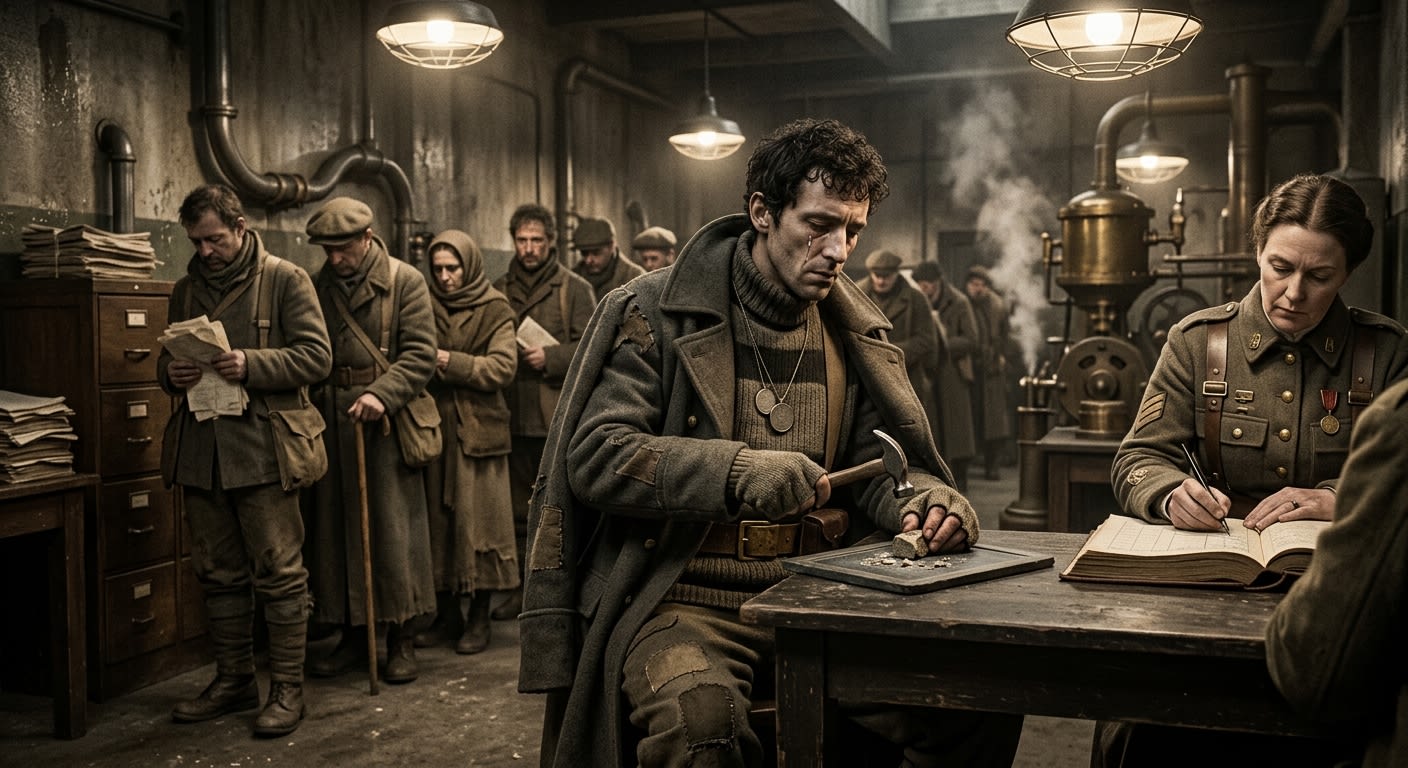
The earliest trustworthy vita names him a road deacon attached to famine columns. He organised barefoot processions during a locust year, kept grain queues from becoming murders, and invented the practice of counting fasts by distance: one meal withheld for one marked mile, three fasts for a difficult pass, seven for a shrine reached without complaint. This was not poetry. It was logistics. Hungry pilgrims move badly unless hunger is given arithmetic. Edras gave sorrow a ledger and hunger a milestone.
He acquired sanctity in the old manner: by making obedience appear voluntary. During the locust season remembered in the western hagiographies as the Grey Mouth Year, he marched a thousand children barefoot across iron plates heated in chapel braziers. The swarm departed from the grain fields before dusk. The children survived in sufficient number for the miracle to be considered successful and suffered in sufficient number for the memory to become useful. Many limped all their days. Their parents smiled for the inspectors. The fields fed them through winter.
Nursery catechisms state that the Procession of Saint Edras “left no child harmed, for Heaven cooled the iron beneath obedient feet.”
Corrected. Heaven took the locusts. It did not cool the iron. Parents preferring the nursery version may submit petitions to Agriculture, Mercy, and Reality, in that order.
That rite explains Edras more cleanly than the painted panels. He did not spare bodies. He spent them with terrifying care. He did not abolish hunger. He taught hunger to report upward. He did not end grief. He gave grief a route, a cadence, a saint-name, and a bowl at the gate.
#On the Bones at Strasbourg
The Reliquary of Saint Edras came to Strasbourg in fragments, which is the usual way saints enter capitals: reduced, disputed, and already profitable. The first accepted translation placed finger bones, ash cloth, and a cracked pilgrim staff in a silver coffer beneath the basilica court. Later centuries added vertebrae, a kneecap, a tooth, and three relics the Bureau of Relics calls “devotional adjuncts,” a phrase meaning either fraud too popular to suppress or uncertainty too lucrative to resolve.
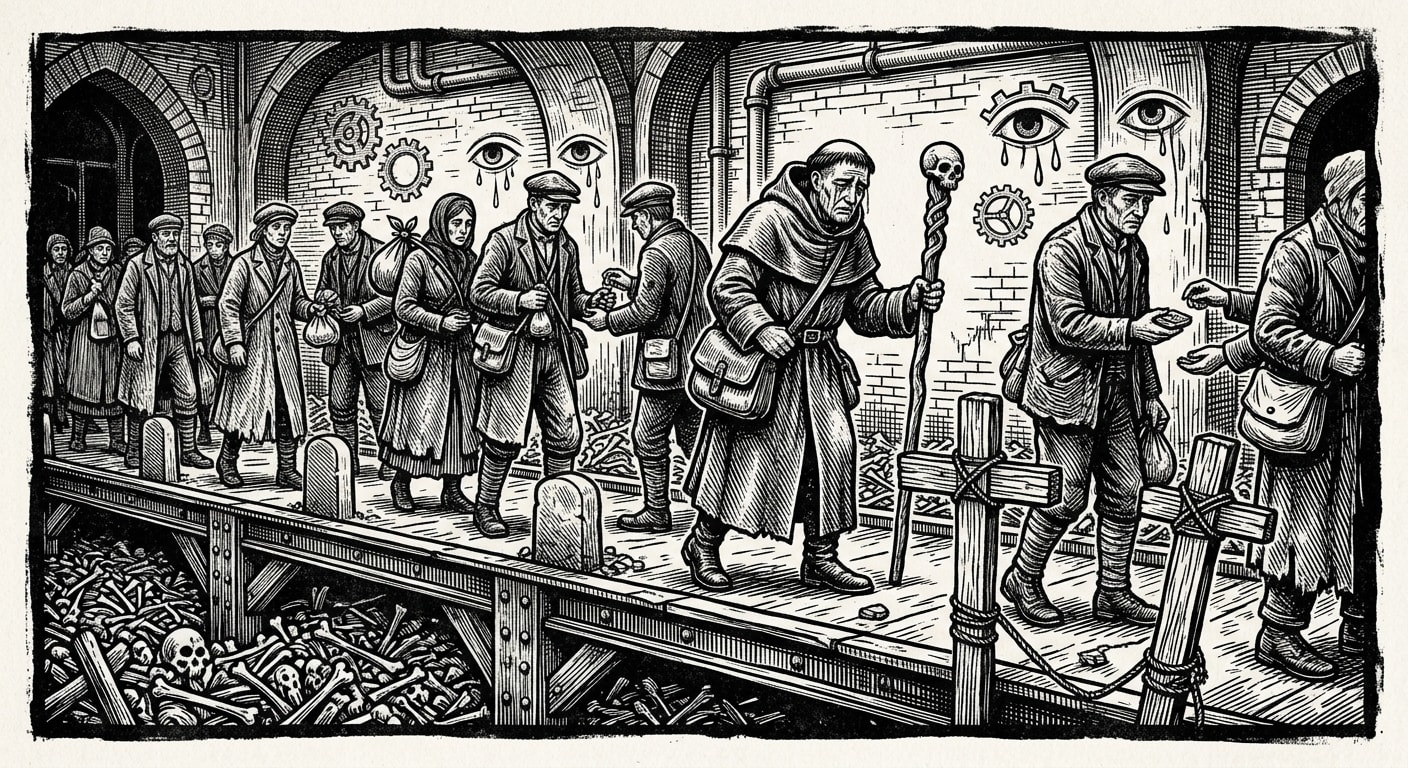
The reliquary’s true power is political. I write this without embarrassment. Politics is merely theology wearing boots. Pilgrims before the reliquary do not only ask Saint Edras to preserve them on the road. They ask to be placed inside a grief larger than their household, inside a queue so long that private loss becomes civic property. This is why Strasbourg guards the shrine with such tenderness and such excellent locks.
Later Synodal histories make the Massacre at Saint-Malo and the reliquary one hinge of history. Pilgrims wept before it, crying for vengeance against the Republic of Reason. Yet the massacre belongs to A.S. 10, when Augustinus and Kratz were about two years old. The First Council of Cologne met seventeen years later, in A.S. 27, and adopted no binding seven-article unity. Successor officials used Saint-Malo grief and Edras's cult to rally roads and processions; their claim of one continuous founding moment is devotional shorthand, not a council record.
The reliquary did not speak. It did not flash. It did not rise from the altar and point east with a flaming metacarpal, though several theatrical engravings later suggested improvements of that sort. It sat. The people wept. The clerks counted. Armies followed. Of all miracles attributed to Edras, this remains the greatest: he made a box of bones more persuasive than three councils and a tax decree.
Popular Saint-Malo broadsheets claim that Saint Edras commanded vengeance in an audible voice from his reliquary.
Withdrawn. No official witness heard speech from the reliquary. The crowd supplied the voice, which is cheaper, louder, and easier to deny afterward.
#On the Weeping Pilgrimage
The Weeping Pilgrimage of Saint Edras’ Bones is among the Synod’s most civilised cruelties. In Strasbourg it proceeds without relics: empty biers, long queues, ward stewards, tear bowls, stamped grief cards, and enough slow marching to teach the spine obedience. In Iberia the rite has grown more muscular. Pilgrims shuffle for miles carrying reliquary fragments or authorised substitutes, weeping audibly as they pass gate inspectors. Insufficient tears incur fines, beatings, or remedial grief instruction.
Children learn early. They are trained to pinch their thighs under their tunics, bite the inside of the cheek, stare at onion cloth, recite dead siblings whether or not the siblings existed, and keep the sound steady. The Bureau insists this is natural piety. The Bureau has also issued three manuals on acceptable weeping posture. Contradiction is the lace on the Bureau’s cassock.
The pilgrimage teaches that grief must be externalised, measured, and made legible. A citizen grieving in private is a citizen unavailable for instruction. A citizen grieving in line can be counted, corrected, taxed lightly, fed poorly, and moved past images selected for moral effect. Mothers with ledger cords braided into their hair carry ward petitions. Fathers kneel at ration-stones carved with Edras’s name. Children chant sums. Beggars mutter approved litanies for alms. The city becomes a throat and grief passes through it on schedule.
Yet do not mistake the rite for emptiness. I have seen true grief there, raw as butchered meat. A widow carrying her son’s boot. A boy weeping because he could not remember his father’s face until the hymn reached the third verse. A veteran who produced no tears and then broke his teeth biting the bowl rim when the ward children began the Edrasian cadence. The Bureau exploits grief because grief exists. We did not invent the wound. We invented the bandage, the fee, and the parade route.
#On Roads, Ration-Stones, and Crossing Names
Every mile of the great pilgrim roads bears saints’ arithmetic. “One meal to Saint Edras.” “Three fasts to Theophania.” “Half a day’s hunger to the Shrine of the Bleeding Thumb.” Soldiers curse these stones as mile-markers. Peasants kiss them bloody. The stones are superb government. They transform distance into debt and fatigue into proof.
The old Confraternity of Saint Edras once held the Carpathian passes before the Bureau of Pilgrimage broke private road-piety into licensed administration. Those fraternities were not gentle. They charged tolls, hired escorts, fought rival guilds, and called every territorial appetite devotion. At Santiago, three guilds converged and forty-one died in a dispute over jurisdiction, tolls, and the right to shepherd pilgrims who had already paid twice. Pilgrimage used the scandal well. Private devotion had embarrassed itself. Bureaucratic devotion stepped forward with forms.
Edras also rules the mouth at crossings. Ferry passwords often use his psalms, his declensions, his minor lauds, and the exact syllable whose mispronunciation can strand three hundred valid travellers at a bank. At Nominalist’s Gate, a traveller said Adras where the guard required Edras. The guard refused him. The queue thickened. By afternoon, three hundred souls stood with valid papers, valid seals, valid transit writs, and one shared deficiency: a consonant. Ferry Chokepoint Brokers still teach the incident as sacrament.
At Bellwater, the evening phrase was a clipped invocation of Saint Edras. The pilot called it. The bank answered. The barge moved. A water-demon had learned the ferrymen’s call-and-response. Seventeen died. A season’s grain cargo vanished. The tithe crates were found empty, seals unbroken, stacked on the far bank in a row so straight that one investigator accused the survivors of theatre. Accusation is the refuge of a man who prefers crime to miracle.
BELLWATER SUPPLEMENT — RESTRICTED ACOUSTIC COPY Recovered bank-answer contained the Edrasian invocation with correct stress, correct breath break, and one additional undernote below human register. Three ferrymen later reported hearing the same undernote during private prayer. Two recanted. One entered the river at dusk holding his tongue between his fingers.
After Bellwater, lawful ferries added harmonic challenge-response overlays blessed by the Bureau of Bells. Black Oars stripped sound away and made silence professional. Edras remained in both practices: spoken under seal by the lawful, withheld under terror by the illegal. A saint does not lose jurisdiction merely because frightened men stop saying his name.
#On Psalms, Wax, and Martial Uses
The Third Psalm of Edras is among the most commonly corrupted sacred texts in wartime. During the Black Procession, Rationalist remnants wrapped counter-sermons in mock-litanies until an entire battalion chanted “Man Alone” while believing they recited the Third Psalm. They were cut down as traitors. The reserve officers who gave the order later requested clarification. Doctrine provided it with admirable brevity: a wrong hymn believed sincerely remains wrong.
Curfew tavern singers, unauthorized melody smugglers, and hymn-cutters love Edras because his cadence is known in every market. Sedition can ride a familiar saint like contraband in a licensed crate. A competent rebel can make a dock ballad sound like Edras Preserve. An incompetent rebel makes Edras Preserve sound like sedition. The second crime is harder to forgive.
His material cult reaches the battlefield through wax. Edras wax seals relic-shot, firing cords, pilgrim tokens, ferry cards, and the little packets of ash carried by Orison crews who would rather trust a saint-name than a quartermaster’s assurance. At Wormwood Hill in A.S. 163, the 7th Orison Battery prepared relic-shot against the black-diesel tank with copper driving bands kissed in Saint Edras wax. The first round turned the vehicle. The second broke the tread. The third entered beneath the forward plate and produced a sound witnesses compared to a choir drowning in oil.
This does not make Edras a war saint in the vulgar sense. He is no patron of glorious charges, bright sabres, or officers standing on ridges in poses purchased from painters. He is patron of the road that brought the shell, the wax that sealed it, the prayer phrase that kept the crew’s hands aligned, and the grief afterward when the report reduced burning men to vehicle loss. War consumes heroes quickly. It lives longer on transport, sealant, and mourning.
A.S. 165 artillery pamphlets credited Saint Edras alone with stopping the Wormwood tank.
Corrected. Relic-shot, Orison drill, gunner discipline, prior terror, Edras wax, and three correctly fired rounds stopped it. Saints dislike being made accomplices to lazy training manuals.
#On Miracles and the Cost of Grief
Edrasian miracles are rarely clean. They do not descend like painted light upon kneeling peasants. They bite. The locusts leave because children cross hot iron. The road opens because pilgrims have paid hunger into it. The ferry phrase saves one boat and drowns another when the water learns to answer. The wax holds the cord while the tank screams. Grace, in Edras’s register, is not comfort. It is accounted suffering with outward effect.
This places him near the hard centre of miracle doctrine. A miracle spends the faithful and leaves the world intact. Sorcery spends the world and leaves the thief smiling until the invoice arrives. Edras is beloved because his costs are visible. Feet blister. Stomachs clench. Tears fill bowls. Children limp. No one can say the price was hidden, though many try to say it was smaller.
The last warning is under-cited. A people trained to mourn on command may forget how to stop. Strasbourg knows this and uses it carefully, by which I mean regularly. The Weeping Pilgrimage, the March of the 144 Wards, the empty biers, the ration-stones, the feast-day bowls: each teaches that sorrow reaches dignity only when witnessed. The private tear becomes suspect. The public tear becomes currency. The dry eye becomes a file.
#On the Present Cult
As of A.S. 201, Saint Edras remains everywhere useful and everywhere contested. Pilgrimage claims his roads. Bells claims his psalm cadences. Relics claims his bones. War claims his wax. Records claims his tear tallies. Tithes claims the procession permits. Purity claims authority over insufficient grief, excessive grief, false grief, unsanctioned grief, suspiciously rhythmic grief, and grief performed without visible doctrinal destination.
The reliquary at Strasbourg remains under layered guard. Pilgrims approach in queues so long that fatigue becomes part of the rite before the shrine is visible. Empty biers pass through the square. Children chant sums. Mothers braid ledger cords. Veterans touch the step and say nothing, which irritates gate assessors trained to prefer audible sorrow. On Saint-Malo anniversaries, the crowd thickens with inherited anger. The Bureau stations extra scribes near the bowls.
His enemies call the cult manufactured. This is true and stupid. Bread is manufactured. Shells are manufactured. Law is manufactured. The only worthwhile question is whether a thing works after being made. Edras works. His name moves caravans, quiets queues, seals batteries, orders grief, and can still make a crowd in Strasbourg remember Saint-Malo as if the blood dried yesterday.
At dusk the reliquary chapel closes. The bowls are weighed. Tear cloths are wrung into labelled vials for disposal or later devotional use, according to quality. The empty biers return to their racks. A final clerk checks the floor for dropped tokens. Somewhere on a ferry, a pilot shapes the saint’s name correctly before the bank can answer. Somewhere on a road, a child touches a ration-stone and decides whether hunger feels holier when named.
#On the Confraternities That Borrowed His Feet
Before the Bureau of Pilgrimage took the roads into its sanctified fist, Edras belonged to fraternities with patched cloaks, iron-shod staves, armed escorts, and account books that would have made Tithes blush with professional admiration. The Confraternity of Saint Edras held the Carpathian passes. It owned no mountains, built few roads, and claimed authority over both with the serenity of men who have discovered that a hungry pilgrim pays before debating jurisdiction.
Their badge was a blistered foot beneath a tear. Their rule required brothers to walk the first mile of every season barefoot, then charge others for the remaining miles in boots. They maintained hostels, yes, and guarded convoys, yes, and rescued foolish pilgrims from ravines into which Providence had clearly wished to drop them. They also levied crossing fees, rented grief bowls, sold approved foot-rags, and demanded “Edrasian passage alms” from caravans whose only spiritual ambition was reaching the next gate before rot touched the flour.
Pilgrimage’s Harmonized Routes Edict broke the confraternities by praising them to death. Their wardens were invited to Strasbourg, seated beneath banners, thanked for centuries of service, and presented with licensing terms dense enough to stun livestock. The Golden Sole surrendered first. The Blessed Foot attempted litigation and was audited into penitence. The Confraternity of Saint Edras resisted longest, claiming ancestral right over the passes. Pilgrimage answered by recognising every ancestral right, subdividing each into fee categories, then requiring separate seals for escort, chant, hostel, guide, bowl, staff, and corpse retrieval. Within three years, the Confraternity existed mostly as a uniform cut worn by Bureau clerks.
The old brothers still linger on remote roads. They know which ration-stones are older than their inscriptions, which shrines have real water under them, which gates pronounce Edras with a clipped Mainz consonant, and which roadside chapels will hide a sick child without reporting the fever until morning. The Bureau tolerates them because toleration is cheaper than replacement. Besides, an old road brother with a cracked bowl and a knife under his cloak can settle a pilgrim riot faster than six polished inspectors reciting harmonisation clauses.
#On Children, Bowls, and the Education of Tears
The cult of Edras begins in childhood because adults are too late to train properly. In Strasbourg’s ward schools, children learn the Tear Measures before they learn full tithe arithmetic. One drop: acknowledgement. Three drops: contrition. A wet cheek: acceptable grief. Audible weeping: meritorious if rhythm remains stable. Wailing: discouraged unless directed by cantor. Dryness: examined. Laughter: recorded. The chart hangs beside multiplication tables, which is sensible, since both concern quantities useful to the state.
A child’s first Edrasian bowl is clay. It cracks easily. This is intentional. Children must learn that grief mishandled leaks. At twelve, the child receives tin. At confirmation, pewter if the family stands solvent, wood if it has failed to please Tithes, glass only for choir trainees whose tears must be visible from the inspection rail. The wealthy occasionally commission silver bowls for infants. This is disgusting. The Bureau permits it because disgusting piety pays promptly.
The children are not fools. They trade methods. Onion cloth behind cuffs. Salt hidden under thumbnail. Dead-pet recitations useful for minor processions. Grandmother memories reserved for major feasts. Some can weep on command by age nine. Some cannot and become hard little creatures with excellent future prospects in Records. One girl in Ward Ninety-Two produced tears only when shown blank forms. She now supervises inheritance corrections and terrifies widowers. Providence distributes gifts according to its own ugly humour.
There is cruelty here. Of course there is. There is also survival. A population that can rehearse grief can withstand bad news without tearing down granaries every time a convoy fails. The bowl teaches sequence: receive loss, show loss, measure loss, file loss, continue. This is the Synod’s deepest catechism and Edras’s most profitable mercy.
#On Drax’s Inspection of the Reliquary
I inspected the Edras reliquary during a wet month when Strasbourg smelled of wool, candle smoke, and the faint civic mildew produced by too many pilgrims breathing penitently in close quarters. The outer queue reached the second square. Mothers held bowls under children’s chins. Veterans stood apart, hating the line and needing it. A merchant from Lyon attempted to hire a professional mourner to supplement his household’s output and was fined for outsourcing sincerity without permit.
The reliquary chamber is colder than the basilica above. This is not miracle. It is stone, depth, and a ventilation error no office wishes to own. The coffer sits behind three screens: iron, silver, and doctrinal language. The bones themselves are rarely visible. Visibility breeds familiarity, and familiarity breeds the sort of peasant who says, “Is that all?” Better the cloth, the glint, the guard’s halberd, the priest’s lowered voice. Mystery is often architecture plus restricted lighting.
INSPECTION NOTE — PRIVATE, LATER SEALED During the third uncovering, the tear-bowl beneath the coffer filled without visible petitioner. Liquid volume: nine measures. Taste test forbidden. Clerk Jorren tasted anyway and began reciting ferry passwords in reverse order until restrained. Jorren reassigned to dry archive work. Bowl sealed.
I found the relic neither comforting nor fraudulent. This disappointed several people. The faithful wanted me moved. The sceptics wanted me amused. I was neither. The bones sat in their cloth, and around them moved an empire of knees, coins, wet cheeks, stamped cards, guards, priests, cleaners, bowl-weighers, and children learning how to hold loss without dropping it. A relic that can make so much machinery move need not glow. Glow is for cheap icons and provincial mushrooms.
At closing bell, the guards drew the cloth. The crowd exhaled as if the city itself had been holding breath. A boy at the rail asked whether the saint was asleep. His mother struck him softly, then kissed the same cheek, which is the family form of Doctrine: correction followed by possession. The boy kept looking at the coffer. Good. Curiosity is tolerable when it learns fear early.